
China to Poland Freight: Sea vs Rail vs Air for B2B Cargo
China to Poland Freight: Sea vs Rail vs Air for B2B Cargo
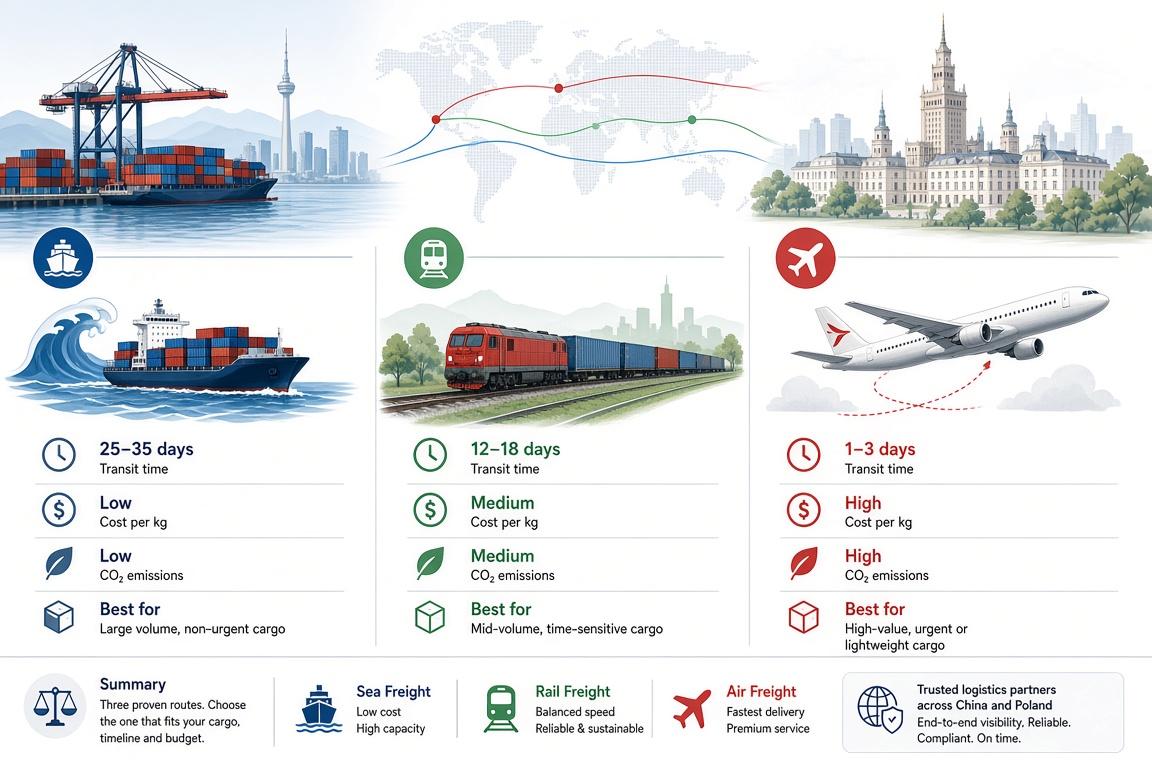
For B2B cargo moving from China to Poland, the choice between sea, rail, and air freight turns on three factors: shipment weight and volume, delivery urgency, and cost tolerance. Sea freight offers the lowest cost per kilogram for full containers and heavy palletized goods, but transit takes roughly 30 to 45 days. Rail freight balances speed and cost on the Eurasian corridor, delivering in about 16 to 20 days at a moderate price premium over sea. Air freight moves urgent, high-value, or time-sensitive shipments in 5 to 8 days, but the cost per kilogram is substantially higher. No single mode wins for every shipment. The right choice depends on your cargo density, inventory carrying cost, and the consignee’s production or sales schedule. This guide lays out the operational trade-offs, customs checkpoints, and quote preparation steps so you can match your shipment to the mode that fits your commercial requirement.
Shipment Fit and Decision Context
Sea freight suits high-volume, low-density cargo, machinery, raw materials, and consumer goods with a lead time of six weeks or more. Rail freight works well for finished goods, automotive parts, electronics, and retail inventory that needs a middle ground between cost and speed. Air freight fits urgent spare parts, samples, high-end electronics, pharmaceuticals, and goods with short shelf life or just-in-time production schedules.
Weak-fit profiles include urgent, lightweight shipments on sea freight, heavy machinery on air freight, and any cargo that cannot tolerate the temperature or handling conditions of the selected mode. Rail freight may not suit shipments requiring fixed weekly departures during peak congestion, and sea freight becomes less competitive when port congestion or blank sailings disrupt schedules.
Before you request a quote, confirm the delivery destination in Poland, the required delivery date, the cargo dimensions and weight, and the responsible party for import clearance and duties. The named trade term—whether the seller arranges transport and insurance or the buyer takes control at origin—determines who handles each leg and who bears the risk during transit. Clarify the customs role: who will file the import declaration, who holds the customs bond if required, and who pays the duties and VAT upon arrival.
Field note: For rail shipments to Poland, the consignee or their customs broker must provide an EORI number and confirm that the cargo meets EU import safety and product compliance standards before the train departs China. Missing documentation at the border can delay release by several days.
Route Logic and Mode Handoffs
Sea freight from China to Poland typically moves via the Suez Canal or, when necessary, around the Cape of Good Hope. Major origin ports include Shanghai, Ningbo, Shenzhen, and Qingdao. Vessels call at transshipment hubs such as Singapore or Port Klang before entering the Mediterranean and discharging at European gateway ports like Gdansk, Hamburg, or Rotterdam. From the port of discharge, cargo moves by truck or rail to the final Polish destination.
Rail freight follows the Eurasian rail corridor, with departures from Chongqing, Xi’an, Chengdu, or Zhengzhou. Trains cross the border at Alashankou or Khorgos into Kazakhstan, then transit Russia and Belarus before entering Poland at Malaszewicze or Terespol. Rail offers fixed weekly schedules, but capacity fluctuates with seasonal demand and geopolitical conditions. Inland trucking from the Polish rail terminal to the final warehouse adds one to three days.
Air freight departs from major Chinese airports—PVG, PEK, CAN, or SZX—and connects through hubs such as Dubai, Doha, or Istanbul before arriving at Warsaw Chopin Airport or Katowice International. Express carriers offer door-to-door service with integrated customs clearance, while standard air freight requires the importer or their broker to handle clearance at the destination airport.
Service scopes differ by mode. Port-to-port sea freight covers only the ocean leg; door-to-door includes pickup, export handling, main transport, import clearance, and delivery. Rail service is typically terminal-to-terminal or door-to-door with optional customs brokerage. Air freight can be airport-to-airport, door-to-airport, or door-to-door. Select the scope that matches your ability to manage each handoff.
Disqualifying conditions include cargo that exceeds the weight or dimension limits of the selected mode, hazardous materials that require specialized handling, or goods that cannot be consolidated into a full container for sea freight. Rail freight excludes certain temperature-sensitive goods and items subject to EU import restrictions. Air freight imposes strict limits on lithium batteries, aerosols, and other dangerous goods.
For full container load (FCL) sea freight, you reserve an entire container; less-than-container load (LCL) consolidates multiple shipments into one container. Rail freight operates on a full-container or palletized basis, with consolidation available for smaller shipments. Air freight charges by chargeable weight—the greater of actual weight and volumetric weight—which makes dense, heavy cargo more cost-effective per kilogram.
To compare options accurately, request a sea freight quote that includes all origin and destination charges, not just the base freight rate. The operational decision starts with your cargo profile and required delivery window; the mode selection flows from those fixed points.
Transit-Time Planning
Transit time separates the modes most distinctly. The table below shows approximate ranges for main carriage from a major Chinese port or airport to the Polish gateway, plus the total door-to-door cycle including pickup and final delivery. These times are planning estimates and vary with carrier schedules, weather, customs clearance speed, and congestion at transshipment points.
| Mode | Main Carriage | Total Door-to-Door Cycle | Key Variable |
|---|---|---|---|
| Sea Freight (FCL/LCL) | 28–38 days | 35–45 days | Port congestion, Suez transit |
| Rail Freight | 14–17 days | 18–22 days | Border crossing, capacity |
| Air Freight | 3–5 days | 5–8 days | Freighter vs. belly cargo |
Sea freight transit includes the ocean voyage, transshipment, and discharge. Rail transit covers the rail journey from the Chinese inland terminal to the Polish railhead. Air transit accounts for the flight and immediate ground handling. Total delivery adds pickup, export clearance, import clearance, and final-mile trucking. Seasonal peaks—Chinese New Year, Golden Week, and the European summer holiday period—can extend any of these ranges by several days.
For rail freight, the scheduled departure day and the border-crossing queue at Malaszewicze are the primary timing drivers. For sea freight, the vessel’s rotation and the availability of trucking or rail capacity from the European gateway to Poland determine the final delivery date. For air freight, the flight frequency and the customs clearance time at Warsaw Chopin Airport define the window.
Cost and Quote Scope
Comparing quotes across modes requires a like-for-like cargo basis. Sea freight quotes are usually per container (FCL) or per cubic meter or ton (LCL). Rail freight quotes are per container or per pallet, with a minimum charge for consolidated shipments. Air freight quotes are per kilogram chargeable weight, with minimum charges for small shipments.
Every quote should break out the following components:
- Origin charges: Pickup, export documentation, container loading or palletization, and terminal handling.
- Main freight: The ocean, rail, or air carriage from China to the Polish gateway.
- Destination charges: Terminal handling, customs clearance, duties and VAT, and delivery to the final address.
- Accessorials: Fuel surcharges, security fees, insurance, and any special handling for oversized or hazardous cargo.
The named trade term determines which party pays each component. Under DAP, the seller delivers the cargo to the named destination but the buyer pays import duties and taxes. Under DDP, the seller handles all charges including duties and VAT. Under EXW, the buyer arranges everything from origin pickup to final delivery. Clarify the trade term before comparing quotes to avoid unexpected costs at the border.
FCL sea freight offers the lowest per-unit cost for shipments that fill a 20-foot or 40-foot container. LCL consolidates smaller volumes but charges a higher rate per cubic meter and adds handling fees. Rail freight provides a fixed cost per container with a transit time that is roughly half of sea freight. Air freight charges a premium for speed; the cost per kilogram can be five to ten times that of sea freight depending on the route and season.
Request a quote that specifies the service scope, the named trade term, the cargo description and dimensions, the pickup and delivery addresses, and the required delivery date. Without these inputs, the quote will be a broad estimate that does not reflect the actual shipment cost.
Note: Freight rates change with cargo details, route, carrier capacity, fuel costs, seasonal demand, service scope, and destination charges. Request a current quote for the specific shipment.
Process and Customs Checkpoints
Request Quote
Provide cargo dimensions, weight, commodity description, pickup address in China, delivery address in Poland, and required delivery date. Specify the named trade term and service scope. The freight forwarder returns a mode-specific quote with a breakdown of charges.
Cargo Pickup
The carrier or forwarder collects the cargo from the supplier’s warehouse in China. The pickup team verifies the cargo count, dimensions, and packaging condition. A packing list and commercial invoice are prepared for export declaration.
Export Customs Clearance
The shipper or their broker files the export declaration with Chinese customs. Required documents include the commercial invoice, packing list, export license if applicable, and the bill of lading or air waybill. Clearance must be completed before the cargo leaves the origin terminal.
International Transportation
The cargo moves by the selected mode: ocean vessel, rail train, or air freighter. The carrier issues a transport document—bill of lading for sea, rail waybill for rail, air waybill for air—that serves as the contract of carriage and proof of shipment.
Destination Customs Clearance
At the Polish gateway, the importer or their customs broker files the import declaration. Required documents include the commercial invoice, packing list, transport document, origin certificate if needed, and any product-specific permits. Duties and VAT are assessed based on the customs value and the commodity code.
Final Delivery
After customs clearance, the cargo is trucked to the final warehouse or production facility in Poland. The delivery team confirms receipt and obtains a signed proof of delivery. The freight bill and customs clearance documents are finalized for the shipper’s records.
For air and express shipments, customs clearance often occurs at the airport warehouse within 24 hours of arrival. For sea and rail, clearance may take several days depending on the commodity and the completeness of the documentation. Verify the Polish import requirements—including the EORI number, VAT registration, and any product safety certifications—before the cargo departs China.
Risks and Controls
Each mode carries distinct risks. Sea freight faces port congestion, transshipment delays, and weather-related schedule changes. Rail freight is subject to border-crossing queues, track maintenance, and geopolitical factors that can affect the Eurasian corridor. Air freight is vulnerable to capacity shortages, flight cancellations, and weight restrictions during peak seasons.
Material risks include cargo damage from improper packaging, theft or pilferage at transshipment points, customs delays from incomplete documentation, and demurrage or detention charges when containers are not returned on time. Preventive controls address each risk:
- Packaging: Use marine-grade packaging, palletize and shrink-wrap, and label each unit with the consignee and destination address. For fragile goods, add internal cushioning and mark the cartons clearly.
- Documentation: Prepare the commercial invoice, packing list, and transport documents in advance. Verify that the commodity code and country of origin are correct. For rail shipments, confirm that the cargo meets EU import standards.
- Insurance: Purchase cargo insurance that covers the full commercial value of the goods plus freight charges. All-risk coverage provides protection against physical loss or damage during transit.
- Carrier selection: Choose carriers with reliable track records on the China-Poland route. Review the transit times and the frequency of sailings or departures. For sea freight, select a carrier that offers competitive rates and consistent vessel schedules.
Common mistake: Shippers often compare freight rates without including destination charges, customs clearance fees, and inland trucking. The lowest base rate can become the most expensive option when demurrage, detention, and storage charges accumulate at the port or terminal. Request a full door-to-door quote that includes all charges before making a decision.
For rail freight, the border crossing between Belarus and Poland can experience delays of two to five days during peak periods. Plan your inventory buffer accordingly and confirm with the carrier the current crossing time before booking.
Disclosure: This page provides general route-planning information and may mention freight services available through this website. Transit times, freight costs, customs requirements, carrier schedules, and destination conditions can change. Confirm the current shipment plan before booking.
Recommendation and Quote Preparation
For most B2B cargo from China to Poland, rail freight offers the best balance of cost and transit time when the shipment fills a container or several pallets. Rail delivers in roughly half the time of sea freight at a moderate premium, making it the practical default for finished goods and retail inventory. Sea freight is the default for heavy machinery, raw materials, and shipments that can tolerate a six-week lead time. Air freight is the default for urgent, high-value, or low-weight shipments where speed outweighs cost.
The fact that changes the recommendation is the cargo weight and volume. A full 40-foot container of consumer goods may be more cost-effective by sea despite the longer transit. A 100-kilogram parcel of spare parts is almost always air freight or express. The delivery deadline is the next decision point: if the consignee needs the goods within ten days, air freight is the only viable option; if the window is four weeks, rail freight fits; if the window is eight weeks or more, sea freight offers the lowest total cost.
Illustrative example (not a customer case): A manufacturer shipping 500 kilograms of automotive sensors from Shanghai to Warsaw. Rail freight delivers in 20 days at a mid-range cost; air freight delivers in 7 days but at three times the cost. The manufacturer chooses rail for routine inventory replenishment and air for emergency stockouts. The decision turns on the inventory carrying cost and the production schedule.
To prepare a quote, provide the following inputs:
- Commodity description and HS code
- Total weight and volume (or number of pallets/containers)
- Pickup address in China and delivery address in Poland
- Required delivery date or order date
- Named trade term (DAP, DDP, EXW, FOB, or CIF)
- Service scope (port-to-port, door-to-door, terminal-to-terminal)
- Special handling requirements (temperature control, hazardous materials, oversized dimensions)
Submit the quote request to your freight forwarder with all the above details. The forwarder returns mode-specific options with the total landed cost and estimated delivery date. Review the quote for completeness, ask about excluded charges, and confirm the customs clearance scope before booking.
Key Takeaways
- Sea freight offers the lowest cost for heavy, voluminous cargo but requires 35–45 days for door-to-door delivery from China to Poland.
- Rail freight balances cost and speed on the Eurasian corridor, delivering in 18–22 days at a moderate premium over sea freight.
- Air freight moves urgent shipments in 5–8 days but costs substantially more per kilogram; use it only when the cargo value or urgency justifies the premium.
- Compare quotes on a like-for-like basis: include origin charges, main freight, destination charges, customs clearance, and delivery.
- Confirm the named trade term, customs role, and documentation requirements before the cargo departs China to avoid delays at the Polish border.
- Purchase cargo insurance and select carriers with reliable schedules to mitigate transit risks.
FAQ
Which mode is cheapest for shipping from China to Poland?
Sea freight is the lowest-cost option for full containers and heavy cargo. Rail freight costs more than sea but less than air. The cheapest mode depends on your cargo weight, volume, and the service scope you select.
How long does rail freight take from China to Poland?
Rail freight from China to Poland typically takes 16 to 20 days for main carriage and 18 to 22 days door-to-door. Border crossing and capacity can extend the timeline.
What documents are required for shipping to Poland?
You need a commercial invoice, packing list, bill of lading or air waybill, and origin certificate. Additional permits may apply for food, chemicals, or regulated products. The importer must have an EORI number.
Can I ship LCL from China to Poland?
Yes, LCL (less-than-container load) consolidation is available for sea and rail freight. Your cargo is consolidated with other shipments and delivered to the Polish gateway. The per-unit cost is higher than FCL, but it suits smaller volumes.
What is the difference between DAP and DDP for China-Poland shipments?
Under DAP, the seller delivers the cargo to the named destination, but the buyer pays import duties and taxes. Under DDP, the seller covers all charges including duties and VAT. Choose based on who controls the import clearance and who bears the customs costs.
How do I avoid customs delays in Poland?
Prepare accurate documentation, classify the cargo with the correct HS code, verify the country of origin, and confirm that the commodity meets EU product standards. Work with a customs broker who has experience with Polish import clearance.
Is cargo insurance necessary for China-Poland shipments?
Yes, cargo insurance is recommended for all commercial shipments. It protects against physical loss or damage during transit. All-risk coverage is the standard choice for B2B cargo.
Disclaimer: Transit times, cost explanations, customs information, and shipping suggestions on this page are general planning references, not a binding quotation, customs ruling, or delivery guarantee. Confirm the current route, service scope, charges, documents, and import requirements before booking.