
Import Duties and Taxes in Turkey: Preparation and Responsibility Guide
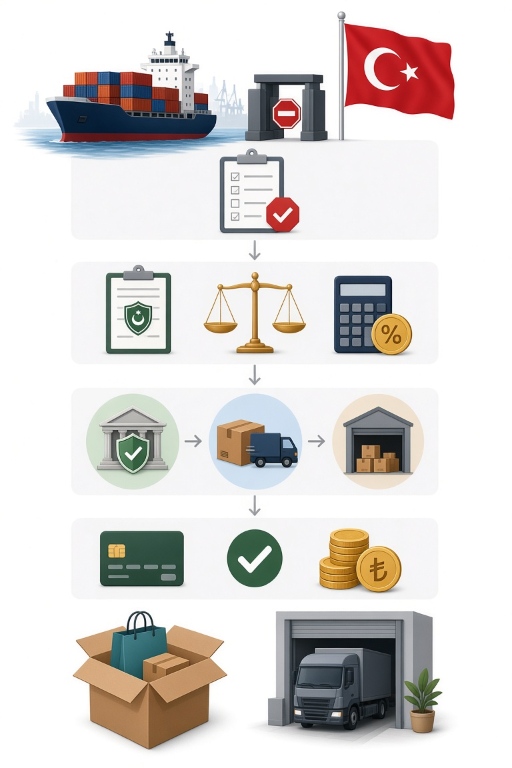
Import Duties and Taxes in Turkey: Preparation and Responsibility Guide
Prepare the Duty and Tax Assessment Before the Shipment Moves
For any commercial shipment entering Turkey, the importer of record bears final responsibility for import duties and taxes. The preparation question is not what the rate is—that depends on classification, origin, and declared value. The preparation question is whether you have the correct product data, supporting documents, and party authorizations to verify the assessment before the customs declaration is filed. The single most important variable to confirm is the tariff classification (HS code) at the six-digit level or deeper, because that drives both duty rates and any applicable value-added tax (VAT) treatment.
This guide covers the operational handoffs, document checks, and verification steps that a shipper should complete before engaging a broker or submitting a declaration. It separates what the shipper controls from what the authority decides and from what a logistics provider coordinates. Use this as a preparation checklist, not as a legal interpretation or a guarantee of clearance outcomes.
Work with a licensed customs broker to confirm current duty and tax treatment for your specific commodity and shipment terms.
Scope: When This Preparation Guidance Applies
This guidance applies to commercial imports into Turkey, regardless of transport mode, where the importer or their designated agent will file a customs declaration and the shipment is subject to duty and tax assessment. The preparation steps vary by cargo type, transaction structure, and service scope.
| Variable | Preparation Impact |
|---|---|
| Jurisdiction | Turkey: Turkish Customs Administration administers duty and VAT collection. Requirements apply to all entry types. |
| Direction | Import into Turkey. Export or transit shipments have different documentation and tax treatment. |
| Commodity type | HS classification determines duty rate, VAT applicability, and potential excise or special taxes. Product-specific restrictions may add permit or certificate requirements. |
| Transport mode | Sea, air, rail, or road freight—mode affects document timing and delivery handoff but does not change the duty assessment basis. |
| Transaction structure | Sale, consignment, temporary import, or repair—each has different valuation and duty treatment. Confirm the entry type before preparing documents. |
| Service scope | Delivered duty unpaid (DDU) vs. delivered duty paid (DDP) arrangements shift responsibility for duty payment and filing between seller and buyer. |
Responsibility and Operating Handoffs
Four parties typically interact around import duty and tax preparation: the shipper/exporter, the importer/consignee, the customs broker, and the freight forwarder or carrier. Each has a distinct role in supplying data, reviewing documents, filing declarations, and making decisions. The authority—Turkish Customs—makes the final assessment and release decision.
| Party | Primary Responsibility | Key Handoff |
|---|---|---|
| Shipper / Exporter | Provides commercial invoice, packing list, and origin documentation. Ensures product description and HS code are accurate to the best of their knowledge. | Transmits commercial documents to importer or broker before cargo departure. |
| Importer / Consignee | Retains authority to appoint the broker, authorizes the customs declaration, and pays duties and taxes (unless DDP terms shift payment to seller). | Signs power of attorney (POA) for the broker; provides Turkish tax identification number (Vergi Kimlik Numarası). |
| Customs Broker | Files the declaration, calculates duties and taxes based on provided data, and coordinates with customs authorities. | Receives complete document set; advises on classification and valuation; submits declaration. |
| Freight Forwarder / Carrier | Manages transport, arranges cargo arrival notifications, and may coordinate warehouse or delivery handoffs. | Provides arrival notice and coordinates cargo delivery after clearance. |
Operating note: The importer of record must be a Turkish entity or a foreign entity with a Turkish tax number. If you are a non-resident importer, confirm your registration status and tax number before the shipment departs. The broker cannot file the declaration without a valid Turkish tax identification number for the importer.
Documents, Data, and Product Checkpoints
Preparing for import duties and taxes in Turkey means assembling a specific set of documents and product data. Each item serves a distinct purpose in the declaration, and missing or mismatched information is a common source of delays.
Commercial invoice. Must include seller and buyer details, product description, HS code (at least six digits), unit value, total value, currency, and terms of sale. The declared value must match the commercial transaction; customs uses this as the basis for duty and VAT calculation.
Packing list. Provides weight, dimensions, package count, and marks/numbers. This supports cargo inspection and verifies that the physical shipment matches the declaration.
Bill of lading / air waybill. The transport document establishes carrier responsibility and delivery terms. It also confirms the shipment’s arrival date, which affects storage and demurrage exposure.
Certificate of origin. Required for preferential duty rates under free trade agreements or for products subject to origin-specific restrictions. Without the correct origin document, customs applies the most-favored-nation (MFN) duty rate.
Importer tax ID and registration. The Turkish tax identification number (Vergi Kimlik Numarası) must be provided to the broker before filing. For non-resident importers, a temporary tax number may be required.
Product compliance documentation. For regulated goods—food, cosmetics, electronics, chemicals, or pharmaceuticals—additional permits, test reports, or certificates may be required. Duty and tax preparation must account for these compliance documents because they affect the release decision.
Verification point: Before sending documents to the broker, verify that the product description on the invoice matches the HS code and the packing list. Discrepancies between these three documents are the most frequent cause of classification challenges and duty assessment adjustments.
Preparation Workflow: From Data Collection to Import Declaration
This workflow outlines the practical sequence for preparing duty and tax documentation for a shipment into Turkey. Each step involves a specific party and a verification point.
Confirm Importer Status and Tax Registration
The importer or consignee confirms their Turkish tax identification number and customs registration status. If the importer is a non-resident entity, coordinate with the broker to obtain a temporary tax number before the shipment arrives.
Collect and Review Commercial Documents
The shipper prepares the commercial invoice, packing list, and any origin or compliance certificates. The importer or their agent reviews these documents for accuracy, consistency, and completeness before transmitting them to the broker.
Assign or Verify the HS Code
The shipper or importer assigns the six-digit HS code based on the product description. If the classification is uncertain, request a binding ruling or advisory opinion from the Turkish Customs Administration or consult a licensed broker before the shipment departs.
Transmit Documents to the Customs Broker
The importer sends the complete document set to the appointed customs broker, along with a signed power of attorney. The broker reviews the documents for technical compliance and may request clarification on valuation or classification.
Broker Files the Import Declaration (importer reviews and authorizes)
The broker prepares and submits the customs declaration to Turkish Customs. The importer authorizes the filing, and the broker calculates the estimated duties and taxes based on the declared value, classification, and origin. The authority determines the final assessment.
Coordinate Payment, Inspection, and Delivery
If customs selects the shipment for inspection, the broker coordinates with the authority. Duties and taxes are paid—either by the importer directly or through the broker. After clearance, the forwarder or carrier arranges delivery.
Cost, Timing, and Delivery Exposure from Incomplete Preparation
Incomplete or inaccurate preparation for import duties and taxes in Turkey creates real operational costs and delays. These exposures are avoidable when data and documents are verified before the shipment departs.
Storage and demurrage. If customs delays clearance due to missing documents or classification issues, cargo sits at the port, airport, or bonded warehouse. Storage fees and demurrage charges accrue daily.
Inspection and correction costs. Physical inspection or document correction requests from customs add handling fees, broker service charges, and potentially re-filing costs.
Delivery delays. Customs hold or re-declaration extends the time between arrival and final delivery. This affects downstream warehouse scheduling, inventory, and customer commitments.
Rebooking and return. In cases where a product cannot be cleared due to classification, origin, or compliance issues, the importer may need to re-export or return the cargo—incurring freight, handling, and administrative costs.
Verification action: Confirm that the broker has received a complete document set at least 5–7 business days before the vessel or aircraft arrival, whenever possible. This allows time for classification review and any clarification with the shipper before the declaration is due.
Failure Modes and Prevention
Most preparation failures for import duties and taxes in Turkey fall into a few predictable categories. Identifying these risks before the shipment moves is the most effective prevention.
Common mistake: Relying on an outdated or generic HS code. Many shippers reuse HS codes from previous shipments without verifying that the code still applies to the current product description or that the product specification has not changed. If the code does not match the product, customs may reclassify the goods and apply a different duty rate—sometimes with retroactive effect. Verify the HS code against the current Turkish Customs Tariff Schedule for each unique product and each shipment.
Risk alert: If the declared value on the commercial invoice does not match the payment records or the broker’s valuation assessment, customs may flag the shipment for a valuation review. This typically results in a delay while the importer provides additional documentation—such as bank transfer records, purchase orders, or contracts—to support the declared value.
Other common failure modes include:
- Unclear importer role. If the buyer and importer of record are different entities, confirm which entity holds the tax identification number and will authorize the declaration. The broker cannot file without a designated importer.
- Missing or mismatched origin documentation. Preferential duty rates require a valid certificate of origin. If the certificate is missing or does not match the product and country of origin, customs applies the MFN rate.
- Incorrect service scope. If the service is quoted as DDP but the importer has not provided the tax ID or authorized the broker, the shipment may arrive without a clear path to payment and clearance.
- Delivery mismatch. If the importer expects door delivery but customs requires a physical inspection at the port, the delivery timeline changes and additional coordination is needed.
Disclosure: This page provides general logistics and customs-preparation information and may mention freight services available through this website. Actual requirements, authority decisions, duties, taxes, document obligations, service scope, and delivery conditions depend on the shipment, jurisdiction, commodity, transaction, and current rules. Confirm current requirements before booking or filing.
Preparation Decision and Coordination
Before you contact a broker, forwarder, carrier, or service provider to review your import duty and tax preparation, have the following data and documents ready. This ensures the review is productive and does not stall due to missing information.
Rule 1: Confirm the importer of record status. Verify who holds the Turkish tax identification number and who has authority to appoint the broker. If the importer is not the ultimate consignee, clarify the relationship.
Rule 2: Validate the HS code. Assign a six-digit or deeper HS code based on the current product specification. If you are uncertain, request a classification opinion from a licensed broker before the shipment departs.
Rule 3: Verify origin documentation. If you intend to claim a preferential duty rate, confirm that the certificate of origin is valid, matches the product, and covers the applicable trade agreement.
Rule 4: Confirm the service scope. Know whether the shipment is DDU, DDP, or other terms. This determines who pays duties and taxes and who files the declaration. Document the agreed terms in writing.
Illustrative example (not a customer case): A shipper sends machinery parts to Turkey under a DDP arrangement. The seller agrees to pay duties and taxes, but the importer has not provided a Turkish tax ID. The broker cannot file the declaration without the tax ID, and the cargo arrives at port with no clearance path. The shipper must coordinate with the importer to obtain the tax ID and authorize the broker—a process that takes several days—while demurrage accrues. The preparation failure was not the duty rate or classification; it was the missing importer registration data. Confirming the tax ID before departure would have prevented the delay.
After you have these items confirmed, contact a licensed broker to review the classification and valuation. The broker can advise on whether the documentation supports the intended duty treatment and can file the declaration once the shipment arrives.
Key Takeaways
- Importer of record responsibility: The Turkish importer—or their authorized agent—bears final responsibility for duties, taxes, and the accuracy of the customs declaration.
- HS code is the critical variable: The tariff classification determines duty rates, VAT treatment, and any additional taxes. Verify the code against the current Turkish Customs Tariff for each product and shipment.
- Document consistency: Ensure the commercial invoice, packing list, and transport documents are aligned on product description, weight, value, and origin. Mismatches are a primary cause of customs queries.
- Tax ID and registration: Confirm the importer’s Turkish tax identification number (Vergi Kimlik Numarası) before the shipment departs. The broker cannot file without a valid tax ID.
- Verify service scope: Know whether the shipment is DDU, DDP, or other terms before departure. The agreed terms determine who pays duties and taxes and who files the declaration.
- Check origin documentation: If claiming preferential duty rates, confirm that the certificate of origin is valid and matches the product and applicable trade agreement.
FAQ
Who is responsible for paying import duties and taxes in Turkey?
The importer of record—the party named on the customs declaration—is responsible for paying duties and taxes. In a delivered duty unpaid (DDU) arrangement, the buyer/importer pays. In a delivered duty paid (DDP) arrangement, the seller pays. However, the legal liability for the accuracy of the declaration remains with the importer of record.
What is the most important document for duty and tax preparation?
The commercial invoice is the most critical document because it contains the product description, HS code, value, and terms of sale. The Turkish Customs Administration uses the invoice to assess duties and taxes. The invoice must match the packing list and transport documents.
Do I need a Turkish tax ID to import goods?
Yes. The importer of record must have a Turkish tax identification number (Vergi Kimlik Numarası). Non-resident importers may be able to obtain a temporary tax number, but this must be arranged before the customs declaration is filed. Confirm this with your broker before the shipment departs.
How do I determine the correct HS code for my product?
The HS code is based on the product’s material composition, function, and intended use. The shipper typically assigns the code using the Turkish Customs Tariff Schedule or a classification tool. If the classification is unclear, request a binding tariff information ruling from the Turkish Customs Administration or consult a licensed broker.
What happens if my documents have discrepancies?
Discrepancies between the invoice, packing list, and transport documents often trigger a customs query or a request for clarification. This can delay clearance while the importer or broker provides corrected or additional documentation. In some cases, customs may adjust the duty assessment or impose penalties.
Can I claim a lower duty rate based on origin?
Yes, if Turkey has a preferential trade agreement with the country of origin and the product qualifies under the rules of origin. You must provide a valid certificate of origin to support the claim. Without the certificate, customs applies the standard most-favored-nation duty rate.
What is the difference between DDU and DDP for import taxes?
Under DDU (delivered duty unpaid), the buyer/importer pays duties and taxes directly and arranges clearance. Under DDP (delivered duty paid), the seller is responsible for paying duties and taxes and arranging clearance. However, even under DDP, the importer of record must authorize the declaration and provide a tax ID.
How can I avoid delays due to duty and tax issues?
Complete the preparation steps before the shipment departs: verify the HS code, confirm the importer’s tax ID, gather origin documentation, and ensure the commercial documents are consistent. Transmit the complete document set to your broker at least 5–7 business days before the cargo arrives.
Disclaimer: This page is general operational guidance, not legal, customs, tax, insurance, product-safety, regulatory, classification, or licensing advice. Requirements, authority decisions, responsibilities, charges, and deadlines depend on the controlling documents, product, jurisdiction, transaction, service terms, and current official guidance. Confirm current shipment requirements with the relevant authority, licensed broker, carrier, or qualified adviser.