
Shipping from China to Turkey: Route Guide and Commercial Freight Options
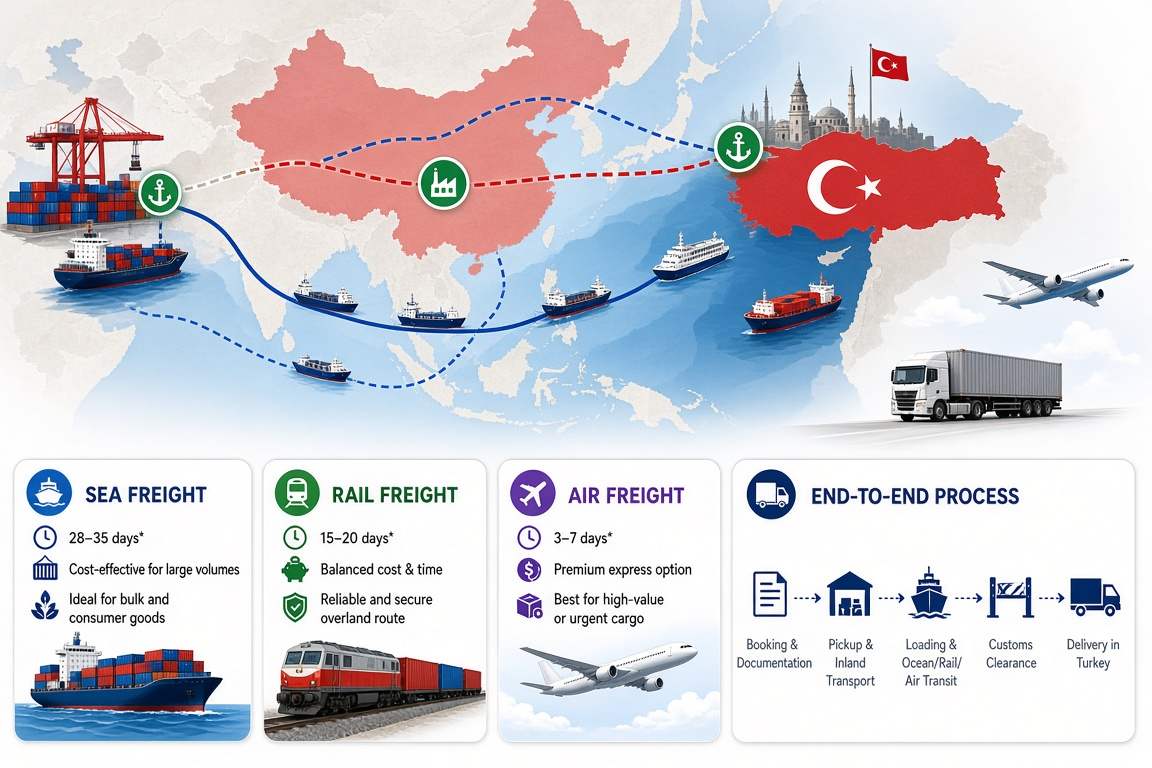
Shipping from China to Turkey: Route Guide and Commercial Freight Options
For commercial freight moving from China to Turkey, sea freight offers the most cost-effective solution for containerized cargo, while air freight serves time-sensitive shipments with higher value density. Rail freight via the Eurasian corridor provides a middle-ground alternative with transit times approximately half that of ocean routes. The practical choice depends on your cargo volume, delivery deadline, and the trade-off between cost and speed. For full-container-load (FCL) shipments from Shanghai, Ningbo, or Shenzhen to Istanbul or Mersin, expect approximate ocean transit of 25–35 days including main leg and feeder connections. Air freight from major Chinese airports to Istanbul Airport typically clears in 5–7 days door-to-door when customs documentation is complete. Rail services along the China–Europe–Turkey corridor generally reach 18–22 days but require careful coordination at border crossings. Each mode carries distinct customs-handling requirements at both origin and destination, and the final delivery scope—port-to-port, airport-to-airport, or door-to-door—fundamentally changes both cost and the buyer’s operational responsibilities.
Shipment Fit and Buyer Decision Context
Shipping from China to Turkey suits a broad range of commercial cargo: industrial machinery, automotive parts, textiles, electronics, and consumer goods. The route works best for importers who can plan 3–6 weeks ahead for sea freight or 1–2 weeks for air freight. Weak-fit shipments include extremely low-value bulk commodities where freight cost exceeds the cargo margin, perishable goods requiring temperature-controlled environments that are not cost-effective by air, and urgent small parcels better served by express services.
Before requesting a quote, define your delivery destination in Turkey (Istanbul, Izmir, Mersin, or inland cities such as Ankara or Konya), your preferred shipping incoterm, and whether you need origin pickup or destination delivery. The buyer’s role in customs clearance at the Turkish border is substantial: the importer of record must have a Turkish tax number, and certain products require additional certifications or import licenses. The key decision is whether to handle Turkish customs clearance through your local broker or include customs brokerage as part of the freight service scope.
Field note: Before finalizing your shipping mode, confirm whether your cargo falls under Turkish customs restrictions or requires a certificate of conformity for electronics, machinery, or food-contact materials. Engage a licensed customs broker in Turkey at least one week prior to departure to verify classification and duty rates.
Method and Route Logic: Sea, Air, and Rail Corridors
Each transport mode from China to Turkey follows a distinct route structure, handoff pattern, and service scope. The following comparison focuses on the shipment condition that makes each option fit or fail.
Sea Freight — FCL and LCL Consolidation
Sea freight from China to Turkey operates through mainline vessels from Chinese ports (Shanghai, Ningbo, Shenzhen, Qingdao, Tianjin) to transshipment hubs such as Singapore, Port Klang, or Colombo, then feeder vessels to Turkish ports including Ambarli (Istanbul), Mersin, Izmir, and Gemlik. FCL (full container load) provides exclusive container use with lower per-unit cost for shipments exceeding approximately 15 CBM or 10 metric tons. LCL (less than container load) consolidates smaller cargo into shared containers, charging on a per-CBM or per-ton basis with additional handling fees. Sea freight is the default choice for non-urgent, high-volume cargo where cost per kilogram is the primary constraint.
Air Freight — Direct and Transshipment Flights
Air freight from China to Turkey moves via scheduled cargo or passenger-belly capacity from Shanghai (PVG), Guangzhou (CAN), Shenzhen (SZX), or Hong Kong (HKG) to Istanbul Airport (IST) or Sabiha Gökçen (SAW). Direct flights operate daily with transit times of 10–12 hours in the air, but total door-to-door time depends on origin trucking, export customs, and destination clearance. Air freight is the preferred mode for high-value, low-volume goods, automotive prototypes, medical supplies, or urgent production-line components. It is not cost-effective for heavy or bulky cargo unless the value density justifies the premium.
Rail Freight — Eurasian Corridor via Central Asia
Rail freight from China to Turkey follows the Trans-Caspian International Transport Route (TITR) through Kazakhstan, the Caspian Sea (via ferry), Azerbaijan, and Georgia, entering Turkey through the Kars–Tbilisi–Baku (BTK) railway. This corridor offers a scheduled service with approximately 18–22 days from Chinese inland depots (Xi’an, Chengdu, Chongqing, Zhengzhou) to Turkish destinations. Rail is suitable for mid-range cargo that cannot tolerate 30+ days at sea but does not justify air freight rates. However, rail capacity is limited, schedules can shift due to border documentation delays, and the service is more expensive than sea but less than air. Rail freight services from China require advance booking and confirmed container space.
Service Scopes and Handoffs
Port-to-port or airport-to-airport service covers main carriage only, leaving origin trucking, export customs, destination clearance, and final delivery to the buyer or local agents. Door-to-door service integrates pickup in China, all export and import customs formalities, main carriage, and delivery to a Turkish address. The latter simplifies execution but increases the quoted price and transfers more responsibility to the freight forwarder. For Turkish imports, customs brokerage at the destination is essential regardless of the chosen service scope, as Turkish customs authorities require precise documentation, duty payment, and compliance with product-specific regulations.
Transit-Time Planning: Main Transport and Total Delivery Cycle
The total delivery cycle from a Chinese factory or warehouse to a Turkish receiver includes three time components: origin preparation and export clearance, main international transport, and destination customs clearance with final delivery. The following ranges are approximate and assume that all documentation is complete and no customs holds occur.
| Mode | Main transport (port/airport to port/airport) | Total door-to-door cycle | Best-fit cargo profile |
|---|---|---|---|
| Sea Freight (FCL) | 25–30 days | 32–42 days | High volume, non-urgent, cost-sensitive |
| Sea Freight (LCL) | 28–35 days | 35–45 days | Smaller shipments, consolidation |
| Air Freight | 2–3 days | 5–7 days | High value, urgent, low weight/volume |
| Rail Freight | 18–22 days | 24–30 days | Mid-range, medium volume, balanced cost/speed |
Timing drivers include vessel or flight schedules, transshipment connection windows, customs clearance at Chinese export and Turkish import stages, and inland trucking to final destination. For rail, the Caspian ferry crossing adds variability. For sea, the choice of transshipment hub (Singapore vs. Colombo vs. Port Klang) affects reliability. For air, the availability of direct vs. connecting flights shifts total transit by 1–2 days.
Cost and Quote Scope: What to Compare and How
Comparing freight quotes for shipping from China to Turkey requires aligning the service scope, cargo basis, and included charges. A true apples-to-apples comparison must specify the point of pickup, the delivery address in Turkey, the cargo dimensions and weight, and the incoterm that defines each party’s cost and risk transfer point.
Freight Calculation Bases
Sea freight (FCL): Quoted per container (20-foot or 40-foot) plus local charges at origin and destination. Sea freight (LCL): Quoted per cubic meter (CBM) or per 1,000 kg, whichever is higher (chargeable weight). Air freight: Quoted per chargeable kilogram, where the greater of actual gross weight and volumetric weight (length × width × height in cm / 6,000) applies. Rail freight: Generally quoted per container or per TEU, similar to FCL sea freight, with additional border-crossing and ferry fees.
What a Comprehensive Quote Includes
A full-service door-to-door quote should itemize: pickup at origin (Chinese factory or warehouse), export customs declaration and clearance, main carriage (sea/air/rail freight), marine or air cargo insurance, destination customs clearance, duties and taxes (if DDP or DAP with duties prepaid), and final delivery to the Turkish address. When the service scope is port-to-port or airport-to-airport, the quote covers only main carriage plus origin terminal handling and destination terminal charges. Accessorial charges such as demurrage, detention, storage, and container cleaning are typically excluded and billed separately if they occur.
For Turkish imports, duty rates vary by HS code and are not included in the freight quote unless explicitly stated. The buyer should obtain a duty estimate from a Turkish customs broker before shipping. Cargo insurance is an additional, recommended line item that protects against loss or damage during the international leg and should be arranged before the cargo departs China.
Note: Freight rates change with cargo details, route, carrier capacity, fuel costs, seasonal demand, service scope, and destination charges. Request a current quote for the specific shipment.
Process and Customs Checkpoints: Six Operational Stages
Each shipment from China to Turkey progresses through six standard operational stages. At every stage, specific documents and responsibilities transfer between the shipper, freight forwarder, carriers, customs authorities, and consignee.
Request Quote and Book Service
Submit cargo details: weight, dimensions, HS code, pickup address in China, delivery address in Turkey, required delivery date, and service scope (port-to-port, door-to-door, etc.). The freight forwarder confirms available capacity, provides a provisional quote, and issues a booking confirmation.
Cargo Pickup and Origin Consolidation
The forwarder arranges trucking from the Chinese supplier’s warehouse to the port of loading (sea) or airport (air), or to an inland rail depot for rail shipments. Cargo is weighed, measured, and packed into containers or pallets as required. Export packing lists and commercial invoices are finalized at this point.
Export Customs Clearance (China)
The shipper or its agent submits the export declaration to Chinese customs, including commercial invoice, packing list, customs declaration form, and export license (if applicable). Customs verifies the declared value, HS code, and product compliance. Clearance must be completed before the cargo is loaded onto the vessel, aircraft, or train.
International Transportation
The cargo moves by sea, air, or rail from China to Turkey. For sea, the bill of lading serves as the contract of carriage and document of title. For air, the air waybill governs. For rail, the CIM/SMGS consignment note accompanies the cargo. The buyer monitors transit and prepares for destination clearance.
Destination Customs Clearance (Turkey)
Upon arrival in Turkey, the importer of record (or its customs broker) submits the import declaration, commercial invoice, packing list, bill of lading or air waybill, certificate of origin, and any product-specific certificates (CE mark, conformity certificates, phytosanitary certificates). Turkish customs calculates duties, VAT, and any special taxes. The cargo is released once duties are paid and customs inspection (if any) is passed.
Final Delivery to Consignee
After customs release, cargo is deconsolidated or removed from the container and delivered by truck to the final address in Turkey. Delivery time depends on distance from the port of entry or airport. The consignee signs a delivery receipt, and any outstanding accessorial charges are settled.
Risks and Preventive Controls for China–Turkey Shipping
Operational Risks and Mitigation
Transshipment delays: Sea freight via Singapore or Colombo may experience congestion. Control: Book with a carrier that offers multiple transshipment options or direct-call services where available.
Turkish customs holds: Missing or inaccurate documentation, incorrect HS code, or undeclared product restrictions trigger inspection and delays. Control: Engage a licensed Turkish customs broker before departure to pre-clear all documents.
Rail border-crossing variability: The Caspian ferry and BTK railway can experience delays due to documentation or weather. Control: Build a 3–5 day buffer into your delivery schedule when choosing rail.
Currency and duty fluctuations: Turkish duties are calculated in Turkish lira based on the customs value. Exchange-rate shifts affect landed cost. Control: Lock in the freight rate and duty estimate close to the shipment date.
Common mistake: Assuming that the Turkish importer of record can be changed after the cargo has departed. The consignee name and tax number on the bill of lading must match the import declaration. Changes require amendment fees and can delay clearance. Verify the consignee details before finalizing the booking.
Risk alert: Turkish customs apply strict rules on product origin and value declaration. Under-declaration of invoice value or misclassification of HS code carries penalties including fines, cargo seizure, and delays. Use the correct transaction value and consult a broker for classification.
Disclosure: This page provides general route-planning information and may mention freight services available through this website. Transit times, freight costs, customs requirements, carrier schedules, and destination conditions can change. Confirm the current shipment plan before booking.
Recommendation and Quote-Preparation Checklist
The practical default for shipping from China to Turkey is sea freight FCL for any shipment exceeding 15 CBM or 10 metric tons, as it provides the lowest cost per unit and reliable schedule integrity for non-urgent cargo. For shipments between 5 and 15 CBM, sea LCL offers a cost-effective consolidation option, but the buyer should compare the LCL per-CBM rate against rail freight, which may deliver comparable cost with faster transit. The factor that changes the default is the delivery deadline: if the cargo must arrive within 10 calendar days, air freight becomes the only viable mode, and the cost premium is justified by the time value of the goods.
Illustrative example (not a customer case): An importer of automotive spare parts shipping 12 pallets (total 8 CBM, 3,500 kg) from Shanghai to Istanbul. Sea LCL delivers a 38-day cycle at approximately $180/CBM. Rail freight offers 26 days at $280/CBM. Air freight arrives in 6 days at $5.50/kg chargeable weight. The buyer chooses rail because the 12-day time saving over sea is critical to avoid a production stoppage, while the rail premium over sea is acceptable versus the air premium.
Required Quote Inputs
- Cargo details: Description, HS code, dimensions (length × width × height per package), total weight, number of packages, and any special handling requirements (hazardous, temperature-controlled, fragile).
- Origin address in China: Factory or warehouse pickup address with contact details and operating hours.
- Destination address in Turkey: Full delivery address with consignee name, tax number, and contact person.
- Preferred service scope: Port-to-port, airport-to-airport, door-to-door, or door-to-airport.
- Required delivery date or window: The buyer’s deadline for cargo availability at the Turkish destination.
- Incoterm (if known): Defines who bears the freight, insurance, and customs costs; affects the quote structure.
Once these inputs are provided, the freight forwarder returns a detailed quote with a break-down of charges. Review the quote for excluded items (demurrage, storage, customs duty, VAT) and confirm the service scope before booking. Sea freight services from China to Turkey are available for both FCL and LCL, and the forwarder can arrange the entire export and import handling through its local partners.
Key Takeaways
- Sea freight FCL is the cost leader for shipments above 15 CBM with a 5–6 week total cycle; air freight serves urgent, high-value cargo in 5–7 days door-to-door.
- Rail freight via the Trans-Caspian corridor offers a middle-ground option with 24–30 day transit for medium-volume shipments that cannot wait for sea but do not justify air costs.
- Turkish customs clearance requires the importer of record to have a Turkish tax number; product-specific certificates may be mandatory.
- The service scope (port-to-port vs. door-to-door) fundamentally changes cost, risk transfer, and the buyer’s operational involvement.
- Before quoting, provide cargo dimensions, weight, HS code, pickup and delivery addresses, and required delivery date.
- Verify the consignee details and product classification early to avoid customs delays and penalties.
FAQ
What is the cheapest way to ship from China to Turkey?
Sea freight, specifically FCL for larger shipments, offers the lowest cost per kilogram or per cubic meter. LCL is cost-effective for smaller cargo volumes. The cheapest option depends on the total shipment size and the service scope.
How long does shipping from China to Turkey take by sea?
Approximate ocean transit from Chinese ports to Turkish ports ranges from 25 to 35 days for main carriage, with total door-to-door delivery of 32 to 42 days depending on origin and destination trucking and customs clearance.
Do I need a customs broker in Turkey for imports from China?
Yes. Turkish customs require a licensed broker to file the import declaration, calculate duties, and manage any inspections. The broker also verifies that all product-specific certificates are in place.
Can I ship from China to Turkey by rail?
Yes. Rail freight via the Trans-Caspian corridor from Chinese inland depots to Turkey is available, with transit times of approximately 24 to 30 days door-to-door. Space is limited, so advance booking is essential.
What documents are required for shipping from China to Turkey?
Commercial invoice, packing list, bill of lading or air waybill, certificate of origin, and any product-specific certificates (CE, conformity, phytosanitary). Turkish customs also require the importer’s tax number.
What is the difference between FCL and LCL for China–Turkey sea freight?
FCL gives you exclusive use of a full container, with a fixed rate per container. LCL shares container space with other shippers, charging per CBM or per ton. FCL is more cost-effective for larger volumes; LCL suits smaller shipments.
Are duties and taxes included in the freight quote?
No. Freight quotes generally exclude Turkish import duties, VAT, and special consumption taxes. These are calculated at customs clearance and are the importer’s responsibility. Always request a duty estimate separately.
Disclaimer: Transit times, cost explanations, customs information, and shipping suggestions on this page are general planning references, not a binding quotation, customs ruling, or delivery guarantee. Confirm the current route, service scope, charges, documents, and import requirements before booking.