
Shipping from China to Amazon FBA: Route & Service Guide
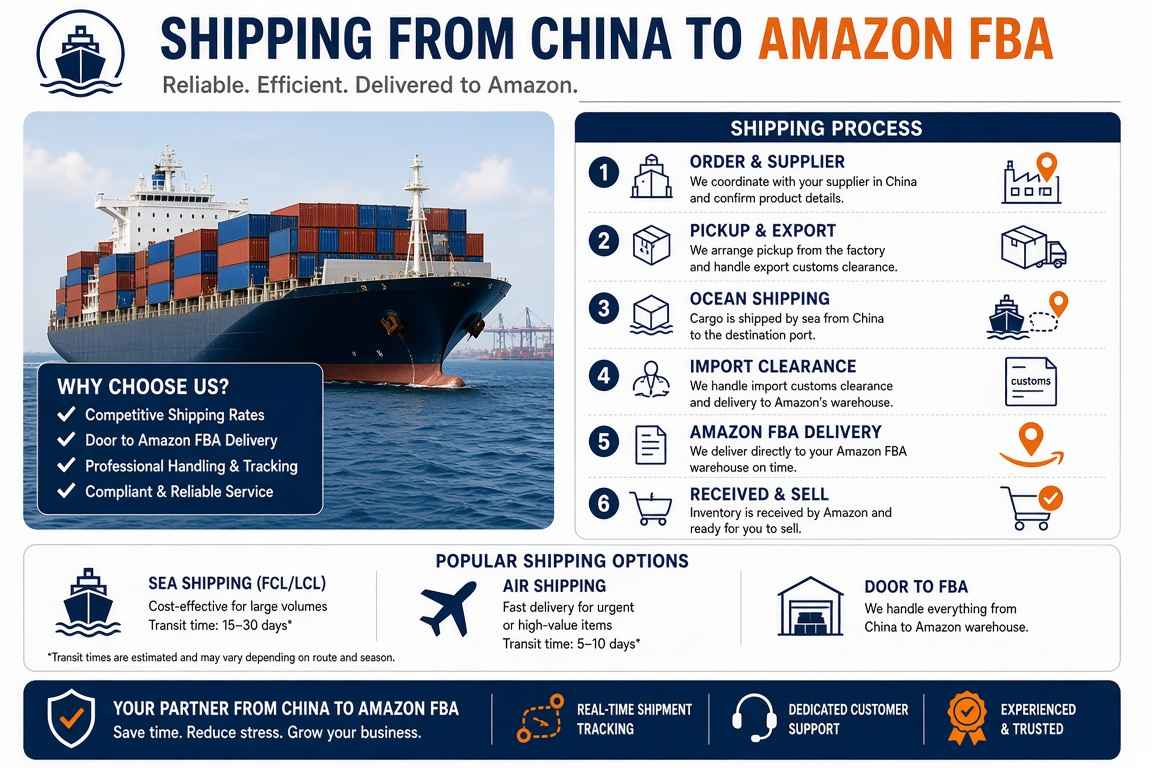
Shipping from China to Amazon FBA: Route & Service Guide
Choose Your Shipping Route to Amazon FBA
Shipping from China to Amazon FBA fulfillment centers involves a direct trade-off between speed and cost per unit. Air freight delivers inventory to US, European, or other regional FBA warehouses in 5–10 days but costs significantly more per kilogram. Sea freight takes 25–40 days total from factory to FBA receiving dock but moves high-volume, heavy shipments at a fraction of the air rate. The right choice depends on your inventory velocity, cash flow, product margins, and whether you are restocking in-stock items or launching a new ASIN.
For most FBA sellers shipping container volumes from China, sea freight is the default economical option. For time-sensitive product launches, seasonal peaks, or low-inventory emergencies, air freight becomes the operational necessity. A third path—express shipping via courier—works for urgent parcel-sized replenishments but rarely scales beyond 100–200 kg per shipment. This guide walks through the decision, timing, customs preparation, and quote process so you can move inventory from a Chinese supplier to an Amazon fulfillment center with confidence.
Shipment Fit: Who Should Use Each Mode
Match your shipment profile to the right service before requesting a quote. The table below maps common FBA shipment characteristics to the best-fit mode.
| Shipment Profile | Volume / Weight | Time Sensitivity | Recommended Mode |
|---|---|---|---|
| Regular restock, stable demand | 2+ CBM or 500+ kg | Low to moderate | Sea LCL or FCL |
| New product launch, limited inventory | 1–5 CBM or 200–1000 kg | High | Air freight or express |
| Emergency replenishment, out of stock | Under 200 kg | Critical | Express courier |
| Full container, established SKU | 20′ or 40′ container | Low | Sea FCL |
| Mixed SKUs, small batch trial | Under 1 CBM or under 100 kg | Moderate | Air freight or express |
Field note: Before booking, confirm that your supplier can deliver to the origin warehouse or port within your required window. A one-week supplier delay can erase the advantage of air freight and force you into expedited handling at origin—an avoidable cost trigger.
Route Logic and Service Scope
Shipping from China to Amazon FBA is never a single leg. Every mode involves an inland pickup in China, export clearance, the main international leg, import clearance at destination, and final delivery to the FBA warehouse. The service scope you choose determines who handles each handoff.
Sea Freight (LCL and FCL)
Sea freight from China to Amazon FBA moves through major Chinese ports—Shanghai, Ningbo, Shenzhen, or Qingdao—to destination ports near FBA clusters: Los Angeles, Long Beach, or Oakland for US West Coast; New York or Savannah for US East Coast; or Rotterdam / Felixstowe for European FBA hubs. From the destination port, a truck or rail drayage moves the container to the final FBA fulfillment center.
Sea freight works best when your shipment exceeds 1 CBM or 200 kg. LCL consolidates your cargo with other shippers’ goods; FCL gives you exclusive use of a container. FBA does not accept direct container deliveries without prior appointment and proper carton labeling, so your freight partner must handle deconsolidation or container unpacking at a warehouse before final FBA delivery.
Air Freight
Air freight from China to Amazon FBA typically departs from Shanghai Pudong, Guangzhou, or Hong Kong and arrives at a major gateway airport near your target FBA region: Chicago O’Hare, Los Angeles, New York JFK, or Frankfurt for European destinations. After import clearance, cargo moves by truck to the FBA warehouse.Air freight becomes the right choice when you need inventory in FBA within 7–10 days total and can absorb the higher freight cost. It also works well for high-value, low-weight products where freight cost per unit remains manageable.
Door-to-Door and Express
Door-to-door services combine pickup, international freight, customs clearance, and delivery to the FBA warehouse under one commercial quote. This simplifies coordination but usually costs more than port-to-port or airport-to-airport arrangements because the freight forwarder assumes responsibility for all handoffs. Express courier services like DHL or FedEx are true door-to-door options for shipments under 200 kg, with tracking and faster delivery, but they are seldom cost-effective for larger FBA replenishments.
Transit-Time Planning
Transit time is the single most critical factor for FBA inventory planning. The table below shows approximate timelines for each mode from supplier pickup to FBA warehouse receiving. All ranges are approximate and exclude customs inspection delays, port congestion, and carrier schedule changes.
| Mode | Origin China Pickup to Export | Main International Leg | Import Clearance & Delivery | Total Approximate Range |
|---|---|---|---|---|
| Sea LCL | 3–5 days | 16–25 days (US West Coast) / 25–35 days (US East Coast) | 3–7 days | 22–40 days |
| Sea FCL | 3–5 days | 14–22 days (US West Coast) / 22–30 days (US East Coast) | 3–5 days | 20–32 days |
| Air Freight | 2–3 days | 2–5 days | 2–4 days | 6–12 days |
| Express Courier | 1–2 days | 2–4 days | 1–2 days | 4–8 days |
For sea freight, the main variable is the destination region. US West Coast FBA warehouses receive cargo substantially faster than East Coast or Midwest locations. European FBA destinations add 3–5 days to sea transit compared to US West Coast. Air freight times are more consistent but can extend during peak seasons (September–December) due to capacity constraints.
Plan your shipment so that cargo arrives at the FBA warehouse at least 14 days before your planned sale date to account for FBA receiving and check-in delays. Amazon does not guarantee same-day receiving, and peak seasons can extend receiving to 7–10 days.
Cost and Quote Scope
Comparing freight quotes for shipping from China to Amazon FBA requires a clear understanding of what each price includes. A complete quote must cover these cost components:
- Pickup and inland transport: Trucking from your supplier’s factory in China to the port or airport of departure.
- Export customs clearance: Documentation, customs declaration, and any export license requirements in China.
- Main freight: The international leg—ocean freight per container or per CBM, or air freight per chargeable kilogram.
- Destination handling: Terminal handling charges, documentation fees, and customs clearance at the destination port or airport.
- Duties, taxes, and VAT: Import duties and VAT imposed by the destination country. These are separate from freight and are either paid by the importer directly or included in a DDP (Delivered Duty Paid) arrangement.
- Final delivery: Trucking from the destination port or airport to the FBA warehouse, including appointment scheduling and FBA receiving fees (if any).
- Accessorials: Palletization, carton labeling, shrink-wrapping, lift-gate service, inside delivery, or residential delivery charges.
When requesting a quote, always ask whether the price is DDP (duties and taxes included) or DAP (duties and taxes payable by the consignee). For FBA shipments, the importer of record is typically the seller or a designated broker. Amazon will not act as the importer, so you must arrange for a licensed customs broker to handle clearance on your behalf.Customs brokerage is a separate service that must be coordinated with your freight movement.
Note: Freight rates change with cargo details, route, carrier capacity, fuel costs, seasonal demand, service scope, and destination charges. Request a current quote for the specific shipment.
Process and Customs Checkpoints
Request Quote & Provide Shipment Details
Submit cargo weight, dimensions, CBM, HS code, destination FBA warehouse code, and preferred Incoterm. The freight forwarder uses this information to select the appropriate carrier, service level, and route. Confirm that your supplier can deliver on the requested pickup date.
Cargo Pickup and Warehouse Consolidation
Your freight forwarder arranges truck pickup from the supplier’s factory in China. Cargo is delivered to the origin warehouse or port terminal for consolidation (LCL) or container loading (FCL). For LCL shipments, ensure cartons are labeled with the master bill of lading number and destination warehouse code.
Export Customs Clearance (China)
The freight forwarder or its customs broker files the export declaration with Chinese customs. Required documents include the commercial invoice, packing list, bill of lading or air waybill, and export license (if applicable). The cargo is cleared for export and loaded onto the vessel or aircraft.
International Transportation
Vessel or aircraft departs China for the destination port or airport. During this leg, the freight forwarder provides tracking updates. For sea freight, the bill of lading is issued; for air freight, the air waybill is issued. Both documents serve as the contract of carriage and evidence of title.
Destination Customs Clearance
Upon arrival, a licensed customs broker files the import entry with the destination customs authority. For US FBA shipments, this requires the HTS classification, bond, ISF filing (for ocean), and commercial invoice. The importer of record must provide its EIN or tax ID. Customs may inspect the cargo; inspection delays are outside the carrier’s control.
Final Delivery to Amazon FBA
After clearance, cargo is trucked to the designated FBA fulfillment center. The freight forwarder schedules a delivery appointment through Amazon’s Carrier Central portal. Cartons must meet FBA labeling and preparation requirements. The FBA warehouse checks in the inventory; receiving confirmation appears in Seller Central.
Field note: Amazon requires that each carton carry a unique FBA label (the shipment ID and carton number) and that all items have scannable barcodes. Missing or incorrect labels are the leading cause of FBA receiving delays. Confirm labeling with your freight partner before pickup.
Risks and Controls
Shipping from China to Amazon FBA involves several operational risks. The controls below mitigate the most common issues.
In-transit Damage or Loss
Marine and air cargo are exposed to handling damage, container condensation, and theft. Prevent this by using proper packaging, palletization, and shrink-wrap. Cargo insurance covers the commercial value of goods in transit. Obtain insurance before the shipment departs; you cannot add coverage after a loss occurs.
Customs Holds and Examinations
Customs can hold cargo for inspection, documentation review, or product compliance checks. The primary control is accurate, complete documentation: correct HTS code, declared value, country of origin, and product descriptions. Work with a licensed customs broker who knows FBA-specific requirements and destination-country import rules. For US ocean shipments, file the ISF (Importer Security Filing) at least 24 hours before vessel loading.
FBA Receiving Rejections
Amazon rejects shipments that fail labeling, packaging, or preparation standards. Rejected cargo must be returned to the freight forwarder’s warehouse for rework, incurring additional cost and delay. Control this by auditing your shipment against the latest FBA preparation guidelines before it leaves China. Your freight forwarder can perform a pre-delivery quality check at the origin warehouse.
Common mistake: Relying on the supplier to handle FBA labeling without verifying the labels against Amazon’s current format. Labels with incorrect barcode symbology, faded print, or missing shipment IDs cause receiving failures. Always obtain a sample label from the supplier and scan it with a barcode reader before mass production.
Risk alert: If your shipment arrives at the FBA warehouse without a valid delivery appointment, Amazon may refuse the delivery or charge a storage fee for holding the cargo at the dock. Confirm that your freight forwarder has secured the appointment before the truck departs the final warehouse.
Disclosure: This page provides general route-planning information and may mention freight services available through this website. Transit times, freight costs, customs requirements, carrier schedules, and destination conditions can change. Confirm the current shipment plan before booking.
Recommendation and Quote Preparation
For most FBA sellers shipping from China, the default recommendation is sea freight LCL for shipments between 1 and 15 CBM, and sea freight FCL for shipments above 15 CBM. This minimizes per-unit freight cost and preserves margin. The exception is a new product launch, where air freight positions inventory quickly to capture early sales and reviews.
Choose air freight when your inventory turnover is high and your margin per unit supports the higher freight cost, or when you are correcting an out-of-stock situation. Use express courier only for emergency replenishments under 200 kg—the cost per kilogram is typically twice that of air freight and four to six times that of sea freight.
Before requesting a quote, prepare these inputs:
- Total carton count, dimensions (length × width × height), and weight per carton
- Total CBM and total gross weight
- HS code (6-digit minimum) for each product
- Destination FBA warehouse code (e.g., FTW1, ONT8, LGB8, MDW2)
- Preferred Incoterm: EXW (pickup at factory), FOB (delivery to Chinese port), or DDP (delivered with duties paid)
- Required delivery date or latest acceptable arrival date at FBA
Illustrative example (not a customer case): An FBA seller with 5 CBM of electronics accessories from Shenzhen needs inventory for a Q4 sales peak. Sea freight LCL offers a total transit of 28 days to the US West Coast at a freight cost of approximately $3.50 per kg. Air freight delivers in 8 days at roughly $9.50 per kg. If the product margin is $15 per unit and the seller expects to sell 500 units per week, the air freight premium of $6 per kg × 500 kg = $3,000 buys three weeks of additional selling time. The seller chooses air freight to capture peak-season demand. If the product is a slow-moving restock, sea freight is the clear choice.
Key Takeaways
- Sea freight is the cost-effective default for FBA replenishments above 1 CBM; air freight is the speed option for launches and emergencies.
- Total transit time from China to FBA ranges from 4–8 days for express to 20–40 days for sea freight, depending on destination region and service scope.
- Customs clearance requires a licensed broker, correct HTS classification, and the importer’s tax ID—Amazon does not act as importer of record.
- FBA labeling and preparation standards are non-negotiable; audit your cargo before it leaves China to avoid receiving rejections.
- Compare quotes on a like-for-like basis: include pickup, export clearance, main freight, destination handling, duties (if DDP), and final delivery.
- Request a current quote with full shipment details; rates vary with cargo, season, and capacity.
FAQ
Can I ship directly from China to an Amazon FBA warehouse?
Yes, but you must work with a freight forwarder or customs broker to handle import clearance. Amazon does not accept shipments without a delivery appointment and proper carton labeling. Your freight partner coordinates the final delivery appointment through Amazon’s Carrier Central portal.
What is the cheapest way to ship from China to Amazon FBA?
Sea freight LCL (less than container load) is the lowest-cost option for shipments between 1 and 15 CBM. For larger volumes, sea freight FCL reduces the per-unit cost further. Air freight and express are significantly more expensive and should be reserved for time-sensitive shipments.
Does Amazon act as the importer of record for shipments from China?
No. Amazon does not act as the importer of record for any shipment. The seller or the seller’s designated customs broker must be the importer of record. This means you need an EIN or tax ID in the destination country and a licensed broker to file the import entry.
What documents do I need for shipping from China to Amazon FBA?
You need a commercial invoice, packing list, bill of lading (sea) or air waybill (air), and export customs declaration. For US FBA shipments, also provide the ISF filing (for ocean), HTS classification, and the importer’s bond. Your freight forwarder and customs broker handle the document preparation.
How long does sea freight take from China to Amazon FBA?
Sea freight from China to US West Coast FBA warehouses typically takes 22–32 days total. To US East Coast, expect 30–40 days. European FBA destinations add 3–5 days. These ranges include pickup, export clearance, ocean transit, import clearance, and final delivery.
What are the FBA labeling requirements for shipments from China?
Each carton must display the FBA shipment ID and carton number label generated from Seller Central. Each product unit must have a scannable barcode (UPC, EAN, or FNSKU). Labels must be placed on a flat surface, not over seams or edges. Your freight forwarder can verify labeling compliance before departure.
Do I need cargo insurance for shipping from China to Amazon FBA?
While not mandatory, cargo insurance is strongly recommended. Marine and air transit carry risks of damage, loss, or theft. Your standard freight contract provides minimal liability—typically far below the commercial value of your inventory. Obtain all-risk cargo insurance before the shipment departs.
Disclaimer: Transit times, cost explanations, customs information, and shipping suggestions on this page are general planning references, not a binding quotation, customs ruling, or delivery guarantee. Confirm the current route, service scope, charges, documents, and import requirements before booking.