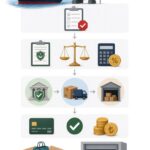


Cargo insurance coverage determines which party bears the financial risk if your shipment is lost, damaged, or delayed in transit. The default position is that the carrier’s liability is limited by international conventions and standard terms of service, often covering far less than the commercial value of your goods. Before any shipment departs, you need to confirm exactly what your cargo insurance policy covers, who is responsible for procuring it, and what exclusions apply.
The core verification checklist includes: policy scope and perils covered, insured value and valuation method, exclusions and sub-limits, named insured parties, geographic coverage, and the claims process. Each of these factors can materially affect whether a claim is paid. This guide walks through each confirmation point and explains the operational decisions that depend on them.
What Cargo Insurance Coverage Actually Controls
Cargo insurance is a contract between the insured party and the insurer that transfers the financial risk of loss or damage to goods during transit from the shipper, importer, or consignee to the insurance provider. The policy defines the perils covered, the maximum payable amount, the geographic scope, and the conditions under which a claim is valid.
The coverage does not replace the carrier’s basic liability. Instead, it sits on top of it, covering the gap between the carrier’s limited liability and the full commercial value of the cargo. Carrier liability under most standard terms is capped at a fixed amount per kilogram or per package, often substantially below the actual invoice value. For high-value cargo, this gap can be significant.
What the policy controls in practice:
- Risk allocation: Specifies which perils are insured — typically all-risk, named perils, or total loss only.
- Claim entitlement: Defines who can file a claim and under what circumstances.
- Recovery amount: Establishes the valuation basis for settlement, usually invoice value plus freight and insurance premium.
- Geographic coverage: Confirms the territorial limits — often worldwide excluding sanctioned countries or specific high-risk zones.
If the policy is not confirmed before shipment, you may discover after a loss that the coverage was insufficient, the peril was excluded, or the claim was filed by the wrong party. Each of these failures is preventable with a structured pre-shipment verification process.
What to Verify Before Shipment
Use this checklist to confirm cargo insurance coverage before the freight forwarder books the shipment. Each item affects whether coverage will respond to a loss.
1. Policy Scope and Perils Covered
Confirm whether the policy covers all-risk or named perils. All-risk is the broadest coverage, insuring against all physical loss or damage except for explicitly excluded perils. Named-perils policies cover only the specific events listed, such as fire, collision, or theft. For most commercial shipments, all-risk is the preferred default. If the policy is named-perils, confirm that the listed perils match the risks of your trade lane.
2. Insured Value and Valuation Method
The insured value determines the maximum claim payout. Confirm that the value declared matches the commercial invoice value plus freight and insurance (CIF) or the agreed valuation basis. Under-declaring the value reduces the recovery; over-declaring may invalidate the policy. For high-value or volatile commodities, confirm whether the policy uses invoice value, replacement cost, or a pre-agreed value.
3. Exclusions and Sub-Limits
Every cargo policy has exclusions. Confirm the standard exclusions apply: inherent vice, insufficiency of packing, delay, and war or strikes (often require separate coverage). Also verify sub-limits for particular risks, such as a lower cap for theft, pilferage, or temperature-controlled cargo. If your cargo type or route triggers a sub-limit, confirm the exposure is acceptable.
4. Named Insured Parties
Confirm who is named as the insured on the policy. Typically the shipper, consignee, or freight forwarder may be named, but if the party with financial interest in the cargo is not listed, they cannot file a claim. If you are the buyer or seller with ownership at the time of loss, confirm the policy names you as an insured or additional insured. A buyer may require a seller’s or freight forwarder’s policy to name them as loss payee.
5. Geographic Coverage
Confirm the territorial limits of the policy. Most policies cover worldwide shipments but exclude certain sanctioned countries or high-risk zones. If your shipment travels through a region with active conflict, political instability, or known piracy risk, confirm coverage applies. Some policies require advance notice for shipments to or through high-risk areas.
6. Claims Process and Notification Deadlines
Confirm the time limits for notifying the insurer of a loss. Most policies require prompt notification, often within 7 to 30 days of the loss event or of the consignee taking delivery. Delayed notification can bar recovery. Also confirm the documentation required for a claim, including the survey report, packing list, commercial invoice, bill of lading, and carrier’s report of loss or damage.
Practical note: Carriers often require a note of damage or loss at the time of delivery to preserve your claim rights against the carrier. This is independent of the cargo insurance claim. Always inspect cargo at delivery and note any damage on the delivery receipt before signing.

When Coverage Applies and When It Does Not
Cargo insurance coverage is not a blanket guarantee. It applies only when the loss or damage occurs during the defined period of transit and is caused by an insured peril. Understanding the boundaries of coverage is essential for deciding whether to rely on it or to seek alternative risk mitigation.
Coverage applies when:
- The loss occurs during the policy’s defined transit period, typically from the time the goods leave the named place of shipment until they arrive at the named destination.
- The cause of loss is an insured peril — for all-risk policies, any fortuitous physical loss or damage not specifically excluded.
- The insured party has an insurable interest in the goods at the time of loss (i.e., they would suffer a financial loss).
- The policy is in force, premiums are paid, and all policy conditions are satisfied.
Coverage typically does not apply when:
- The loss is caused by an excluded peril such as inherent vice, insufficiency of packing, delay, nuclear risk, or war and strikes (unless separately covered).
- The loss occurred before the policy inception or after expiry.
- The insured value was materially misstated or the cargo was misdescribed.
- The loss was caused by ordinary leakage, loss of weight, or normal wear and tear.
- The shipment was to or through a sanctioned country or excluded territory.
When the shipment profile is outside standard coverage parameters, the shipper or freight forwarder should seek a special policy endorsement, a separate war or strikes policy, or a tailored cargo insurance policy that addresses the specific risk. Do not assume standard coverage protects against every contingency.
Trade-Offs and Alternatives
Choosing the right cargo insurance approach involves balancing cost, coverage breadth, and administrative burden. The alternatives below are not mutually exclusive; many shippers combine them depending on the shipment value, frequency, and risk profile.
| Approach | Coverage Breadth | Cost | Administrative Overhead | Best Fit |
|---|---|---|---|---|
| Carrier liability only | Very limited; capped per kg/package | Included in freight | Lowest | Low-value cargo, commodity goods where loss risk is low |
| Freight forwarder’s open policy | Broad; varies by forwarder | Moderate; per-shipment fee | Low; arranged by forwarder | Regular shipments, moderate value, needs quick arrangement |
| Separate cargo insurance policy | Broad to tailored; directly controlled by shipper | Varies by cargo value and risk | Higher; requires application and negotiation | High-value cargo, sensitive goods, frequent shippers |
| Self-insurance / retention | None; shipper bears the risk | No premium; but full loss exposure | Lowest | Large shippers with diversified cargo and risk appetite |
The practical selection rule: if the cargo value exceeds the carrier’s liability limit by a material margin and the loss of the cargo would affect your business operations, obtain separate cargo insurance. Use the freight forwarder’s open policy for smaller, regular shipments where administrative efficiency outweighs the need for customized coverage. Self-insurance is only appropriate when the shipper has sufficient financial reserves and the cargo value is a small fraction of total throughput.
Operational Requirements and Documentation
Cargo insurance is not a standalone document; it depends on accurate shipment documentation and timely communication between the shipper, freight forwarder, and insurer. The following documents and actions are typically required to bind coverage and support a claim.
Pre-shipment documents required for insurance:
- Insurance application or declaration: Submitted to the insurer or freight forwarder, stating the cargo description, value, packing details, routing, and requested coverage terms.
- Commercial invoice: Establishes the declared value of the goods. The insured value is typically based on the invoice amount plus freight and insurance.
- Packing list: Provides the number of packages, weight, dimensions, and handling instructions. Insurers use this to assess packing adequacy.
- Bill of lading or airway bill: Confirms the shipping details, carrier, routing, and dates. The policy attaches to the transport document.
Who procures the insurance:
Under standard commercial terms, the party responsible for insurance is determined by the sales contract and the agreed delivery terms. Under most terms, the seller arranges insurance when the contract requires the seller to deliver the goods to the named destination. Under other terms, the buyer procures insurance for the main carriage. Confirm the specific terms of your contract to determine who is responsible for binding coverage and paying the premium.
Verification point: Before the shipment is booked, confirm that the responsible party has obtained a binding insurance certificate or policy number. The insurance certificate should be issued before the shipment departs and should be available for inspection by all parties. Do not rely on an oral confirmation of coverage.
Common Mistakes and Operator Checks
Mistake: Assuming the carrier’s liability is equivalent to cargo insurance. Carriers limit their liability under international conventions to amounts that are often far below the commercial value of the cargo. For ocean shipments under the Hague-Visby Rules, the limit is roughly USD 800 per package or USD 1.20 per kilogram, whichever is higher. For a container of high-value electronics, this covers only a fraction of the invoice value.
Mistake: Failing to report a loss or damage within the policy’s notification window. Most cargo policies require written notice of a claim within 7 to 30 days of the loss event or of delivery. If you delay notification while investigating or negotiating with the carrier, you may forfeit coverage entirely.
Mistake: Not inspecting cargo at delivery and noting damage on the carrier’s delivery receipt. If you sign a clean delivery receipt without noting damage, the carrier is released from liability, and the insurer may deny the claim for lack of evidence.
Operator check: Before each shipment, verify the policy certificate, named insured, declared value, and exclusions. After delivery, inspect cargo within the policy’s notification period, preserve damaged packaging, and document the loss with photographs. File the claim with the insurer and simultaneously notify the carrier in writing to preserve your rights against both parties.
Hypothetical illustration: An exporter ships a container of consumer electronics valued at USD 250,000 from Shenzhen to Rotterdam. The freight forwarder arranges cargo insurance on the exporter’s behalf under an open policy with a standard all-risk clause. During transit, the container is damaged in a storm, and water ingress causes damage to half the cargo. The exporter files a claim. The insurer confirms coverage applies and pays the claim based on the declared commercial invoice value plus freight and insurance premium. The exporter is fully covered for the loss. If, however, the exporter had not confirmed that the policy named them as the insured or that the declared value matched the invoice, the claim would have been reduced or denied. This illustration shows the difference between a confirmed, properly declared policy and one where key details were not verified before shipment.
Disclosure: This guide provides general logistics information and may refer to services relevant to the topic. Carrier terms, customs requirements, fees, service coverage, and operating conditions can change. Confirm current requirements and responsibilities before acting.
Key Takeaways
- Verify policy scope: Confirm whether the policy is all-risk or named-perils and ensure the covered perils match the risks of your trade lane.
- Check insured value and exclusions: Confirm the declared value matches the commercial invoice plus freight and premium, and review exclusions that could affect your cargo type.
- Name the correct insured parties: Ensure the party with financial interest in the cargo is named as the insured or additional insured on the policy.
- Confirm geographic coverage: Verify the policy’s territorial limits and any exclusions for high-risk areas or sanctioned countries.
- Know the claims deadline: Confirm the notification period and required documentation before the shipment departs, not after a loss occurs.
- Inspect at delivery: Always inspect cargo at the time of delivery and note any damage on the carrier’s receipt to preserve claim rights.
Frequently Asked Questions About Cargo Insurance Coverage
What is cargo insurance coverage and what does it protect against?
Cargo insurance coverage is a policy that transfers the financial risk of loss or damage to goods during transit from the shipper, importer, or consignee to the insurer. It protects against physical loss or damage caused by insured perils such as accidents, theft, handling errors, or natural disasters. Coverage is typically triggered when the loss occurs during the defined transit period and the cause is an insured peril.
What should I confirm about cargo insurance coverage before shipment?
You should confirm the policy scope and perils covered, the insured value and valuation method, all exclusions and sub-limits, the named insured parties, geographic coverage, and the claims process including notification deadlines. Each of these factors determines whether coverage will respond to a loss and the amount recoverable.
Is the carrier’s liability the same as cargo insurance coverage?
No. Carrier liability is limited by international conventions and standard terms of service, typically capped at a fixed amount per kilogram or per package. This limit is often far below the commercial value of the goods. Cargo insurance covers the gap between the carrier’s limited liability and the full insured value of the cargo.
What are common exclusions in cargo insurance coverage?
Standard exclusions include inherent vice, insufficiency of packing, delay, ordinary leakage, wear and tear, war, strikes (unless separately covered), nuclear risk, and willful misconduct of the insured. Policies also exclude loss caused by the insolvency of the carrier or freight forwarder. Confirm your policy’s specific exclusions before shipment.
How is the insured value determined for cargo insurance?
The insured value is typically based on the commercial invoice value of the goods plus the freight charges and the insurance premium, commonly known as CIF (Cost, Insurance, and Freight). Some policies use a pre-agreed value, replacement cost, or formula specified in the policy. Under-declaring the value can reduce the claim payout; over-declaring may invalidate the policy.
Who should be named as the insured on a cargo insurance policy?
The party with the financial interest in the cargo at the time of loss should be named as the insured. This is typically the owner of the goods, the buyer, or the seller depending on the sales contract and delivery terms. If you are buying goods, confirm the policy names you as an insured or additional insured, especially if the seller arranges the insurance.
What happens if I do not confirm cargo insurance coverage before shipment?
If you do not confirm coverage before shipment, you may discover after a loss that the policy excludes the cause of loss, the insured value is under-declared, the named insured party is not the correct entity, or the geographic coverage does not include the route. Any of these failures can result in a denied claim or a significantly reduced recovery, leaving you to bear the financial loss.
How soon must I notify the insurer after a cargo loss?
Most cargo policies require prompt notification of a loss, typically within 7 to 30 days of the loss event or of the consignee taking delivery. The exact deadline is stated in the policy. Delayed notification may bar recovery entirely. Review the claims section of your policy before the shipment departs to confirm the deadline and required documentation.
Disclaimer: This article is general informational guidance, not a binding quotation, legal opinion, customs ruling, carrier commitment, or delivery guarantee. Requirements, charges, service terms, and responsibilities can vary by route, cargo, contract, carrier, and jurisdiction. Confirm current requirements before booking or filing.