

Reviewed by TJ Logistics Team — October 2026. Market, cost, customs, tariff, and marketplace information was reviewed for this month; regulatory and commercial information may change after the review. The review applies practical route-planning checks across supplier pickup, gateway and mode selection, customs handoff, and final delivery.
Shipping from China to Algeria: Route Update
For container cargo from China to Algeria, the China to Algiers Port FCL 20GP reference is $3,672–$4,488/container with a 35–44 day planning transit. This gives buyers a named reference for evaluating the initial supplier-to-port movement and the onward Algerian delivery plan.
Sea freight is the practical starting point for non-urgent containerized cargo, while air freight suits shipments where delay is more costly than transport expense. The shipment sequence runs from the Chinese supplier to an appropriate export gateway, through international transport to an Algerian port or Algiers Airport, then through import clearance and final delivery.
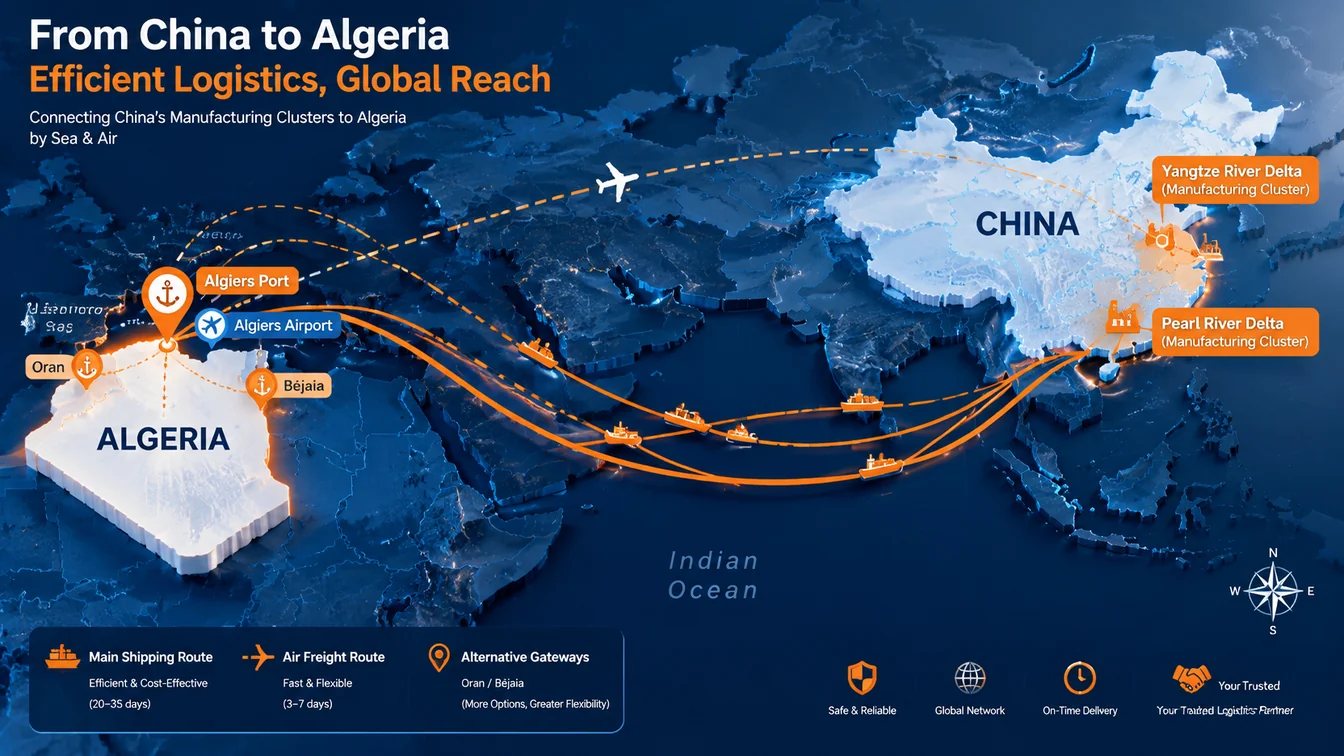
Route Planning Summary
- Which China gateway should the supplier use?
- The closest suitable China export gateway is the normal starting point; compare Shanghai, Ningbo-Zhoushan, Shenzhen/Yantian, Guangzhou/Nansha, Qingdao, or another suitable port against the factory location and available routing.
- Which transport mode fits the shipment?
- Ocean freight is the main option to evaluate for non-urgent container and consolidated cargo, while air freight or express suits time-sensitive shipments; a rail–sea service requires a defined intermodal handoff.
- How should delivery time be planned?
- Use the applicable route-and-method transit reference as the starting point, then plan separately for cargo readiness, export handling, customs release, and any final-delivery activity outside the named service scope.
- Who is responsible for Algerian import clearance?
- The Algerian importer or its legally authorized representative is responsible for the applicable import declaration, supporting documents, product compliance, duties, and taxes.
- What defines final-delivery responsibility?
- The agreed service plan must allocate the supplier pickup, international movement, import-clearance handoff, and delivery to the specified Algerian address or receiving facility.
China to Algeria Shipping Cost
The table provides route-specific indicative shipping costs and planning transit references for the October 2026 review. Each reference applies to its named route, method, and unit.
| Shipping route | Shipping method | Price | Transit time |
|---|---|---|---|
| China → Algiers Port, Algeria | FCL 20GP | $3,672–$4,488/container | 35–44 days |
| China → Algiers Port, Algeria | FCL 40GP | $5,004–$6,116/container | 35–44 days |
| Shenzhen City, China → Algiers Port, Algeria | FCL 40HQ | $5,020/container | 41 days |
| China → Algiers Port (CFS), Algeria | LCL | $150–$250/CBM | 37–53 days |
| China → Algiers (ALG), Algeria | Air freight | $6.50–$8.70/kg | 3–6 days |
| China → Algeria (door-to-door) | Express | $12–$16/kg | 5–9 days |
| China → Duisburg, Germany (rail) → Algiers, Algeria (sea; transfer port not specified) | Rail–sea multimodal (20ft container) | $4,700–$6,100/20ft container | 25–32 days |
Cost scope: The indicative cost references apply to the route, method, and unit shown; they are not carrier freight rates, market averages, TJ selling prices, or binding quotations. The actual booking, cargo, and agreed service scope determine the commercial arrangement, including responsibility for relevant pickup, handling, customs, duty and tax, inland delivery, insurance, storage, examination, appointment, and surcharge items.
Algeria Import Duty and Taxes
Import duty and tax in Algeria depend on the commodity code, customs value, origin, applicable trade measures, product category, and current regulations. Algeria’s Directorate General of Taxes lists a standard taxe sur la valeur ajoutée (TVA) rate of 19% and a reduced rate of 9% for specified eligible categories; the applicable treatment for an imported product must be checked against its classification and current rules in the official Algerian tax guidance.
Calculate the prospective import liability through four checks before the cargo leaves China:
- Classify the product. Determine the applicable Algerian customs tariff code from the product’s actual composition, function, and specifications rather than relying only on its supplier’s general description.
- Document the customs value and origin. Prepare the commercial transaction records and origin evidence needed to support valuation and any applicable trade treatment.
- Verify duty and TVA. Check the current tariff treatment for the declared code and calculate applicable import taxes using the valuation rules and taxable base relevant to that product.
- Check additional requirements. Determine whether product-specific restrictions, licences, conformity requirements, exemptions, or other applicable charges affect entry and release.
This is a simplified shipment-planning sequence, not tax advice. The Algerian importer and its qualified customs or tax adviser should determine the actual classification, liability, and eligibility for any special treatment before dispatch.
China to Algeria Shipping Time
Sea freight is the principal planning option for non-urgent containerized shipments from China to Algeria, with separate references available for Algiers Port and a Shenzhen-origin container route. The applicable figure is a planning reference for the named route and method, not a guaranteed delivery date.
- The China-origin-unspecified to Algiers Port FCL 20GP and FCL 40GP references are 35–44 days.
- The Shenzhen City, China to Algiers Port FCL 40HQ reference is 41 days.
- The China-origin-unspecified to Algiers Port (CFS) LCL reference is 37–53 days.
- The China-origin-airport-unspecified to Algiers (ALG) air-freight reference is 3–6 days.
- The China-origin-and-delivery-city-unspecified to Algeria door-to-door express reference is 5–9 days.
- The China to Duisburg, Germany by rail, followed by sea transport to Algiers, rail–sea multimodal reference is 25–32 days; the intermediate sea-transfer port is not specified in that route label.
For execution planning, work backward from the required receiving date to allow for supplier readiness, origin handling, international movement, and Algerian import release. Final delivery may require additional time when it falls outside the named transport scope, particularly for inland addresses or receiving locations with specific access or appointment requirements.
Shipping Methods from China to Algeria
Choose the transport mode according to shipment dimensions, actual and chargeable weight, cargo volume, urgency, handling requirements, origin geography, destination postcode, and the cost of delay. Ocean freight is the normal starting point for non-urgent containerized cargo, while faster or intermodal methods become relevant when the cargo, deadline, or delivery requirement justifies the additional routing complexity.

- FCL: Choose FCL when the shipment needs a dedicated container or a controlled containerized movement, because direct container handling can simplify equipment allocation and cargo segregation. Compare 20GP, 40GP, and 40HQ according to the cargo’s external dimensions, usable loading space, weight, and handling needs, rather than assuming one container format suits every product.
- LCL: Choose LCL when the shipment does not require a dedicated container and can tolerate consolidation and deconsolidation handling, because shared container space can suit smaller consignments. The relevant reference is for Algiers Port (CFS), so the handling and onward-delivery plan must match the shipment’s final destination.
- Air freight: Choose air freight when the required arrival window or cost of delay outweighs the higher transport expense, because air transport can suit urgent, compact, or higher-value cargo. Compare actual weight with chargeable weight, dimensions, packaging, product acceptance, and the available China-airport-to-Algiers routing before deciding.
- Express: Choose express when parcels, samples, or small consignments need a delivery-oriented service, because a coordinated parcel network can simplify the movement to an addressed destination. Verify the receiving postcode, product acceptance, customs documentation, and the exact delivery boundary through the express-shipping service.
- Rail–sea multimodal: Choose a rail–sea arrangement when the defined intermodal route meets the delivery schedule and the shipper can work with its transfer requirements, because it combines inland rail movement with a later sea leg rather than relying on an all-rail route. The China–Duisburg–Algiers reference leaves the sea-transfer port unnamed, so the physical handoff must be defined before the option is treated as an executable route; the multimodal service describes the relevant service category.
The lowest-looking unit figure is not, by itself, proof of the lowest delivered shipment cost. Compare alternatives on compatible cargo assumptions, actual service boundaries, destination handling, and final-address requirements; use the available rail-freight service information only where a credible rail-based or intermodal movement is offered for the required route.
Door-to-Door Shipping from China to Algeria
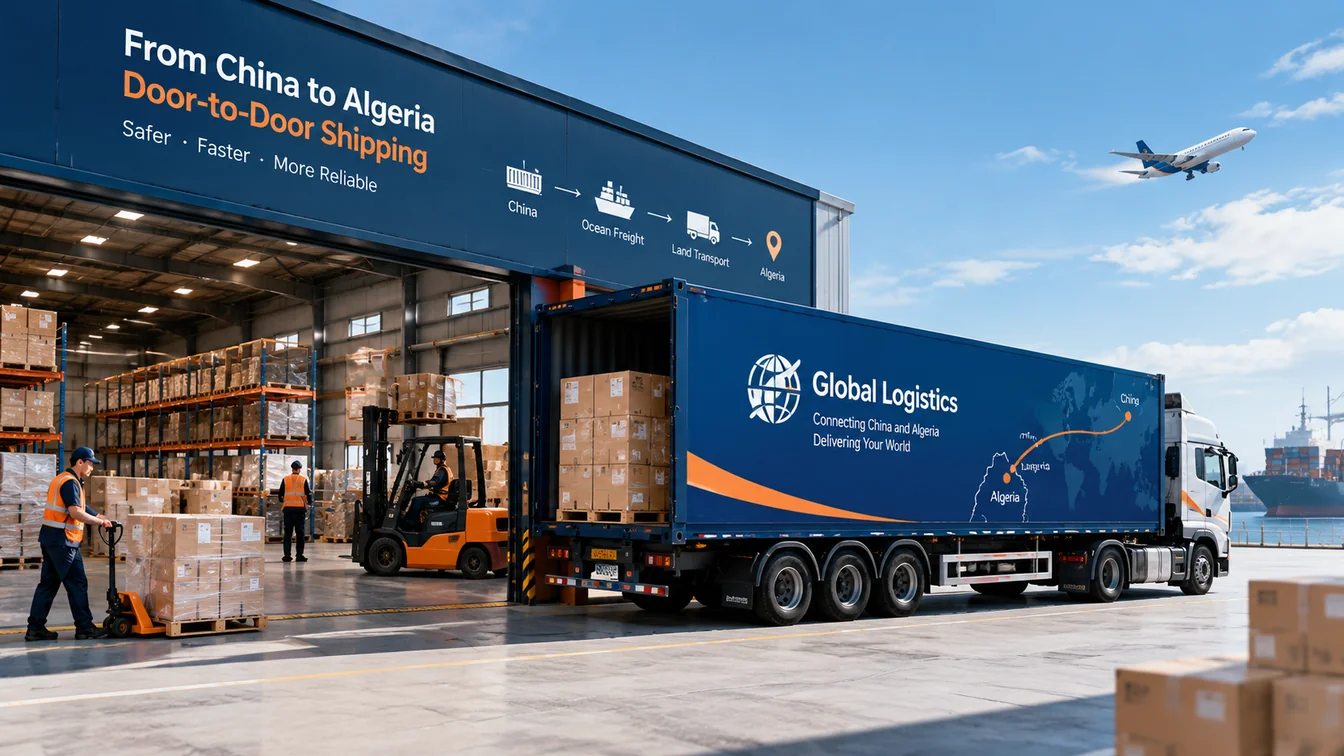
A workable China-to-Algeria door-to-door shipping plan assigns each handoff from the supplier’s premises through international transport, import clearance, and delivery to the final address. The specific receiving location and importer’s legal responsibilities determine the final execution plan.
-
Cargo and Compliance Review
Record the product description, quantities, dimensions, gross and net weights, packaging, handling needs, and destination address. Flag regulated goods, batteries, liquids, oversized cargo, and any product requiring prior documentation or authorization before fixing the transport plan.
-
Route and Method Selection
Match the supplier’s location to a suitable China export port or airport, then compare an appropriate sea, air, express, or credible intermodal route toward Algeria. The final delivery postcode, receiving requirements, and the chosen destination gateway can change the practical route.
-
Supplier Coordination and Pickup
Arrange the cargo-ready date, collection address, access instructions, loading arrangements, measurements, and packing records with the supplier. Check that the actual shipment matches the cargo information used for routing and transport acceptance.
-
China Export Handling
Coordinate the agreed export handoff, shipping documents, cargo delivery to the nominated gateway, and any applicable export formalities. Changes to packing, dimensions, cargo classification, or readiness can require the transport plan to be updated before departure.
-
International Transportation
Move the shipment through the agreed international service and route. For sea freight, keep the destination port and container or consolidation arrangement aligned; for air freight, express, or intermodal movement, follow the applicable airport or transfer handoffs rather than assuming an ocean-port process applies.
-
Algeria Import Clearance
The Algerian importer or its legally authorized representative handles the applicable import declaration, duties and taxes, and product-specific requirements. A DDP shipping arrangement should be considered only when the agreed importer, clearance, tax, and delivery responsibilities are legally workable and clearly documented.
-
Final Delivery
Release the cargo for delivery after the required customs and destination handoffs are complete. The delivery plan should specify the final address, unloading responsibility, access arrangements, receiving hours, appointment requirements where applicable, and any limits affecting the last mile.
-
Shipment Close-Out
Reconcile the shipment documents, delivery or receipt evidence, and outstanding handling records. Record any discrepancy in quantity, packaging condition, damage, or delivery completion while the relevant transport and insurance evidence remains available.
Main China to Algeria Routes
The most practical China-to-Algeria route normally starts at a gateway that limits supplier-side movement while matching the destination port to the final delivery region. A different factory location, available service, equipment requirement, Algerian destination, or inland-delivery arrangement can change that comparison.
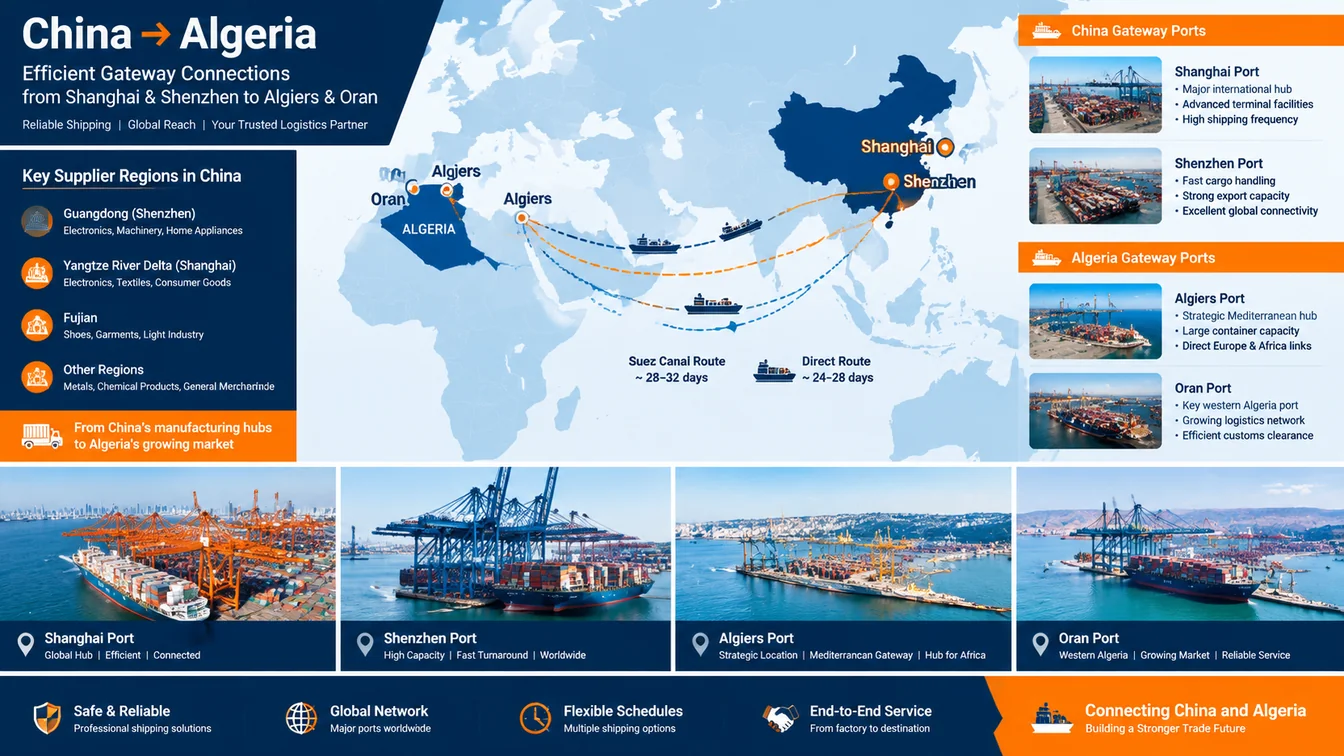
Major China Export Ports for Algeria Shipping
- Port of Shanghai
- Shanghai serves suppliers in the Yangtze River Delta, including manufacturing areas around Shanghai and Jiangsu. Compare it for containerized industrial goods, electronics, and general merchandise when the factory’s pickup geography and the available Algeria-bound routing support the choice.
- Port of Ningbo-Zhoushan
- Ningbo-Zhoushan is a relevant comparison for Zhejiang suppliers and cargo sourced around Ningbo or nearby manufacturing and trading areas. Evaluate it alongside Shanghai when pickup distance, cargo readiness, equipment access, and the available routing to Algerian entry ports favor a different origin.
- Port of Shenzhen/Yantian
- Shenzhen/Yantian is relevant to suppliers in Shenzhen and the eastern Pearl River Delta, including cargo from nearby electronics and consumer-goods manufacturers. Compare it with other southern China gateways for container shipments intended for Algiers, Oran, Béjaïa, or another suitable Algerian entry port, subject to the actual service offered.
- Port of Guangzhou/Nansha
- Guangzhou/Nansha provides another comparison for suppliers in Guangzhou, Foshan, and surrounding Pearl River Delta manufacturing areas. It can be useful when the factory is closer to Nansha or the equipment and transport arrangements suit that gateway better than a Shenzhen-area alternative.
- Port of Qingdao
- Qingdao is relevant to North China and Shandong suppliers shipping industrial products, machinery, and general containerized cargo. Compare the inland movement from the factory and the available international routing with southern or eastern China alternatives before selecting the origin gateway.
- Port of Xiamen
- Xiamen can be compared for suppliers in Fujian, including manufacturing areas around Xiamen and Quanzhou. Its practical use depends on the cargo’s pickup location, available equipment, the actual service routing, and the preferred Algerian destination port.
Major Algeria Import Ports for Cargo from China
Algeria has several commercial seaport gateways, so the delivery region should influence which port the buyer compares. The official SERPORT port group lists public port operators serving locations including Algiers, Béjaïa, Djendjen, Oran, Skikda, and Annaba.
- Port of Algiers
- The Algiers gateway is a natural comparison for deliveries to Algiers and the central-northern market. The China-origin route should be evaluated alongside destination handling and the inland movement required for the actual receiving address.
- Port of Oran
- Oran is relevant to western Algeria and deliveries around Oran and neighboring western destinations. Compare it with Algiers when a western final address could make the inland leg from another entry port less suitable.
- Port of Béjaïa
- Béjaïa is a destination gateway to compare for eastern-central and northeastern delivery areas. The supplier’s available China-origin routing and the final receiving location determine whether it is more practical than Algiers or a farther-eastern port.
- Port of Skikda
- Skikda is relevant to eastern Algerian destinations and should be compared when the buyer’s delivery area and the available port-routing arrangements support entry farther east. Account for the destination-side handling plan and the onward inland movement.
- Port of Annaba
- Annaba is a useful comparison for Annaba and northeastern destinations. Its suitability depends on the actual available international routing, cargo handling requirements, and the final delivery postcode rather than distance to the destination city alone.
- Port of Djendjen
- Djendjen, in the Jijel area, can be considered for eastern-central or neighboring northeastern delivery requirements. Compare the actual service and inland connection with Béjaïa, Skikda, and Algiers rather than treating port proximity as proof of a suitable shipment route.
Supplier Region to Destination Routing Logic
| Supplier region in China | Origin port to compare | Destination port and delivery region | Planning reason |
|---|---|---|---|
| Pearl River Delta: Shenzhen, Dongguan, Guangzhou | Shenzhen/Yantian or Guangzhou/Nansha | Algiers for central-northern delivery; Oran for western Algeria; Béjaïa where the eastern-central destination supports it | Start with a Pearl River Delta supplier → the closer suitable export port → the selected Algerian entry port → import clearance → final delivery. Change the pairing when factory pickup distance, actual routing, equipment availability, or the final delivery region favors another gateway. |
| Yangtze River Delta: Shanghai, Suzhou, surrounding Jiangsu areas | Shanghai or Ningbo-Zhoushan | Algiers for central-northern delivery or Béjaïa for an appropriate eastern-central destination | Compare a Yangtze River Delta pickup → Shanghai or Ningbo-Zhoushan → the chosen Algerian port → customs clearance → final delivery. Factory location and the actual international service can change which China gateway is more practical. |
| Zhejiang and nearby eastern China: Ningbo, Yiwu, Wenzhou | Ningbo-Zhoushan or Shanghai | Béjaïa, Skikda, or Annaba for suitable eastern or northeastern delivery areas | Start with an eastern China supplier → Ningbo-Zhoushan or Shanghai → the Algerian port suited to the destination → import clearance → inland delivery. The final postcode, current routing, and port-side handling requirements can change the comparison. |
| North China: Qingdao and Shandong manufacturing areas | Qingdao | Algiers for central-northern delivery or Oran for western delivery | Compare a North China factory → Qingdao → an Algerian entry port suited to the destination → customs clearance → final delivery. A longer supplier-side transfer or an unsuitable international service can make another China gateway preferable. |
| Fujian: Xiamen, Quanzhou, surrounding manufacturing areas | Xiamen | Algiers or Oran when the available route and final delivery area support that choice | Start with the Fujian supplier → Xiamen → the selected Algerian gateway → import clearance → final delivery. Compare another China port if pickup distance, cargo handling, available routing, or the receiving destination makes the Xiamen option less suitable. |
Destination Regional Delivery Logic
- Central-northern Algeria
- Compare Algiers Port for deliveries in and around the capital and nearby northern destinations. The final address and receiving arrangements determine whether the inland leg can be handled directly or requires a separate onward-delivery plan.
- Western Algeria
- Compare Oran for western destinations against other suitable ports when the actual international routing is available. A shorter inland movement may be advantageous, but the destination-side handling and usable route still determine the practical choice.
- Eastern and northeastern Algeria
- Compare Béjaïa, Skikda, Annaba, and Djendjen against the final postcode and the available route. Their geographic position can change the inland leg, so compare the complete destination movement rather than just the port name.
- Southern and inland Algeria
- Plan for an inland road movement from the selected Algerian entry gateway to the final location. The required destination access, distance, receiving conditions, and agreed delivery boundary may outweigh the attraction of a particular coastal entry port.
How the Gateway Is Selected
A practical gateway decision must work for both the supplier’s pickup location and the final Algerian delivery point.
- Match the origin port to the supplier’s actual warehouse, factory location, cargo-ready date, and collection access.
- Compare the real international routing and available schedule instead of assuming a direct sailing from every named China port to each Algerian port.
- Match container type, cargo dimensions, weight, stackability, or other handling needs to the equipment and receiving facilities available for the selected route.
- Select the Algerian entry port against the final postcode, destination handling arrangement, and inland movement required after customs release.
- For air or intermodal alternatives, define the airport or transfer handoff and the subsequent path to the Algerian delivery address before comparing the complete route.
Algeria Customs Clearance
Ordinary commercial imports entering Algeria require an accurate declaration, supporting commercial and transport documents, appropriate product compliance, and payment or authorized treatment of applicable duties and taxes. The Algerian importer or its legally authorized representative is responsible for the applicable import obligations; a freight booking does not replace importer registration, product authorization, or declaration responsibilities.
What the Algeria Importer Normally Needs
An Algerian commercial importer should prepare the following shipment and compliance records before the goods depart China, with the exact requirements determined by the commodity and applicable import procedure.
- Commercial registration and tax identification Prepare the importer’s relevant commercial-register and tax-identification records. The importer should ensure its registered activity and legal status are appropriate for the proposed transaction.
- Commercial invoice Describe the goods accurately, including quantities, values, product specifications, seller and buyer details, and transaction terms. The invoice must support the declared customs value and product classification.
- Packing list List cartons, packages, quantities, dimensions, and gross and net weights so the declared cargo can be matched to the physical shipment and transport documents.
- Transport document Prepare the applicable bill of lading for sea freight or air waybill for air cargo, with shipper, consignee, routing, and shipment particulars consistent with the supporting commercial records.
- Commodity code and customs value Document the product’s appropriate tariff classification, transaction value, and supporting information needed to determine the applicable duties, taxes, and import treatment.
- Origin evidence Prepare the country-of-origin information and any origin certificate or supporting evidence required for the product, declaration, or applicable trade measure. Do not assume a certificate creates a preference without a legal basis.
- Import licences and product approvals Check whether the product or applicable import regime requires a licence, conformity evidence, inspection, or other authorization. Algeria’s Ministry of Commerce import-licence guidance describes supporting records for licence applications, including commercial registration and a pro forma invoice for relevant cases.
- Customs representative authorization and inspection records Where a customs representative is used, prepare the appropriate authorization and information needed for its declaration. Product-specific border controls may apply at designated locations listed in the Ministry border-inspection locations.
Common Causes of Algeria Customs Delays
- Product descriptions that are too broad to support the correct commodity classification or do not match the actual goods.
- Differences between the commercial invoice, packing list, transport document, declared quantities, and physical cargo.
- Unsupported customs values, inconsistent transaction documents, or missing information required to assess the taxable base.
- Missing origin evidence or a claim to preferential treatment that the shipment cannot substantiate.
- Incomplete importer registration, missing representative authorization, or an import procedure unsuitable for the transaction.
- Product-specific permits, conformity documents, inspections, or approvals that have not been obtained or arranged when required.
- Unresolved cargo-description, packaging, label, or receiving-document discrepancies that prevent the goods from being released or delivered as planned.
Resolve document and product-compliance issues before the cargo leaves China whenever possible. The Algerian importer and its authorized customs representative should settle classification, valuation, permission, and inspection questions before the shipment reaches the relevant entry point.
Special Cargo, Packaging, and Insurance
Algeria-bound cargo that contains regulated materials, requires special handling, or falls outside ordinary carton or pallet dimensions needs additional review before dispatch. The product classification, packaging, transport mode, and intended receiving location determine the required checks.
Cargo Requiring Additional Review
- Batteries and dangerous goods: Confirm the battery chemistry, installed or standalone configuration, applicable dangerous-goods classification, packaging, labeling, and carrier acceptance before booking.
- Chemicals and liquids: Review the product’s composition, safety data, packaging integrity, leak prevention, transport classification, and any Algerian product controls before dispatch.
- Food and temperature-controlled cargo: Check applicable sanitary, labelling, temperature, shelf-life, and inspection requirements, together with the handling capability of the proposed route.
- Cosmetics and medical goods: Verify product-specific registration, conformity, authorization, labelling, and health-sector requirements before shipping rather than relying on a general merchandise description.
- Wood packaging: Check whether the wood packaging is regulated and whether required treatment, markings, or supporting evidence apply to the shipment.
- Oversized or heavy cargo: Verify package dimensions, lifting points, gross weight, loading equipment, securing arrangements, and destination access. The project-cargo service is relevant where the cargo requires a dedicated handling or movement plan.
- Controlled or otherwise restricted goods: Review the current product-specific import rules and required approvals before selecting the route, as a transport provider’s acceptance does not establish Algerian import eligibility.
Packaging Checks
Packaging for the China-to-Algeria route should protect the goods through the actual loading, transfer, transport, and destination-handling sequence. Requirements change with cargo fragility, container or aircraft loading, handling equipment, moisture exposure, and any product-specific packaging rules.
- Use cartons or crates strong enough for the product weight, stacking arrangement, and anticipated handling conditions.
- Fit internal cushioning and restraints to prevent impact, abrasion, movement, or component damage.
- Check pallet suitability, load stability, weight distribution, and handling-equipment access.
- Protect moisture-sensitive goods with suitable wrapping, liners, or other cargo-appropriate moisture protection.
- Apply handling marks, package identification, and any product or transport labels required for the shipment.
- Record the actual packed dimensions, package count, gross weight, and net weight for transport documentation.
- Meet applicable regulated wood-packaging treatment and marking requirements when wooden packaging is used.
Cargo Insurance
Carrier liability is not the same as cargo insurance, and the two can provide different protection for a loss or damage event. Before dispatch, confirm the policy’s coverage, exclusions, deductible, insured value, evidence requirements, and covered transport period through the agreed cargo-insurance service, including any conditions for loading, unloading, transshipment, or inland delivery.
Why Use a Freight Forwarder for Shipping from China to Algeria?
A freight forwarder helps solve three practical China-to-Algeria shipment problems: turning cargo facts into a usable movement definition, selecting a credible route, and keeping commercial and operational handoffs aligned. The appropriate arrangement changes with the cargo’s requirements, origin, international routing, and final Algerian delivery location.
- One usable shipment definition
- A buyer who has supplier information scattered across messages may lack the consistent details needed to evaluate a route. A forwarder can organize the cargo description, movement requirements, and receiving need into a common shipment definition; regulated products or unusual handling can require additional information before the definition is complete.
- A workable route comparison
- A buyer can choose an impractical gateway by focusing only on port proximity or one transport option. A forwarder can compare supplier pickup, available international routing, equipment, destination-port handling, and final delivery as one movement; the actual schedule and final postcode can change the preferred arrangement.
- Clear operational handoffs
- A shipment can be delayed when the supplier, transport parties, importer, customs representative, and receiving location do not share the same next action. A forwarder can help coordinate responsibilities and the sequence of handoffs, while the Algerian importer and relevant professionals remain responsible for their statutory and product-compliance obligations.
How TJ Logistics Team Plans a China-to-Algeria Shipment
- Shipment definition review
- TJ Logistics Team reviews the stated cargo, packing information, supplier location, destination address, and requested timing, then flags any missing information that prevents a reliable routing or handling decision.
- Transport and gateway comparison
- TJ Logistics Team compares credible transport and gateway options against the defined cargo, including the China-side movement, international route, Algerian entry point, and destination handoff. A special handling requirement or an unconfirmed intermodal transfer can rule out an otherwise attractive alternative.
- Service-boundary documentation
- TJ Logistics Team records the agreed service scope and the parties responsible for the next operational handoffs before a formal commercial arrangement is prepared. The document should distinguish logistics coordination from the importer’s declarations, regulatory obligations, and tax responsibilities.
- Execution coordination after approval
- After the buyer confirms the agreed scope, TJ Logistics Team coordinates the relevant booking information, commercial documents, and cargo handoff, while flagging the next operational decision if timing, routing, documentation, or receiving conditions change.
China to Algeria Shipping FAQ
How much does a 20ft container from China to Algeria cost?
The indicative China to Algiers Port FCL 20GP cost reference is $3,672–$4,488/container in the October 2026 review. It applies to that named route and container method, so a different origin, destination port, or service arrangement needs its own comparison.
How long does sea freight from China to Algeria take?
The China to Algiers Port FCL 20GP and FCL 40GP planning references are 35–44 days. The applicable route, cargo-ready date, and any handling or clearance outside the referenced transport movement determine the wider delivery plan.
Which China port or gateway is best for shipping to Algeria?
The normal starting point is the suitable major export gateway closest to the Chinese supplier, with the Algerian entry port selected for the final delivery region. Pearl River Delta suppliers can compare Shenzhen/Yantian and Guangzhou/Nansha, while Yangtze River Delta suppliers can compare Shanghai and Ningbo-Zhoushan; actual routing and supplier pickup distance can change the choice.
Which Algerian port should I compare for the final delivery address?
Algiers is a natural port to compare for central-northern deliveries, Oran for western Algeria, and Béjaïa, Skikda, Annaba, or Djendjen for suitable eastern and northeastern destinations. The final postcode, available international routing, port handling, and onward inland movement determine the practical gateway.
Can I ship door-to-door from China to Algeria?
Yes, a China-to-Algeria door-to-door arrangement can be planned when supplier pickup, international transportation, Algerian import clearance, and final-address delivery are assigned in the agreed service plan. The plan should state who handles import formalities and address any special receiving, unloading, access, or appointment requirements.
What documents should be prepared before shipping from China to Algeria?
Prepare a consistent commercial invoice, packing list, applicable bill of lading or air waybill, origin evidence, product classification information, and the Algerian importer’s relevant commercial and tax-identification records. Products subject to specific licensing, inspection, conformity, or other controls may need additional documents under the applicable Algerian import procedure; the current Ministry of Commerce import-licence guidance explains requirements for relevant licence applications.
Do all goods imported into Algeria pay the same customs duty and VAT?
No, Algerian customs duty and TVA treatment depend on the product’s tariff classification, customs value, origin, and applicable rules. The standard TVA rate is 19%, while 9% applies to specified eligible categories; the applicable rate and any duty must be determined for the specific product rather than assumed from the destination country alone.
Does rail freight run directly from China to Algeria?
The supplied China-to-Algiers rail–sea reference is an intermodal movement, not a direct all-rail route: its named sequence runs by rail to Duisburg, Germany, followed by sea transport to Algiers. The intermediate sea-transfer port is not specified in that route label, so the actual transfer arrangement must be defined before the route is treated as an executable shipment plan.