

Reviewed by TJ Logistics Team — November 2026. This review covers current market, cost, customs, tariff, and marketplace information for the China–Germany route. The review applies practical route-planning checks across supplier pickup, gateway and mode selection, customs handoff, and final delivery, so that the cost references and operational guidance below reflect conditions as of the review month.
Shipping from China to Germany: Route Update
A 20GP container from Ningbo to Hamburg is referenced at $2,634–$2,824 with a 36-day planning transit, while rail from Xi’an or Yiwu to Duisburg is referenced at $3,500–$4,800 per 20GP with a 15–20-day transit — the fastest surface option for Germany-bound FCL cargo when the supplier can reach a rail origin. The route begins at the China supplier, passes through an origin gateway (seaport or rail terminal), moves by the applicable mode, enters Germany through Hamburg, Bremerhaven, Wilhelmshaven, or Duisburg, clears German customs under ATLAS, and completes final delivery to the consignee or Amazon fulfillment center. Ocean freight remains the volume default for Germany; rail is the time-sensitive surface alternative; air and express serve urgent or high-value cargo.
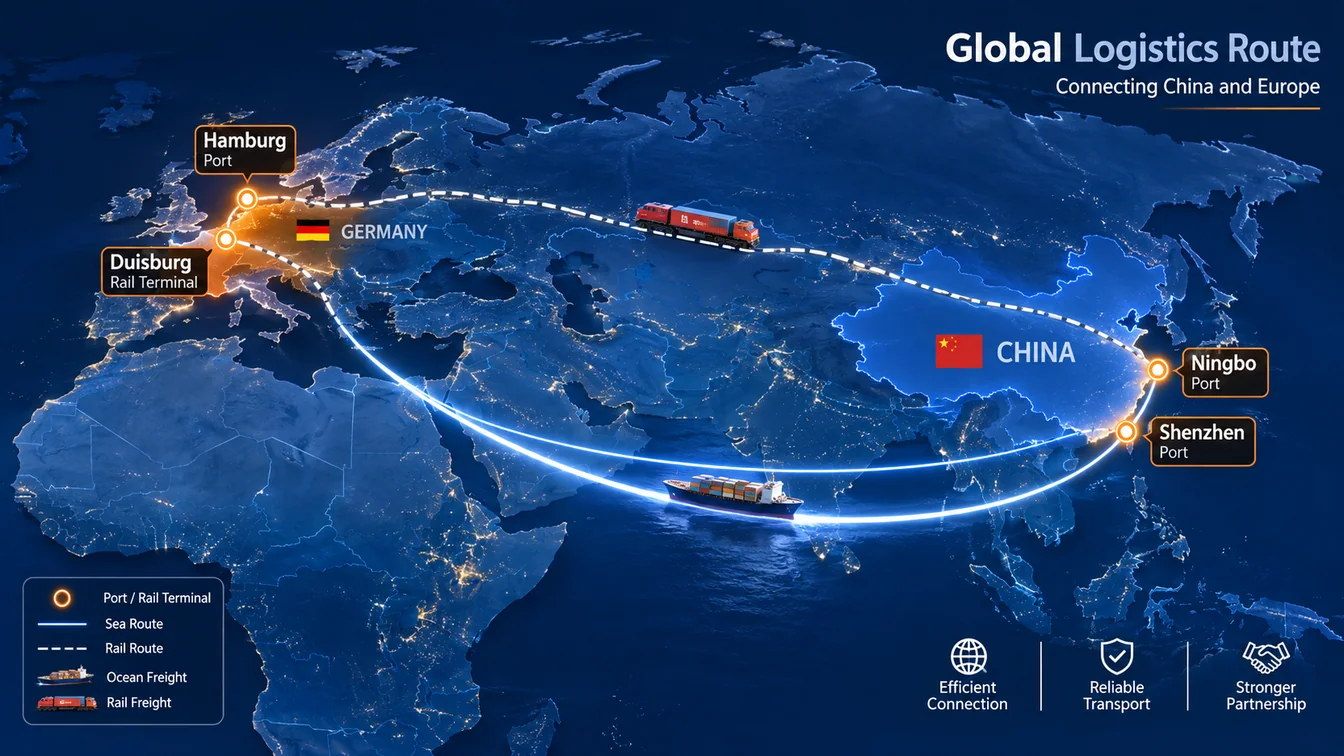
For most full-container shipments from eastern or southern China, ocean FCL via Ningbo or Shenzhen to Hamburg is the practical cost baseline, while rail via Duisburg cuts surface transit roughly in half at a higher per-container reference. Air freight from Shanghai Pudong to Frankfurt at $3.00–$3.80/kg and express from Shenzhen at $4.75/kg cover urgent cargo, but neither should be compared directly with ocean per-container costs because the units and service scopes differ. Use the mode that matches cargo readiness, urgency, and final-delivery tolerance rather than a single headline number.
Route Planning Summary
- Which China gateway should I start from for a Germany shipment?
- Start from the major export port closest to the supplier cluster that also has a suitable service toward the intended German entry point: Ningbo or Shanghai for eastern China, Shenzhen/Yantian for southern China, and Qingdao for northern China. A rail origin such as Xi’an or Yiwu becomes the better comparison when the supplier can reach it and the buyer prioritizes shorter surface transit over per-container cost.
- Which transport mode fits a Germany-bound shipment?
- Ocean FCL is the default for full containers of general cargo; LCL suits smaller volumes that do not justify a container; rail FCL is the surface option when 15–20 days of transit materially improves the buyer’s planning position; air and express serve urgent or high-value cargo where per-kilogram cost is acceptable against the value and deadline.
- How long should I plan for China-to-Germany movement?
- Use the supplied transit references as planning windows: 36 days for Ningbo–Hamburg FCL, 29–33 days for Shenzhen–Hamburg LCL, 15–20 days for Xi’an/Yiwu–Duisburg rail FCL, 1–3 days for PVG–FRA air freight, and 3–7 days for Shenzhen–Germany express. Ocean and rail windows measure main-carriage movement; add supplier pickup, origin handling, customs, and final delivery when building the door-to-door timeline.
- Who is responsible for German customs clearance?
- The importer of record — a legal entity holding a valid German EORI number — is responsible for the customs declaration, duty and import VAT settlement, and product-compliance evidence. A freight forwarder or customs agent can file the ATLAS declaration on the importer’s behalf, but the legal responsibility and tax liability remain with the importer of record.
- What final-delivery scope should I plan for?
- Plan the delivery scope explicitly: port-to-port, port-to-door, or door-to-door. Hamburg and Bremerhaven connect to inland destinations by rail or truck; Duisburg rail arrivals distribute by intermodal or road; Frankfurt air cargo connects by truck or air-road service. The agreed scope determines who arranges and pays for the final leg and whether Amazon appointment scheduling is included.
China to Germany Shipping Cost
The table below provides route-specific indicative shipping costs and planning transit references for the current November 2026 review. Each reference applies only to the named route, method, and unit shown.
| Shipping route | Shipping method | Price | Transit time |
|---|---|---|---|
| Ningbo, China → Hamburg, Germany | FCL 20GP | $2,634–$2,824/柜 | 36 days |
| Ningbo, China → Hamburg, Germany | FCL 40GP | $3,442–$3,690/柜 | 36 days |
| Ningbo, China → Hamburg, Germany | FCL 40HQ | $3,512–$3,766/柜 | 36 days |
| Shenzhen, China → Hamburg, Germany | LCL | $55–$90/CBM | 29–33 days |
| Shanghai Pudong (PVG), China → Frankfurt (FRA), Germany | Air freight | $3.00–$3.80/kg | 1–3 days |
| Shenzhen, China → Germany | Express | $4.75/kg | 3–7 days |
| Xi’an / Yiwu, China → Duisburg, Germany | Rail FCL 20GP | $3,500–$4,800/柜 | 15–20 days |
Cost scope: The indicative cost references above apply to the route, method, and unit shown; they are not carrier freight rates, market averages, TJ selling prices, or binding quotations. The actual booking, cargo, and agreed service scope determine the commercial arrangement, including responsibility for relevant pickup, handling, customs, duty and tax, inland delivery, insurance, storage, examination, appointment, and surcharge items.
Germany Import Duty and Taxes
German import duty and import VAT depend on the commodity code (HS/TARIC), the customs value, the country of origin, applicable trade measures, and the product category; no single rate applies to all China-origin goods. The standard import VAT (Einfuhrumsatzsteuer) rate is 19%, with a reduced 7% rate for qualifying goods such as food and books, as of the November 2026 review.
- Classify the goods under the correct TARIC code. The commodity code determines the duty rate, any anti-dumping or trade measure, and the import VAT treatment; a wrong code is the most common cause of unexpected duty assessments.
- Establish the customs value. German customs generally assesses duty on the transaction value of the goods, including the price paid or payable, plus certain adjustments such as inland freight to the EU border where applicable; import VAT is then calculated on the duty-inclusive value.
- Apply the applicable duty rate and trade measures. The duty rate for China-origin goods is the erga omnes rate unless a preferential rate applies; anti-dumping duties may apply to specific product categories, and current measures should be checked against the TARIC database for the exact code.
- Calculate import VAT. The standard 19% rate applies to most goods, including electronics, machinery, and consumer products; the reduced 7% rate covers qualifying food, books, and a limited list of other goods. Import VAT is normally paid or deferred at clearance and may be reclaimable as input VAT if the importer is VAT-registered in Germany.
- Confirm the treatment before dispatch. Duty rates, trade measures, and low-value import rules can change; the simplified explanation above is not tax or legal advice, and the importer should verify the applicable treatment against current official guidance before the shipment departs.
German customs publishes binding tariff information and maintains the official Zoll guidance on import duty and import VAT; the TARIC consultation tool should be used for the exact commodity code and any current trade measure.
China to Germany Shipping Time
Ningbo–Hamburg FCL ocean freight is referenced at 36 days, making it the practical planning baseline for full-container ocean cargo from eastern China to Germany. Shenzhen–Hamburg LCL is referenced at 29–33 days, reflecting the consolidation and deconsolidation steps that LCL adds to the ocean leg. Rail from Xi’an or Yiwu to Duisburg is referenced at 15–20 days, the shortest surface transit among the supplied references, while PVG–FRA air freight is referenced at 1–3 days and Shenzhen–Germany express at 3–7 days.
These references measure the main-carriage movement between the named origin and destination gateways. A door-to-door timeline also includes supplier pickup and export handling in China, customs clearance at the German entry point, and final delivery to the consignee’s postcode. Ocean and rail schedules can shift with carrier service rotations, terminal congestion, and rail path availability; air and express timelines assume normal flight and clearance conditions. For planning, treat each supplied transit value as a reference window for its route and method, not as a guaranteed door-to-door duration.
Shipping Methods from China to Germany
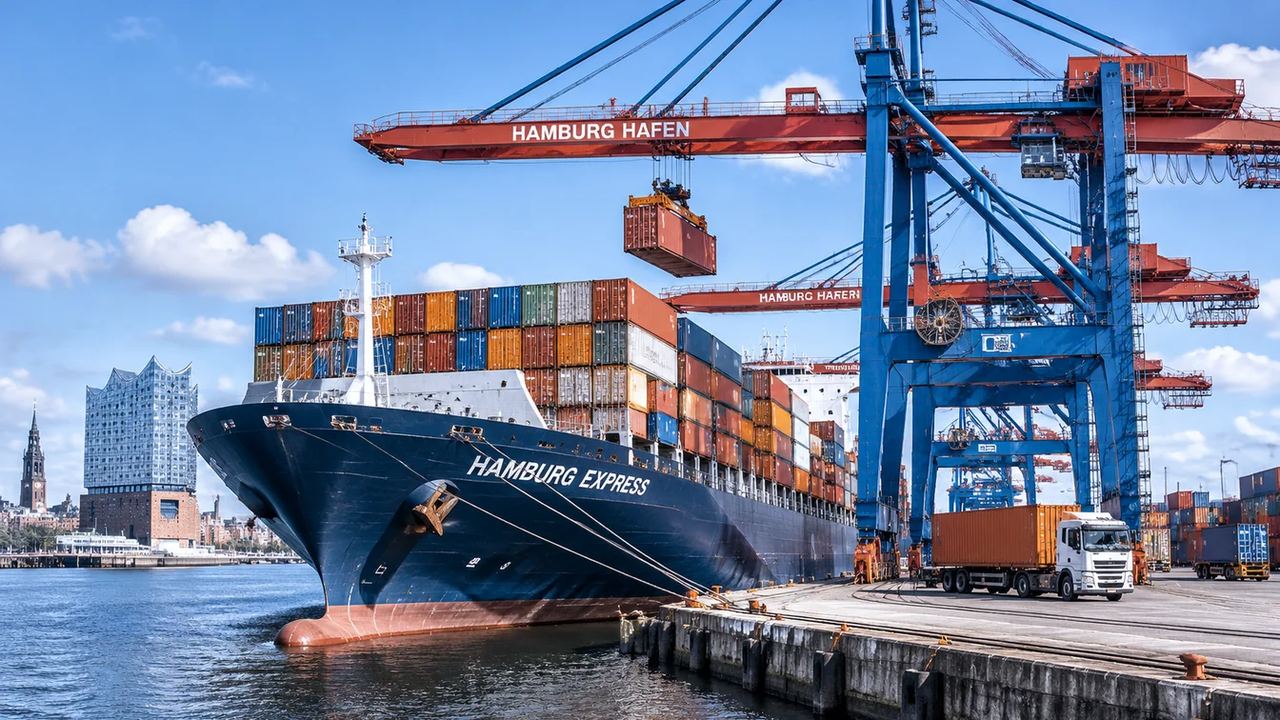
Choose ocean FCL when the shipment fills or nearly fills a container and the buyer can accept a 36-day main-carriage window, because a dedicated container avoids LCL consolidation delays and keeps handling risk lower. FCL is referenced for Ningbo–Hamburg at $2,634–$2,824 per 20GP, $3,442–$3,690 per 40GP, and $3,512–$3,766 per 40HQ, all at 36 days. The condition that changes this choice is cargo volume: below roughly 15 CBM, LCL may be more economical, although the exact crossover depends on the commodity, route, and current LCL rates rather than on the supplied figures alone. For FCL booking and container options, see sea freight services.
Choose LCL when the cargo is below a full-container volume and the buyer can accommodate a slightly longer consolidation window, because LCL lets multiple shippers share container space and avoids paying for unused capacity. Shenzhen–Hamburg LCL is referenced at $55–$90 per CBM with a 29–33-day transit. The condition that changes this choice is cargo sensitivity: LCL involves additional handling at consolidation and deconsolidation points, so fragile or high-value goods may justify FCL even at lower volume.
Choose air freight when the cargo is urgent, high-value, or time-sensitive enough to justify per-kilogram pricing, because PVG–FRA air freight is referenced at $3.00–$3.80/kg with a 1–3-day transit. Air freight is suited to electronics, samples, seasonal goods, and replenishment shipments where the cost of delay exceeds the air premium. The condition that changes this choice is chargeable weight: bulky low-density cargo may be charged on volumetric weight, which can make air freight uneconomical relative to ocean or rail. See air freight services for airport-to-airport and door-to-door options.
Choose express when the shipment is small, urgent, and requires door-to-door tracking with minimal buyer-side handling, because Shenzhen–Germany express is referenced at $4.75/kg with a 3–7-day transit. Express suits samples, small parcels, and urgent spare parts, but the per-kilogram reference applies to the express product’s weight and service conditions. The condition that changes this choice is shipment size and value: larger or heavier consignments may be better served by air freight or LCL.
Choose rail FCL when the buyer wants a shorter surface transit than ocean and the supplier can deliver to a rail origin, because Xi’an/Yiwu–Duisburg rail FCL is referenced at $3,500–$4,800 per 20GP with a 15–20-day transit. Rail is a credible surface option for Germany-bound cargo because Duisburg is an established China–Europe rail terminus with intermodal distribution into Germany and neighboring markets. The condition that changes this choice is supplier location and cargo routing: rail requires the cargo to reach a rail terminal, and the final destination must be served by an intermodal or road leg from Duisburg. See rail freight services for rail-based and multimodal planning.
Door-to-Door Shipping from China to Germany
Door-to-door shipping connects the China supplier’s pickup location to the German consignee’s delivery address under one coordinated scope, with the importer of record and customs formalities defined before departure. The eight steps below follow the route thread from cargo review to shipment close-out.
-
Cargo and Compliance Review
Confirm the commodity, HS/TARIC classification, declared value, dimensions, weight, and any product-specific requirements before booking. This step flags regulated, battery-containing, or restricted goods early, so that documentation and carrier acceptance can be arranged before the shipment leaves the supplier.
-
Route and Method Selection
Match the cargo definition to a credible mode and gateway: ocean FCL or LCL via Ningbo, Shenzhen, or another export port; rail via Xi’an or Yiwu to Duisburg; air via PVG to FRA; or express for small urgent shipments. The selection also sets the German entry point and the inland leg to the final delivery area.
-
Supplier Coordination and Pickup
Coordinate the pickup window, loading readiness, and export documentation with the China supplier. This step confirms who tenders the cargo to the origin carrier, whether pickup is included in the agreed scope, and what documents must accompany the goods to the export terminal.
-
China Export Handling
Complete China export declaration and terminal handover for the selected mode. The export broker or forwarder files the declaration, the container or cargo is gated in, and the transport document is issued for the main carriage.
-
International Transportation
Move the cargo by the selected mode to the German gateway: ocean to Hamburg, Bremerhaven, or Wilhelmshaven; rail to Duisburg; air to Frankfurt; or express to the destination address. The main-carriage transit follows the supplied reference for the chosen route and method.
-
Germany Import Clearance
File the ATLAS import declaration through the importer of record or its customs agent, settle duty and import VAT, and release the goods for free circulation. The importer’s EORI number, commodity code, customs value, and supporting documents must be consistent before the declaration is lodged.
-
Final Delivery
Move the cleared cargo from the German gateway to the consignee’s address or Amazon fulfillment center by rail, truck, or intermodal service. For Amazon FBA deliveries, the appointment window and fulfillment-center requirements must be aligned with the customs release and delivery schedule.
-
Shipment Close-Out
Reconcile the delivered shipment against the booking, confirm that proof of delivery and customs release documents are on file, and close out any outstanding charges, claims, or documentation gaps. This step also captures the actual transit and cost outcome for future route comparisons.
Main China to Germany Routes
The most practical China-to-Germany route normally starts at the export gateway that limits supplier-side movement while fitting the German delivery area and a credible entry gateway. A supplier in Zhejiang or Jiangsu is usually best served by Ningbo or Shanghai; a supplier in Guangdong by Shenzhen/Yantian; a supplier in Shandong or northern China by Qingdao. The condition that changes the comparison is the final German delivery region and the required transit: a Hamburg entry suits northern and central Germany, Bremerhaven offers a second North Sea option, Wilhelmshaven provides a deep-water direct service from Ningbo, and Duisburg rail entry suits inland and western German destinations.
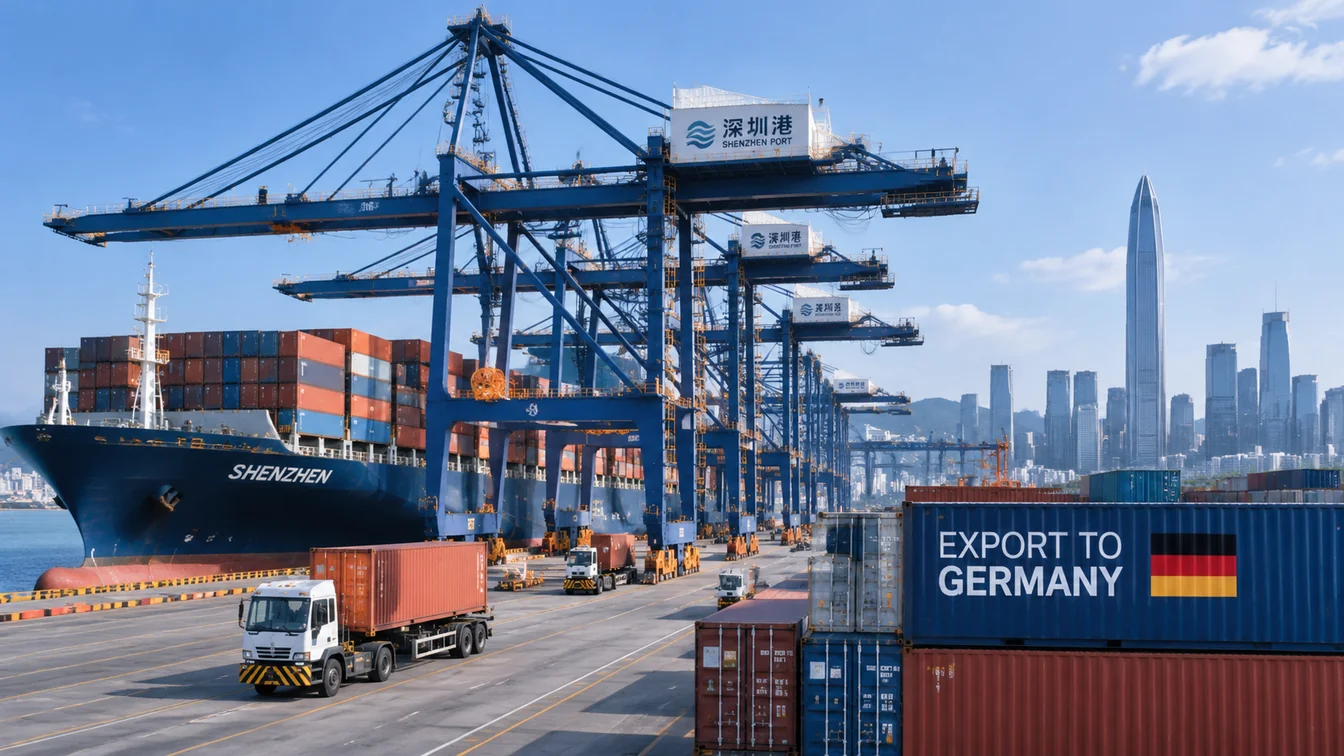
Major China Export Ports for Germany Shipping
- Ningbo-Zhoushan
- Eastern China’s primary container export gateway, serving suppliers in Zhejiang, Jiangsu, and the Yangtze River Delta. Ningbo has direct ocean services to Hamburg and is the origin for the supplied FCL cost references; it also connects to Wilhelmshaven through a direct China–Europe service.
- Shanghai
- China’s largest container port and a major gateway for suppliers across eastern and central China. Shanghai offers frequent ocean services to North European ports, including Hamburg and Bremerhaven, and serves as the air-freight origin for PVG–FRA cargo.
- Shenzhen/Yantian
- Southern China’s main container export gateway, serving suppliers in Guangdong and the Pearl River Delta. Shenzhen/Yantian has ocean services to Hamburg and is the origin for the supplied LCL and express references.
- Qingdao
- Northern China’s primary container port, serving suppliers in Shandong and surrounding provinces. Qingdao is a practical origin when the supplier is in northern China and the shipment is routed to a North Sea gateway; carrier schedules and service frequency should be compared against Ningbo or Shanghai for the specific German entry point.
Major Germany Import Ports for Cargo from China
- Hamburg
- Germany’s largest seaport and the primary gateway for China-origin container cargo; it handles a substantial share of China–Germany trade by tonnage and connects to inland destinations by rail and truck. Hamburg is the destination port for the supplied Ningbo and Shenzhen FCL and LCL references.
- Bremerhaven
- Germany’s second major container port, located on the North Sea and connected by rail and road to central and southern Germany. Bremerhaven is a credible alternative to Hamburg when carrier service, schedule, or inland routing makes it a better fit for the final delivery area.
- Wilhelmshaven (JadeWeserPort)
- Germany’s only deep-water container terminal, capable of handling fully loaded ultra-large container vessels independent of tide. Wilhelmshaven has a direct China–Europe service connection with Ningbo-Zhoushan and should be compared when a direct deep-water call aligns with the final German delivery region.
- Duisburg (inland rail gateway)
- Duisburg is not a seaport but Europe’s key inland rail terminus for China–Europe freight trains, with intermodal distribution into Germany and neighboring markets. It is the destination for the supplied Xi’an/Yiwu rail FCL reference and suits inland and western German destinations that can be served by rail or road from the Duisburg terminal.
Supplier Region to Destination Routing Logic
| Supplier region in China | Origin port to compare | Destination port and delivery region | Planning reason |
|---|---|---|---|
| Zhejiang / Jiangsu (eastern China) | Ningbo | Hamburg → northern and central Germany | Ningbo–Hamburg is the supplied FCL reference route with a 36-day transit; compare it first when the supplier is in the Yangtze River Delta and the consignee is in Hamburg, Lower Saxony, or North Rhine-Westphalia. The condition that changes the pattern is carrier schedule or a final postcode better served from Bremerhaven or Duisburg rail. |
| Guangdong / Pearl River Delta (southern China) | Shenzhen/Yantian | Hamburg → nationwide German delivery | Shenzhen–Hamburg is the supplied LCL reference route at $55–$90/CBM and 29–33 days; it is also the express origin. Compare it when the supplier is in Guangdong and the cargo volume does not justify a full container from a northern port. The condition that changes the pattern is cargo urgency or volume: rail via a Guangdong–Xi’an connection or air via PVG may fit better. |
| Shaanxi / Zhejiang inland (rail origin) | Xi’an or Yiwu rail terminal | Duisburg → western and inland Germany | Xi’an/Yiwu–Duisburg rail FCL is the supplied 15–20-day surface reference; it is the fastest surface option when the supplier can reach the rail terminal and the consignee can be served from Duisburg by intermodal or road. The condition that changes the pattern is the final delivery region: Hamburg ocean entry may be more practical for northern coastal destinations. |
| Shandong / northern China | Qingdao | Hamburg or Wilhelmshaven → northern and central Germany | Qingdao is the closest major export port for northern suppliers; compare its ocean services to Hamburg or the Wilhelmshaven direct service against trucking or rail to a southern export port. The condition that changes the pattern is service frequency: Qingdao may offer fewer Germany-bound sailings than Ningbo or Shanghai, so schedule fit matters as much as proximity. |
Destination Regional Delivery Logic
- Northern Germany (Hamburg, Bremen, Lower Saxony)
- Hamburg and Bremerhaven are the natural ocean gateways for northern German delivery; the inland leg is typically short by truck or rail, and Hamburg’s port terminals connect directly to the rail network. Wilhelmshaven should be compared when a direct deep-water service aligns with the final postcode.
- Western Germany and North Rhine-Westphalia
- Duisburg is the practical rail gateway for western German destinations, and Hamburg or Bremerhaven ocean cargo can also reach the region by rail or truck. Compare rail-to-Duisburg against ocean-to-Hamburg when the supplier can reach a rail origin and the buyer wants to shorten surface transit.
- Southern Germany (Bavaria, Baden-Württemberg)
- Frankfurt air cargo and Hamburg or Bremerhaven ocean cargo both connect to southern Germany by truck or rail; Duisburg rail arrivals can also serve the region via intermodal connections. The final postcode, inland distance, and delivery scope determine whether the air, ocean, or rail path is the better fit.
- Eastern Germany (Saxony, Thuringia, Brandenburg, Berlin)
- Hamburg is the primary ocean gateway for eastern German delivery, with rail and truck connections into the region; Duisburg rail cargo can also reach eastern destinations by intermodal service. Compare total inland distance and delivery scope rather than choosing a gateway on ocean transit alone.
How the Gateway Is Selected
Gateway selection starts with the supplier region and the final German delivery postcode, then narrows to the mode and service that fits both ends of the route.
- Supplier-to-origin distance: the nearest major export port or rail terminal normally reduces pre-carriage cost and handling, but only if it offers a suitable service toward the intended German entry point.
- German entry gateway fit: Hamburg is the default ocean gateway for most German destinations; Bremerhaven and Wilhelmshaven are alternatives when service or inland routing favors them; Duisburg is the rail entry for inland and western destinations; Frankfurt is the air entry.
- Inland distance and delivery scope: a gateway that is close to the final postcode reduces the inland leg, but the agreed delivery scope must state whether that leg is included, who arranges it, and whether an Amazon appointment or other receiving requirement applies.
- Schedule and service frequency: a closer port with infrequent Germany-bound sailings can be slower overall than a slightly farther port with a reliable weekly service; compare the actual service rotation, not just the port name.
- Cargo and equipment requirements: oversized, temperature-controlled, or dangerous-goods cargo may narrow the choice of carrier, terminal, and inland mode, so equipment availability and handling capability should be checked at the candidate gateway before booking.
Germany Customs Clearance
Importing goods into Germany requires a legal importer of record established in the EU, an accurate electronic customs declaration through the ATLAS system, and evidence that the goods meet applicable product and documentation requirements. German customs rules apply within the EU customs territory; goods entering through Hamburg, Bremerhaven, Wilhelmshaven, Duisburg, or Frankfurt are subject to the same Union Customs Code framework, although specific procedures and competent offices may vary by entry point.
What the Germany Importer Normally Needs
The following requirements are the practical baseline for a commercial import into Germany; product-specific licences or certificates may add further conditions.
- EORI number A valid German or EU EORI number is mandatory for the importer of record and for the customs agent filing the ATLAS declaration. Non-EU companies cannot act as importer of record without an EU-established entity or a licensed importer-of-record arrangement.
- German VAT registration (where applicable) Import VAT is assessed at clearance; a German VAT registration allows the importer to account for and potentially reclaim import VAT. Sellers holding inventory in Germany through Amazon FBA generally need a German VAT registration.
- Commodity code (HS/TARIC) The declaration must state the correct commodity code for each product line; the code determines duty, trade measures, and import VAT treatment, and a misclassification can trigger a customs hold or post-clearance adjustment.
- Commercial invoice A commercial invoice showing the seller and buyer, description of goods, quantity, unit value, total value, currency, Incoterm, country of origin, and commodity codes; the declared value must be consistent with the transaction.
- Packing list A packing list detailing each package’s contents, dimensions, gross and net weight, and marks; it supports the customs declaration and the carrier’s cargo documentation.
- Transport document The bill of lading for ocean freight, the rail waybill or CIM document for rail, the air waybill for air freight, or the express consignment note, depending on the mode.
- Import declaration (SAD/ATLAS) The Single Administrative Document is the standard EU import declaration; in Germany it is lodged electronically through ATLAS by the importer or an authorized customs agent.
- Licences, certificates, or product evidence Certain goods require import licences, conformity documentation, plant-health certificates, CE marking evidence, or other product-specific approvals; these must be identified before dispatch, not at the border.
Common Causes of Germany Customs Delays
- Incorrect or inconsistent commodity codes between the commercial invoice, packing list, and ATLAS declaration.
- Customs value that does not match the transaction, or an invoice that omits freight, insurance, or assists that should be included.
- Missing or invalid EORI number for the importer of record or the customs agent.
- Incomplete product-specific documentation, such as a missing certificate of conformity, plant-health certificate, or import licence.
- Wood packaging that lacks the required ISPM 15 mark or has been treated with a non-compliant method.
- Amazon FBA shipments arriving at a fulfillment center without confirmed customs release, import VAT settlement, and a valid EORI mapped to the actual importer.
- Declaration errors that require a correction or a post-clearance audit, which can hold the release and generate storage or demurrage charges.
Resolve documentation and classification issues before the shipment departs China; correcting them after arrival at a German gateway adds time, cost, and uncertainty to the delivery schedule.
Shipping to Amazon FBA Germany
Amazon Germany operates a relevant FBA route for China-origin inventory, and Amazon does not act as the importer of record for inbound FBA shipments. The seller or its appointed representative must hold a valid EU EORI number, complete German import clearance and import VAT settlement before the fulfillment-center appointment, and ensure that the commercial invoice, commodity codes, and declared values are consistent. Amazon fulfillment centers require domestically cleared, duty-paid inventory; a shipment without confirmed customs release can be refused at the dock. The seller must also meet Amazon’s shipment-plan, labeling, carton, and appointment requirements for the assigned fulfillment center, and product eligibility should be verified against current Amazon Germany guidance before booking.
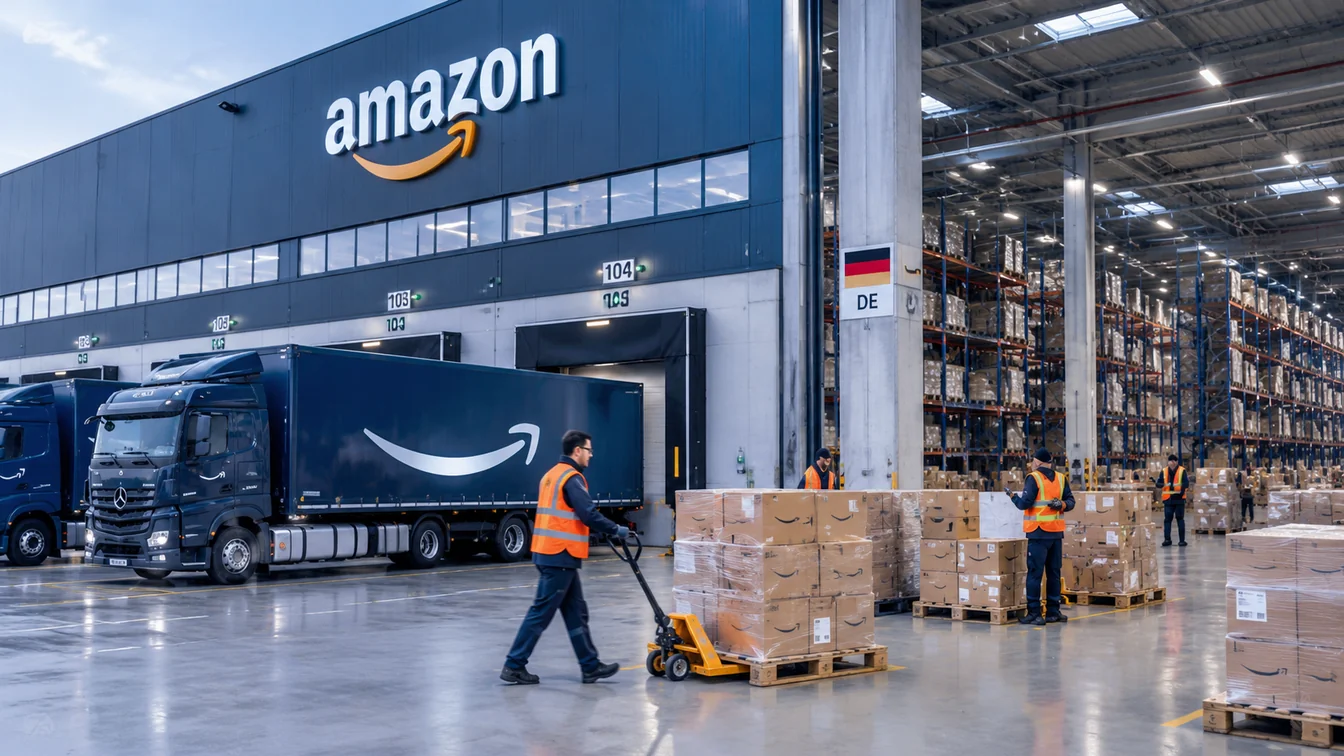
For FBA preparation and inbound coordination, see Amazon FBA services; customs brokerage for the import declaration is covered under customs brokerage.
Special Cargo, Packaging, and Insurance
Cargo Requiring Additional Review
- Lithium batteries and battery-containing products, which require carrier acceptance, classification, and possibly testing documentation.
- Dangerous goods, including flammable, corrosive, or toxic substances, which must be declared and packaged according to modal regulations.
- Chemicals, liquids, and cosmetics, which may require safety data sheets, ingredient declarations, or product-notification evidence.
- Food and food-contact products, which may require health certificates, labeling review, or import notification depending on the commodity.
- Medical goods and personal protective equipment, which may be subject to conformity assessment, CE marking, or import authorization.
- Wood packaging, including pallets and crates, which must comply with ISPM 15 and bear the official IPPC mark.
- Oversized or heavy cargo, which may require special equipment, route surveys, or lifting plans at origin and destination.
- Temperature-controlled cargo, which requires validated cold-chain equipment and carrier acceptance before booking.
- Controlled or dual-use goods, which may require export licences from China and import authorizations in Germany.
Packaging Checks
Packaging must protect the cargo through ocean, rail, air, or express handling and must satisfy German import requirements for wood packaging and labeling.
- Carton strength: use board grade and compression strength suited to the stacking load and mode; ocean and rail containers can subject cartons to sustained compression and humidity.
- Internal protection: cushion and brace the cargo against shock and vibration, particularly for electronics, machinery, and fragile goods.
- Pallets: use pallets that fit the container or trailer dimensions and can withstand forklift handling; confirm pallet exchange or return terms with the consignee.
- Moisture protection: include desiccant or barrier protection where condensation risk is material, especially for ocean and rail shipments with temperature swings.
- Handling marks: apply clear orientation, fragile, and weight markings in a form that survives the full journey.
- Labels: shipping marks, consignee details, and any required product or handling labels must be legible and consistent with the customs documents.
- Dimensions and weights: declare accurate carton and pallet dimensions and gross weights; these drive chargeable weight and handling arrangements.
- Regulated wood packaging: solid-wood pallets, crates, and dunnage must be ISPM 15-treated and marked with the IPPC logo, country code, producer number, and treatment code.
Cargo Insurance
Carrier liability is not the same as cargo insurance: a carrier’s legal liability is typically capped by weight (for example, 8.33 SDR per kilogram under German HGB/CMR rules for road carriage), while cargo insurance covers the insured value of the goods against specified risks regardless of fault. The coverage, exclusions, deductible, insured value, claims evidence, and insurance period must be confirmed before the shipment departs, because a carrier’s liability cap may cover only a small fraction of the cargo’s commercial value. For coverage options, see cargo insurance services.
Why Use a Freight Forwarder for Shipping from China to Germany?
A freight forwarder helps the buyer turn cargo facts into a workable shipment definition, select a credible route across the China–Germany lane, and keep commercial and operational handoffs aligned from supplier pickup to German delivery.
- From cargo details to a usable movement definition
- The buyer’s cargo description, dimensions, weight, value, and readiness window are converted into a shipment definition that carriers and customs can act on, without the buyer having to supply every operational field at the first contact. The condition that changes the work is product regulation: a battery, chemical, or food item may require earlier documentation review than general cargo.
- Matching transport and gateway choices to the actual need
- Credible mode and gateway options are compared against the supplier location, cargo urgency, and final German delivery area, so the buyer sees the trade-offs between ocean, rail, air, and express on the same route. The condition that changes the comparison is the final postcode and delivery scope: an inland destination may favor Duisburg rail over Hamburg ocean even when ocean is cheaper per container.
- Keeping commercial and operational handoffs coordinated
- The forwarder keeps the booking, documents, cargo handoff, and customs steps moving in the right order, so the buyer knows which party is responsible for the next action and where a delay would affect the route. The condition that changes the coordination is the importer-of-record arrangement: a seller using Amazon FBA must resolve its EORI and VAT position before the forwarder can file the German import declaration.
How TJ Logistics Team Plans a China-to-Germany Shipment
- Shipment definition review
- Review the cargo description, HS classification, declared value, dimensions, weight, supplier location, and delivery postcode, and flag any information gap that prevents a reliable mode or gateway recommendation. A missing EORI number or an unresolved product-regulation question is flagged at this stage rather than after booking.
- Route and handoff comparison
- Compare credible transport, gateway, international-routing, and German destination-handoff options against the defined shipment, including the supplied cost and transit references for Ningbo–Hamburg, Shenzhen–Hamburg, PVG–FRA, Shenzhen–Germany express, and Xi’an/Yiwu–Duisburg rail. The comparison records which options depend on supplier readiness, carrier schedule, or final-delivery conditions.
- Service-boundary record
- Record the agreed scope — pickup, export handling, main carriage, customs clearance, duty and tax responsibility, inland delivery, insurance, and any Amazon appointment or receiving requirement — and the parties responsible for each handoff before a formal commercial arrangement is prepared. This step makes the cost-scope boundary explicit for the specific shipment.
- Coordination after confirmation
- After the buyer confirms the agreed scope, coordinate booking information, commercial documents, cargo handoff, and the next operational decision if timing, route, document, or receiving conditions change. The team flags a revised cut-off, a customs query, or a delivery appointment conflict as soon as it affects the route, rather than waiting for the shipment to arrive.
For door-to-door coordination across the full route, see door-to-door shipping; for combined ocean, rail, or air legs, see multi-modal freight.
China to Germany Shipping FAQ
How much does a 20ft container from China to Germany cost?
A 20GP container from Ningbo to Hamburg is referenced at $2,634–$2,824 with a 36-day transit in the November 2026 review. That reference applies to the Ningbo–Hamburg FCL 20GP route and unit; it is an indicative cost reference, not a carrier rate or a door-to-door quotation, and the actual booking depends on the cargo, service scope, and charges agreed for the specific shipment.
How long does sea freight from China to Germany take?
Ningbo–Hamburg FCL ocean freight is referenced at 36 days, and Shenzhen–Hamburg LCL is referenced at 29–33 days. These values measure the main ocean carriage between the named origin and destination gateways; the door-to-door timeline also includes supplier pickup, China export handling, German customs clearance, and final delivery to the consignee’s postcode.
What is the most cost-effective way to ship from China to Germany?
For full-container general cargo, ocean FCL via Ningbo or Shenzhen to Hamburg is the practical cost baseline, with the supplied 20GP reference at $2,634–$2,824 from Ningbo. The most cost-effective choice for a specific shipment depends on cargo volume and urgency: LCL at $55–$90/CBM suits smaller volumes, while rail at $3,500–$4,800 per 20GP to Duisburg costs more per container but offers a 15–20-day transit that can reduce inventory-carrying cost for time-sensitive goods.
Which China port is best for shipping to Germany?
For ocean cargo, the practical default is the closest major export gateway to the supplier that has a suitable service toward the intended German entry point: Ningbo or Shanghai for eastern China, Shenzhen/Yantian for southern China, and Qingdao for northern China. The condition that changes the choice is the German delivery region and schedule fit: a supplier in Zhejiang may still compare Shanghai for a specific sailing, and a buyer prioritizing a shorter surface transit may compare the Xi’an or Yiwu rail origin to Duisburg instead of an ocean port.
Can I ship door-to-door from China to Germany?
Door-to-door shipping from China to Germany is available when the importer of record, customs clearance, and final-delivery scope are defined before departure. The service boundary must state whether supplier pickup, China export handling, main carriage, German duty and import VAT, inland delivery, and any Amazon appointment are included; for an FBA shipment, the seller must also resolve its EORI number and German VAT position before the forwarder can file the import declaration.
What documents should be prepared before shipping from China to Germany?
A Germany-bound commercial shipment normally requires a valid EORI number for the importer, a commercial invoice with commodity codes and declared value, a packing list with package dimensions and weights, the applicable transport document (bill of lading, rail waybill, air waybill, or express note), and an ATLAS import declaration. Product-specific licences, certificates of conformity, plant-health certificates, and ISPM 15 wood-packaging marks must be added where the goods or packaging require them.
Why can two China-to-Germany shipping costs differ?
Two China–Germany cost references can differ because they cover different routes, methods, units, and service scopes: a Ningbo–Hamburg 20GP FCL reference is priced per container, a Shenzhen–Hamburg LCL reference is priced per CBM, a PVG–FRA air reference is priced per kilogram, and a Xi’an/Yiwu–Duisburg rail reference is priced per 20GP. Differences in origin gateway, carrier service, transit time, cargo handling, and the inclusion of pickup, customs, duty, or delivery also change the commercial comparison, so the references should be compared only on a like-for-like shipment definition.
Does Amazon Germany act as the importer of record for FBA shipments?
No. Amazon does not act as the importer of record for FBA inventory entering Germany; the seller or its appointed representative must hold a valid EU EORI number, complete German import clearance and import VAT settlement, and provide consistent commercial invoice, commodity code, and declared-value information before the fulfillment-center appointment. A shipment that reaches an Amazon Germany fulfillment center without confirmed customs release and the correct importer documentation can be refused at the dock.