

Reviewed by TJ Logistics Team — October 2026. This page is for planning only: transit times, schedules, customs outcomes, taxes, destination charges, and service availability must be reconfirmed against the exact cargo, supplier location, destination postcode, and booking date. The current review window covers market, cost, customs, tariff, regulatory, and marketplace information available for October 2026. The review applies practical route-planning checks across supplier pickup, gateway and mode selection, customs handoff, and final delivery.
China to Saudi Arabia Shipping Update
Shipping from China to Saudi Arabia is planned as one connected move: collect from the supplier, select a practical China origin gateway, choose sea, air, express, or a verified multimodal route, move through a Saudi gateway, complete import clearance, and deliver to the final postcode. For most containerized commercial cargo, start by comparing sea freight options against the required delivery scope rather than comparing headline transport prices alone.
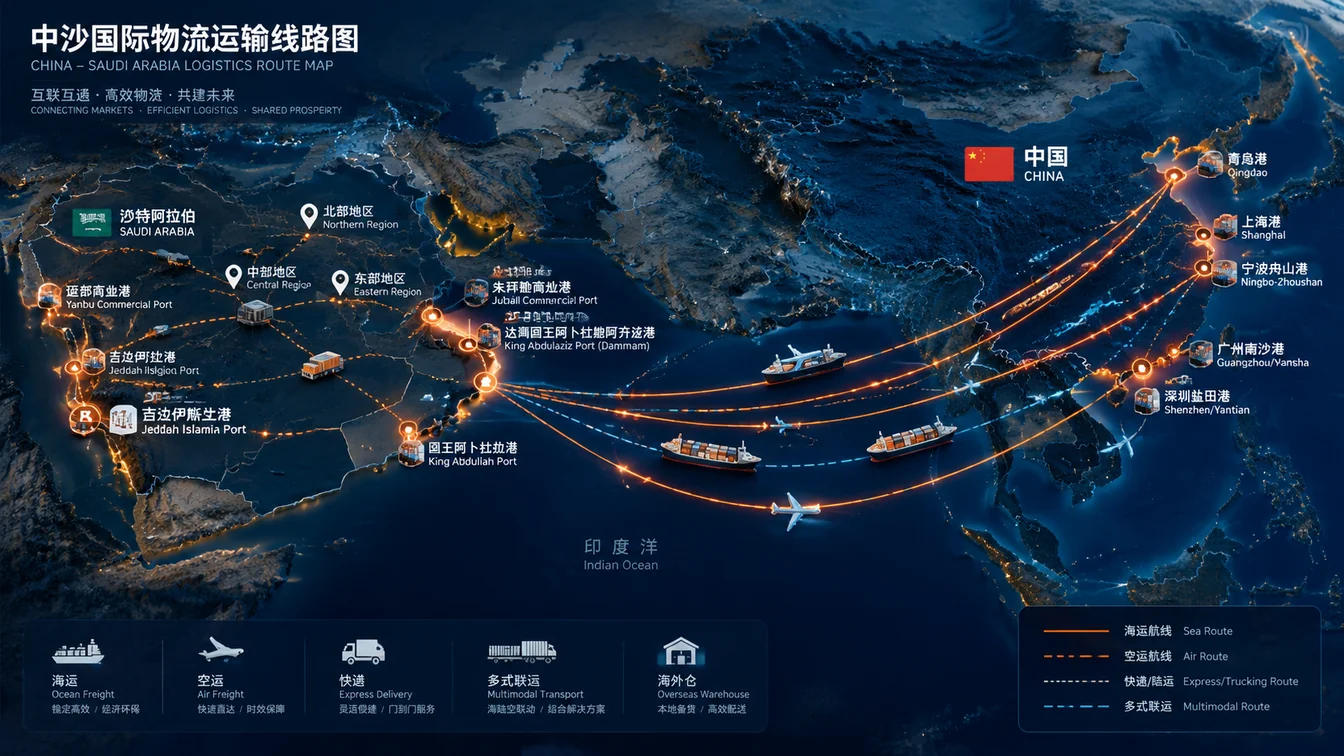
FCL planning in the supplied reference range is 20–35 days, while air freight is 3–10 days and express is 3–6 days. Use air freight when the cost of delay is more important than container economics, and confirm whether customs clearance and final-mile delivery sit inside or outside the quoted scope.
Route Planning Summary
- How should the supplier reach the origin gateway?
- Map the supplier’s factory or warehouse to a practical China gateway such as Shanghai, Ningbo-Zhoushan, Shenzhen/Yantian, Guangzhou/Nansha, or Qingdao, then compare pickup distance, origin handling, sailing or flight schedule, and destination scope.
- Which transport mode is applicable?
- FCL is the primary container option for larger shipments; air freight and express suit more time-sensitive cargo, while rail-based movement should be treated only as a verified multimodal solution rather than assumed direct rail.
- What planning time should be used?
- Use 20–35 days as the supplied FCL planning reference, 3–10 days for air freight, and 3–6 days for express. The start point, end point, customs period, and final delivery scope still need confirmation.
- Who is responsible for Saudi import clearance?
- The Saudi importer remains responsible for the import transaction and required tax and customs obligations; an authorized customs broker can act on the importer’s behalf through the applicable ZATCA/Fasah process.
- What must be fixed before a route quote is comparable?
- Provide the supplier location, cargo description and dimensions, gross weight, commercial value, likely HS code, desired Incoterm, Saudi destination postcode, delivery scope, and any required customs or product-compliance work.
China to Saudi Arabia Shipping Cost
There is no single China-to-Saudi Arabia shipping cost because the commercial scope changes with the supplier location, cargo, gateway, destination postcode, customs responsibility, and delivery service. The figures below are indicative shipping cost references for route planning, not carrier freight rates, TJ selling prices, or binding quotations.
| Shipping option | Indicative shipping cost | Supplied transit time | Main cost drivers |
|---|---|---|---|
| FCL 20GP | $7,300–$10,800/container | 20–35 days | Supplier pickup location, container availability, origin handling, routing and schedule, destination handling, and final delivery scope |
| FCL 40GP | $9,000–$14,200/container | 20–35 days | Supplier pickup location, container availability, origin handling, routing and schedule, destination handling, and final delivery scope |
| Air freight | $5.0–$13.5/kg | 3–10 days | Chargeable weight, supplier location, airport handling, routing, customs scope, and final delivery requirements |
| Express | $9–$24/kg | 3–6 days | Chargeable weight, origin pickup, express routing, customs scope, delivery postcode, and shipment-specific surcharges |
Cost scope: The cost references provide a price and transit value but do not specify which charges are included. Confirm origin pickup, export and origin handling, main transport, destination handling, customs-clearance service, duty and tax, inland delivery, insurance, storage, examination, appointments, and surcharges as relevant to the shipment.
Final cost can change with the supplier location, cargo description, CBM or chargeable weight, destination ZIP or postcode, delivery scope, customs requirements, duties and taxes, destination charges, storage or examination, and insurance. Treat included charges and excluded charges as separate quote fields so two figures are compared only when their units and route scope match. The cost-table review stamp is October 2026; it is a content and cost-data review month, not a carrier rate-validity period or formal quote date, and the indicative costs must be reconfirmed for the actual booking date, cargo, route, and requested service scope.
Saudi Arabia Import Duty and Taxes
Saudi Arabia does not apply one universal import-duty percentage to every shipment. The customs duty depends on the product classification, customs value, country of origin, product category, applicable trade measures, and the current integrated tariff. ZATCA’s current guidance also states that import VAT is generally 15% on imported goods, with limited exemptions, and that the VAT value is based on the customs value plus customs duty, excise tax, and other applicable imposts excluding VAT. Check the ZATCA integrated customs tariff and the current ZATCA import VAT guidance before dispatch.

Use this simplified planning sequence for Saudi Arabia imports:
- Confirm the HS classification, product description, country of origin, customs value, and any product-specific restrictions before the shipment leaves China.
- Use the current ZATCA tariff to identify the applicable customs duty and check whether the goods are subject to excise tax or other regulatory charges.
- Plan for the standard 15% import VAT unless a specific legal exemption applies; ZATCA states that the import VAT value is built from the customs value plus customs duty, excise tax, and other applicable imposts excluding VAT.
- Ensure the importer or authorized representative is ready to settle customs duty, import VAT, and other amounts shown on the customs declaration before release to free circulation.
- Reconfirm the result with the current ZATCA rules and the product-specific requirements because tariff classifications, restrictions, exemptions, and tax treatment may change.
This is a simplified logistics-planning explanation, not tax or legal advice. Review ZATCA import instructions for the current documentary and clearance requirements.
China to Saudi Arabia Shipping Time
The supplied planning references are 20–35 days for FCL 20GP, 20–35 days for FCL 40GP, 3–10 days for air freight, and 3–6 days for express. These values do not define whether the clock starts at supplier pickup, terminal delivery, airport acceptance, or another handoff, and they do not establish how much time is allowed for Saudi customs and final delivery.
For planning, separate the international movement from the steps before and after it: supplier readiness and pickup, China export handling, the international leg, Saudi gateway handling, import clearance, and delivery to the final postcode. Before booking, confirm the exact start point, destination gateway, sailing or flight schedule, customs handoff, and whether the quoted transit is terminal-to-terminal, airport-to-airport, or door-to-door.
Shipping Methods from China to Saudi Arabia
Choose the method after fixing the supplier location, cargo size and weight, Saudi destination postcode, delivery scope, required arrival window, and cost of delay. Express shipping and air freight suit tighter deadlines; FCL usually fits larger, containerized commercial cargo; LCL can be considered when the shipment does not justify a full container; and multimodal freight can connect different legs when the supplier, gateway, and destination cannot be served efficiently by one mode.
Route decisions should be made against the actual shipment rather than against mode names alone:
- FCL: Compare 20GP and 40GP when cargo volume, handling needs, or shipment value make a dedicated container practical.
- LCL: Consider consolidation for smaller commercial cargo, while checking destination handling, delivery scope, and the consolidation schedule.
- Air freight: Use when a 3–10 day planning reference can justify the higher transport cost through the value of time.
- Express: Consider for urgent, smaller shipments where a 3–6 day planning reference and simplified handling are more useful than container economics.
- Rail-based: Do not assume a direct China-to-Saudi rail service. Where a current corridor exists, evaluate it as a rail-based multimodal route with verified transshipment, customs, and final-mile handoffs.
Door-to-Door Shipping from China to Saudi Arabia
A door-to-door plan should connect the supplier’s actual pickup point in China to the final Saudi postcode without leaving an unassigned customs, destination-handling, or final-mile handoff. A door-to-door shipping service can be evaluated when the customer wants one coordinated route scope, but the quotation must still identify what is included at origin and destination.
-
Cargo and Compliance Review
Confirm the product description, dimensions, weights, commercial value, HS code, batteries or other regulated characteristics, packaging, and Saudi product requirements before the supplier hands over the cargo.
-
Route and Method Selection
Compare the practical China gateway and transport mode against the final Saudi postcode, delivery deadline, cargo profile, and required customs scope rather than selecting by transport mode alone.
-
Supplier Coordination and Pickup
Confirm the factory or warehouse address, cargo-ready date, pickup contact, carton or pallet count, dimensions, gross weight, loading conditions, and any pickup appointment before collection.
-
China Export Handling
Coordinate export documentation, booking or flight acceptance, origin terminal handling, and loading so the commercial invoice, packing list, and transport information are consistent before departure.
-
International Transportation
Move the shipment through the confirmed sea, air, express, or verified multimodal route and keep the destination gateway, expected arrival window, and handoff responsibility aligned with the quote.
-
Saudi Arabia Import Clearance
Prepare the importer’s customs declaration and supporting documents through the applicable ZATCA/Fasah process; a customs brokerage service may handle the declaration work when properly authorized, but the importer retains the underlying import responsibility.
-
Final Delivery
Release the cargo for inland movement only after the destination charges, customs status, delivery address, unloading needs, appointment requirements, and any restricted-access conditions are clear.
-
Shipment Close-Out
Confirm proof of delivery, final transport documents, customs records, outstanding destination charges, and any damage or exception records so the shipment file matches the agreed route scope.
Main China to Saudi Arabia Routes
The practical route is the one that connects the supplier region to the final Saudi postcode while balancing pickup distance, origin gateway, international schedule, destination handling, inland movement, and total route scope. Saudi Arabia’s western Red Sea gateways and eastern Arabian Gulf gateways should be compared against the actual destination region rather than treated as interchangeable.
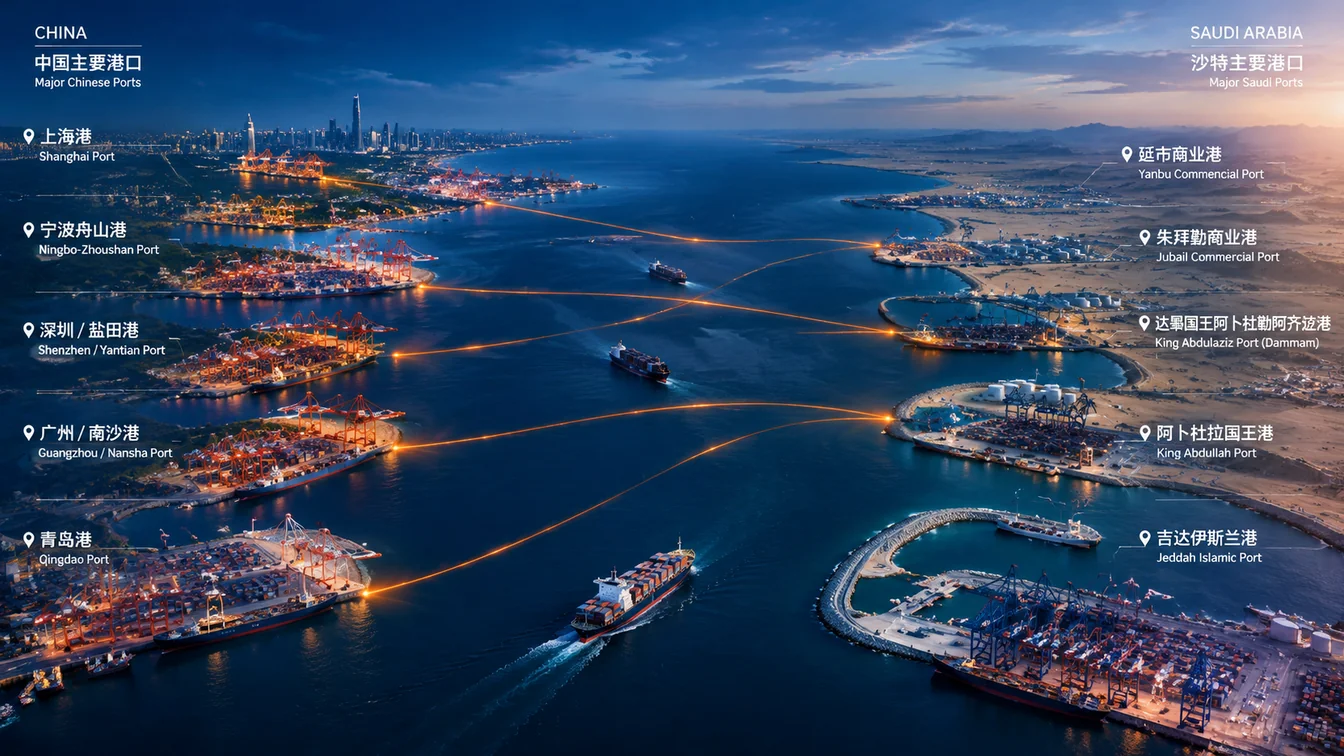
Major China Export Ports for Saudi Arabia Shipping
- Shanghai
- Use for the Yangtze River Delta supplier base, including Shanghai, southern Jiangsu, northern Zhejiang, and nearby manufacturing clusters. Compare Shanghai with Ningbo-Zhoushan when the final Saudi destination is in the west, center, or east and the pickup balance changes the route scope.
- Ningbo-Zhoushan
- Strongly relevant to Zhejiang and southern Yangtze-area suppliers, especially when factory pickup is closer to Ningbo than Shanghai. Compare the available China-to-Saudi sailing schedule and destination gateway rather than assuming the shorter inland pickup always produces the lower total route cost.
- Shenzhen/Yantian
- Useful for Pearl River Delta exporters around Shenzhen, Dongguan, and southern Guangdong. Compare Yantian with Nansha when the supplier cluster and current vessel schedule produce different origin-handling and inland-pickup requirements for Jeddah-area or eastern Saudi delivery.
- Guangzhou/Nansha
- Relevant to the wider Greater Bay Area supplier base and cargo moving through Guangzhou-area logistics networks. Compare it with Shenzhen/Yantian where pickup distance, consolidation, vessel availability, and final Saudi inland delivery differ.
- Qingdao
- Useful for Shandong and northern China suppliers, including industrial cargo that would otherwise require a longer inland move to a southern gateway. Compare Qingdao against another suitable northern or eastern gateway when the final Saudi port, service schedule, and inland cost change the overall route.
Major Saudi Arabia Import Ports for Cargo from China
- Jeddah Islamic Port
- Key Red Sea gateway for western Saudi Arabia, particularly Jeddah and the Makkah-region market, and a gateway to compare when cargo also needs inland movement toward central destinations. Current Saudi port activity continues to support container and logistics operations here.
- King Abdullah Port
- Red Sea gateway at King Abdullah Economic City that can be compared for western Saudi and some central Saudi delivery plans when the current China service, destination handling, and inland routing fit the final postcode.
- King Abdulaziz Port, Dammam
- Primary comparison point for Eastern Province cargo and deliveries around Dammam, Al Khobar, and nearby industrial areas. It should also be compared for central Saudi shipments when the inland leg and available China service make the eastern gateway workable.
- Jubail Commercial Port
- Relevant to industrial cargo and eastern Saudi delivery, especially around Jubail and the Eastern Province. Compare it with Dammam when cargo characteristics, current service, terminal handling, and final delivery location point to a different gateway.
- Yanbu Commercial Port
- Western Red Sea gateway to compare for cargo serving Yanbu, parts of Madinah Province, and nearby inland markets when the available service and cargo profile fit. It should be evaluated against Jeddah or King Abdullah Port when the final postcode changes the inland route.
Supplier Region to Destination Routing Logic
| Supplier region in China | Origin port to compare | Destination port and delivery region | Planning reason |
|---|---|---|---|
| Yangtze River Delta | Shanghai or Ningbo-Zhoushan | Jeddah Islamic Port or King Abdullah Port; Western and Central Saudi Arabia | Compare the two nearby gateways against factory pickup, current sailing service, Red Sea destination handling, and the inland leg to Riyadh or other final postcodes. |
| Pearl River Delta and Shenzhen | Shenzhen/Yantian or Guangzhou/Nansha | Jeddah Islamic Port or King Abdullah Port; Western and Central Saudi Arabia | Use pickup distance and current vessel schedule to decide between the two South China gateways, then compare Saudi inland movement to the final postcode. |
| Shandong and northern China | Qingdao | King Abdulaziz Port, Dammam or a Red Sea gateway; Eastern or Central Saudi Arabia | Compare the direct inland pickup burden, available international service, destination charges, and the final Saudi inland route instead of selecting by sea distance alone. |
| Greater Bay Area and nearby southern factories | Guangzhou/Nansha or Shenzhen/Yantian | King Abdulaziz Port, Dammam or Jeddah Islamic Port; Eastern or Western Saudi Arabia | Match the origin port to the actual factory location and compare the current service, final postcode, inland distance, destination handling, and requested delivery scope. |
Destination Regional Delivery Logic
- Western Saudi Arabia
- For Jeddah, Makkah-region, and nearby western demand, compare Jeddah Islamic Port and King Abdullah Port, with Yanbu also relevant for suitable northwestern cargo. The final decision should account for inland delivery distance, current schedule, destination charges, and the required delivery scope.
- Central Saudi Arabia
- Riyadh-area deliveries are inland moves after the sea gateway. Compare a Red Sea gateway such as Jeddah or King Abdullah with an eastern gateway such as Dammam when available services, inland transport, destination handling, and the final postcode produce different total route scopes.
- Eastern Saudi Arabia
- Dammam and Jubail are the principal port comparisons for Eastern Province destinations. For industrial or oversized cargo, check terminal acceptance, unloading requirements, inland route conditions, and whether a different gateway materially changes the final delivery scope.
- Northwestern Saudi Arabia
- Yanbu can be considered for suitable cargo serving the northwestern Red Sea area, while Jeddah and other gateways may remain relevant depending on current services and final delivery distance. Compare the full inland leg rather than choosing a port from geography alone.
How the Gateway Is Selected
Use these checks before confirming the origin-to-destination route:
- Measure the supplier’s actual pickup distance and loading constraints to the candidate China port or airport.
- Verify the current carrier or service schedule, transshipment pattern where applicable, equipment availability, and destination gateway acceptance.
- Match the Saudi gateway to the final postcode and inland delivery requirement, including truck access, unloading, appointments, and any special handling.
- Separate customs clearance, duty and tax, destination handling, storage, examination, insurance, and inland delivery from the main transport cost when comparing quotations.
- Choose the route only after confirming the complete supplier-to-gateway-to-Saudi-gateway-to-final-delivery chain and the required commercial scope.
Saudi Arabia Customs Clearance
Commercial imports into the Kingdom of Saudi Arabia require an appropriately licensed importer, accurate declarations, supporting documents, and product-specific permissions where applicable. The rules in this section apply to imports into the Saudi customs territory; special customs zones or different GCC customs arrangements should be checked separately. Current ZATCA guidance requires advance customs preparation through the Fasah process, and for sea-port arrivals ZATCA’s sea-port advance-submission notice made advance submission of the manifest and customs declaration mandatory from 29 October 2025.
What the Saudi Arabia Importer Normally Needs
Prepare the following before the shipment reaches the Saudi entry point:
- Saudi importer registration The commercial importer must be properly licensed to import and registered for the applicable customs process; ZATCA’s FASAH registration service uses identifiers such as a Commercial Registration Number or ID.
- Tax Identification Number ZATCA’s VAT import guidance states that the importer’s TIN is disclosed in the customs declaration, with accepted identity records including Commercial Registration, 700 Code, Saudi ID, or GCC ID as applicable.
- Commercial invoice Provide an accurate invoice showing the parties, goods, values, and commercial details used for customs valuation and declaration.
- Bill of lading or air waybill Match the transport document with the invoice, cargo description, consignee information, and declared route.
- Certificate of origin ZATCA lists a certificate of origin among standard import documents, with an exception where country of origin is clearly established as specified in its guidance.
- Packing list and cargo details Keep carton or pallet counts, dimensions, weights, and item-level descriptions consistent with the shipment and customs declaration.
- Commodity code and product permissions Confirm the correct HS classification and any licensing, conformity, IECEE, Saber, food, medical, cosmetic, or other product-specific requirement before dispatch.
- Fasah customs declaration and broker authorization Submit the customs declaration and required documents through the applicable electronic process, and authorize a licensed customs broker when the importer delegates clearance work.
ZATCA’s current import instructions state that the core documents include the commercial invoice, bill of lading, and certificate of origin, with additional documents required according to the nature of the goods.
Common Causes of Saudi Arabia Customs Delays
- Incorrect HS classification, product description, or declared value.
- Mismatch between the invoice, packing list, transport document, and customs declaration.
- Missing product registration, conformity, permit, or other approval required for the commodity.
- Incomplete importer registration, tax information, or broker authorization.
- Late submission of the customs declaration or required supporting documents.
- Unclear consignee, delivery scope, or final Saudi postcode after clearance.
- Customs examination, testing, storage, or other destination action that requires additional handling.
Resolve classification, importer information, product permissions, document consistency, and destination-delivery details before departure whenever possible. For sea freight, use the current advance-declaration requirement rather than waiting for the vessel to arrive before starting the clearance file.
Shipping to Amazon FBA Saudi Arabia
Amazon Saudi Arabia currently offers Fulfillment by Amazon for eligible sellers and products. Amazon’s FBA guidance requires sellers to prepare products for transportation, create a shipment plan, use the required labels, book the relevant appointment, and send inventory to the designated fulfillment center. Amazon FBA shipping support can be considered when the shipment is intended for Amazon.sa inventory rather than ordinary retail delivery.

For China-to-Saudi FBA shipments, keep these responsibilities explicit:
- Importer and exporter responsibility: Amazon’s current SEND terms state that, unless agreed otherwise, the seller is the exporter of record and importer of record, and Amazon does not act as EOR or IOR.
- Customs and tax: The seller or designated importer remains responsible for required import licenses, HS/commodity-code information, duties, taxes, and customs documentation. Do not assume that an FBA appointment removes Saudi customs obligations.
- Product compliance: Confirm Saudi product permissions, conformity, restricted-goods rules, FBA eligibility, and any category-specific requirements before creating the shipment plan.
- Shipment-plan destination: Ship only to the fulfillment center or destination assigned through Seller Central and follow Amazon’s current routing and carton-label instructions.
- Tracking and appointment: Amazon’s FBA workflow requires shipment preparation, shipment identification, shipment tracking, and appointment booking before delivery to the fulfillment center.
- Scope and cost: Freight, customs clearance, duties, taxes, destination accessorials, and FBA fees are separate cost considerations unless a particular shipping program explicitly includes them.
Amazon’s current Saudi FBA and SEND terms should be checked immediately before dispatch because program requirements can change. Amazon also states in its SEND terms that the seller remains responsible for the accuracy of customs information and for applicable customs costs and taxes.
Special Cargo, Packaging, and Insurance
Cargo Requiring Additional Review
- Batteries and battery-powered goods: Confirm battery chemistry, watt-hour information, packaging, transport restrictions, and destination product requirements before booking.
- Dangerous goods: Declare dangerous-goods status and provide the required classification and transport documentation; carrier and gateway acceptance must be confirmed in advance.
- Chemicals and liquids: Check SDS, composition, packaging, labeling, and any Saudi regulatory or import permissions relevant to the product.
- Food: Food imports can fall under SFDA requirements for importer registration, product registration, documents, labeling, and inspection.
- Cosmetics and medical goods: Confirm product classification, registration or notification, conformity, and clearance requirements with the applicable Saudi authority before dispatch.
- Wood packaging: Use compliant regulated wood packaging where required and confirm the destination’s phytosanitary or marking requirements for the actual cargo.
- Oversized or project cargo: Check dimensions, lifting method, road restrictions, port acceptance, and final unloading before selecting the gateway; project cargo shipping may be relevant when standard container handling is not sufficient.
- Temperature-controlled cargo: Confirm temperature range, monitoring, power requirements, handling points, and final delivery conditions across the complete route.
- Controlled or restricted goods: Verify licenses, permits, import eligibility, and any approval required before cargo is packed or dispatched.
Packaging Checks
Packaging should be planned around the full China-to-Saudi route, including domestic pickup, terminal handling, vessel or aircraft movement, customs inspection, inland delivery, and final unloading.
- Confirm carton strength and internal protection for stacking, vibration, and handling.
- Use suitable pallets and make sure pallet dimensions do not conflict with the transport or receiving requirement.
- Protect cargo from moisture and dust where the product requires it, especially during port storage or inland handling.
- Apply handling marks and product labels consistently with the commercial documents.
- Record final package dimensions and gross weights before booking because chargeable weight or equipment acceptance can change with inaccurate measurements.
- Use regulated wood packaging and required marks or treatment documentation where applicable to the commodity and destination.
Cargo Insurance
Carrier liability is not the same as cargo insurance. For higher-value, fragile, project, or damage-sensitive shipments, confirm the cargo insurance coverage, exclusions, deductible, insured value, evidence required for a claim, and coverage period from supplier pickup through the agreed delivery point.
Choosing a China to Saudi Arabia Freight Forwarder
When comparing quotations, make sure each one identifies origin pickup, main transport, customs scope, destination charges, inland delivery, insurance, delivery scope, and the final Saudi postcode. Two cost figures are not directly comparable when one is based on a container while another uses chargeable weight, or when their included and excluded route charges differ.

Why Use a Freight Forwarder for China-to-Saudi Arabia Shipping
A route-focused forwarder can reduce coordination gaps between the supplier, gateway, customs, and final delivery:
- One coordination point for supplier pickup, booking, mode selection, and the destination handoff.
- Document-readiness checks that help align invoices, packing lists, transport documents, declared values, and product requirements before departure.
- Shipment consolidation or multimodal coordination where the cargo profile or supplier location makes a single-mode route impractical.
- Visibility over customs status, destination handling, and delivery exceptions instead of treating the main transport as the whole shipment.
- Clearer quote scope by tying the route to the Saudi postcode, delivery requirement, customs responsibility, and relevant accessorials.
Why Choose TJ for China-to-Saudi Arabia Shipping
TJ can structure the shipment around the supplier location, compare applicable sea, air, rail-based, express, multimodal, and door-to-door options, coordinate the origin and destination handoffs, and build the quotation around the final Saudi postcode and requested delivery scope. Where the commercial terms require it, a DDP shipping option can be evaluated as a defined customs-and-delivery scope rather than assumed from the headline freight figure.
For a route-specific quotation, send the supplier pickup location, cargo description, carton or pallet count, dimensions, gross weight, cargo value, likely HS code, desired shipping method or arrival window, final Saudi postcode, Incoterm, and whether you need customs clearance and final delivery included: Get a China to Saudi Arabia Shipping Quote.
Frequently Asked Questions
How much does shipping from China to Saudi Arabia cost?
The supplied indicative references are $7,300–$10,800/container for FCL 20GP, $9,000–$14,200/container for FCL 40GP, $5.0–$13.5/kg for air freight, and $9–$24/kg for express. Their included charges and transport scope are not specified, so they must be reconfirmed for the actual cargo and Saudi postcode.
How long does sea freight from China to Saudi Arabia take?
The supplied FCL planning reference is 20–35 days for both 20GP and 40GP. The reference does not define whether this is port-to-port, terminal-to-terminal, or door-to-door and does not include a guaranteed customs or final-mile period.
Which major China ports handle cargo for Saudi Arabia?
Shanghai, Ningbo-Zhoushan, Shenzhen/Yantian, Guangzhou/Nansha, and Qingdao are practical China gateway comparisons for different supplier regions. The right comparison depends on factory pickup distance, current service, destination gateway, and final delivery scope.
Which Saudi Arabia port should I compare for my final destination?
For Western Saudi Arabia compare Jeddah Islamic Port and King Abdullah Port, with Yanbu relevant for suitable northwestern cargo; for Eastern Province compare King Abdulaziz Port in Dammam and Jubail Commercial Port. For Riyadh and other Central Saudi destinations, compare the complete inland route from the available western or eastern gateway to the final postcode.
Can I ship from China to Saudi Arabia door-to-door?
Yes, a door-to-door route can be arranged as a defined service scope, but the quote must identify supplier pickup, China export handling, international transport, Saudi customs clearance, destination charges, and final delivery to the exact postcode. Door-to-door shipping should not be assumed to include duties or every destination charge unless stated.
What documents are required to ship from China to Saudi Arabia?
ZATCA lists a commercial invoice, bill of lading, and certificate of origin among the standard import documents, with additional documents required according to the goods. The importer also needs the applicable customs declaration information, and product-specific permits or conformity documents may be required.
Is rail or rail-based shipping from China to Saudi Arabia available?
A direct China-to-Saudi rail route should not be assumed. Rail-based movement can be evaluated only as a verified multimodal solution with a current transshipment corridor, customs arrangements, and final Saudi inland delivery; no rail cost or transit reference is supplied on this page.
Can TJ arrange delivery to Amazon FBA in Saudi Arabia?
Amazon Saudi Arabia currently offers FBA, and its guidance requires sellers to prepare inventory, create the shipment plan, label units or cartons as required, book the appointment, and deliver to the assigned fulfillment center. For cross-border shipments, the seller remains responsible for the applicable EOR/IOR, customs, duties, taxes, licenses, and documentation unless a specific program states otherwise.