

Reviewed by TJ Logistics Team — Content and cost-data review month: November 2026. This review applies practical route-planning checks across China supplier pickup, origin gateway selection, mode fit, South Korea customs handoff, and final delivery for the China–South Korea trade lane. Market conditions, carrier schedules, customs procedures, tariff treatment, and marketplace receiving rules can change; confirm current requirements before booking or dispatch.
Shipping from China to South Korea: Route Update
A Shenzhen-to-Incheon FCL 20GP shipment is referenced at $345–$355 per container with a 6-day transit time for the current review month, making it a practical starting comparison for full-container cargo moving from South China into the Seoul metropolitan area. Suppliers in other Chinese regions may find a different origin gateway more efficient; the cost table below sets out the route-specific references supplied for this lane.
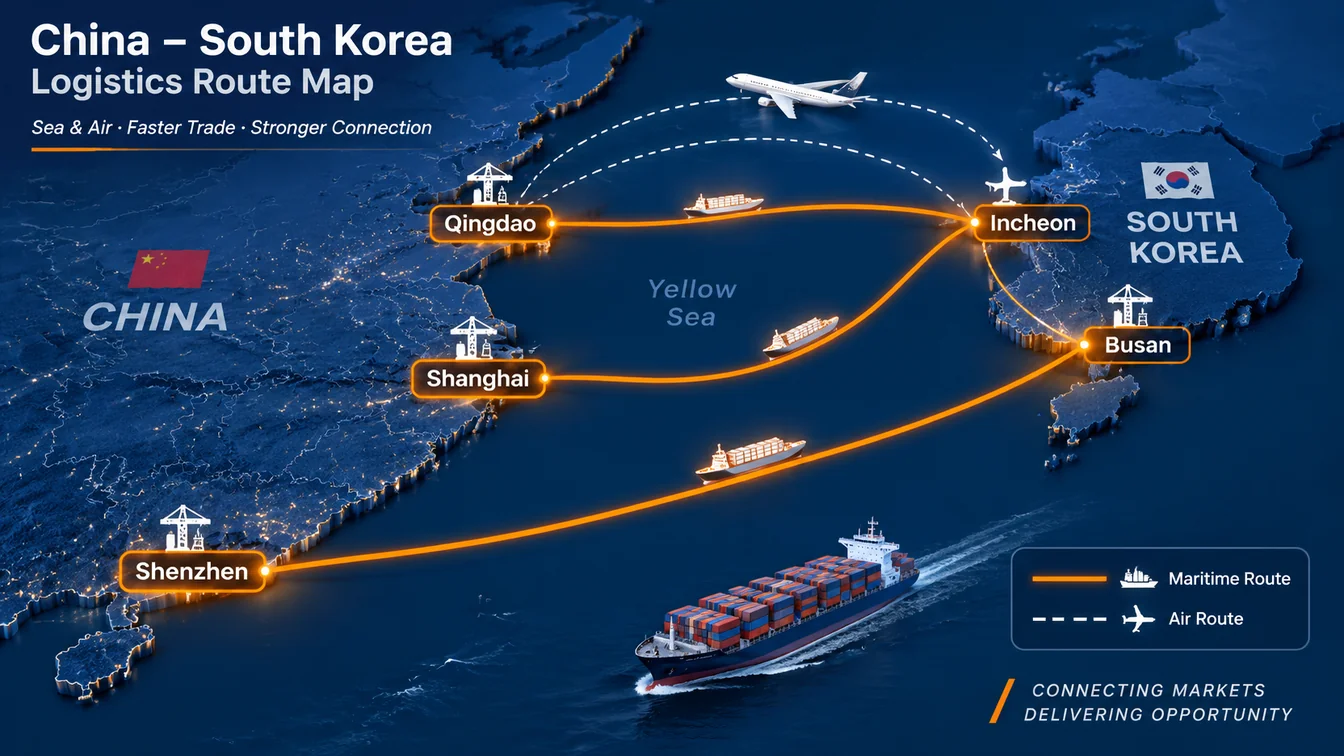
For time-sensitive cargo, air freight from China to Incheon International Airport is referenced at $1.60–$2.40/kg with a 1–3-day transit time. LCL and FCL ocean options suit volume shipments where the per-unit economics of sea transport outweigh speed, while express covers small parcels and samples. Each mode carries a different service boundary, so the first decision is matching cargo form and urgency to the right method rather than comparing headline figures across unlike units.
Route Planning Summary
- How does cargo move from a China supplier to the South Korea gateway?
- The supplier ships to a China export port or airport — most commonly Shenzhen, Shanghai, Ningbo, or Qingdao — for ocean or air loading toward Incheon or Busan. The origin gateway should be the one that limits supplier-side inland movement while still offering a credible service to the destination region.
- Which transport mode fits this route?
- FCL suits full-container volume where per-unit sea cost matters; LCL suits smaller ocean volumes that do not fill a container; air freight and express suit urgent, lightweight, or high-value cargo. Rail–sea multimodal via Wuwei, Gansu to Kunsan is a narrower option whose current cost and transit are not supplied for this review month.
- What planning time should be built into a China-to-South Korea shipment?
- Ocean FCL from Shenzhen to Incheon is referenced at 6 days, LCL at 9–16 days, air freight at 1–3 days, and express at 3–5 days for the current review month. These are transport-window references only; supplier pickup, export handling, customs clearance, and final delivery add time around that core movement.
- Who is responsible for South Korea import clearance?
- The Korean importer of record is responsible for accurate declaration, duty and VAT payment, and product compliance. A licensed customs broker typically files the import declaration through the UNI-PASS electronic system; the forwarder coordinates the handoff but does not replace the importer’s legal responsibility.
- What does final delivery look like after clearance?
- Final delivery moves cargo from the Incheon or Busan gateway to the consignee’s door, Amazon fulfillment center, or another receiving point. The delivery scope — port-to-port, port-to-door, or door-to-door — must be agreed before booking, because inland trucking, appointment scheduling, and unloading responsibility change the operational plan.
China to South Korea Shipping Cost
The table below provides route-specific indicative shipping costs and planning transit references for the current November 2026 review. Each reference applies to the named route, method, and unit only.
| Shipping route | Shipping method | Price | Transit time |
|---|---|---|---|
| Shenzhen, China → Incheon Port, South Korea | FCL 20GP | $345–$355/container | 6 days |
| Shenzhen, China → Incheon Port, South Korea | FCL 40GP | $449–$464/container | 6 days |
| Shenzhen, China → Incheon Port, South Korea | FCL 40HQ | $459–$474/container | 6 days |
| China → South Korea | LCL | $13.50/CBM | 9–16 days |
| China → Incheon International Airport, South Korea | Air freight | $1.60–$2.40/kg | 1–3 days |
| China → South Korea | Express | $2.50–$4.50/kg | 3–5 days |
Cost scope: The indicative cost references above apply to the route, method, and unit shown; they are not carrier freight rates, market averages, TJ selling prices, or binding quotations. The actual booking, cargo profile, and agreed service scope determine the commercial arrangement, including responsibility for relevant pickup, export handling, main transport, customs clearance, duty and tax, destination charges, inland delivery, insurance, storage, examination, appointments, and surcharges. A supplied figure does not by itself confirm that any of these items are included.
South Korea Import Duty and Taxes
South Korea import duty depends on the commodity code, customs value, origin, applicable trade measures, product category, and current rules; no single rate applies to all cargo. The following steps outline the general calculation logic, but the explanation is simplified and is not tax or legal advice.
South Korea applies a customs duty rate to the CIF-based customs value, then calculates value-added tax on the duty-inclusive amount, with preferential rates available where a valid origin claim is made.
- Classify the goods under the correct 10-digit HSK code. South Korea uses a 10-digit Harmonized System Korea code; the first six digits align with the WCO standard, and the final four digits determine the applicable basic rate, import requirements, and FTA eligibility. Classification errors can trigger retroactive duty and penalties, so a binding advance ruling is available through UNI-PASS where the code is uncertain.
- Establish the customs value. Korea generally assesses duty on a CIF basis — the transaction price plus international freight and insurance to the port of import — subject to customs valuation rules.
- Apply the duty rate that matches the origin claim. The MFN rate applies by default; a lower or zero rate may apply under the China–Korea FTA or RCEP if the goods meet the origin rules and a valid certificate of origin is presented. The average MFN rate across all goods is approximately 8.8%, but individual rates vary widely by product.
- Calculate VAT at the standard 10% rate. VAT is levied on the customs value plus duty (and any other applicable internal taxes such as individual consumption tax or liquor tax), not on the customs value alone. VAT applies to commercial imports regardless of the duty rate.
- Check for product-specific taxes or anti-dumping duties. Certain steel, chemical, and photovoltaic products may carry anti-dumping duties in addition to the basic rate; the applicable measure should be checked against the specific HSK before shipment. As of the review month, current official guidance on anti-dumping scope and rates should be confirmed with the Korea Customs Service.
China to South Korea Shipping Time
FCL ocean freight from Shenzhen to Incheon Port is referenced at 6 days for the current review month, the most commercially relevant direct timing reference for full-container cargo on this lane. LCL ocean freight from China to South Korea is referenced at 9–16 days; the wider range reflects consolidation and deconsolidation time around the ocean leg rather than a single sailing schedule.
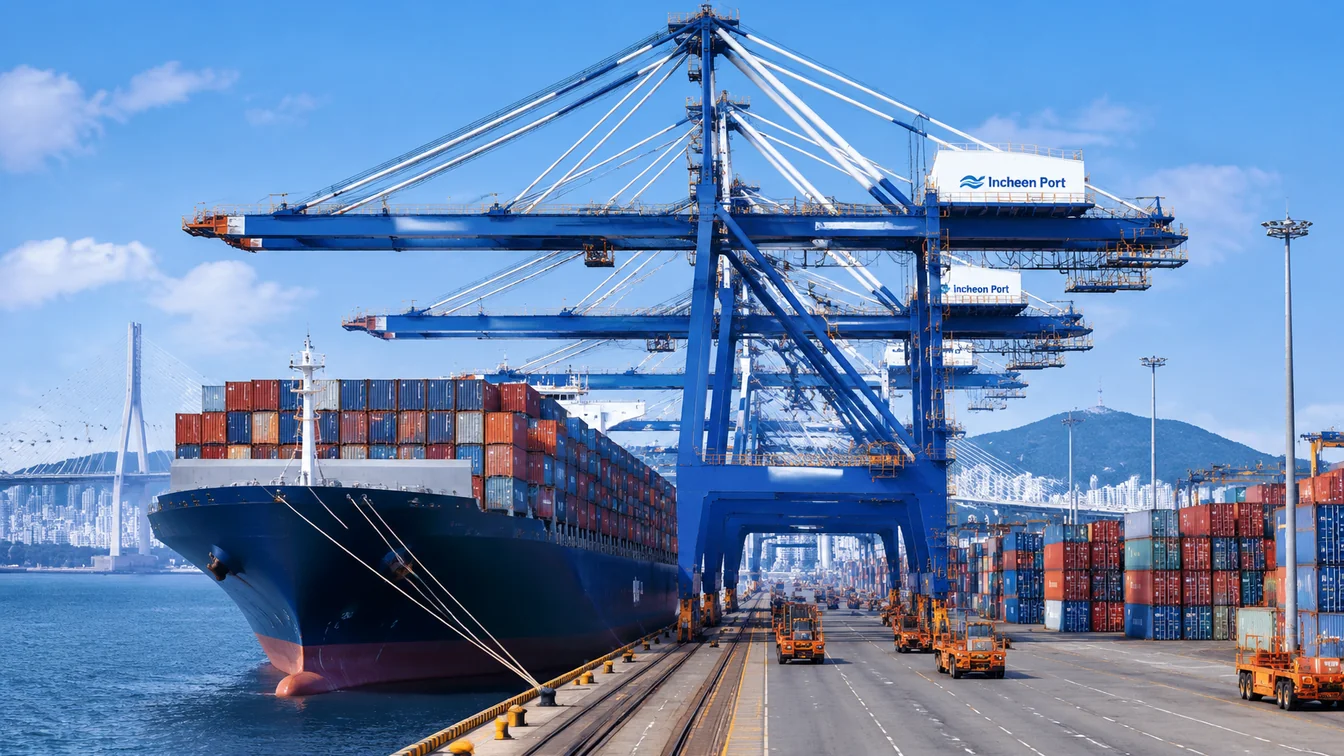
Air freight from China to Incheon International Airport is referenced at 1–3 days, and express at 3–5 days. These transport-window references exclude supplier pickup, China export handling, Korean customs clearance, and final delivery; they describe the core international movement only. For planning purposes, the clearance step and inland delivery should be added separately, and the clearance timeline can vary with document readiness, HSK classification, and whether the goods require KC certification or other product-specific review. When a shipment must meet a fixed in-store or FBA receiving date, the transport reference should be combined with the importer’s clearance preparation and the consignee’s appointment availability rather than read as a door-to-door promise.
Shipping Methods from China to South Korea
Choose FCL ocean freight when the cargo fills or nearly fills a 20GP, 40GP, or 40HQ container, because a full container avoids LCL consolidation handling and gives a more predictable per-unit sea cost for dense or bulky shipments. FCL is less suitable when the cargo volume is small enough that container fixed costs outweigh the per-unit benefit.
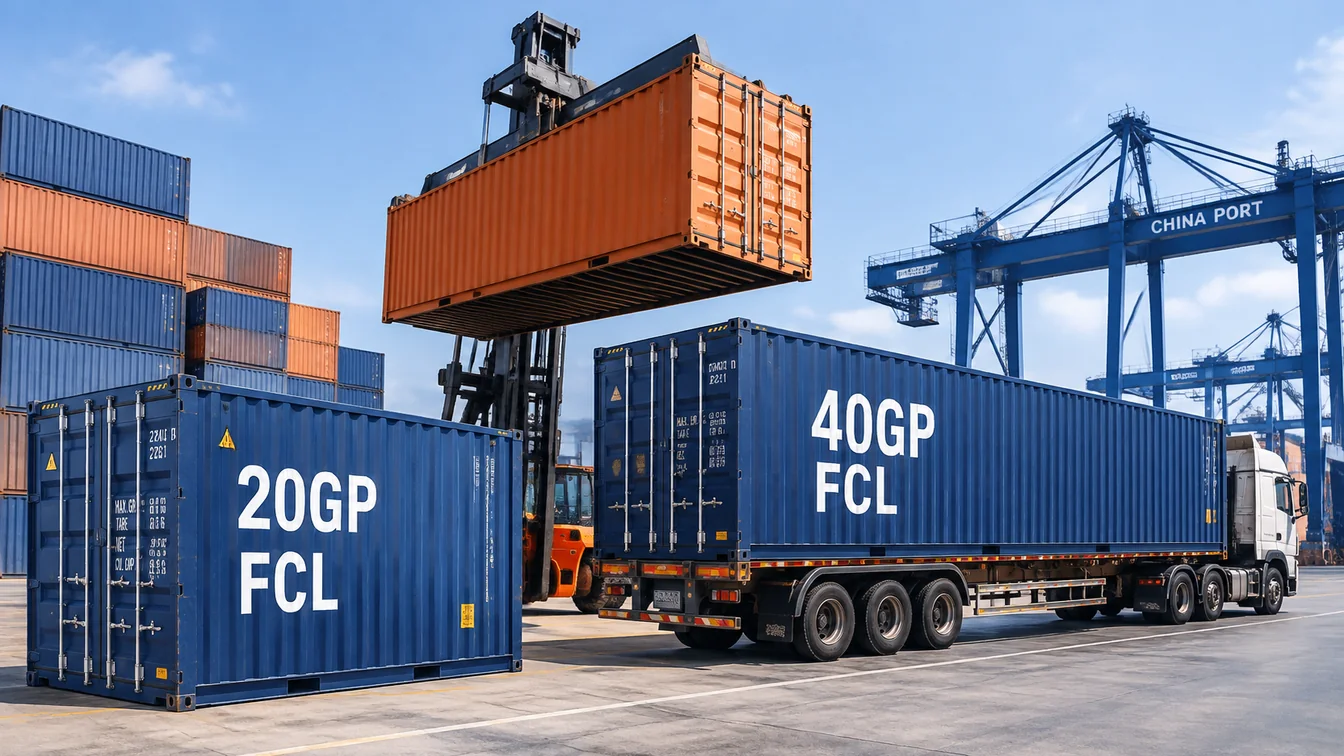
Choose LCL ocean freight when the shipment occupies a partial container volume and the cargo does not need to meet a tight date, because LCL consolidates multiple shippers’ goods and usually costs less than booking a full container for small volumes, but the 9–16-day transit reference reflects additional handling at origin and destination. LCL is a weaker fit for fragile cargo that cannot tolerate co-loading or multiple handling points.
Choose air freight when the cargo is urgent, relatively light for its value, and can move as airport-to-airport or airport-to-door cargo, because the 1–3-day transit reference compresses the international leg. Air freight economics change with chargeable weight; low-density cargo may be charged on volumetric weight rather than actual weight, which can narrow the cost advantage against express or ocean for bulky-light goods.
Choose express when the shipment is a small parcel, sample, or replacement part and a 3–5-day transit reference fits the need, because express integrates pickup, export, air movement, clearance coordination, and final delivery into a single service. Express is less suitable for palletized or oversized cargo where per-kilogram costs and handling limits apply.
Choose rail–sea multimodal via Wuwei, Gansu to Kunsan Port only when the supplier is in inland Gansu or a nearby northwest China region and the cargo can absorb the multimodal handoff, because the corridor links an inland origin to a Korean west-coast port without a separate domestic truck leg to a coastal export port. Current cost and transit for this specific corridor are not supplied for the review month, so the option should be evaluated against the ocean and air references rather than assumed to be cheaper or faster. The TJ multimodal freight service covers this type of combined routing where the supplier location makes it relevant.
Door-to-Door Shipping from China to South Korea
Door-to-door shipping on the China–South Korea route links supplier pickup, export handling, international transport, Korean import clearance, and final delivery into one coordinated sequence. The eight steps below show where handoffs occur and which party normally owns each decision.
-
Cargo and Compliance Review
The shipment is defined by commodity, HSK code, dimensions, weight, value, origin, destination postcode, and required delivery date. This step flags whether the goods fall under KC certification, food or cosmetics import requirements, dangerous-goods rules, or other product-specific controls before a mode or route is selected. The TJ customs brokerage service can support the documentation and declaration review where the importer needs coordination.
-
Route and Method Selection
The origin gateway, transport mode, and destination gateway are compared against the cargo profile and delivery deadline. A Shenzhen-area supplier moving full-container cargo to the Seoul metropolitan area may compare Shenzhen ocean service to Incheon against a truck-to-Shanghai or Ningbo option; the choice depends on sailing frequency, equipment availability, and the consignee’s receiving schedule rather than a single fixed rule.
-
Supplier Coordination and Pickup
The supplier’s factory address, ready date, loading capability, and export documentation are confirmed before pickup. The forwarder coordinates the collection window and checks that the carton marks, packing list, and commercial invoice match the cargo actually tendered, because a mismatch at this stage carries through to export and import declaration.
-
China Export Handling
Export declaration, container loading or airport handover, and origin documentation are completed at the China gateway. The TJ ocean freight service covers FCL and LCL export coordination where that mode is selected. A certificate of origin for China–Korea FTA or RCEP treatment should be prepared before departure if a preferential rate is claimed, because the document must accompany the import declaration.
-
International Transportation
The main leg moves by ocean to Incheon or Busan, by air to Incheon International Airport, or by express, depending on the selected method. The supplied transit references — 6 days for Shenzhen–Incheon FCL, 9–16 days for LCL, 1–3 days for air, and 3–5 days for express — describe this leg only and do not include the surrounding pickup, clearance, or delivery time.
-
South Korea Import Clearance
The Korean importer of record, or a licensed customs broker acting on the importer’s behalf, files the import declaration through the UNI-PASS electronic clearance system. The declaration requires an import declaration form, invoice, packing list, B/L or AWB, and certificate of origin where a preferential rate is claimed; product-specific certificates such as KC certification are added where the commodity requires them. Duty and VAT are assessed at this stage, and the importer remains responsible for their payment.
-
Final Delivery
After release, the cargo moves from the gateway to the consignee’s door, warehouse, or Amazon fulfillment center. The delivery scope determines whether inland trucking, appointment scheduling, unloading, and inside delivery are included; a port-to-port arrangement ends at the gateway, while a door-to-door arrangement extends to the receiving point. The TJ door-to-door service covers the coordinated version of this final segment where the agreed scope includes it.
-
Shipment Close-Out
Proof of delivery, final charges, and any examination or storage costs are reconciled against the agreed scope. If the shipment moved under a preferential origin claim, the supporting certificate and commercial documents are retained for the importer’s records, because Korean customs can review origin and classification after release.
Main China to South Korea Routes
The most practical China-to-South Korea route normally starts at a Chinese gateway that limits supplier-side inland movement while fitting the final delivery area and a credible Korean entry port. A Shenzhen supplier shipping FCL to the Seoul metropolitan area will usually compare a direct Shenzhen–Incheon sailing against trucking to a larger gateway; that comparison changes when equipment availability, sailing frequency, or the consignee’s inland distance shifts the balance.
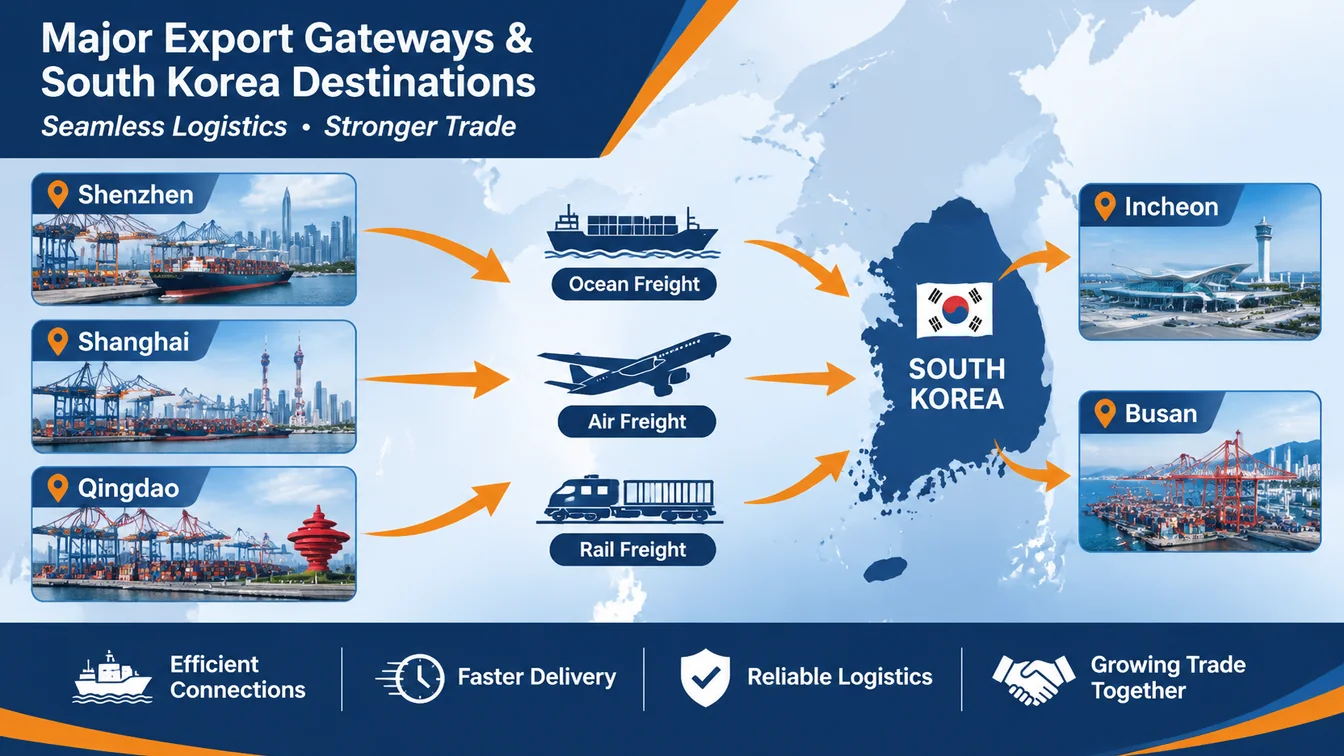
Major China Export Ports for South Korea Shipping
- Shenzhen (Yantian and Shekou)
- Serves South China manufacturing clusters in Guangdong, including electronics, consumer goods, and light industrial products. The supplied Shenzhen–Incheon FCL references make this the direct ocean origin for South China suppliers whose cargo fits a full container; for LCL or air, the same region accesses Hong Kong or Shenzhen airport connections.
- Shanghai
- Serves the Yangtze River Delta supplier base and offers broad ocean and air connectivity toward Incheon and Busan. Suppliers in Jiangsu, Zhejiang, and Shanghai proper often compare Shanghai-origin service when their inland distance to Shenzhen would add cost or time; the choice depends on the specific sailing and equipment rather than port size alone.
- Ningbo-Zhoushan
- A major container gateway for Zhejiang and eastern China exporters, with ocean services toward Korean ports. It is a practical origin for suppliers in the Ningbo–Hangzhou–Wenzhou corridor when a Ningbo sailing matches the delivery window better than routing cargo south to Shenzhen.
- Qingdao
- Serves Shandong and northern China supplier clusters and sits geographically close to the Korean west coast. For suppliers in Qingdao, Yantai, or Weifang, Qingdao is often the natural ocean or air origin because the overland leg to another Chinese gateway would add domestic trucking without a corresponding route benefit.
- Tianjin
- Serves the Beijing–Tianjin–Hebei industrial region and offers ocean connections toward Incheon and Busan. It is a relevant origin for suppliers in northern China producing steel products, equipment, or construction materials, where the cargo profile and sailing schedule align with a Tianjin loading port.
Major South Korea Import Ports for Cargo from China
- Incheon Port
- The primary ocean gateway for the Seoul metropolitan area and Gyeonggi Province, with direct services from Chinese ports including Shenzhen, Shanghai, Qingdao, and Tianjin. It is the natural entry point when the final delivery area is Seoul, Incheon, or the surrounding industrial and logistics zones; the inland trucking leg is short, which reduces destination drayage exposure.
- Busan Port
- South Korea’s largest port, located in the southeastern industrial hub and connected to global and intra-Asia services. It is a relevant comparison for cargo destined to Busan, Ulsan, Daegu, or the southeastern industrial corridor, and for shipments where a Busan service offers a better sailing frequency or equipment match than an Incheon routing.
- Gwangyang Port
- A major industrial port on the south coast serving the Yeosu–Gwangyang industrial complex and nearby manufacturing regions. It is a narrower comparison than Incheon or Busan and becomes relevant when the consignee is in the south-central industrial zone and a direct or feeder service to Gwangyang reduces inland trucking.
- Pyeongtaek Port
- A west-coast gateway serving the Gyeonggi southern industrial and logistics area, including Pyeongtaek and Hwaseong. It is a secondary comparison when the final delivery point is closer to Pyeongtaek than to Incheon, because the inland distance and trucking cost can differ even though both are west-coast gateways.
Supplier Region to Destination Routing Logic
| Supplier region in China | Origin port to compare | Destination port and delivery region | Planning reason |
|---|---|---|---|
| Guangdong (Shenzhen, Dongguan, Guangzhou) | Shenzhen (Yantian/Shekou) | Incheon Port → Seoul metropolitan area | Direct Shenzhen–Incheon FCL is the supplied reference route; the pattern changes if the supplier’s cargo is LCL and a consolidation gateway or different sailing frequency offers a better fit, or if the consignee is in Busan rather than the Seoul area. |
| Zhejiang (Ningbo, Hangzhou, Wenzhou) | Ningbo-Zhoushan | Incheon or Busan → central or southeastern Korea | Ningbo avoids southbound domestic trucking to Shenzhen; the comparison shifts if a direct Ningbo–Busan service better matches the consignee’s southeastern location, or if equipment availability at Ningbo is tighter than at Shanghai. |
| Shandong (Qingdao, Yantai, Weifang) | Qingdao | Incheon Port → Seoul metropolitan area or Gyeonggi | Qingdao’s proximity to the Korean west coast shortens the ocean leg; the pattern changes when the cargo requires a specific equipment type not available on a Qingdao sailing, or when the consignee’s delivery point is closer to Busan than to Incheon. |
| Yangtze River Delta (Shanghai, Jiangsu) | Shanghai | Incheon or Busan → Seoul metropolitan area or southeastern Korea | Shanghai offers broad sailing choice and can absorb cargo from Jiangsu and Shanghai proper without a southbound truck leg; the comparison changes if a direct Shanghai–Incheon service is less frequent than a Shenzhen or Ningbo alternative, or if the final postcode favors Busan entry. |
| Northern China (Tianjin, Hebei) | Tianjin | Incheon Port → Seoul metropolitan area or northern Gyeonggi | Tianjin serves northern industrial cargo and can feed Incheon directly; the pattern shifts if the cargo is project-sized or requires a specialized vessel not calling Tianjin, in which case a different origin port or a break-bulk gateway may be compared. |
Destination Regional Delivery Logic
- Seoul Metropolitan Area (Seoul, Incheon, Gyeonggi)
- Incheon Port is the closest ocean gateway for most of this region, and Incheon International Airport is the main air gateway. Inland trucking distances are short, but Seoul congestion and delivery-window restrictions can affect appointment timing; the delivery scope should state whether inside delivery, unloading, and appointment scheduling are included.
- Southeastern Industrial Corridor (Busan, Ulsan, Daegu, Gyeongnam)
- Busan Port is the natural ocean entry for this region, with direct services from multiple Chinese gateways. A shipment cleared at Incheon and trucked south may still compare favorably for some cargo, but the inland distance is longer; the trade-off depends on sailing frequency, equipment availability, and destination handling charges rather than a fixed rule.
- Central and South-Central Korea (Daejeon, Cheongju, Gwangju, Jeolla)
- No single gateway dominates this area; Incheon, Pyeongtaek, and Busan each become relevant depending on the final postcode. Pyeongtaek can shorten inland distance for southern Gyeonggi and northern Chungcheong, while Busan may fit southern Jeolla or Gyeongnam destinations better. The comparison should use the consignee’s actual delivery address and the available inland transport cost, not a regional label alone.
How the Gateway Is Selected
Gateway selection follows the supplier’s location and the consignee’s delivery region before it follows a preferred port or carrier.
- Supplier-to-origin distance and service: The origin port should reduce domestic trucking while still offering a sailing or flight that matches the delivery window. A nearby port with a poor schedule can be less practical than a slightly farther gateway with reliable service.
- Destination gateway and inland distance: For Seoul-area delivery, Incheon is the default ocean comparison; for Busan and the southeast, Busan is the natural comparison. A west-coast versus south-coast choice changes inland trucking time and cost.
- Equipment and cargo requirements: A 40HQ container, dangerous-goods shipment, or temperature-controlled cargo may not be available on every sailing or at every terminal. The gateway must be able to handle the specific equipment and cargo type.
- Clearance and product compliance: KC-certified goods, food, cosmetics, and other regulated categories may require designated review channels or additional documents. The clearance path should be confirmed before the gateway is fixed, because a port without the necessary handling capacity can delay release.
- Agreed delivery scope: A port-to-port arrangement ends at the gateway and leaves inland trucking to the buyer; a door-to-door arrangement requires the gateway choice to support the forwarder’s destination network and appointment capability.
South Korea Customs Clearance
South Korea import clearance involves the importer of record, an accurate declaration, product-specific requirements, supporting documents, and payment of duty and VAT. The rules apply within South Korea’s customs territory; Jeju Island and certain special zones may have different treatment, and the scope should be confirmed for the specific destination.
What the South Korea Importer Normally Needs
The Korean importer or a licensed customs broker acting on the importer’s behalf files the import declaration through the UNI-PASS electronic system. The following items normally form the preparation set, subject to the commodity and applicable regulations.
- Importer identity and customs registration A Korean business registration and the importer’s customs identification are required to file the import declaration. The importer of record is legally responsible for the declaration and tax payment.
- 10-digit HSK commodity code The Korean 10-digit Harmonized System Korea code determines the duty rate, import requirements, and FTA eligibility. The code should be confirmed against the UNI-PASS tariff database or through an advance ruling where classification is uncertain.
- Commercial invoice and packing list The invoice must show the transaction value, seller and buyer, commodity description, quantity, and terms of sale. The packing list should match the invoice line by line, with carton-level details where applicable.
- Transport document (B/L or AWB) The bill of lading for ocean cargo or air waybill for air cargo identifies the consignee, notify party, port or airport of arrival, and cargo description. The document must be available before or at the time of import declaration.
- Certificate of origin for preferential treatment A China–Korea FTA or RCEP certificate of origin is required to claim a preferential rate. The goods must meet the applicable origin rule, and the certificate must be valid and consistent with the invoice and transport documents.
- Product-specific certificates or approvals KC certification applies to many electrical, children’s, and consumer products; food, cosmetics, medical devices, and certain chemicals require separate import approvals or quarantine certificates. The requirement should be checked against the HSK before shipment.
- Customs broker authorization Where the importer uses a licensed customs broker to file the declaration, a power of attorney or authorization arrangement should be in place. The broker files through UNI-PASS but does not replace the importer’s responsibility for accuracy.
Common Causes of South Korea Customs Delays
- HSK classification mismatch: An incorrect or overly broad commodity code can trigger a correction request, a reclassification, or a post-clearance audit, and may invalidate a preferential origin claim.
- Missing or inconsistent certificate of origin: A certificate that does not match the invoice value, commodity description, or production address can cause the preferential rate to be denied and the shipment to be reassessed at the MFN rate.
- KC certification not available or not matching the product: Commercial goods requiring KC certification can be held or rejected if the certificate does not cover the specific model or if the product, label, and certified sample are inconsistent.
- Invoice and packing list discrepancies: A mismatch between declared quantity, value, or description and the physical cargo can lead to inspection, valuation review, or a request for supplementary documents.
- Valuation questions: A declared value that appears low relative to the transaction or comparable goods can prompt a customs valuation review, which extends clearance while supporting evidence is provided.
- Import requirements not identified before departure: Food, cosmetics, medical products, and certain chemicals may require import approval or quarantine that cannot be completed after arrival without delaying release.
These issues are more efficiently resolved before departure than at the destination gateway. A pre-shipment document check against the HSK, origin claim, and product-specific requirements reduces the likelihood of a hold that affects the consignee’s receiving schedule.
Shipping to Amazon FBA South Korea
Amazon Korea operates a fulfillment network, and China-based sellers can route inventory to Amazon fulfillment centers in South Korea through a coordinated import and delivery arrangement. The FBA route adds marketplace-specific requirements on top of the general Korean import rules, and these should be settled before the shipment leaves China.
The Korean importer of record and the tax responsibility must be fixed in advance; Amazon does not act as the importer of record for a seller’s inventory. The commercial invoice should carry the FBA shipment identifier, SKU details, and country of origin, and the packing list must match the invoice. A China–Korea FTA or RCEP certificate of origin can support a preferential duty rate, but it must be valid and consistent with the shipment. Where the product falls under KC certification, the certificate must be in place before import; commercial goods are subject to KC control, and the small-parcel route does not remove that requirement for regulated products.
Amazon assigns the destination fulfillment center, and the carton labels, pallet configuration, and shipment plan must match the assigned destination and Amazon’s receiving requirements. The TJ Amazon FBA service covers the coordination between the China supplier, the international movement, Korean import clearance, and the FBA delivery appointment where that scope is agreed.
Special Cargo, Packaging, and Insurance
Cargo Requiring Additional Review
- Batteries and dangerous goods: Lithium batteries, power banks, and other dangerous goods require mode-specific acceptance checks, packaging compliance, and carrier approval; not every sailing or flight accepts them.
- Chemicals and liquids: Safety data sheets, classification, and packaging requirements apply, and certain chemicals may require import approval or be restricted from standard ocean or air acceptance.
- Food, cosmetics, and medical goods: These categories carry separate import approval, labeling, and quarantine requirements in South Korea; the applicable approval should be confirmed before the goods are shipped.
- Wood packaging: Solid wood packaging must meet ISPM 15 treatment and marking requirements; non-compliant wood packaging can be refused or treated at the destination.
- Oversized or temperature-controlled cargo: Out-of-gauge dimensions, heavy lifts, and temperature-sensitive goods require equipment and handling checks at the selected gateway and mode.
- Controlled goods: Products subject to strategic export controls or Korean import restrictions require licence review before booking.
Packaging Checks
Packaging should match the mode, the handling stages, and the receiving requirements at the destination. For ocean LCL, cartons are co-loaded and handled more often than FCL, so internal protection and carton strength should reflect that risk; for FBA delivery, carton labels and pallet configuration must match Amazon’s shipment plan.
A practical packaging check covers the following before the cargo is tendered to the carrier.
- Carton strength and closure suitable for the stacking and handling expected in the selected mode.
- Internal protection and void fill for fragile or precision goods.
- Pallet condition, dimensions, and stability where palletized delivery is required.
- Moisture protection for ocean cargo and condensation-prone routes.
- Handling marks, labels, and carton identification that match the packing list.
- Recorded dimensions and weights for chargeable-weight calculation and loading planning.
- ISPM 15 treatment and marking where solid wood packaging is used.
Cargo Insurance
Carrier liability is limited and is not the same as cargo insurance. Cargo insurance coverage, exclusions, deductible, insured value, claim evidence, and the period of cover should be confirmed before the shipment moves, because the carrier’s liability limit may be far below the commercial value of the goods. The TJ cargo insurance service supports coverage arrangement where the importer chooses to insure the shipment.
Why Use a Freight Forwarder for Shipping from China to South Korea?
A freight forwarder helps the buyer turn cargo facts into a workable shipment definition, select a credible route across the available China gateways and Korean entry points, and keep the commercial and operational handoffs aligned from supplier pickup through final delivery. The value is in coordination and route fit, not in replacing the importer’s legal or compliance responsibilities.
- From shipment request to movement definition
- A forwarder converts the buyer’s commodity, dimensions, value, delivery address, and deadline into a declared shipment profile that a carrier and customs broker can act on. The profile changes when the cargo requires KC certification, dangerous-goods handling, or a product-specific import approval, because those requirements affect which mode and gateway are viable.
- From route options to a credible match
- A forwarder compares origin gateways, sailing or flight options, and Korean entry ports against the actual cargo and delivery need, rather than presenting every port as equally suitable. The match changes when the supplier’s inland location, the consignee’s postcode, or the available equipment makes a nominally attractive gateway impractical.
- From handoffs to coordinated responsibility
- A forwarder coordinates the sequence between the supplier, the carrier, the customs broker, and the consignee so that documents, cargo release, and delivery appointments connect without a gap. The coordination changes when the importer of record, the clearance responsibility, or the delivery scope is not defined before booking, because an undefined boundary creates a delay at the handoff point.
How TJ Logistics Team Plans a China-to-South Korea Shipment
- Shipment definition review
- The team reviews the commodity, HSK code, dimensions, weight, value, supplier location, consignee address, and required delivery date, and flags any missing information — such as an unresolved KC requirement or an origin claim that cannot be supported — that would prevent a reliable mode or gateway decision.
- Route and handoff comparison
- The team compares credible China origins, ocean, air, or multimodal options, Korean entry gateways, and destination delivery arrangements against the defined shipment. The TJ air freight service and the TJ express service are relevant where urgency or parcel size makes those modes the practical comparison.
- Service boundary and responsibility record
- Before a formal commercial arrangement is prepared, the team records the agreed scope — which party handles pickup, export declaration, main transport, import clearance, duty and VAT, inland delivery, and any examination or storage — so that the next handoff is assigned rather than assumed.
- Booking and change coordination
- After the buyer confirms the scope, the team coordinates booking information, commercial documents, cargo handoff, and the next operational decision if timing, route, documents, or receiving conditions change. The team flags a changed condition rather than silently absorbing it, so the buyer can decide whether to adjust the method, gateway, or delivery plan.
China to South Korea Shipping FAQ
How much does a 20ft container from China to South Korea cost?
A 20GP FCL container from Shenzhen, China to Incheon Port, South Korea is referenced at $345–$355 per container with a 6-day transit time for the November 2026 review. The reference applies to the named Shenzhen–Incheon FCL route and unit; a booking from a different Chinese origin or to a different Korean gateway should be compared against its own route reference rather than treated as the same cost.
How long does sea freight from China to South Korea take?
FCL ocean freight from Shenzhen to Incheon Port is referenced at 6 days, while LCL ocean freight from China to South Korea is referenced at 9–16 days for the current review month. The FCL figure describes the port-to-port ocean leg; the LCL range includes consolidation and deconsolidation time around the sailing, so the two should not be read as directly interchangeable door-to-door times.
What is the most cost-effective way to ship from China to South Korea?
For full-container volume, FCL ocean freight is normally the cost-effective default because the container is dedicated to one shipper and avoids LCL handling; for a Shenzhen origin to the Seoul area, the supplied 20GP reference is $345–$355/container. The calculation changes when the cargo does not fill a container and LCL’s per-CBM basis fits the actual volume better, or when urgency makes a faster mode worth the higher per-unit cost.
Which China port is best for shipping to South Korea?
The practical default is the major Chinese export gateway closest to the supplier that offers a suitable service toward the relevant Korean entry area — for a Guangdong supplier, Shenzhen toward Incheon; for a Shandong supplier, Qingdao; for a Zhejiang supplier, Ningbo-Zhoushan. The choice changes when the nearest port lacks the required equipment or sailing frequency, or when the consignee’s Korean delivery point makes a different destination gateway more efficient.
Can I ship door-to-door from China to South Korea?
Door-to-door shipping from China to South Korea can be arranged as a coordinated service covering supplier pickup, export handling, international transport, Korean import clearance, and final delivery. The service boundary must be agreed before booking: the importer remains responsible for the import declaration and duty and VAT, and the final-delivery condition — whether the consignee’s address can accept the truck, whether an appointment is required, and whether unloading is included — changes the operational plan.
What documents should be prepared before shipping from China to South Korea?
A China-to-South Korea shipment normally needs a commercial invoice, packing list, bill of lading or air waybill, and a 10-digit HSK commodity code for the import declaration. A China–Korea FTA or RCEP certificate of origin is needed to claim a preferential duty rate, and product-specific certificates such as KC certification apply where the commodity requires them. The exact set should be checked against the HSK and the Korean importer’s registration status before departure.
Why can two China-to-South Korea shipping costs differ?
Two China-to-South Korea shipping costs can differ because the quoted prices may cover different service scopes — one may be port-to-port while another includes pickup, clearance, duty, or inland delivery — or because the origin gateway, sailing date, equipment type, and cargo profile differ. The supplied references in this page are indicative costs for the named route and unit, not all-inclusive door-to-door prices, so a comparison should confirm the included and excluded items before treating two figures as equivalent.