

Reviewed by TJ Logistics Team — September 2026. This route-planning review covers current market conditions, indicative shipping costs, customs and tariff guidance, and marketplace information for China-to-Indonesia cargo as of September 2026. The review applies practical route-planning checks across supplier pickup, gateway and mode selection, customs handoff, and final delivery.
Shipping from China to Indonesia: Route Update
A 20GP container from Shanghai to Jakarta carries an indicative cost of $1,050–$1,650 with a planning transit time of 12–14 days, while LCL cargo from China to Jakarta Port is referenced at $10 per CBM over 11–18 days. The operational chain for this lane runs from the China supplier’s premises through a selected origin gateway—typically Shanghai, Ningbo-Zhoushan, Shenzhen, Guangzhou, or Qingdao—via ocean, air, or express transport to an Indonesian entry point such as Tanjung Priok, Tanjung Perak, or Belawan, followed by import clearance and final delivery to the consignee’s location.
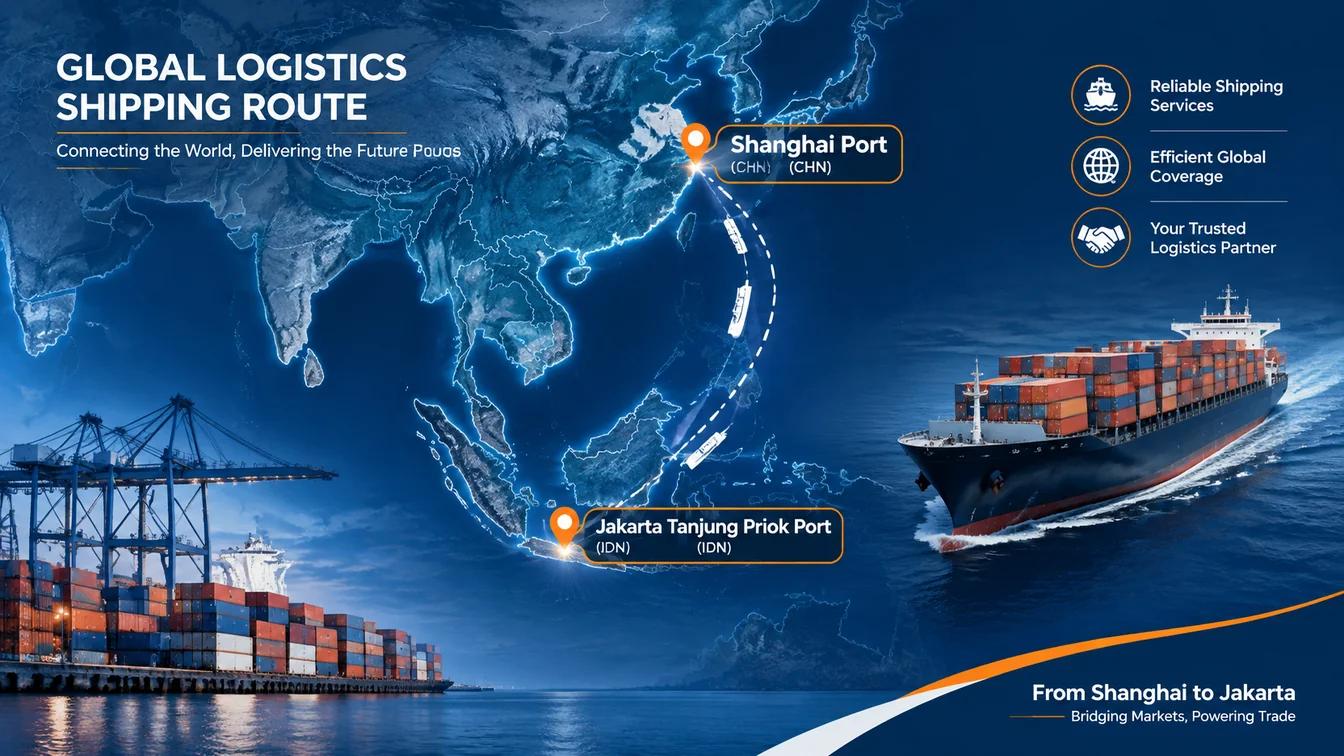
Air freight from Guangzhou (CAN) to Jakarta (CGK) at $3.95 per kilogram with 1–2 days transit serves urgent, low-weight shipments, while express from Wuxi to Bandung at $4.57–$4.77 per kilogram over 5–7 days suits smaller parcels that need door delivery without a separate customs broker arrangement. The route decision normally turns on whether the shipment is a full container, a partial load, or a time-sensitive parcel—each pointing to a different gateway and handling sequence.
Route Planning Summary
- How does cargo move from a China supplier to the Indonesian gateway?
- The supplier’s province determines which origin port or airport limits inland movement—Shanghai and Ningbo-Zhoushan serve the Yangtze Delta, Shenzhen and Guangzhou serve South China manufacturing, and Qingdao serves northern export clusters. The chosen gateway must also have a credible service toward the Indonesian entry point that matches the final delivery region.
- Which transport mode fits a China-to-Indonesia shipment?
- FCL is the default for full container loads where cost per unit matters and the cargo can wait 12–14 days on the water; LCL fits smaller volumes that do not justify a container; air freight from Guangzhou to Jakarta suits urgent cargo within airline weight and dimension limits; express from Wuxi to Bandung handles parcels needing door delivery; and rail–sea multimodal can be compared for inland Chinese origins routing through Nansha, subject to schedule confirmation.
- What planning time should be allowed for China-to-Indonesia shipping?
- Ocean transit is referenced at 12–14 days for FCL Shanghai–Jakarta and 11–18 days for LCL, but the total door-to-door timeline adds supplier pickup, export handling, Indonesian clearance, and final delivery. Air freight at 1–2 days and express at 5–7 days shorten the main leg but still require clearance and last-mile time.
- Who is responsible for Indonesian import clearance?
- The Indonesian importer of record must hold a valid NPWP tax number, NIB business identification, and API import identification, and must file the PIB customs declaration through the CEISA system. A licensed customs broker (PPJK) can submit on the importer’s behalf with written authorization.
- What final-delivery scope should be confirmed before booking?
- Door-to-door service must specify whether the supplier pickup, Indonesian inland delivery, unloading, and any appointment or receiving-window requirement are included. The indicative costs in this page are not door-to-door quotations unless the agreed service scope explicitly states those inclusions.
China to Indonesia Shipping Cost
The table below provides route-specific indicative shipping costs and planning transit references for the September 2026 review. Each reference applies to its named route, method, and unit only.
| Shipping route | Shipping method | Price | Transit time |
|---|---|---|---|
| Shanghai, China → Jakarta, Indonesia | FCL 20GP | $1,050–$1,650/柜 | 12–14 days |
| Shanghai, China → Jakarta, Indonesia | FCL 40GP | $2,100–$3,200/柜 | 12–14 days |
| Shanghai, China → Jakarta, Indonesia | FCL 40HQ | $2,100–$3,200/柜 | 12–14 days |
| China → Jakarta Port, Indonesia | LCL | $10/CBM | 11–18 days |
| Guangzhou (CAN), China → Jakarta (CGK), Indonesia | Air freight | $3.95/kg | 1–2 days |
| Wuxi, China → Bandung, Indonesia | Express | $4.57–$4.77/kg | 5–7 days |
Cost scope: The indicative cost references above apply to the route, method, and unit shown; they are not carrier freight rates, market averages, TJ selling prices, or binding quotations. The actual booking, cargo, and agreed service scope determine the commercial arrangement, including responsibility for relevant pickup, handling, customs, duty and tax, inland delivery, insurance, storage, examination, appointment, and surcharge items.
Indonesia Import Duty and Taxes
Indonesia import duty and tax liability is calculated on the customs value (CIF) at rates that depend on the commodity HS code, origin, trade agreements, and current fiscal rules—there is no single universal rate for all goods. Most MFN import-duty rates fall within 0%–150% under the BTKI tariff schedule, while VAT (PPN) and income-tax withholding (PPh 22) apply as separate layers on top of the duty amount.
- Classify the goods under the correct HS code in the INSW national single window to identify the applicable BTKI duty rate, any lartas restriction, and eligibility for preferential treatment under China–ASEAN or RCEP origin documentation.
- Establish the CIF customs value using the commercial invoice, freight cost, and insurance amount; Indonesia duty is levied on this CIF value, not on the ex-works price alone.
- Calculate import duty (Bea Masuk) at the BTKI rate—typically 0%–40% for many manufactured goods, with higher rates on selected categories such as automobiles—and add any luxury-goods sales tax (PPnBM) if the product is classified as luxury.
- Apply VAT (PPN) at the effective 11% rate for most taxable goods, with a 12% effective rate reserved for luxury goods under the 2025 framework, and add PPh 22 income-tax withholding at 2.5% for API-P production importers or 7.5% for API-U general trade importers.
- Confirm the total landed tax position before dispatch; the explanation here is simplified and is not tax or legal advice—current rates and scope should be verified against PwC’s Indonesia tax summary or INSW before booking.
China to Indonesia Shipping Time
Shanghai to Jakarta FCL sea freight is referenced at 12–14 days port-to-port, making ocean the planning baseline for full-container cargo that can absorb a two-week main leg. The 11–18-day LCL window from China to Jakarta Port reflects consolidation and deconsolidation time, so LCL planning should use the longer end when the cargo has a fixed downstream delivery date.

Air freight from Guangzhou (CAN) to Jakarta (CGK) at 1–2 days is the fastest main-leg option for urgent shipments, but the door-to-door timeline still adds supplier delivery to CAN, export screening, import clearance at CGK, and final delivery. Express from Wuxi to Bandung at 5–7 days covers a smaller-parcel door-to-door pattern that includes the carrier’s clearance handling, whereas FCL and LCL require a separate Indonesian clearance step after the container or consolidated cargo arrives at the port.
Shipping Methods from China to Indonesia
Choose FCL when the cargo fills or nearly fills a 20GP, 40GP, or 40HQ container and the delivery date can absorb 12–14 days of ocean transit, because a full container avoids LCL consolidation delays and gives the importer control over loading and seal. Choose LCL when the shipment volume is too small to justify a container and the supplier can deliver to a China consolidation warehouse, because per-CBM pricing at $10/CBM makes partial loads workable—but allow 11–18 days for the consolidated sailing and Jakarta deconsolidation.

Choose air freight when urgency outweighs cost and the cargo fits airline weight and dimension limits, because the Guangzhou–Jakarta airport pair moves in 1–2 days and bypasses ocean-port congestion. Choose express when the shipment is a parcel or small carton set that needs door delivery without the importer arranging a separate customs broker, because the Wuxi–Bandung express pattern at 5–7 days bundles clearance and last-mile into one service—subject to weight and commodity acceptance. Rail–sea multimodal can be compared when the supplier is in inland Hunan or adjacent provinces and a Nansha routing fits the schedule, but the supplied table does not carry a cost for that option, so it should be evaluated against FCL or LCL rather than assumed to be cheaper.
Door-to-Door Shipping from China to Indonesia
A door-to-door China-to-Indonesia shipment coordinates supplier pickup, China export handling, international transport, Indonesian import clearance, and final delivery under one agreed service boundary. The eight steps below show the operational sequence; the responsible party for each handoff should be recorded in the booking confirmation before cargo moves.
-
Cargo and Compliance Review
The shipment is defined by commodity, HS code, weight, volume, dimensions, packaging, and destination address, and the review flags any Indonesian lartas restriction, BPOM registration, SNI conformity, or Halal requirement that would prevent clearance before a route is selected.
-
Route and Method Selection
A credible origin gateway and transport mode are matched to the supplier location and delivery urgency—Shanghai or Ningbo-Zhoushan for Yangtze Delta FCL, Shenzhen or Guangzhou for South China cargo, and CAN–CGK air or Wuxi–Bandung express for time-sensitive parcels—with the final postcode and receiving conditions checked against the destination gateway.
-
Supplier Coordination and Pickup
The supplier receives the pickup window, cargo-ready date, export document checklist, and labeling or pallet requirements; the pickup is confirmed only after the supplier’s loading location, dock access, and cargo dimensions have been matched to the assigned vehicle or container.
-
China Export Handling
The cargo is tendered to the origin terminal or airport with the export declaration, commercial invoice, packing list, and booking confirmation, and any China export licensing or commodity inspection requirement is resolved before the cutoff time.
-
International Transportation
The booked vessel, flight, or express service carries the cargo to the Indonesian entry gateway—Tanjung Priok for Jakarta, Tanjung Perak for Surabaya and East Java, Belawan for Medan and North Sumatra, or CGK for air cargo—with tracking and arrival notice issued to the importer before discharge.
-
Indonesia Import Clearance
The importer or authorized PPJK submits the PIB through CEISA using the NPWP, NIB, API, invoice, packing list, and transport document, pays duty, PPN, and PPh 22, and releases the cargo only after customs grants the SPPB clearance approval.
-
Final Delivery
The cleared cargo moves from the gateway to the consignee’s address under the agreed delivery scope, with unloading, appointment, and receiving-window responsibilities confirmed before dispatch because Jakarta, Surabaya, and Bandung delivery conditions can change the final-mile arrangement.
-
Shipment Close-Out
Proof of delivery, final charges, and any exception or damage notation are recorded, and the importer receives the completed document set for tax and customs records.
Main China to Indonesia Routes
The most practical China-to-Indonesia route normally starts at a gateway that limits supplier-side inland movement while fitting the final delivery area and credible Indonesian handling—Shanghai and Ningbo-Zhoushan for Yangtze Delta suppliers delivering to Jakarta, Shenzhen and Guangzhou for South China cargo, and Qingdao for northern suppliers. The comparison changes when the final postcode is outside Java, when the cargo requires a direct sailing rather than a transshipment, or when the Indonesian gateway’s equipment and inland connection add more cost than the origin-side saving.
Major China Export Ports for Indonesia Shipping
- Shanghai
- Shanghai serves suppliers across Jiangsu, Zhejiang, and Shanghai itself and offers frequent container services toward Tanjung Priok; it is the default comparison for Yangtze Delta FCL cargo destined for Jakarta, subject to the sailing schedule and the supplier’s distance to the terminal.
- Ningbo-Zhoushan
- Ningbo-Zhoushan handles a large share of Zhejiang and eastern China exports and provides an alternative to Shanghai when the supplier is closer to Ningbo or when the sailing toward Tanjung Priok or Tanjung Perak matches the cargo-ready date; it should be compared alongside Shanghai rather than assumed interchangeable.
- Shenzhen (Yantian)
- Yantian serves Guangdong electronics, consumer goods, and light manufacturing and connects to Indonesian ports through South China services; it is the practical origin for suppliers in Shenzhen, Dongguan, and Huizhou, with the final Jakarta or Surabaya delivery region determining whether the sailing or transshipment fits.
- Guangzhou (Nansha)
- Nansha serves Pearl River Delta suppliers and also feeds the air cargo option through CAN; for ocean freight it competes with Yantian when the supplier is in western Guangdong or when a Nansha sailing aligns with the Jakarta arrival window, and the decision should include the supplier’s trucking distance to each terminal.
- Qingdao
- Qingdao serves Shandong and northern China exporters and should be compared for suppliers in that region shipping to Indonesia; it is not a default for southern suppliers because the inland repositioning can offset any sailing advantage.
Major Indonesia Import Ports for Cargo from China
- Tanjung Priok (Jakarta)
- Tanjung Priok is Indonesia’s largest container gateway and the primary entry for Jakarta, West Java, and much of Sumatra-bound cargo; it handles the Shanghai–Jakarta and China–Jakarta LCL references in the cost table, and its inland connection to Jakarta and Bandung makes it the default comparison for consumer and industrial cargo destined for western Java.
- Tanjung Perak (Surabaya)
- Tanjung Perak serves East Java and eastern Indonesia and should be compared when the final delivery region is Surabaya, Malang, or eastern Java rather than Jakarta; the port’s container terminal and feeder connections make it a credible alternative to Tanjung Priok when the destination is closer to Surabaya.
- Belawan (Medan)
- Belawan serves North Sumatra and the Medan region and is the relevant gateway when the final delivery is in Sumatra rather than Java; it should be compared only when the cargo’s destination region justifies the different sailing pattern and inland leg.
Supplier Region to Destination Routing Logic
| Supplier region in China | Origin port to compare | Destination port and delivery region | Planning reason |
|---|---|---|---|
| Jiangsu, Zhejiang, Shanghai | Shanghai or Ningbo-Zhoushan | Tanjung Priok for Jakarta or Bandung delivery | The Yangtze Delta origin has frequent sailings to Tanjung Priok and limits supplier-side trucking; compare Shanghai and Ningbo-Zhoushan against the cargo-ready date and the Jakarta inland delivery cost. |
| Guangdong (Shenzhen, Dongguan, Huizhou) | Yantian or Nansha | Tanjung Priok or Tanjung Perak depending on final region | South China manufacturing clusters sit close to Yantian and Nansha; the final delivery region decides whether a Jakarta or Surabaya gateway is more practical, and the sailing schedule can change the comparison. |
| Shandong and northern China | Qingdao | Tanjung Priok or Tanjung Perak | Qingdao is the closest major export gateway for northern suppliers, but the longer southbound sailing may offset the inland saving; compare total route cost and schedule rather than origin distance alone. |
| Guangdong near Guangzhou airport | CAN (Guangzhou Baiyun) | CGK (Jakarta Soekarno-Hatta) for Jakarta delivery | The CAN–CGK air pair at 1–2 days fits urgent cargo whose value or delivery window justifies air cost; the final Jakarta postcode and clearance arrangement determine the door-to-door scope. |
| Jiangsu (Wuxi and nearby) | Wuxi express origin | Bandung door delivery | The Wuxi–Bandung express pattern at 5–7 days suits parcel or small-carton shipments that need door delivery without a separate broker arrangement; weight, commodity, and carrier acceptance remain the changing conditions. |
Destination Regional Delivery Logic
- Greater Jakarta and West Java
- Tanjung Priok is the default gateway for Jakarta and Bandung delivery because the port’s inland connection to these demand centers is shorter than routing through Surabaya; the final postcode, Jakarta traffic and appointment rules, and the importer’s preferred delivery window can change the inland arrangement.
- East Java
- Tanjung Perak should be compared when the final delivery is in Surabaya, Malang, or eastern Java because the inland distance from Tanjung Priok would add cost and time; the sailing frequency from the chosen China origin and the destination handling fee determine whether Tanjung Perak is the practical choice.
- North Sumatra
- Belawan is the relevant gateway when the final delivery is in Medan or North Sumatra, because routing through Jakarta would require a domestic feeder or inland repositioning; the China origin’s direct sailing availability to Belawan and the destination delivery scope are the conditions that can change the comparison.
How the Gateway Is Selected
- Match the China origin port to the supplier’s actual province so inland trucking does not offset the ocean-freight saving; a closer port with a less frequent sailing may still be the better choice if the cargo-ready date allows.
- Confirm that the chosen Indonesian gateway connects to the final delivery region—Tanjung Priok for Jakarta and Bandung, Tanjung Perak for East Java, Belawan for North Sumatra, and CGK for Jakarta air cargo—rather than assuming every port serves every destination.
- Check the sailing or flight schedule against the importer’s required arrival window, because a gateway with a direct service can outperform a cheaper but transshipped routing when the delivery date is fixed.
- Compare the destination handling and inland cost, not just the main-leg freight, because the total landed route cost includes port charges, customs brokerage, and final delivery that vary by gateway.
- Verify lartas, BPOM, SNI, or Halal requirements against the chosen entry point, because a regulated commodity may need pre-import approval that changes the gateway or timing.
Indonesia Customs Clearance
Indonesia import clearance requires the importer of record to hold valid tax and business identification, file an accurate PIB declaration through the CEISA system, and pay the applicable duty, VAT, and income-tax withholding before the cargo can be released. The rules apply across Indonesia’s customs territory, and the Directorate General of Customs and Excise (DJBC) administers clearance at Tanjung Priok, Tanjung Perak, Belawan, and other international entry points.
What the Indonesia Importer Normally Needs
The importer’s document and registration set should be assembled before cargo arrives, because a missing or mismatched item can delay the PIB submission and incur storage charges.
- NPWP (tax identification number) A valid 16-digit NPWP is required for commercial imports; without it, PPh 22 may be charged at a higher rate.
- NIB (business identification number) The NIB issued through the OSS system also serves as the API importer identification for the company.
- API (import identification) API-U for general trade or API-P for production importers must be active and matched to the NIB.
- Commercial invoice and packing list The invoice supports the CIF customs value, and the packing list must match the cargo description and quantity.
- Bill of lading or air waybill The transport document identifies the arriving vessel or flight and the release reference at the gateway.
- HS code and PIB data The goods must be classified under the correct BTKI HS code, and the PIB is filed electronically through CEISA with the duty and tax calculation.
- Lartas permit or technical recommendation Restricted goods such as food, cosmetics, medical devices, electronics, and agricultural commodities may require BPOM, SNI, Halal, or ministry approval before clearance.
- PPJK authorization If a customs broker submits the PIB on the importer’s behalf, written authorization naming the PPJK should be in place.
Common Causes of Indonesia Customs Delays
- HS code mismatch between the invoice, packing list, and PIB, which triggers a customs query or reclassification.
- Missing or expired NPWP, NIB, or API, which prevents the PIB from being submitted under the importer’s name.
- Undervalued or inconsistently valued invoice, which can lead to a customs valuation challenge and additional examination.
- Lartas-restricted goods arriving without the required BPOM, SNI, Halal, or ministry technical approval.
- Incomplete or non-compliant labeling and packaging for regulated consumer goods, which can cause a border hold.
- Late payment of duty, PPN, or PPh 22, which delays the SPPB release approval after the PIB is accepted.
- Port congestion or incomplete document handoff between the carrier, broker, and importer, which extends storage and examination time.
These issues should be resolved before departure whenever the commodity or importer status makes them foreseeable, because clearance delays at Tanjung Priok, Tanjung Perak, or Belawan add cost that is not captured in the main-leg freight reference.
Special Cargo, Packaging, and Insurance
Cargo Requiring Additional Review
- Batteries and products containing lithium cells, which require carrier acceptance and may be subject to dangerous-goods documentation.
- Dangerous goods, chemicals, and liquids, which need classification, safety data sheets, and carrier approval before booking.
- Food, cosmetics, and medical goods, which may require BPOM registration or Halal certification before Indonesian clearance.
- Wood packaging, which must meet ISPM 15 treatment and marking requirements for entry into Indonesia.
- Oversized or temperature-controlled cargo, which requires equipment, routing, and handling confirmation that differs from standard container or air-cargo service.
- Controlled or restricted goods listed under Indonesia’s lartas framework, which cannot move without the specific permit or technical recommendation.
Packaging Checks
Packaging for China-to-Indonesia shipments should protect the cargo through ocean or air handling and support efficient customs examination without damage. Cartons need adequate strength and internal protection, pallets should be sized to the container or aircraft contour, and moisture protection is important for ocean cargo that may sit at a humid port. Handling marks and labels should be legible and consistent with the packing list, dimensions and weights should be recorded for the booking, and regulated wood packaging must carry the correct ISPM 15 mark. Any label containing Indonesian-language product information or regulated-content declarations should be checked against the applicable BPOM or SNI requirement before dispatch.
- Carton strength and internal cushioning matched to the cargo weight and handling mode.
- Pallet dimensions and stacking limits confirmed against the container or air-cargo contour.
- Moisture protection for ocean cargo, especially for machinery, paper, and textile products.
- Handling marks, carton labels, and shipping marks that match the packing list and PIB description.
- Recorded dimensions and weights for each carton or pallet, used for the booking and chargeable-weight calculation.
Cargo Insurance
Carrier liability is not the same as cargo insurance: the carrier’s liability is normally limited by the transport convention or bill-of-lading terms, while cargo insurance covers the insured value under the policy’s terms, exclusions, deductible, and claim-evidence requirements. For a China-to-Indonesia shipment, the insurance arrangement should state the insured value, the coverage period from pickup to final delivery, the evidence required for a claim, and whether the policy responds to ocean, air, or express transit. TJ Logistics Team’s cargo insurance service can be reviewed against the shipment’s declared value and routing, but the coverage and exclusions must be confirmed in the policy before dispatch.
Why Use a Freight Forwarder for Shipping from China to Indonesia?
A freight forwarder helps the buyer turn cargo facts into a workable shipment definition, select a credible China-to-Indonesia route, and keep the commercial and operational handoffs aligned so the importer, supplier, carrier, and customs broker are working from the same scope. The value is in coordinating the sequence—not in replacing the importer of record, the customs authority, a licensed PPJK, or the product-compliance owner.
- Turning cargo facts into a bookable shipment
- The forwarder converts commodity, HS code, weight, volume, packaging, supplier location, and delivery postcode into a defined booking scope, which resolves the first buyer problem: an undefined request cannot be priced or routed reliably. If the cargo is lartas-regulated or needs BPOM or SNI approval, that condition is flagged before a mode is selected.
- Matching transport and gateway choices to the actual route
- The forwarder compares FCL, LCL, air, express, and credible multimodal options against the supplier’s province, urgency, cargo dimensions, and final delivery region, then selects the origin gateway and Indonesian entry point that fit the route. The comparison changes when the final postcode is outside Java, when the sailing schedule does not meet the delivery date, or when the destination handling adds more cost than the main leg.
- Keeping commercial and operational handoffs aligned
- The forwarder records who is responsible for supplier pickup, export declaration, main transport, Indonesian clearance, duty and tax payment, and final delivery, so the buyer can see where the scope ends and the next party begins. This coordination does not replace the importer’s customs and tax obligations, and the agreed service boundary should be written into the commercial arrangement.
How TJ Logistics Team Plans a China-to-Indonesia Shipment
- Shipment definition review
- We review the commodity, HS code, weight, dimensions, packaging, supplier location, and delivery postcode, and flag any information gap—such as a missing NPWP, NIB, API, or lartas permit—that would prevent a reliable next decision.
- Transport and gateway comparison
- We compare credible transport, gateway, international-routing, and destination-handoff options against the defined shipment, using the supplier’s region to narrow the China origin port and the final delivery area to narrow the Indonesian gateway.
- Service boundary and responsibility record
- We record the agreed service boundary and the parties responsible for the next handoffs before a formal commercial arrangement is prepared, including pickup, export handling, main transport, clearance, duty and tax, and final delivery.
- Booking and exception coordination
- After the buyer confirms the agreed scope, we coordinate booking information, commercial documents, cargo handoff, and the next operational decision if timing, route, document, or receiving conditions change; relevant service pages include sea freight, air freight, and customs brokerage.
China to Indonesia Shipping FAQ
How much does a 20ft container from China to Indonesia cost?
A 20GP container from Shanghai to Jakarta carries an indicative cost of $1,050–$1,650 per container with a 12–14-day planning transit time, as shown in the September 2026 cost reference. The figure applies to the named Shanghai–Jakarta route and 20GP container only; a different China origin port or Indonesian destination gateway would require a separate reference.
How long does sea freight from China to Indonesia take?
FCL sea freight from Shanghai to Jakarta is referenced at 12–14 days, while LCL from China to Jakarta Port is referenced at 11–18 days. The FCL timing covers the port-to-port main leg, and LCL timing includes consolidation and deconsolidation; neither figure includes supplier pickup, export handling, Indonesian clearance, or final delivery.
What is the most cost-effective way to ship from China to Indonesia?
FCL is the practical default for shipments that fill or nearly fill a 20GP, 40GP, or 40HQ container, because the container cost is spread across the full load and avoids LCL per-CBM accumulation. LCL at $10/CBM becomes the cost-effective choice when the volume is too small to justify a container; air and express are not the lowest-cost modes but answer urgency and door-delivery needs that FCL and LCL do not.
Which China port is best for shipping to Indonesia?
The practical default is the closest major export gateway to the supplier that has a suitable sailing toward the Indonesian entry region—Shanghai or Ningbo-Zhoushan for Yangtze Delta suppliers delivering to Jakarta, and Yantian or Nansha for South China suppliers. The final destination condition can change the comparison: a shipment destined for East Java may favour a sailing toward Tanjung Perak, and a North Sumatra delivery may justify comparing a route toward Belawan instead.
Can I ship door-to-door from China to Indonesia?
Door-to-door service can be arranged when the agreed scope includes supplier pickup, China export handling, main transport, Indonesian import clearance, and final delivery, but the service boundary must be written into the booking. The material condition is that the importer of record must still hold the NPWP, NIB, and API and remain responsible for the PIB declaration, duty, PPN, and PPh 22; a door-to-door quote does not transfer those legal obligations to the carrier.
What documents should be prepared before shipping from China to Indonesia?
The core preparation set is the commercial invoice, packing list, bill of lading or air waybill, the importer’s NPWP, NIB, and API, and the correct HS code for the PIB declaration. Regulated goods add the relevant lartas permit, BPOM registration, SNI certificate, or Halal documentation; a PPJK authorization is needed if a customs broker files the PIB on the importer’s behalf.
Why can two China-to-Indonesia shipping costs differ?
Two quotes for the same China-to-Indonesia lane can differ because the origin port, destination gateway, container size, cargo weight or volume, sailing schedule, and agreed service scope are not identical. A Shanghai–Jakarta 20GP reference at $1,050–$1,650 is not directly comparable to an LCL $10/CBM reference or an air $3.95/kg reference because the units and included services differ; the commercial arrangement should be compared only when the route, method, unit, and scope match.
Is rail freight from China to Indonesia available?
Rail–sea multimodal from Zhuzhou through Nansha Port to Jakarta is referenced at 12–13 days, but the supplied table does not include a cost for that option, so it should be evaluated against FCL or LCL rather than assumed to be cheaper. The route is a rail-plus-ocean combination, not a direct rail service into Indonesia, and the schedule and terminal handoff should be confirmed before booking.