

Reviewed by TJ Logistics Team — October 2026. Planning information only; reconfirm schedules, routing, customs requirements, charges, and final delivery scope against the exact cargo, supplier location, destination postcode, and booking date. This October 2026 review window covers market, cost, customs, tariff, and marketplace information available at review time, and practical route-planning checks across supplier pickup, gateway and mode selection, customs handoff, and final delivery. Transit times and indicative cost references are not guarantees and must be reconfirmed for the actual shipment.
China to Türkiye Shipping Update
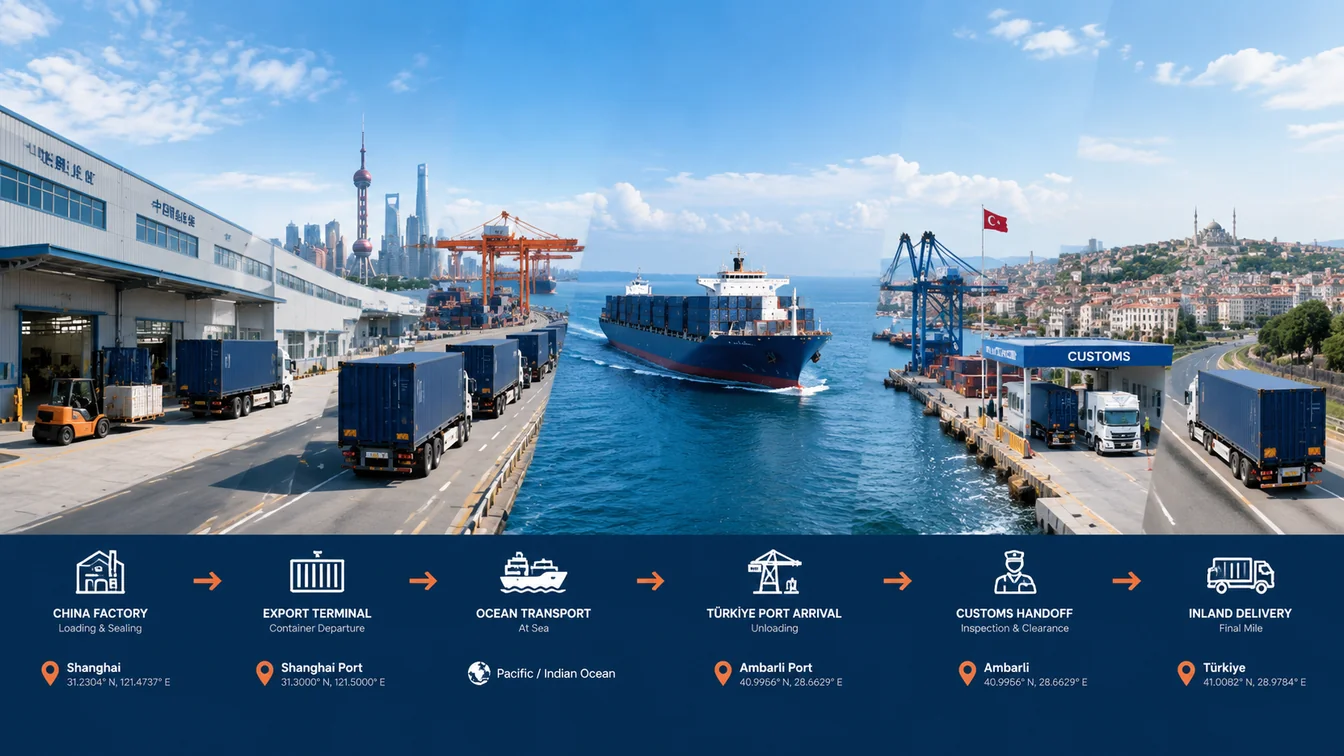
China-to-Türkiye shipping is best planned as one connected route: collect the cargo from the supplier, move it to the origin gateway that fits the supplier region, select sea, rail-based, air, or express transportation according to the shipment profile, clear the goods through Türkiye customs at the appropriate destination gateway, and then complete inland delivery to the final postcode. The quotation should describe that whole handoff clearly rather than comparing a transport price without the destination scope.
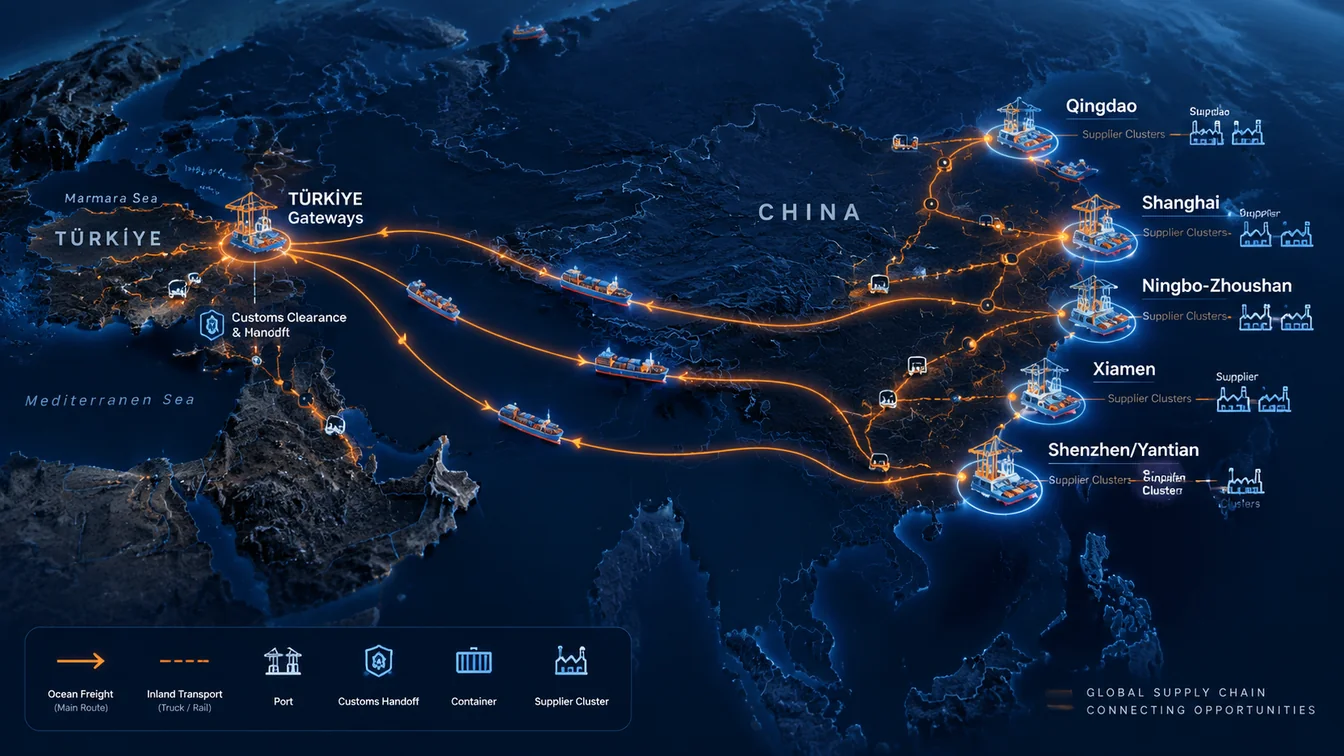
For most commercial cargo, FCL or LCL is the starting point when the delivery deadline allows ocean transit, while air freight and express are more suitable for tighter replenishment or smaller urgent consignments. Rail-based routing can also be considered when the shipper needs a middle ground between ocean and air and accepts corridor-specific transfers. The practical choice depends on supplier pickup distance, cargo volume and weight, final postcode, customs requirements, destination handling, and the commercial cost of delay.
Route Planning Summary
- How should the supplier-to-gateway route be planned?
- Start with the actual Chinese supplier city or industrial cluster, then compare the inland move to Shanghai, Ningbo-Zhoushan, Shenzhen/Yantian, Qingdao, Xiamen, or another suitable export gateway before selecting the international leg.
- Which transport mode applies to the shipment?
- FCL and LCL are the main sea options for planned inventory, rail-based transport can suit time-sensitive container cargo on an available corridor, and air freight or express can suit urgent or lower-volume cargo.
- What planning time should be used?
- Use the supplied mode-specific transit references as planning inputs, then add time for supplier readiness, origin handling, customs, possible transfers, and final delivery because the supplied ranges do not define the complete door-to-door scope.
- Who is responsible for destination customs clearance?
- The Türkiye importer remains responsible for import compliance, declarations, applicable duties and taxes, and product-specific requirements, even when a customs representative or freight forwarder coordinates the process.
- How should final delivery and quote scope be defined?
- The quotation should identify the destination postcode, delivery address or area, customs scope, destination charges, inland transport, insurance, and any special handling so that apparently similar prices are compared on the same route scope.
China to Türkiye Shipping Cost
There is no single China-to-Türkiye shipping cost because the commercial scope changes with supplier location, cargo size, handling requirements, gateway, customs arrangements, destination postcode, and delivery service. The figures below are indicative shipping cost references for route planning, not carrier freight rates, TJ selling prices, or binding quotations. For ocean cargo, sea freight service is generally the first option to compare when the schedule permits; for urgent, smaller, or higher-value cargo, air freight service can be considered.
| Shipping option | Indicative shipping cost | Supplied transit time | Main cost drivers |
|---|---|---|---|
| FCL 20GP | $3,000–$5,500/container | 25–45 days | Supplier pickup distance, container handling, origin charges, ocean routing, destination handling, inland delivery scope, and cargo-specific surcharges. |
| FCL 40GP | $4,200–$5,500/container | 25–45 days | Container utilization, pickup geography, origin handling, ocean routing, destination charges, inland distance, and delivery requirements. |
| LCL | $50–$150/CBM | 28–40 days | Chargeable volume, consolidation point, origin handling, deconsolidation, destination handling, customs scope, and final-mile delivery. |
| Rail 40GP | $7,000–$8,700/container | 15–25 days | Available corridor, rail or multimodal transfers, container pickup, border and transshipment handling, destination charges, and inland delivery. |
| Air freight | $5–$9/kg | 3–10 days | Chargeable weight, airport handling, cargo type, security requirements, customs scope, and final delivery. |
| Express | $10–$20/kg | 3–5 days | Chargeable weight, pickup area, service level, customs requirements, remote-area handling, and final delivery scope. |
Cost scope: The supplied figures provide an indicative cost and transit reference but do not specify which charges are included. Confirm origin pickup, export and origin handling, main transport, destination handling, customs-clearance service, duty and tax, inland delivery, insurance, storage, examination, appointments, and applicable surcharges before comparing or accepting a quotation. The table does not establish any figure as port-to-port, airport-to-airport, door-to-door, all-inclusive, or duty-paid.
The final shipment cost will depend on the supplier location, cargo description, CBM or chargeable weight, destination ZIP or postcode, delivery scope, customs requirements, duties and taxes, destination charges, storage or examination, and insurance. The only published amounts above are the supplied indicative cost references; any other charge included in a booking must be confirmed as either included in the quotation scope or separately payable.
Cost-data review: October 2026. Reconfirm the indicative cost references for the actual booking date, cargo, routing, destination postcode, and requested service scope before shipment release.
Türkiye Import Duty and Taxes
Türkiye does not apply one universal import-duty rate to all cargo from China. The result depends on the product’s tariff classification, customs value, origin, applicable trade measures, product category, and the rules in force when the goods enter Türkiye. The Turkish Ministry of Trade maintains the current tariff framework and classification guidance; the current 2026 import regime also includes product-specific tariff and testing changes that should be checked before dispatch. For shipment execution, a customs brokerage service can help coordinate the declaration package, while DDP shipping should only be quoted where the importer, tax, customs, and delivery responsibilities have been explicitly defined.
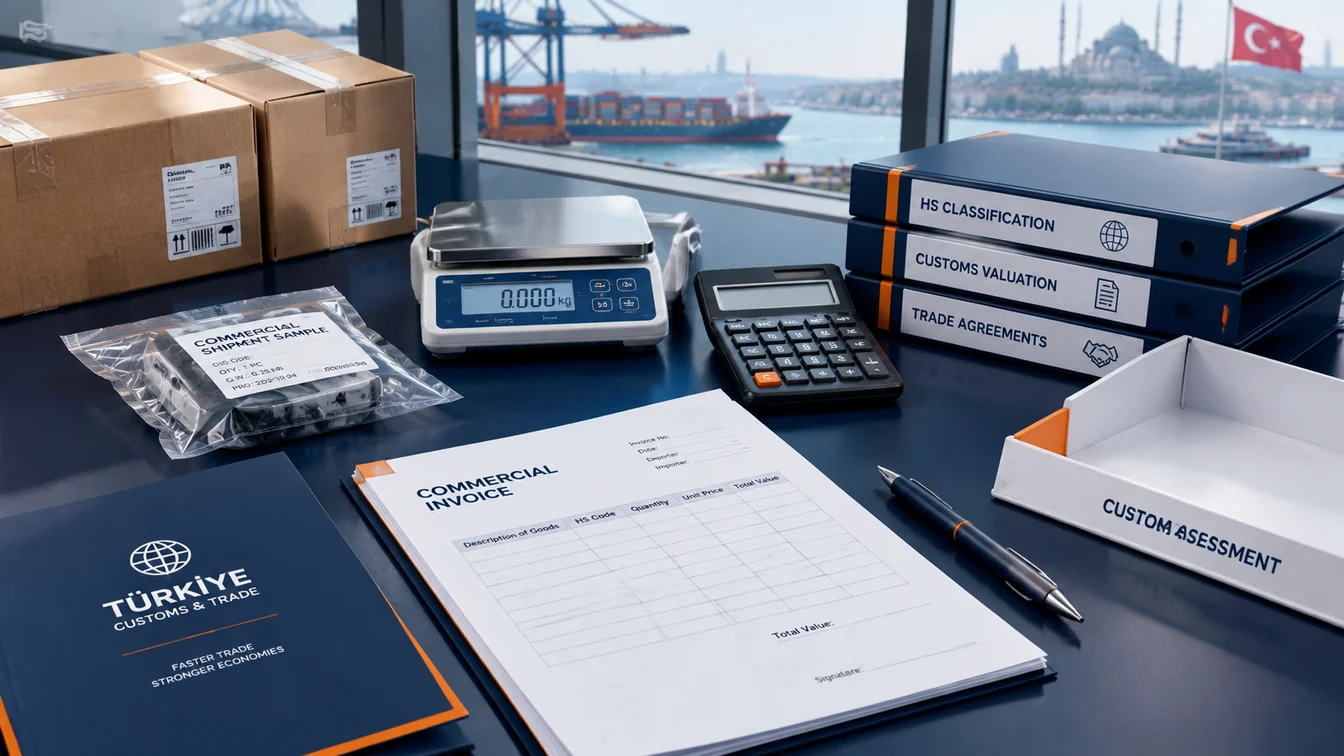
Use this simplified planning sequence before the cargo leaves China. It is route-planning guidance, not tax advice, and the actual assessment is determined under Türkiye’s customs and tax rules applicable to the product and transaction.
- Confirm the applicable tariff classification. The product should be assigned the correct Turkish tariff/GTIP classification rather than relying on a supplier description alone. The Ministry of Trade publishes current tariff and classification guidance.
- Establish the customs value. Türkiye determines the customs value under its customs valuation framework, and that value is used as the basis for ad valorem customs-duty calculations. Commercial terms, freight, insurance, and other valuation elements should therefore be reviewed rather than assumed from the supplier invoice alone.
- Check customs duty and trade measures for the specific product. The applicable duty may change by tariff classification and may be affected by additional duties, trade-remedy measures, product controls, or other current import rules. Türkiye’s tariff guidance should be checked against the exact classification before shipment.
- Determine KDV and other import taxes that apply to the product. Türkiye’s official KDV schedule states a general 20% rate, with listed goods and services subject to 1% or 10% rates where the applicable conditions are met. Current tax treatment should be checked for the exact product and import transaction.
- Confirm who will declare, pay, and release the cargo. The importer or authorized representative must complete the required customs process and settle the taxes and duties due before the goods can enter free circulation. A quotation should clearly state whether the forwarder is coordinating these steps and which costs remain for the importer.
China to Türkiye Shipping Time
The supplied transit references are 25–45 days for FCL 20GP, 25–45 days for FCL 40GP, 28–40 days for LCL, 15–25 days for Rail 40GP, 3–10 days for air freight, and 3–5 days for express. These are planning references rather than guaranteed delivery times. The input does not define whether each range starts at supplier pickup, export terminal receipt, vessel departure, airport acceptance, or another milestone, so the commercial quote should identify the actual timing scope.
For ocean cargo, the practical timeline can include supplier readiness and pickup, origin consolidation or container handling, export procedures, international movement, destination terminal handling, customs clearance, and inland delivery to the final postcode. LCL can also add consolidation and deconsolidation handoffs. Rail-based transportation may involve corridor transfers or transshipment points, so the published rail reference should not be interpreted as a guaranteed direct China-to-Türkiye rail movement. For urgent shipments, rail freight service and express shipping service should be compared against the actual delivery deadline rather than against transport time alone.
When a delivery date matters commercially, request a milestone-based plan covering supplier cargo-ready date, pickup, origin gateway receipt, departure, destination arrival, customs handoff, release, and final delivery. This makes it easier to distinguish a transport estimate from a genuine end-to-end delivery commitment.
Shipping Methods from China to Türkiye
The right mode is a route decision, not a generic product choice. Compare the shipment’s supplier location, cargo size and weight, destination postcode, customs complexity, available schedule, and the commercial cost of delay. A multimodal freight service can be useful when the most practical route combines more than one transport leg.
- FCL
- Best suited to regular containerized inventory, larger shipments, factory-origin cargo, and loads where a dedicated container gives better control over consolidation and handling. Compare the supplier’s inland distance to the selected Chinese port with the final delivery region in Türkiye before selecting the gateway.
- LCL
- Useful when the supplier does not justify a full container or when multiple suppliers need to be consolidated. The route should account for consolidation at origin, deconsolidation in Türkiye, customs timing, and inland delivery after cargo release.
- Air Freight
- Suitable for higher-value, time-sensitive, or relatively compact cargo where a faster international movement is more important than the lowest transport spend. Chargeable weight and customs readiness remain critical to the final scope.
- Express
- Suitable for samples, urgent replenishment, small commercial shipments, or shipments where a simplified carrier-led process is commercially justified. Product eligibility, customs documentation, and destination restrictions should be confirmed before booking.
- Rail-Based Transport
- Can be considered for container cargo that needs a faster planning reference than ocean while avoiding an air-freight model. China-to-Türkiye rail routing may be corridor-based and multimodal, with transfers and border handling depending on the current service path, so the specific route and handoff points must be confirmed.
Door-to-Door Shipping from China to Türkiye
Door-to-door shipping is useful when the buyer wants the route coordinated from the Chinese supplier through the Türkiye destination rather than arranging each transport and handoff separately. The commercial scope should still identify who acts as importer, who handles customs, what duties and taxes are paid, which destination charges are included, and exactly where final delivery ends.
-
Cargo and Compliance Review
Confirm the supplier address, commodity description, HS/GTIP classification, quantity, dimensions, weight, packaging, value, destination postcode, and any product-specific import or conformity requirements before the route is booked.
-
Route and Method Selection
Compare FCL, LCL, rail-based, air, and express options against the cargo profile and required delivery date, then select the Chinese export gateway and Türkiye destination gateway that give a practical end-to-end route rather than simply the shortest international leg.
-
Supplier Coordination and Pickup
Confirm cargo-ready timing with the supplier, verify carton or pallet details, arrange pickup from the actual factory or warehouse, and make sure the pickup point matches the quoted origin scope.
-
China Export Handling
Move the shipment through the chosen origin gateway, complete export handling and required documentation, and confirm that the cargo and transport documents match the commercial invoice, packing details, and final consignee information.
-
International Transportation
Execute the selected sea, rail-based, air, or express movement and track the milestone handoffs that matter to the final delivery plan, especially where rail corridors or multimodal transfers are involved.
-
Türkiye Import Clearance
Prepare the Turkish import declaration, classification, customs value, tax and duty information, product permits or conformity requirements where applicable, and coordinate the customs handoff with the importer or authorized representative.
-
Final Delivery
After customs release, move the cargo from the destination gateway to the exact postcode or delivery point, confirming whether appointment, liftgate, restricted-access handling, storage, or other delivery conditions apply.
-
Shipment Close-Out
Confirm proof of delivery, final documents, remaining destination charges, exceptions, and any customs or insurance records that should be retained for the shipment file.
Main China to Türkiye Routes
The best China-to-Türkiye route starts with the supplier’s actual industrial cluster and ends with the final delivery postcode. A nearby Chinese gateway can reduce domestic pickup complexity, while a different Turkish port can reduce inland distance or destination handling for the consignee. Compare the complete route, including transfers, inland movement, customs, and delivery scope.
Major China Export Ports for Türkiye Shipping
- Shanghai
- Useful for the Yangtze River Delta and nearby manufacturing clusters across Shanghai, Jiangsu, Zhejiang, and surrounding industrial areas. It is a practical gateway to compare for containerized cargo heading toward Marmara and Mediterranean destinations in Türkiye, subject to the sailing plan and inland pickup distance.
- Ningbo-Zhoushan
- Strongly relevant for suppliers in Zhejiang and nearby East China manufacturing zones. Compare it with Shanghai when the supplier is closer to Ningbo and when the resulting destination-port combination offers a better overall inland and handling balance.
- Shenzhen/Yantian
- A major choice for Pearl River Delta manufacturing around Shenzhen, Dongguan, and nearby South China production areas. It can be compared for cargo moving to Mersin, Aliaga, Marmara gateways, or other Turkish destinations according to the available service and final delivery region.
- Qingdao
- Relevant to Shandong and parts of North China, especially where supplier pickup would otherwise require a long inland move to a southern port. It is useful to compare for Marmara, Black Sea, and other Turkish destination routings available on the booking date.
- Xiamen
- Useful for Fujian and nearby South-East China supplier clusters, especially where factory pickup to Xiamen is materially shorter than repositioning cargo to another major gateway. The final comparison should consider the available Türkiye service and the inland destination region.
- Guangzhou Nansha
- Relevant to the wider Pearl River Delta manufacturing base and can be compared with Yantian when supplier location, inland pickup, consolidation needs, and the available international service point toward a different origin gateway.
Major Türkiye Import Ports for Cargo from China
- Ambarli Port Complex
- Important for Istanbul and the wider Marmara commercial region. Compare Ambarli when the final consignee is in Istanbul or nearby Marmara markets and when the resulting inland delivery is more practical than routing through a southern Turkish port.
- Yarımca Port, Kocaeli
- Relevant to the Kocaeli industrial belt and eastern Marmara. It can be practical for manufacturers, distributors, and warehouses around Kocaeli and nearby inland markets where minimizing post-port road distance is important.
- Gemlik Port Cluster
- Useful for Bursa and the southern Marmara manufacturing region. Gemlik facilities handle container cargo and can be compared where the final delivery area is around Bursa or where an eastern Marmara routing produces a stronger total route balance.
- Aliaga Port Area
- Relevant to Izmir and the Aegean industrial region. Compare Aliaga for Western Türkiye destinations when inland delivery from Izmir-area gateways is more practical than routing through Marmara.
- Mersin Port
- Important for Southern Türkiye and Mediterranean-facing inland markets. It can be compared for Mersin, Adana, Gaziantep, and surrounding regions where a Mediterranean gateway can reduce inland distance or make the full route operationally simpler.
Supplier Region to Destination Routing Logic
| Supplier region in China | Origin port to compare | Destination port and delivery region | Planning reason |
|---|---|---|---|
| Yangtze River Delta: Shanghai, Jiangsu, Zhejiang | Shanghai | Ambarli — Istanbul and wider Marmara | Compare when the supplier is close to Shanghai and the final demand is concentrated around Istanbul or western Marmara. The final choice should still reflect pickup distance, current vessel service, destination charges, postcode, and inland delivery scope. |
| Zhejiang and nearby East China manufacturing clusters | Ningbo-Zhoushan | Mersin — Mediterranean and Southern Türkiye | Useful to compare where the supplier has a short move to Ningbo and the final destination is in Southern or Central Türkiye. Check current service, transshipment pattern, inland trucking distance, and destination handling before selection. |
| Pearl River Delta: Shenzhen, Dongguan, Guangzhou | Shenzhen/Yantian | Aliaga — Izmir and Aegean region | Relevant for Western Türkiye distribution when the supplier is close to South China gateways. Compare against Marmara and Mediterranean alternatives using the final postcode, inland cost, schedule, and customs handoff requirements. |
| Shandong and North China | Qingdao | Gemlik — Bursa and Southern Marmara | Can reduce inland positioning for North China suppliers serving Bursa or adjacent Marmara markets. The correct choice depends on pickup distance, available sailing, destination charges, and the final delivery scope. |
| Fujian and South-East China | Xiamen | Mersin — Southern and Central Türkiye | Useful when the supplier’s factory is close to Xiamen and the shipment can reach a Mediterranean gateway on a suitable service. Confirm current schedule, transshipment, inland movement, and customs scope. |
Destination Regional Delivery Logic
- Marmara and Istanbul
- Ambarli, Kocaeli/Yarımca, and Gemlik should be compared around the final postcode. For Istanbul cargo, a Marmara gateway can shorten inland delivery, while Bursa and Kocaeli shipments may favor a different port when road distance and destination handling are considered.
- Aegean and Izmir
- Aliaga and the Izmir-area gateway cluster are natural comparisons for Western Türkiye. The route should account for where the supplier is located in China, the current international service, and whether the final consignee is close enough to reduce the inland leg.
- Mediterranean and Southern Türkiye
- Mersin is a key comparison for Mersin, Adana, Gaziantep, and nearby markets. A southern gateway can simplify the final inland movement when the consignee is geographically closer to the Mediterranean side of Türkiye.
- Central Anatolia
- Central destinations such as Ankara may require comparing multiple Turkish ports because no single gateway is universally best. The decision should consider inland distance, road or rail availability, destination charges, current international schedules, and the total landed route to the final postcode.
How the Gateway Is Selected
Use these checks before fixing the route in the quotation.
- Measure the supplier’s actual pickup distance to the proposed Chinese gateway rather than choosing a port only because it is large.
- Confirm the current service path, sailing or rail-based corridor, transfer points, and destination gateway available for the shipment’s cargo type.
- Compare the destination port against the final Turkish postcode, including inland distance, destination handling, road constraints, and delivery appointment requirements.
- Check whether customs clearance will be performed at the destination gateway and identify the importer or authorized representative responsible for the declaration.
- Compare the complete route scope, not just the international transport segment, including pickup, handling, customs, taxes, inland delivery, insurance, and any special cargo requirements.
Türkiye Customs Clearance
Commercial imports into Türkiye require a properly identified importer, accurate customs declarations, correct tariff classification and customs value, supporting transport and commercial documents, and compliance with product-specific import requirements. The Turkish Ministry of Trade states that persons with a tax number can generally conduct import transactions subject to the applicable legal framework, and entry into free circulation requires completion of the required import procedures and payment of legally due taxes. The rules apply to the customs territory of Türkiye and should be checked against the product and transaction in force at the time of import.
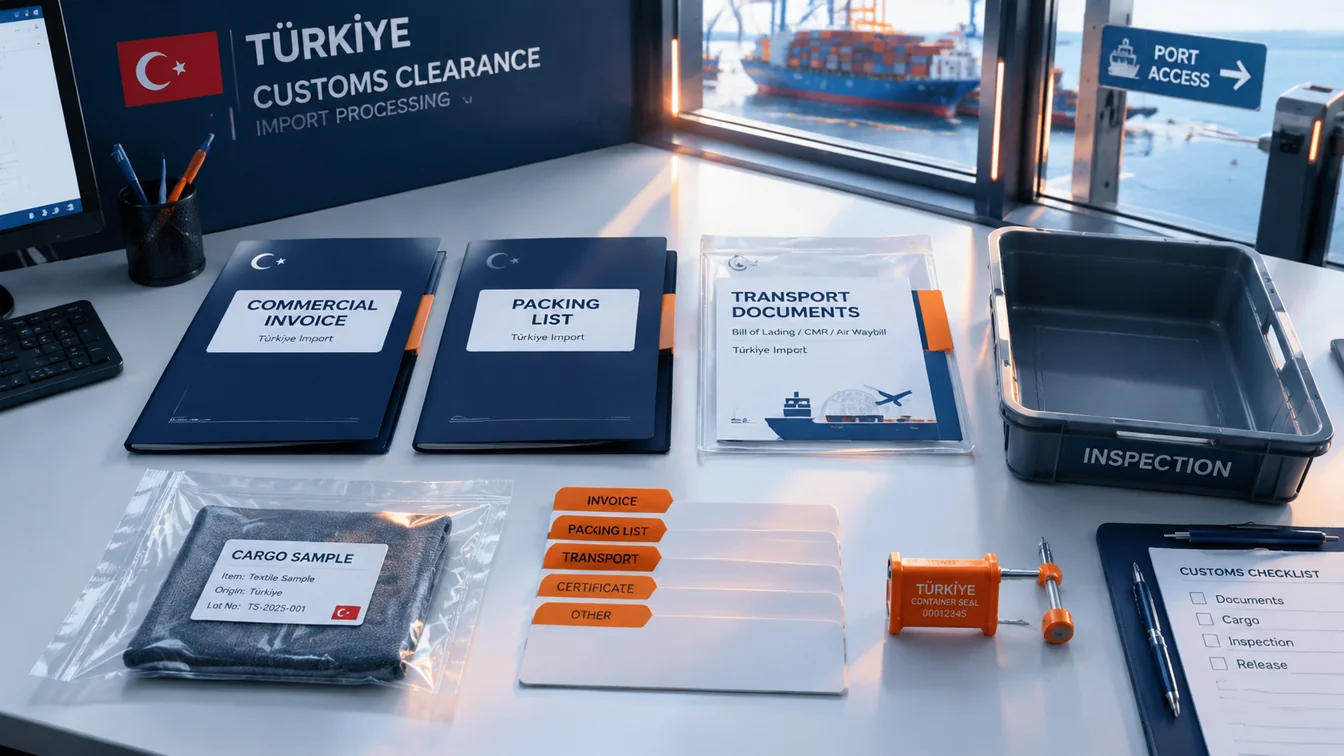
What the Türkiye Importer Normally Needs
The exact document set varies by commodity, customs regime, transaction terms, and product controls, but the importer should prepare the following core information before the cargo departs China.
- Importer Tax Number and Importer Identity The importer should have the applicable Turkish tax identification and legal entity information needed for the import process. The Ministry of Trade’s current import guidance explains who may conduct imports under Türkiye’s rules. Current Turkish import guidance should be checked for the transaction structure.
- Customs Declaration The shipment must be declared under the appropriate customs regime with accurate product, value, quantity, origin, transport, and consignee information.
- Commodity Code and Product Description The importer or representative must use the correct Turkish tariff classification and a commercially meaningful product description that matches the physical goods and supporting documents.
- Commercial Invoice The invoice should clearly identify the seller, buyer, goods, quantities, unit values, transaction terms, and currency, with details consistent with the customs declaration.
- Packing List Provide carton, pallet, package count, dimensions, gross and net weight, and packing information where required so that the customs and transport records can be reconciled.
- Transport Document The shipment may require the relevant bill of lading, sea waybill, airway bill, or other transport document matching the consignee and shipment data.
- Origin and Product-Specific Certificates Certificate of origin, conformity documents, permits, inspection records, or other certificates may be required depending on the tariff treatment and commodity. Product controls can include risk-based TAREKS checks and other agency requirements.
- Customs Representative Authorization Where an importer uses a customs representative or broker, the relevant authorization and scope should be arranged before the shipment reaches the destination gateway so that clearance responsibility is not left undefined.
The Ministry of Trade’s current digital customs documentation catalogue includes documents such as invoices, freight invoices, insurance policies, customs value declarations, transport documents, packing lists, certificates of origin, and A.TR or EUR.1 documents where applicable. Which documents are actually required depends on the transaction and product, so the shipment file should be reviewed before departure rather than copied from another commodity.
Common Causes of Türkiye Customs Delays
- Incorrect or insufficient tariff classification or a product description that does not match the goods.
- Commercial invoice values, quantities, Incoterms, or consignee information that conflict with the customs declaration.
- Missing packing details, transport documents, origin evidence, or other documents required for the selected customs regime.
- Product-specific permits, conformity requirements, testing, or risk-based controls that were not checked before dispatch.
- Unclear importer responsibility, missing authorization, or incomplete customs representative coordination.
- Unresolved duty, KDV, additional tax, or other import-payment requirements.
- Destination handling, examination, storage, or appointment requirements that were not included in the original route scope.
Resolve these issues before departure whenever possible. Customs review is easier when the importer, tariff classification, customs value, invoice, packing list, transport document, and product compliance file are aligned before the cargo reaches the Turkish gateway.
Shipping to Amazon FBA Türkiye
Amazon Türkiye currently operates Amazon Logistics (FBA), with inventory stored at contracted Amazon logistics centers in Türkiye and managed through Seller Central. Amazon FBA service planning should therefore start from the seller’s exact Amazon inventory workflow, destination assignment, product eligibility, and importer setup rather than assuming that any Amazon delivery address can receive international inventory. Amazon’s current Türkiye guidance confirms that sellers can use Amazon Logistics and create inbound inventory shipments through the platform. Amazon Türkiye’s current FBA guidance should be checked before dispatch.
For China-to-Türkiye FBA inventory, the operational handoff should be confirmed at four levels before the first shipment is booked.
- Importer of record: Amazon does not automatically become the importer of record for an international inbound shipment. The responsible importer must be identified and able to handle the applicable customs, duty, tax, and compliance obligations.
- Duty, tax, and delivery scope: Amazon Seller Central guidance for international FBA shipments states that the importer of record is responsible for duties, taxes, and fees and that inbound international shipments should use DDP terms. Confirm the current Seller Central requirements for the specific Türkiye shipment before dispatch.
- Shipment plan and labeling: The seller should create the shipment in Seller Central, follow the assigned destination and shipment-plan instructions, and ensure unit, carton, pallet, and carrier labels match the approved workflow.
- Product eligibility and compliance: Confirm category restrictions, Turkish product regulations, VAT and importer requirements, packaging and labeling rules, and any required certificates before cargo leaves the China supplier.
- Final receiving point: Do not assume that the seller’s preferred warehouse address is the final destination. Use the current Amazon-assigned fulfillment destination and quote the China supplier-to-FBA route against that actual receiving point.
FBA rules, capacity settings, fees, shipping workflows, and marketplace requirements can change. Treat the current Seller Central workflow as the controlling operational source and reconfirm the shipment plan immediately before dispatch.
Special Cargo, Packaging, and Insurance
Cargo Requiring Additional Review
- Batteries: Confirm battery chemistry, watt-hour or equivalent technical data, packaging, transport mode restrictions, and required declarations before booking.
- Dangerous goods: Provide the correct classification, SDS or relevant safety documentation, packing instructions, labels, and carrier acceptance information where required.
- Chemicals and liquids: Review product composition, transport classification, leakage controls, customs permits, and Turkish product requirements before export.
- Food: Check food-import controls, health or sanitary documents, labeling, shelf-life requirements, and any inspection requirements before dispatch.
- Cosmetics: Confirm product composition, labeling, importer obligations, and any applicable Turkish conformity or market-entry requirements.
- Medical goods: Determine whether registration, conformity, product authorization, or additional agency review applies to the specific goods.
- Wood packaging: Check whether pallets, crates, or other wooden packaging are subject to phytosanitary or treatment requirements for the selected shipment.
- Oversized cargo: Confirm dimensions, weight, lifting points, equipment availability, road restrictions, and port or delivery-site handling before pricing.
- Temperature-controlled or controlled goods: Confirm permitted temperature range, monitoring, handling, security, and any product-specific import authorization before movement.
Packaging Checks
Packaging should be planned around the complete China-to-Türkiye route, not just the factory pickup. Inspect carton strength, internal protection, pallet stability, moisture protection, handling marks, labels, dimensions, gross and net weight, and the condition of the goods after consolidation or transshipment. Where wood packaging is used, verify the applicable treatment and marking requirements before loading.
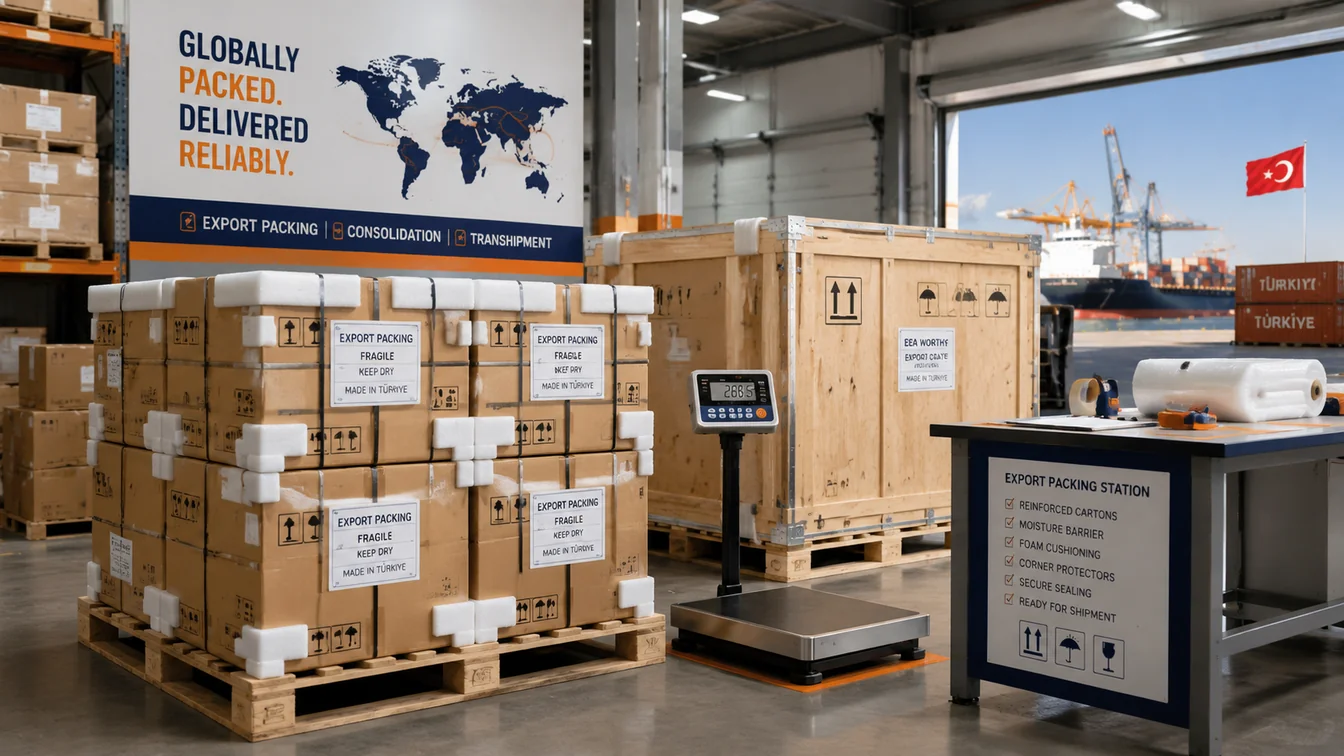
Before the supplier releases the cargo, confirm:
- Cartons can withstand stacking and handling through the selected mode.
- Internal protection prevents movement, crushing, abrasion, or moisture exposure.
- Pallets are stable, correctly sized, and compatible with the destination receiving method.
- Package labels, shipping marks, and product labels match the commercial and customs documents.
- Dimensions and weights are measured consistently and match the booking data.
- Regulated wood packaging is treated and marked where the applicable rules require it.
Cargo Insurance
Carrier liability is not the same as cargo insurance. Where the shipment value or loss exposure justifies it, confirm cargo insurance service terms before dispatch, including the insured value, covered risks, exclusions, deductible, required evidence, and coverage period from origin through the agreed delivery point.
Choosing a China to Türkiye Freight Forwarder
A freight-forwarding quotation is only comparable when the route scope is clear. Check whether each quote identifies the Chinese pickup point, origin gateway, main transport, destination gateway, customs scope, destination charges, inland delivery, insurance, delivery conditions, and the final Turkish postcode. Two prices or cost references using different units, milestones, or included charges are not like-for-like comparisons.
Why Use a Freight Forwarder for China-to-Türkiye Shipping
For a cross-border route with multiple handoffs, the practical value is coordination and scope clarity.
- One route coordination point: Supplier pickup, booking, origin handling, international transport, destination handoff, and final delivery can be coordinated against one route plan.
- Mode comparison: The shipper can compare sea, rail-based, air, express, or multimodal options against the same supplier location and final postcode.
- Document readiness: Invoice, packing list, transport information, classification details, and shipment instructions can be checked before the cargo reaches the Turkish gateway.
- Handoff visibility: The shipment can be managed around origin terminal milestones, destination arrival, customs handoff, release, and final delivery rather than focusing only on departure.
- Exception coordination: When cargo is held for documentation, inspection, destination handling, or delivery issues, the forwarder can coordinate the next action between the relevant parties.
- Scope clarity: A route quotation can distinguish transport charges from customs, taxes, inland delivery, insurance, and special handling so that the shipper can evaluate the total commercial exposure.
A freight forwarder does not replace the importer of record, Turkish customs authority, legally required customs representative, product-compliance owner, or legal and tax adviser. Those responsibilities must remain with the party that is legally responsible for them under the transaction and applicable regulations.
Why Choose TJ for China-Türkiye Shipping
TJ’s route-planning approach can be structured around the supplier’s actual China location, the applicable sea, rail-based, air, express, multimodal, or door-to-door option, the destination gateway, the customs handoff, and the final Turkish postcode. The quotation should be built around the requested delivery scope rather than around a transport mode alone.
- Compare the practical gateway and mode options for the supplier’s factory or warehouse location.
- Coordinate origin pickup, export handling, destination handoffs, and shipment-status milestones.
- Support the preparation and organization of shipment documents needed for the planned route.
- Build the quotation around the final postcode and clearly requested customs and delivery scope.
Get a China to Türkiye freight quotation by sending the supplier city or postcode, cargo description, quantity, CBM or chargeable weight, package dimensions and weights, cargo-ready date, preferred transport mode if known, destination postcode, importer details, and any customs, FBA, dangerous-goods, temperature-control, or special-delivery requirements.
Frequently Asked Questions
How long does sea freight from China to Türkiye take?
The supplied planning reference is 25–45 days for both FCL 20GP and FCL 40GP, and 28–40 days for LCL. These values do not define the exact start and end milestones, so supplier pickup, origin handling, destination customs, and final delivery must be confirmed separately.
Which major China ports handle cargo for Türkiye?
Shanghai, Ningbo-Zhoushan, Shenzhen/Yantian, Qingdao, Xiamen, and Guangzhou Nansha are practical gateways to compare depending on the supplier region. Shanghai and Ningbo-Zhoushan are especially relevant to East China, Yantian and Nansha to South China, and Qingdao to Shandong and North China.
Which Türkiye port should I compare for my final destination?
Ambarli is a key comparison for Istanbul and wider Marmara, Yarımca for Kocaeli and eastern Marmara, Gemlik for Bursa and southern Marmara, Aliaga for Izmir and the Aegean, and Mersin for Southern Türkiye. The final choice should be based on the exact postcode, inland distance, destination handling, and current service.
Can I ship from China to Türkiye door-to-door?
Yes, a door-to-door route can be coordinated from the China supplier through the selected Turkish gateway and onward to the final delivery point. The quotation must still identify the importer, customs scope, duties and taxes, destination charges, inland delivery, and the exact postcode or delivery conditions.
What documents are required to ship from China to Türkiye?
The core file normally includes a commercial invoice, packing list, transport document, customs declaration data, tariff classification, and customs-value information, with certificates of origin, conformity documents, permits, or inspections added when applicable. The Turkish Ministry of Trade’s current import guidance and document catalogue should be checked for the specific commodity and customs regime.
Is rail or rail-based shipping from China to Türkiye available?
Rail-based China-to-Türkiye routing can be used when a suitable corridor and service are available, but it should not be assumed to be a single direct train movement. The supplied Rail 40GP planning reference is 15–25 days, and the exact corridor, transfers, border handling, and delivery scope must be confirmed for the booking date.
What does the Türkiye importer need before customs clearance?
The importer should have the applicable tax identification, importer details, correct tariff classification, customs value, commercial invoice, packing information, transport document, and any required permits or conformity evidence ready before arrival. The importer or authorized representative remains responsible for the declaration and applicable duties and taxes.
Can TJ arrange delivery to Amazon FBA in Türkiye?
China-origin inventory can be planned for Amazon Logistics in Türkiye when the seller’s product, shipment plan, importer arrangement, and Amazon receiving requirements are satisfied. Amazon’s current guidance requires the international inbound shipment to have an importer of record and follow its applicable DDP and shipment-plan rules, so the assigned fulfillment destination and current Seller Central instructions must be confirmed before dispatch.