

Reviewed by TJ Logistics Team — Content and cost data reviewed November 2026. Market, cost, customs, tariff, and marketplace information can change; verify current requirements before booking or dispatch. This review applies practical route-planning checks across supplier pickup, gateway and mode selection, customs handoff, and final delivery.
Shipping from China to Mexico: Route Update
A Shanghai-to-Manzanillo FCL 20GP sailing is an indicative $6,100 per container with a 20–25 day planning transit, while LCL via Manzanillo or Lázaro Cárdenas runs $80–$150 per CBM over 24–40 days. The route that fits a given shipment depends on whether the cargo fills a container, how fast it must arrive, and whether the final delivery address can receive ocean or air freight without adding an unsupported inland leg.
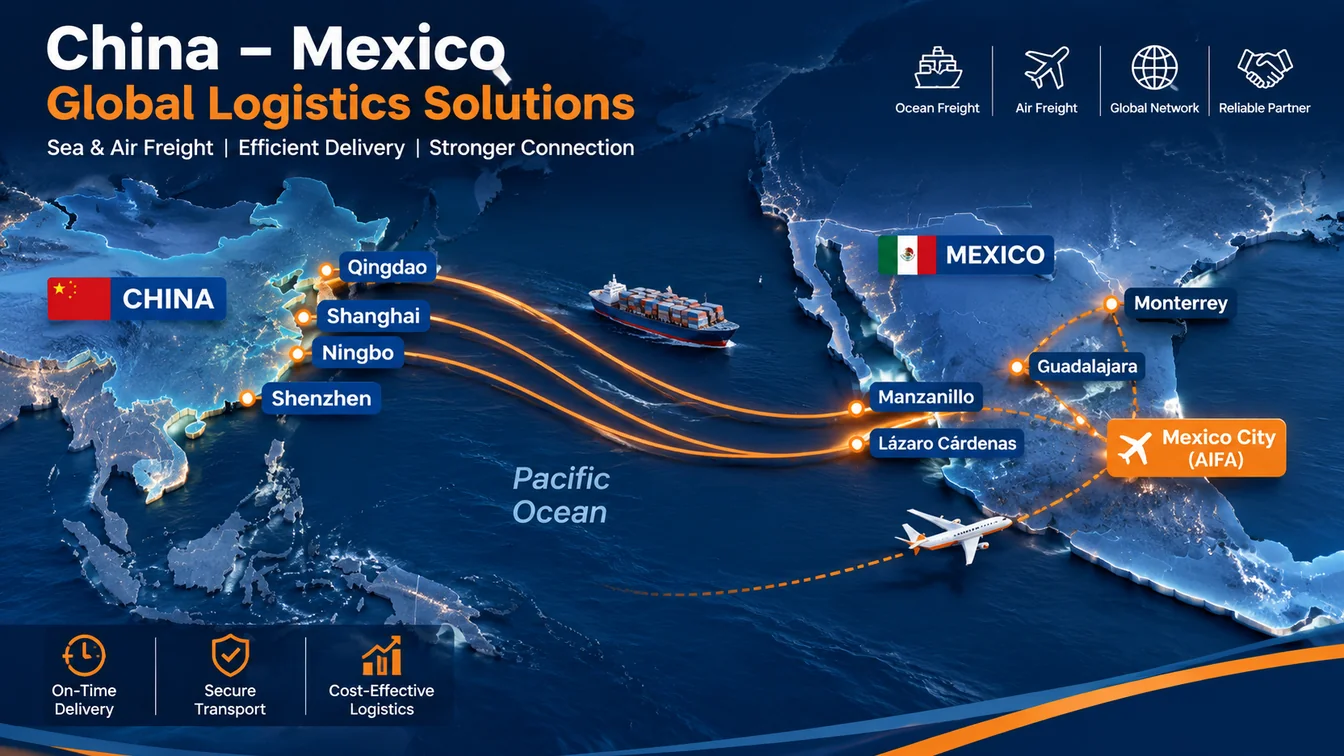
FCL is the normal choice when the cargo reaches container scale and the receiver can accept port or door delivery after customs clearance; air freight and express protect schedule when chargeable weight is low relative to urgency. The cost table below places the supplied references beside the method that produces them, so the next decision is method fit rather than a single “cheapest” label. Sea freight service scope and booking availability can be reviewed through TJ sea freight; time-critical cargo can be matched against air freight before committing to a port-to-port plan.
Route Planning Summary
- How does cargo move from a China supplier to the first gateway?
-
Supplier pickup or factory loading normally feeds the nearest major China export seaport or airport that has a credible sailing or flight toward Mexico. Shanghai, Ningbo-Zhoushan, Shenzhen/Yantian, and Qingdao are the main ocean origin candidates; the actual choice follows the supplier’s province, the cargo ready date, and the destination port nominated for Mexican clearance.
- Which transport mode fits a China-to-Mexico shipment?
-
FCL suits container-scale cargo that can wait 20–25 days port-to-port from Shanghai to Manzanillo; LCL fits smaller volumes that cannot justify a container; air freight and express fit urgent or low-weight cargo. The mode decision should be made before comparing prices across unlike units.
- What planning transit should be used for the main leg?
-
The supplied FCL reference is 20–25 days from Shanghai to Manzanillo, and the air reference is 7–13 days from Shanghai Pudong to Mexico City AIFA. These are main-leg planning references, not door-to-door guarantees; customs and inland delivery add separate time that must be planned rather than assumed.
- Who is responsible for Mexican import clearance?
-
The Mexican importer of record, acting through a licensed customs broker (agente aduanal or apoderado aduanal), files the pedimento and pays applicable IGI, IVA, and DTA. A foreign seller or freight forwarder cannot substitute for the importer’s RFC registration and Padrón de Importadores obligations.
- How far does final delivery extend beyond the Mexican gateway?
-
Final delivery may stop at the port or airport, or continue by truck or rail to Mexico City, Guadalajara, Monterrey, or another inland destination. The agreed service scope should state whether the forwarder arranges that inland leg or whether the importer’s own carrier collects from the gateway.
China to Mexico Shipping Cost
The table provides route-specific indicative shipping costs and planning transit references for the November 2026 review. Each reference applies to the named route, method, and unit shown in its row.
| Shipping route | Shipping method | Price | Transit time |
|---|---|---|---|
| Shanghai, China → Manzanillo, Mexico | FCL 20GP | $6,100/container | 20–25 days |
| Shanghai, China → Manzanillo, Mexico | FCL 40GP | $6,250/container | 20–25 days |
| Shanghai, China → Manzanillo, Mexico | FCL 40HQ | $6,250/container | 20–25 days |
| China → Manzanillo / Lázaro Cárdenas, Mexico | LCL | $80–$150/CBM | 24–40 days |
| Shanghai Pudong (PVG), China → Mexico City AIFA (NLU), Mexico | Air freight | $5.00–$6.20/kg | 7–13 days |
| Shenzhen, China → Benito Juárez, Mexico | Express | $30.71–$52.09/kg | 5–9 days |
Cost scope: The indicative cost references above apply to the route, method, and unit shown; they are not carrier freight rates, market averages, TJ selling prices, or binding quotations. The actual booking, cargo, and agreed service scope determine the commercial arrangement, including responsibility for relevant pickup, handling, customs, duty and tax, inland delivery, insurance, storage, examination, appointment, and surcharge items.
Mexico Import Duty and Taxes
Mexican import duty depends on the tariff classification under the TIGIE, the customs value, the origin of the goods, and any applicable trade measures. China and Mexico do not have a free trade agreement, so Chinese-origin goods generally face the published IGI rate rather than a preferential rate. As of the review month, official guidance and trade reporting indicate that duties on a broad set of tariff lines from countries without a trade agreement, including China, were adjusted upward starting 1 January 2026; the exact rate must be verified against the specific tariff fraction before dispatch. [reference:0]
Use the following sequence to estimate the Mexican tax stack for a China-origin shipment.
- Classify the product under the correct TIGIE fracción arancelaria. The tariff fraction drives the IGI rate and any non-tariff regulation. Misclassification is a common cause of adjustment or delay at Mexican customs, so classification should be confirmed before the pedimento is prepared.
- Establish the customs value. Mexican customs value is normally built on the transaction value, including freight and insurance to the Mexican border where applicable. The declared value must be supported by the commercial invoice and, where customs questions it, additional evidence of the transaction.
- Apply the General Import Tax (IGI). The IGI rate is taken from the TIGIE schedule for the classified fraction. Chinese-origin goods do not receive USMCA, EU, CPTPP, or Pacific Alliance preference, so the MFN or applicable general rate normally governs unless a valid preferential or sectoral programme applies.
- Add the Value Added Tax (IVA). IVA is generally 16% of the customs value plus IGI and other applicable charges; an 8% rate applies in the northern and southern border regions under current rules. IVA is a tax on the importer and may be recoverable depending on the importer’s tax position.
- Add the customs processing fee (DTA) and any applicable IEPS or anti-dumping duty. The DTA is a fee calculated on customs value, and the IEPS special tax or a Ministry of Economy anti-dumping order may apply to specific product categories. The simplified explanation here is a planning aid, not tax or legal advice; the importer’s customs broker and tax adviser should confirm the final calculation. ANAM provides the official import framework and SAT administers the pedimento and RFC system.
China to Mexico Shipping Time
A Shanghai-to-Manzanillo FCL shipment has a supplied planning transit of 20–25 days; that figure describes the main ocean leg and does not include supplier pickup, export handling, Mexican customs clearance, or inland delivery. An LCL shipment via Manzanillo or Lázaro Cárdenas carries a supplied planning range of 24–40 days, which reflects the additional consolidation and deconsolidation steps typical of LCL routing. Air freight from Shanghai Pudong to Mexico City AIFA is supplied at 7–13 days, and express from Shenzhen to Benito Juárez at 5–9 days.
Sea transit from China to Mexico should be read as a port-to-port reference rather than a date-certain delivery commitment. Schedules, blank sailings, port dwell time, and the customs clearance sequence can move the actual arrival and availability date; a shipment that must meet a fixed delivery window should plan backward from the receiver’s required date and treat the supplied transit range as one input, not the whole timeline.
Shipping Methods from China to Mexico
Choose FCL when the cargo fills or nearly fills a 20GP, 40GP, or 40HQ container, because the container can be sealed at the supplier and moved as one unit to Manzanillo or Lázaro Cárdenas without LCL consolidation. The condition that changes this recommendation is cargo volume below the point where a container can be economically justified; in that case LCL becomes the practical sea option, provided the longer 24–40 day planning range fits the receiver’s schedule.
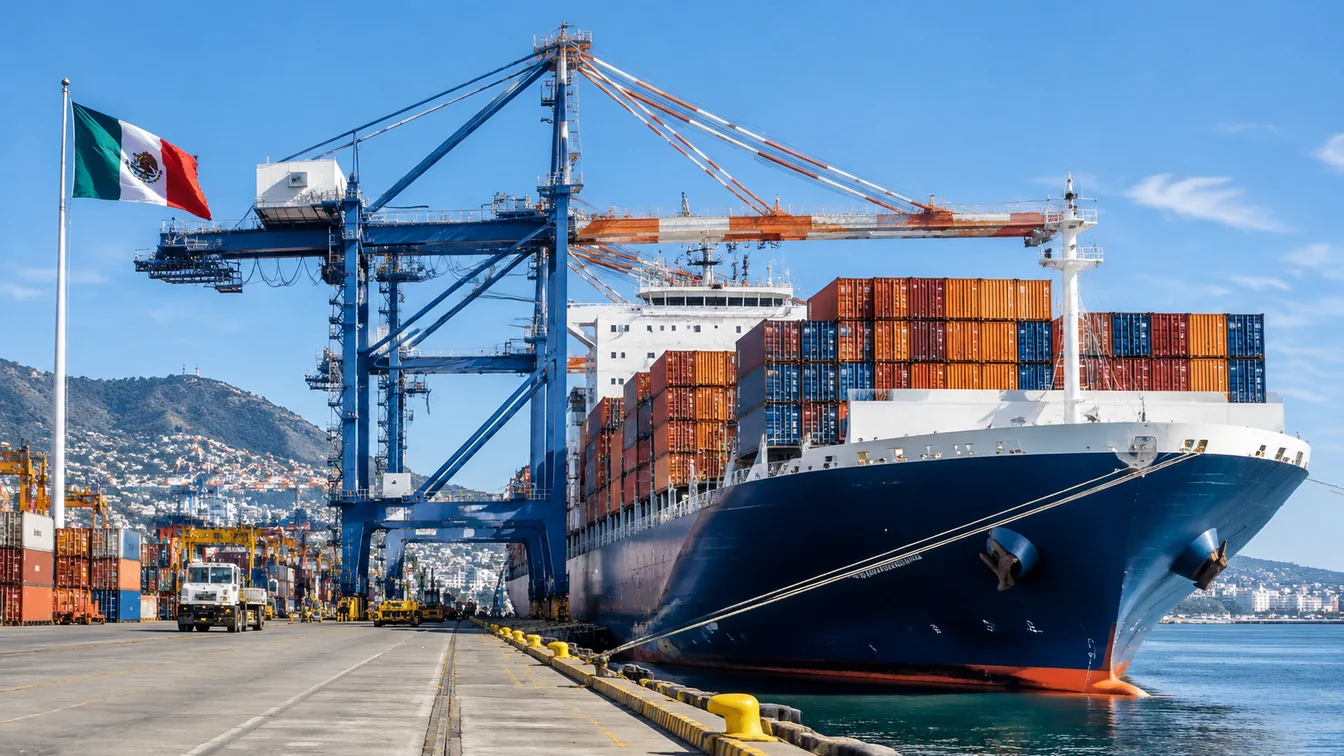
Choose LCL when the shipment does not reach container scale and the buyer can accept consolidation and deconsolidation, because the supplied $80–$150 per CBM reference is charged on volume rather than a full container. The condition that can make LCL less suitable is cargo that is time-sensitive, unusually fragile, or subject to special handling at the consolidation warehouse; those shipments may be better served by air or by a dedicated container even if the volume does not fill it.
Choose air freight when the shipment’s urgency or value density justifies a per-kilogram cost, because the supplied Shanghai Pudong–Mexico City AIFA reference of $5.00–$6.20/kg over 7–13 days trades cost for speed and avoids the longer ocean transit. The condition that changes the calculation is the chargeable weight: air freight is billed on the greater of actual weight and volumetric weight, so low-density cargo can reach a chargeable weight far above its physical weight.
Choose express when the shipment is small, urgent, and moving to a city served by the express network, because the supplied Shenzhen–Benito Juárez reference of $30.71–$52.09/kg over 5–9 days provides a door-oriented option without a separate ocean booking. The condition that can make express unsuitable is cargo that exceeds the carrier’s size, weight, or commodity limits, or a delivery address outside the express network’s standard coverage. Express shipping and multi-modal freight can be compared when a single mode does not fit the shipment’s actual profile.
Door-to-Door Shipping from China to Mexico
A door-to-door China-to-Mexico movement connects the supplier’s premises to the receiver’s final address through a defined sequence of handoffs; the scope must state whether each handoff is included or arranged separately. The eight steps below trace that sequence so the buyer can see where responsibility changes.
-
Cargo and Compliance Review
The shipment’s commodity, HS classification, dimensions, weight, value, and destination are reviewed before a route is fixed, because the TIGIE fraction determines the duty rate and any NOM or licensing requirement. Cargo that may require a NOM certificate or a regulated-goods review is flagged at this stage rather than after booking.
-
Route and Method Selection
A mode and gateway are selected against the supplier location, cargo size, urgency, and final delivery region. Shanghai, Ningbo-Zhoushan, Shenzhen/Yantian, and Qingdao are compared as origin gateways; Manzanillo, Lázaro Cárdenas, Veracruz, and Altamira are compared as Mexican entry points depending on the receiver’s inland destination.
-
Supplier Coordination and Pickup
The supplier is given a cargo-ready date, pickup window, and loading instructions that match the chosen mode. For FCL, the container is positioned for factory loading; for LCL or air, the cargo is moved to the consolidation or airport facility with the documents required for export.
-
China Export Handling
The export declaration, commercial invoice, packing list, and transport document are prepared or checked before the cargo leaves China. Any export licence or certificate required for the commodity is confirmed at this stage so the shipment is not held at the origin gateway.
-
International Transportation
The main leg moves by the selected mode: ocean to Manzanillo or Lázaro Cárdenas for FCL and LCL, or air to Mexico City AIFA for air freight. The main-leg transit is tracked against the planning reference, and any schedule change is communicated before it affects the downstream handoff.
-
Mexico Import Clearance
The Mexican importer or its licensed customs broker files the pedimento, presents the invoice, transport document, and any NOM certificate or permit, and pays IGI, IVA, DTA, and applicable IEPS or anti-dumping duty. Clearance cannot be completed without an active RFC and, for formal commercial imports, Padrón de Importadores registration.
-
Final Delivery
The cleared cargo moves from the port or airport to the receiver’s address by truck or rail. Manzanillo and Lázaro Cárdenas have rail connections toward Mexico City and Guadalajara, while Veracruz and Altamira serve the Gulf-coast and eastern corridors; the final delivery scope should state which carrier performs this leg and who pays for it.
-
Shipment Close-Out
Proof of delivery, the final cost reconciliation, and any customs or carrier documentation are returned to the parties responsible for closing the shipment. Any exception — a customs adjustment, a storage charge, or a delivery re-schedule — is recorded so the next China-to-Mexico shipment can be planned with better inputs.
Main China to Mexico Routes
The most practical China-to-Mexico ocean route normally starts at the major China export gateway closest to the supplier that has a credible sailing toward the Mexican port serving the final delivery region. That comparison changes when the supplier is inland, when the receiver’s postcode is closer to a Gulf-coast port than to a Pacific port, or when the required equipment is not available at the first-choice gateway.
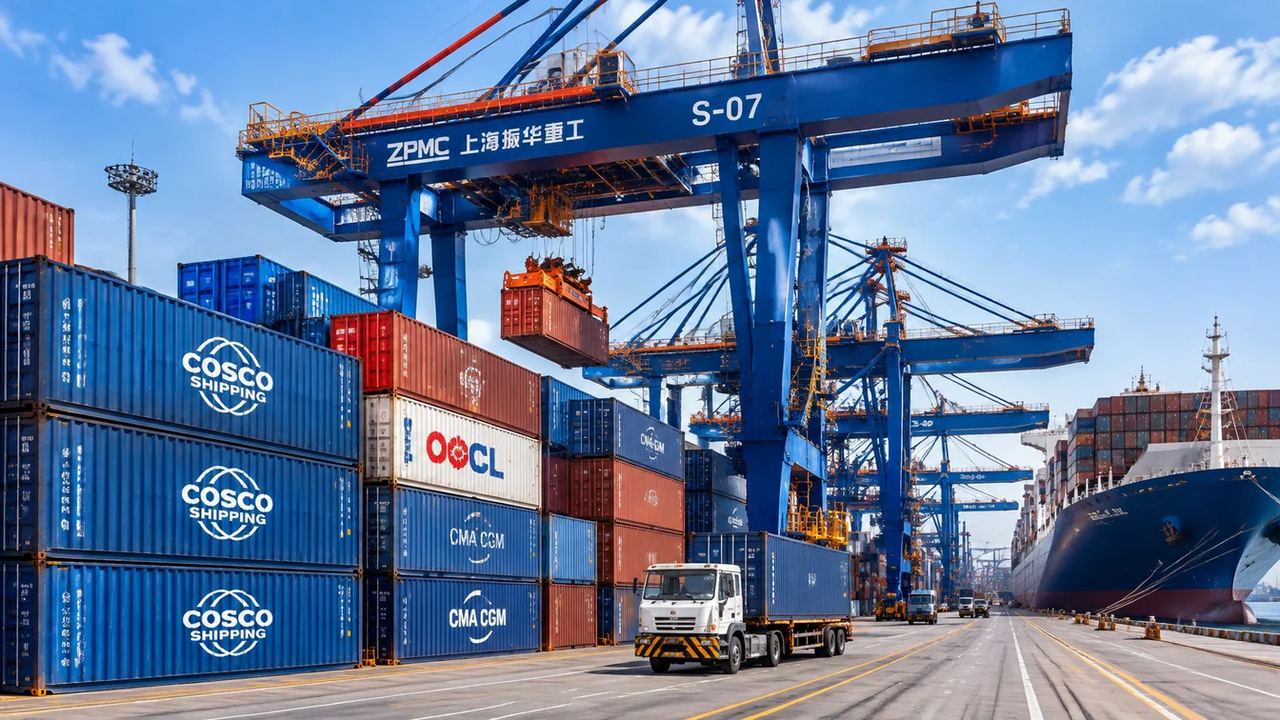
Major China Export Ports for Mexico Shipping
- Shanghai
- A major east-coast gateway with direct transpacific sailings toward Manzanillo and Lázaro Cárdenas, serving suppliers in the Yangtze River Delta and eastern China. It is a practical origin for cargo that can reach Shanghai by truck or feeder and does not need a southern or northern port diversion.
- Ningbo-Zhoushan
- A high-volume east-coast port that frequently appears on Asia–Mexico port rotations alongside Shanghai, with sailings toward Manzanillo and Lázaro Cárdenas. Suppliers in Zhejiang and the wider Yangtze Delta can compare Ningbo when Shanghai schedules or terminal handling do not fit the cargo-ready date.
- Shenzhen/Yantian
- A south China gateway with direct services toward Manzanillo and a strong position for suppliers in Guangdong and the Pearl River Delta. It is often the closest ocean origin for electronics, consumer goods, and other light manufactured cargo from south China.
- Qingdao
- A north China port that appears on some Asia–Mexico rotations and serves suppliers in Shandong and northern China. It is a relevant comparison when the supplier is closer to Qingdao than to Shanghai or Ningbo, and when the sailing schedule aligns with the required departure window.
Major Mexico Import Ports for Cargo from China
- Manzanillo
- Mexico’s leading container gateway on the Pacific coast, handling the largest share of the country’s containerized cargo and serving as the primary entry point for Asia-origin shipments. It connects by rail and road toward Mexico City, Guadalajara, and the central manufacturing belt, making it the default comparison for many China-to-Mexico FCL and LCL shipments.
- Lázaro Cárdenas
- A Pacific port that has become the second major container gateway for Mexican imports and appears on direct Asia–Mexico rotations. It has rail connections toward Mexico City, Cuautitlán, Tula, and Guadalajara, and is a credible alternative to Manzanillo when schedules, terminal congestion, or inland routing favor the Michoacán corridor.
- Veracruz
- A Gulf-coast port that serves the eastern and central Mexican market and is a practical entry point for cargo destined toward Mexico City or the Gulf-coast industrial corridor. It is a relevant comparison when the final delivery address is closer to the Gulf coast than to the Pacific ports.
- Altamira
- A Gulf-coast port serving northeastern Mexico and the Monterrey industrial region. It is a credible entry point when the receiver’s final destination is in Nuevo León, Tamaulipas, or the broader northeast, and when the ocean schedule and inland truck availability support it.
Supplier Region to Destination Routing Logic
| Supplier region in China | Origin port to compare | Destination port and delivery region | Planning reason |
|---|---|---|---|
| Yangtze River Delta (Shanghai, Jiangsu, Zhejiang) | Shanghai or Ningbo-Zhoushan | Manzanillo, then rail or truck to Mexico City or Guadalajara | Direct transpacific sailings and the shortest supplier-to-origin movement. Change the pattern if Ningbo offers a better sailing date or if the final postcode is closer to Lázaro Cárdenas. |
| Pearl River Delta (Guangdong, Shenzhen) | Shenzhen/Yantian | Manzanillo, then inland to Mexico City or Guadalajara | South China cargo avoids a northbound feeder to Shanghai or Ningbo. Change the pattern if a direct Yantian sailing is not available and a Ningbo or Shanghai sailing produces a better total route. |
| Shandong and northern China | Qingdao | Manzanillo or Lázaro Cárdenas, then rail toward Mexico City or Guadalajara | Qingdao can reduce supplier-side trucking for northern cargo. Change the pattern if the Qingdao sailing schedule adds more waiting time than the inland saving justifies. |
| Yangtze Delta or south China cargo destined to northeastern Mexico | Shanghai, Ningbo, or Shenzhen/Yantian | Altamira, then truck to Monterrey or the northeast | Altamira can shorten the final inland leg for Nuevo León and Tamaulipas receivers. Change the pattern if the Pacific-port sailing frequency and inland rail economics produce a lower total landed route. |
Destination Regional Delivery Logic
- Central Mexico (Mexico City, Estado de México, Querétaro)
- Manzanillo and Lázaro Cárdenas are the main Pacific entry points, with rail corridors toward Mexico City and the Bajío. The gateway choice should weigh sailing availability, port dwell time, and the rail or truck rate to the final postcode rather than assuming one port is always faster.
- Western Mexico (Guadalajara, Jalisco)
- Manzanillo is the closest major Pacific gateway to Guadalajara and is supported by rail and road connections. Lázaro Cárdenas is a secondary comparison when schedules or terminal conditions favor the Michoacán corridor, but the inland distance to Guadalajara should be priced before the route is fixed.
- Northeastern Mexico (Monterrey, Nuevo León, Tamaulipas)
- Altamira is the natural Gulf-coast gateway for Monterrey and the northeast, while Manzanillo and Lázaro Cárdenas can be compared when Pacific sailings are stronger. The decision should include the inland truck or rail cost from each gateway to the receiver’s postcode.
- Gulf-coast and eastern Mexico (Veracruz, Puebla, eastern corridor)
- Veracruz serves the Gulf-coast and central-eastern market and may reduce inland distance for receivers in its hinterland. Pacific ports remain relevant when their sailing frequency or equipment availability outweighs the shorter inland leg from Veracruz.
How the Gateway Is Selected
Gateway selection should follow the supplier’s location and the receiver’s delivery region before price is compared across ports.
- Confirm the supplier’s province and the nearest major China export port with a credible Mexico sailing; do not assume a distant port is cheaper before adding feeder or truck cost.
- Compare the Mexican entry port against the final delivery postcode, including the inland rail or truck leg, rather than treating the ocean port as the endpoint.
- Check current sailing frequency and equipment availability at each candidate gateway, because a port that appears cheaper can lose its advantage if the next available sailing is later.
- Match the gateway to the cargo’s clearance profile: a port with the right customs infrastructure and NOM or regulated-goods handling is preferable to a nominally cheaper port that adds examination or storage risk.
- Record the agreed service boundary at the selected gateway so the importer, customs broker, and inland carrier know who arranges and pays for each handoff.
Mexico Customs Clearance
Importing into Mexico requires a Mexican importer of record, an accurate pedimento, product-specific compliance documents, and payment of applicable duties and taxes. The rules apply across Mexican customs territory; special customs zones and border regions have separate tax treatment that should be verified for the specific entry point.

What the Mexico Importer Normally Needs
A formal commercial import into Mexico normally requires the following elements before the pedimento can be filed and the cargo released.
- RFC tax registration The importer must be registered in the Registro Federal de Contribuyentes and be current with its tax obligations. The RFC is declared on the pedimento and is a prerequisite for formal import clearance. SAT administers the RFC system.
- Padrón de Importadores registration Importers bringing goods into Mexico must be enrolled in the Padrón General de Importadores; specific product categories may also require sectoral registration. The registration is completed through the SAT portal and should be active before the shipment arrives.
- Licensed customs broker The pedimento is filed through a licensed agente aduanal, apoderado aduanal, or legal representative authorized by SAT. The broker is responsible for the declaration’s accuracy and for presenting the supporting documents to customs.
- Pedimento and tariff classification The pedimento identifies the importer, the goods, the TIGIE fracción arancelaria, the customs value, and the applicable contributions. The classification should be confirmed before the pedimento is transmitted, because an incorrect fraction can trigger a reclassification or a fine.
- Commercial invoice and packing list The invoice must describe the goods, quantity, unit value, currency, seller and buyer, and terms of sale in enough detail to support the declared customs value. The packing list should match the invoice and the transport document.
- Transport document The bill of lading for ocean freight or air waybill for air freight identifies the consignee and the port or airport of entry. The consignee on the transport document should align with the importer of record used on the pedimento.
- NOM certificate or permit where applicable Products subject to a Norma Oficial Mexicana require a NOM certificate or compliance evidence before customs release. The applicable NOM depends on the product category, and the certificate must be presented with the other import documents.
- Agent authorization and importer identification The customs broker acts under a power of attorney or mandate from the importer, and the importer’s RFC, name, and address on the pedimento must match its tax registration. Any discrepancy between the commercial documents and the tax identity should be corrected before filing.
Common Causes of Mexico Customs Delays
- An incorrect or unsupported TIGIE classification, which can lead to a reclassification, a value adjustment, or a requirement for additional documentation.
- A missing or expired NOM certificate for a product category that requires one, particularly electronics, apparel, toys, and footwear.
- An importer RFC that is not active or not enrolled in the Padrón de Importadores, preventing the pedimento from being processed in the normal commercial regime.
- Commercial invoice values that customs considers below the estimated price for the tariff fraction, triggering a guarantee or deposit requirement.
- Inconsistent consignee, importer, and buyer names across the invoice, transport document, and pedimento.
- Cargo that arrives before the customs broker has received the complete document set, adding storage or demurrage time at the port or airport.
- A missing permit or official authorization for a regulated product category, including certain chemicals, medical goods, or agricultural products.
These issues should be resolved before the shipment departs China, because a document gap discovered at the Mexican gateway is harder and more expensive to fix than the same gap corrected before booking.
Shipping to Amazon FBA Mexico
Amazon Mexico operates a local FBA fulfilment route, and Amazon states that it and its fulfilment centres will not serve as the importer of record for FBA inventory shipments. A seller shipping inventory to Amazon Mexico must therefore establish a Mexico-based importer of record with an RFC and ensure that the product category meets the applicable NOM certification and Spanish-language labeling requirements before the inventory is sent to the fulfilment centre. [reference:1]
Product eligibility, the shipment plan, carton labeling, and the assigned fulfilment centre must be confirmed in Seller Central before dispatch. Amazon Mexico may apply category restrictions or dangerous-goods review, and the FBA shipment should not be planned on the assumption that the marketplace will handle customs entry or duty payment. The seller’s importer of record remains responsible for the pedimento, the IGI, IVA, and DTA, and any NOM compliance evidence required for the product category. TJ Amazon FBA support can be reviewed where the seller needs the China-side handoff coordinated with the Mexico import entity’s customs arrangements.
Special Cargo, Packaging, and Insurance
Cargo Requiring Additional Review
- Lithium batteries and battery-powered devices, which may require transport documentation, state-of-charge limits, and carrier acceptance before booking.
- Dangerous goods, chemicals, and liquids, which must be classified and declared before the mode and packaging are confirmed.
- Food, cosmetics, and medical goods, which may require health or sanitary registration in addition to customs documents.
- Wood packaging, including crates and pallets, which may be subject to ISPM 15 treatment and marking requirements.
- Oversized or temperature-controlled cargo, which needs equipment and handling confirmed before the route is priced.
- Controlled or regulated goods, where a permit, licence, or restricted-party check may apply.
Packaging Checks
Packaging for a China-to-Mexico shipment should match the mode, the handling environment, and the inland delivery leg, because damage discovered after customs clearance is difficult to attribute and recover.
- Use carton strength and internal protection appropriate to the cargo’s weight, fragility, and stacking height.
- Confirm pallet dimensions and load stability where the cargo will be handled as a unit at the port or fulfilment centre.
- Add moisture protection for ocean or humid-climate movements, and use handling marks and labels that remain legible after transit.
- Record carton dimensions and weights before dispatch, because dimensional and weight data affect chargeable weight and inland handling.
- Verify that any wood packaging is treated and marked to the applicable standard before it reaches the export gateway.
Cargo Insurance
Carrier liability is not the same as cargo insurance: the carrier’s liability is normally limited by the transport convention or bill of lading terms, while cargo insurance can cover loss or damage beyond those limits. Coverage, exclusions, deductible, insured value, claim evidence, and the period during which a claim can be made should be confirmed before the shipment departs, so the insured party knows what is covered at each handoff. Cargo insurance can be arranged alongside the transport booking when the shipment value or handling profile justifies it.
Why Use a Freight Forwarder for Shipping from China to Mexico?
A freight forwarder helps a China-to-Mexico buyer turn cargo facts into a workable shipment definition, compare credible route and gateway options, and keep the commercial and operational handoffs aligned from supplier pickup through Mexican clearance and final delivery. The forwarder does not replace the Mexican importer of record, the customs broker, the product-compliance owner, or the importer’s tax adviser.
- Shipment definition without a spreadsheet of unknowns
- A forwarder converts the supplier’s cargo details, ready date, destination address, and delivery requirement into a movement definition that can be quoted and executed. The definition changes if the cargo turns out to be regulated, if the receiver cannot accept a port-only delivery, or if the supplier’s loading capability does not match the chosen equipment.
- Route and gateway matching against the actual cargo
- A forwarder compares FCL, LCL, air, and express options against the shipment’s urgency, volume, weight, and final delivery area, rather than presenting a single mode as universally appropriate. The comparison can change when a sailing schedule, a terminal condition, or a final-postcode delivery constraint shifts the practical choice.
- Commercial and operational handoff coordination
- A forwarder records the agreed service boundary and the parties responsible for pickup, export handling, main transport, customs, and inland delivery, so the importer knows which handoff it owns and which handoff the forwarder coordinates. The boundary can change when the buyer adds or removes an inland leg, or when the Mexican importer’s customs arrangements require a different document flow.
How TJ Logistics Team Plans a China-to-Mexico Shipment
- Defined-shipment review
- TJ Logistics Team reviews the cargo description, supplier location, ready date, destination address, and any known compliance or delivery constraint, and flags the missing input that would prevent a reliable next decision. Customs brokerage coordination is reviewed at this stage when the Mexican importer’s clearance arrangements affect the route.
- Transport and gateway comparison
- The team compares credible ocean, air, express, and gateway options against the defined shipment, including the origin port or airport, the Mexican entry point, and the inland delivery leg. The comparison records the reason one option fits better, rather than presenting every mode as equally suitable.
- Service boundary and handoff record
- Before a formal commercial arrangement is prepared, the team records the agreed scope and the responsible party for each handoff: supplier pickup, export handling, main transport, Mexican customs, and final delivery. Door-to-door shipping is reviewed where the agreed scope includes the full handoff chain.
- Booking, documents, and change management
- After the buyer confirms the scope, TJ Logistics Team coordinates booking information, commercial documents, and the cargo handoff, and flags the next operational decision if timing, route, document, or receiving conditions change. The team does not guarantee a carrier booking or a customs outcome; it keeps the information flow aligned so the responsible parties can act on the change.
China to Mexico Shipping FAQ
How much does a 20ft container from China to Mexico cost?
A Shanghai-to-Manzanillo FCL 20GP shipment is listed at an indicative $6,100 per container for the November 2026 review, with a 20–25 day planning transit. This is a route-specific cost reference, not a carrier rate or a door-to-door quotation; the booking scope and the importer’s customs arrangements can change the total commercial arrangement.
How long does sea freight from China to Mexico take?
Sea freight from Shanghai to Manzanillo has a supplied planning transit of 20–25 days for FCL, while LCL via Manzanillo or Lázaro Cárdenas is listed at 24–40 days. These are main-leg references; Mexican customs clearance and inland delivery to Mexico City, Guadalajara, or Monterrey should be planned as additional time rather than assumed to be included.
What is the most cost-effective way to ship from China to Mexico?
LCL is the lower-cost sea option for cargo that does not fill a container, with a supplied reference of $80–$150 per CBM over 24–40 days, while FCL becomes more practical when the cargo reaches container scale and can use a 20GP or 40HQ. The practical default is LCL for small volumes and FCL for container-scale cargo; air or express should be compared only when urgency or cargo value justifies the higher per-kilogram cost.
Which China port is best for shipping to Mexico?
The practical default is the major China export port closest to the supplier that has a credible sailing toward the Mexican gateway serving the final delivery region. Shanghai and Ningbo-Zhoushan serve Yangtze Delta suppliers toward Manzanillo and Lázaro Cárdenas; Shenzhen/Yantian serves south China cargo toward Manzanillo; Qingdao can suit northern suppliers. No single port is universally best, and the comparison should include the inland cost from the Mexican port to the receiver’s postcode.
Can I ship door-to-door from China to Mexico?
Door-to-door service can connect the China supplier to a Mexican delivery address, but the scope must state whether it includes Mexican customs clearance and the inland leg, because the importer of record remains responsible for the pedimento and duty payment. A door-to-door plan should identify the Mexican importer, the customs broker, and the party that arranges the final truck or rail move; without those handoffs, the service is not truly door-to-door.
What documents should be prepared before shipping from China to Mexico?
A formal Mexico import should prepare the commercial invoice, packing list, bill of lading or air waybill, the importer’s RFC and Padrón de Importadores registration, and the pedimento filed through a licensed customs broker. Products subject to a NOM standard also need the applicable NOM certificate or compliance evidence, and the invoice and transport document should identify the same importer used on the pedimento.
Why can two China-to-Mexico shipping costs differ?
Two China-to-Mexico costs can differ because they may cover different service scopes, such as port-to-port versus door-to-door, or because they use different gateways and inland legs that carry different charges. A quotation that excludes Mexican customs, duty, IVA, DTA, or final delivery is not directly comparable to one that includes those items, even when the ocean or air reference looks similar.
Does Amazon FBA Mexico require a Mexican importer of record?
Amazon Mexico FBA requires a Mexico-based importer of record with an RFC, because Amazon states that it and its fulfilment centres will not serve as the importer of record for FBA inventory. The seller must also meet the applicable NOM certification and Spanish-language labeling requirements for the product category before the inventory can be cleared and received at the fulfilment centre.