

Reviewed by TJ Logistics Team — November 2026. This route page reflects a practical review of market conditions, cost references, customs procedures, tariff treatment, and marketplace rules as of November 2026. The review applies route-planning checks across China supplier pickup, origin gateway and mode selection, Canadian customs handoff, and final delivery execution for commercial shipments.
Shipping from China to Canada: Route Update
A 20GP FCL booking from Shanghai to Vancouver is listed at $4,321.08–$4,633.20 per container with a 17-day planning transit, while LCL cargo moves at $125–$175 per CBM over 22–45 days depending on consolidation and routing. These indicative references frame the core choice on the China–Canada lane: container load versus consolidated cargo, and Pacific gateway versus inland destination.
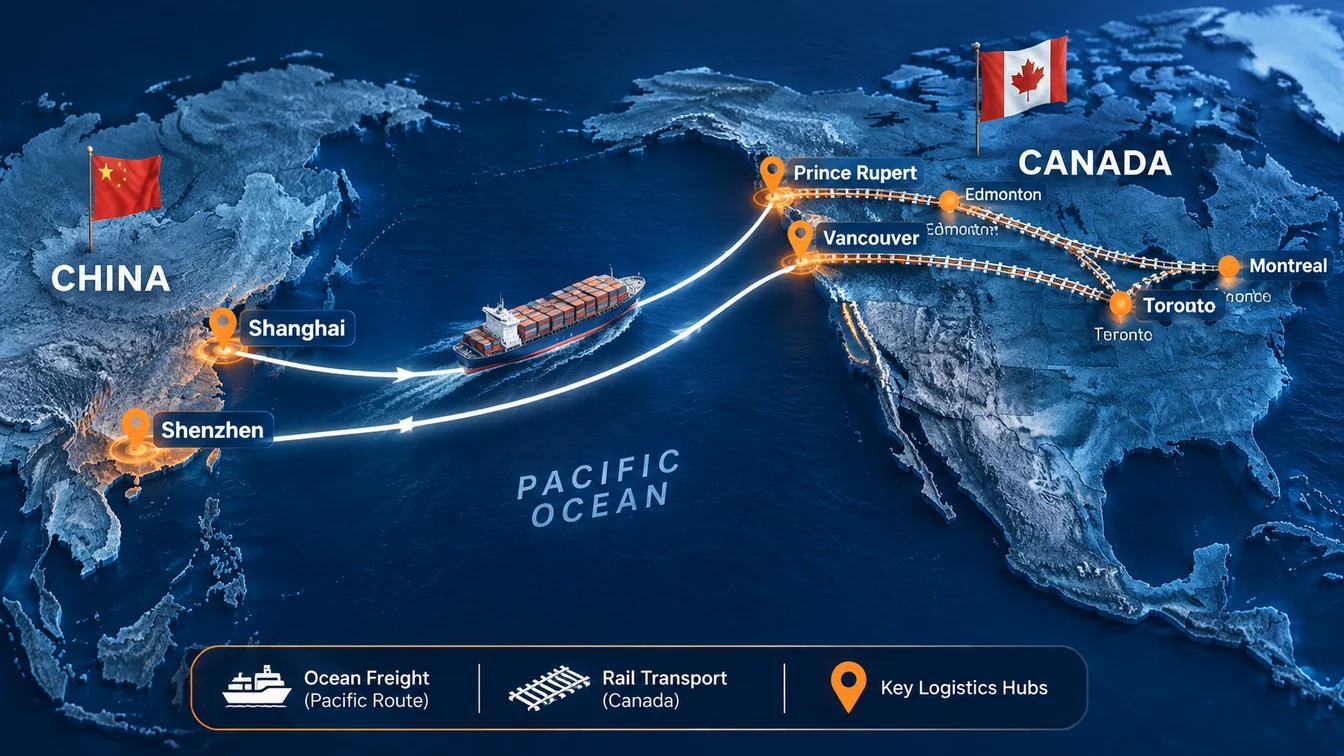
Ocean freight through Vancouver or Prince Rupert remains the default for most commercial volume moving to Western Canada and the Prairies, with rail onward to Ontario and Quebec; air freight at $9.30/kg over 3–4 days is the practical override when inventory timing or per-unit value changes the cost of delay. The operational thread runs from the China supplier through the origin gateway, the applicable mode, the Canadian entry port, CBSA clearance, and the final delivery postcode. Sea freight and air freight are the primary mode decisions to lock before booking.
Route Planning Summary
- How does cargo move from the China supplier to the first gateway?
- A supplier in the Pearl River Delta (Shenzhen/Yantian, Guangzhou/Nansha) normally trucks to a South China export port, while suppliers in Zhejiang or Jiangsu use Shanghai or Ningbo; the closest major gateway with a credible service to the intended Canadian entry port is the normal starting comparison. A supplier more than a day’s trucking from that port, or a cargo-ready date that misses the sailing, changes the gateway choice before mode selection is finalised.
- Which transport mode fits a China-to-Canada commercial shipment?
- FCL is the default for full-container volumes moving to a Canadian port or inland rail ramp, because it keeps cargo sealed from origin to destination discharge. LCL suits smaller consignments that cannot justify a container, air freight at $9.30/kg protects against stockouts for high-value or urgent goods, and express at $19.27/kg is reserved for samples and time-critical parcels where the per-kilogram premium is acceptable.
- What planning time should be assumed for China-to-Canada shipping?
- Port-to-port ocean transit from Shanghai to Vancouver is 17 days for FCL and 22–45 days for LCL in the supplied references; air freight is 3–4 days and express is 3–5 days. Destination rail to Toronto or Montreal, CBSA clearance, and final trucking add time outside those port-to-port figures, so the door-to-door calendar should be built from the full handoff sequence rather than the sailing alone.
- Who is responsible for Canadian customs clearance?
- The importer of record is responsible for the CBSA declaration, duty and tax payment, and record retention; Amazon will not act as importer of record for FBA inventory, and a customs broker files on the importer’s behalf through the CARM Client Portal. The importer must hold a business number with an import-export account and post financial security before goods can be released prior to payment.
- How far does the service scope extend beyond the Canadian port?
- Door-to-door scope covers supplier pickup, export handling, international transport, CBSA clearance, duty and tax responsibility, and final delivery to the consignee’s address or warehouse. Port-to-port or airport-to-airport arrangements leave inland rail, trucking, and destination handling with the importer or a separate provider, so the service boundary should be agreed before the booking is placed.
China to Canada Shipping Cost
The table below provides route-specific indicative shipping costs and planning transit references for the November 2026 review. Each reference applies to the named route, shipping method, and unit shown.
| Shipping route | Shipping method | Price | Transit time |
|---|---|---|---|
| Shanghai, China → Vancouver, Canada | FCL 20GP | $4,321.08–$4,633.20/柜 | 17 days |
| Shanghai, China → Vancouver, Canada | FCL 40GP | $7,778.16–$8,339.76/柜 | 17 days |
| Shanghai, China → Vancouver, Canada | FCL 40HQ | $7,857–$8,424/柜 | 17 days |
| China → Canada | LCL | $125–$175/CBM | 22–45 days |
| Shanghai Pudong (PVG), China → Vancouver (YVR), Canada | Air freight | $9.30/kg | 3–4 days |
| China → Canada | Express | $19.27/kg | 3–5 days |
Cost scope: These indicative cost references apply to the route, method, and unit shown; they are not carrier freight rates, market averages, TJ selling prices, or binding quotations. The actual booking, cargo, and agreed service scope determine the commercial arrangement, including responsibility for relevant pickup, handling, customs, duty and tax, inland delivery, insurance, storage, examination, appointment, and surcharge items. Cost and transit data reviewed November 2026.
Canada Import Duty and Taxes
Canadian import duty depends on the product’s 10-digit tariff classification, its value for duty, its country of origin, and any current trade measures; there is no single rate that applies across a mixed shipment. GST is charged at 5% federally on the duty-paid value of most commercial imports, and provincial HST, PST, or QST may layer on top depending on the destination province.
- Classify every product line to its Canadian Customs Tariff code; the classification drives the duty rate and determines whether anti-dumping, countervailing, or surtax measures apply to Chinese-origin goods.
- Establish the value for duty, normally the transaction value, and confirm that the commercial invoice supports that value with a full description, quantity, unit price, and terms of sale.
- Identify the tariff treatment based on origin; Chinese-origin goods generally receive Most-Favoured-Nation treatment, while preferential rates under a free trade agreement apply only when the goods qualify and the origin certification is valid.
- Calculate 5% federal GST on the duty-paid value, then add the destination province’s HST, PST, or QST component; the Canada Revenue Agency administers the federal GST, while provincial tax collection rules vary by province.
- Account for the amounts through the CBSA Assessment and Revenue Management system using a Commercial Accounting Declaration; this explanation is simplified and does not constitute tax or legal advice, and current rates and measures should be verified against official guidance before entry. Canada Border Services Agency publishes current tariff and tax guidance.
China to Canada Shipping Time
FCL ocean freight from Shanghai to Vancouver is a 17-day port-to-port reference, the most commercially direct timing figure for containerised cargo on this lane. LCL from China to Canada spans 22–45 days, reflecting consolidation dwell time and routing through a Vancouver or Prince Rupert deconsolidation point; air freight from Shanghai Pudong to Vancouver is 3–4 days airport-to-airport, and express is 3–5 days door-to-door for eligible parcels.
The supplied transit values are port-to-port or airport-to-airport planning references for the named methods and do not include supplier pickup, origin export handling, CBSA clearance, rail to an inland ramp, or final trucking. A shipment destined for Toronto that discharges at Vancouver adds rail time from the West Coast to Ontario, so the door-to-door calendar should be built from the full handoff sequence rather than the sailing reference alone. When a supplier’s cargo-ready date sits close to a sailing cut-off, the practical gate-in deadline, not the port-to-port figure, becomes the controlling timing decision.
Shipping Methods from China to Canada
Choose FCL when the shipment fills or nearly fills a 20GP or 40GP container, because the container stays sealed from the China origin port through to Canadian discharge and avoids the consolidation and deconsolidation dwell that extends LCL transit to 22–45 days. A shipment that occupies more than a partial container but has a destination postcode far from the discharge port should be compared on a door-to-door basis, because inland rail or trucking can change the cheapest port-to-port option.
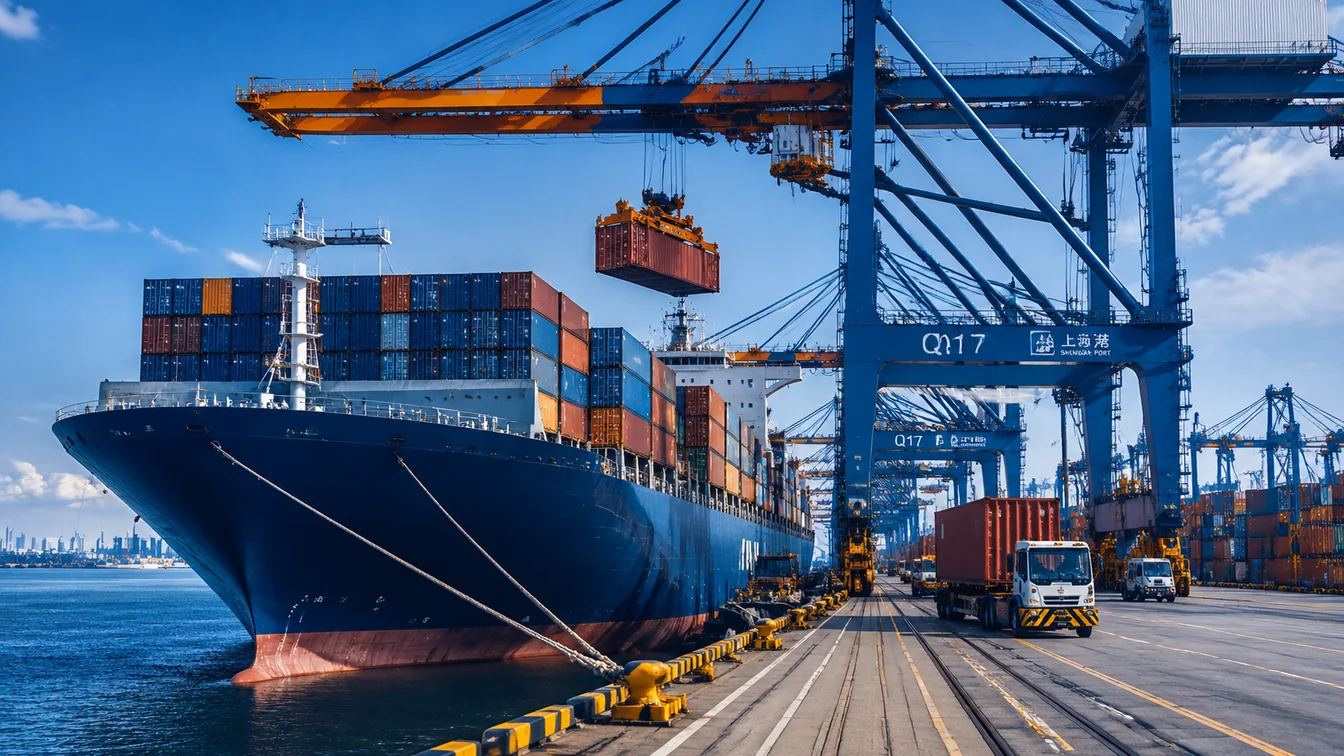
Choose LCL when the cargo volume is too small to justify a full container and the delivery window can absorb consolidation time, because per-CBM pricing at $125–$175 lets a smaller consignment move without paying for unused container space. The changing condition is fragility or high per-unit value: LCL cargo is handled at a consolidation facility, so additional packaging and cargo insurance review are warranted before booking.
Choose air freight at $9.30/kg when the shipment is high-value, time-sensitive, or needed to prevent a stockout that costs more than the air premium, because the 3–4-day Shanghai Pudong to Vancouver transit replaces a 17-day ocean reference with a days-scale movement. Air freight is less suitable for dense, low-value cargo where chargeable weight drives the cost above the ocean alternative.
Choose express at $19.27/kg for samples, documents, or urgent parcels where a 3–5-day door-to-door service and end-to-end tracking outweigh the per-kilogram premium, because express handles the pickup-to-delivery chain without a separate freight forwarder booking. Express is not the default for commercial pallet volume because the per-kilogram cost scales unfavourably against LCL or FCL on larger shipments.
Rail is not a standalone China-to-Canada mode on this lane; Canadian rail enters the route after ocean discharge at Vancouver or Prince Rupert, moving containers inland to Toronto, Montreal, Calgary, Edmonton, and Winnipeg. The rail leg is a destination-handoff decision, not an alternative to the Trans-Pacific sailing, and its schedule should be compared as part of the door-to-door plan rather than as a separate origin-to-destination mode. Multi-modal freight coordination applies where ocean discharge and inland rail are booked as one scope.
Door-to-Door Shipping from China to Canada
Door-to-door shipping on the China–Canada lane connects supplier pickup, China export handling, the Trans-Pacific movement, CBSA clearance, and final delivery into one coordinated scope, with the service boundary recorded before booking.
-
Cargo and Compliance Review
The shipment is defined by commodity, HS classification, dimensions, weight, cargo-ready date, and final Canadian address; any product requiring a permit, licence, or regulated-goods review is flagged before a mode or gateway is selected. Customs brokerage review at this stage identifies whether the goods can enter under the planned declaration.
-
Route and Method Selection
The origin gateway is compared against the supplier region and sailing availability, and the Canadian entry port is compared against the final delivery postcode, inland rail access, and CBSA port-of-entry options. FCL, LCL, air, or express is then matched to the shipment definition rather than to a single rate figure.
-
Supplier Coordination and Pickup
The supplier receives the pickup window, export document requirements, carton labelling instructions, and cargo-ready confirmation; the trucking leg to the China export port is scheduled against the sailing cut-off rather than against the supplier’s production completion alone.
-
China Export Handling
The export declaration, commercial invoice, packing list, and bill of lading instructions are prepared and checked for consistency with the Canadian import declaration; discrepancies in description, value, or origin are resolved before the container gates in.
-
International Transportation
The booked vessel or flight moves the cargo from the China origin gateway to the Canadian entry gateway; the carrier booking, sailing or flight confirmation, and any transhipment point are tracked against the planned CBSA pre-arrival timeline.
-
Canada Import Clearance
The importer of record’s CARM account and business number are confirmed active, the customs broker files the entry with the correct HS classification and value for duty, and CBSA assesses duty and GST for payment or release prior to payment under the importer’s financial security. DDP shipping scope, where agreed, places duty and tax responsibility within the booking rather than with the consignee.
-
Final Delivery
After CBSA release, the container or deconsolidated cargo moves by rail or truck to the final address, warehouse, or fulfilment centre; the delivery appointment, unloading capability, and any residential or remote-area access condition are confirmed before dispatch from the port or rail ramp.
-
Shipment Close-Out
Proof of delivery, final accounting through CARM, and the commercial documents are reconciled against the agreed service scope; any examination, storage, or destination charge that fell outside the original scope is identified and resolved with the responsible party.
Main China to Canada Routes
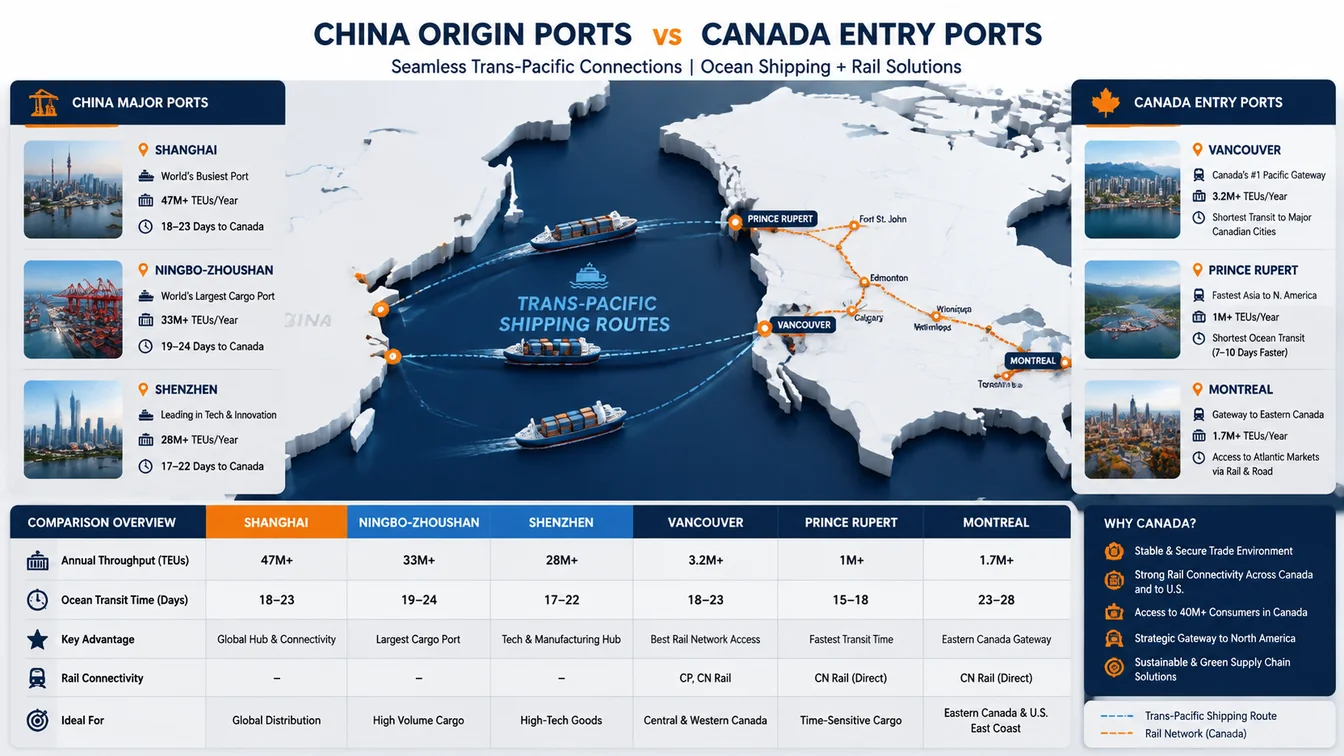
The most practical China-to-Canada route normally starts at the China export gateway closest to the supplier that also has a credible service toward the Canadian entry port suited to the final delivery area; a supplier more than a day’s trucking from that port, or a destination postcode that makes inland rail from a different Canadian gateway cheaper, can change the comparison before the sailing is booked.
Major China Export Ports for Canada Shipping
- Shanghai (CNSHA)
- Serves suppliers across Jiangsu, Zhejiang, and Shanghai and offers high-frequency Trans-Pacific sailings to Vancouver and Prince Rupert; it is the default origin gateway for Yangtze River Delta cargo and a comparison point when a South China supplier’s inland trucking cost to Shenzhen outweighs the sailing frequency advantage.
- Ningbo-Zhoushan (CNNGB)
- Handles dense manufacturing cargo from Zhejiang and Jiangsu and provides an alternative to Shanghai when schedule or equipment availability at the larger hub tightens; it connects to the same Canadian West Coast gateways and is compared on trucking distance from the supplier rather than on port size alone.
- Shenzhen/Yantian (CNSZX)
- The natural export gateway for Pearl River Delta suppliers in Shenzhen, Dongguan, and Guangzhou, with direct Trans-Pacific services to Vancouver; it is the first comparison for electronics, consumer goods, and furniture manufactured in South China, and the trucking leg from a Foshan or Guangzhou supplier is shorter than routing the same cargo through Shanghai.
- Qingdao (CNTAO)
- Serves suppliers in Shandong and northern China and offers an alternative sailing base when cargo originates north of the Yangtze; it is compared when the supplier’s inland distance to Qingdao is materially shorter than to Shanghai or Ningbo, and its Canada service frequency should be checked against the specific sailing date rather than assumed.
- Xiamen (CNXMN)
- Connects Fujian-based suppliers to Vancouver and is a relevant comparison for footwear, apparel, and consumer goods produced in the province; it is evaluated when the supplier’s pickup point is closer to Xiamen than to Shenzhen or Ningbo, with the trade-off being sailing frequency against inland trucking savings.
Major Canada Import Ports for Cargo from China
- Port of Vancouver (British Columbia)
- Canada’s largest container gateway and the primary Pacific entry point for China-origin cargo, with direct Trans-Pacific services and CN and CPKC rail connections to the Prairies, Ontario, and Quebec; it is the default comparison for shipments destined to Western Canada and a rail-onward option for Central Canada.
- Port of Prince Rupert (British Columbia)
- A shorter Trans-Pacific sailing from Shanghai and North China and a direct CN rail connection into the Prairie provinces and Ontario; it is compared when the final destination aligns with the CN corridor or when Vancouver congestion or rail dwell makes the northern gateway’s efficiency advantage material.
- Port of Montreal (Quebec)
- An eastern gateway serving Quebec and Ontario via all-water or transhipment routing, with rail and truck connections into Central Canada; it is compared for Eastern Canada destinations when the total route via the West Coast plus rail is slower or more expensive than an all-water service, and its schedule should be checked against the specific sailing.
- Port of Halifax (Nova Scotia)
- An Atlantic gateway and ice-free port serving Atlantic Canada and Eastern Quebec, with rail connections to inland points; it is a comparison for Atlantic Canada deliveries where a West Coast discharge plus transcontinental rail adds distance, and its vessel schedule and rail dwell should be verified before the gateway is selected.
Supplier Region to Destination Routing Logic
| Supplier region in China | Origin port to compare | Destination port and delivery region | Planning reason |
|---|---|---|---|
| Pearl River Delta (Shenzhen, Dongguan, Guangzhou) | Shenzhen/Yantian; Guangzhou/Nansha | Vancouver, then rail to Ontario or Quebec | Direct South China to Vancouver sailings keep the origin trucking leg short; the comparison changes if the final postcode favours an all-water service to Montreal or Halifax instead of West Coast discharge plus rail. |
| Yangtze River Delta (Shanghai, Ningbo, Jiangsu, Zhejiang) | Shanghai; Ningbo-Zhoushan | Vancouver or Prince Rupert, then rail to the Prairies, Ontario, or Quebec | High-frequency Trans-Pacific services from Shanghai and Ningbo support weekly sailings; Prince Rupert becomes the better comparison when the final destination aligns with the CN corridor and the sailing date matches the cargo-ready window. |
| Shandong and northern China | Qingdao | Prince Rupert or Vancouver, then rail east | Qingdao shortens the inland trucking leg for northern suppliers, and Prince Rupert’s shorter Trans-Pacific sailing from North China can reduce total time; the comparison changes if Qingdao’s Canada service frequency is materially lower than Shanghai’s on the required sailing date. |
| Fujian (Xiamen, Quanzhou, Fuzhou) | Xiamen | Vancouver, then rail or truck to Western Canada or Ontario | Xiamen offers direct services to Vancouver for Fujian-origin consumer goods; the trade-off is sailing frequency against the inland trucking saving versus routing the same cargo through Shenzhen or Ningbo. |
Destination Regional Delivery Logic
- Western Canada (British Columbia, Alberta)
- Vancouver is the default entry port for Lower Mainland and Vancouver Island deliveries, with trucking replacing rail for nearby postcodes; Alberta destinations typically discharge at Vancouver or Prince Rupert and move by rail to Calgary or Edmonton, so the rail ramp location and trucking distance to the final address determine the comparison.
- Prairies (Saskatchewan, Manitoba)
- Prince Rupert’s CN connection and Vancouver’s CPKC and CN connections both serve Prairie destinations; the gateway choice turns on the specific rail ramp, the dwell time at each port, and the trucking leg from the ramp to the final city rather than on port-to-port transit alone.
- Ontario and Quebec
- Containers discharge at Vancouver or Prince Rupert and move by rail to Toronto or Montreal, or use an all-water service to Montreal; the comparison should include rail dwell, destination terminal handling, and the final trucking leg, because a shorter ocean transit through a West Coast port can still produce a longer door-to-door calendar if rail capacity is constrained.
- Atlantic Canada (Nova Scotia, New Brunswick, Newfoundland and Labrador, Prince Edward Island)
- Halifax and Montreal are the practical eastern gateways, with Halifax serving Atlantic Canada directly and Montreal offering rail and truck connections into the region; West Coast discharge plus transcontinental rail is normally the longer comparison for Atlantic postcodes, but it can still be competitive when an all-water sailing date is distant.
How the Gateway Is Selected
The gateway decision is made by comparing the supplier’s inland distance to the China port, the sailing availability toward the candidate Canadian entry port, the rail or truck connection from that entry port to the final postcode, and the CBSA clearance location, not by selecting the largest port or the lowest port-to-port figure alone.
- Supplier-to-origin-port trucking distance and the cargo-ready date against the sailing cut-off; a port with more frequent sailings can absorb a later cargo-ready date than a closer port with a single weekly departure.
- Canadian entry port against the final delivery region: Vancouver and Prince Rupert for Western Canada and rail-onward Central Canada, Montreal and Halifax for Eastern Canada when the all-water schedule is credible.
- Rail ramp availability and dwell at the Canadian gateway; a port with a direct rail connection to the destination province may outperform a closer port whose rail dwell adds days to the inland leg.
- CBSA clearance location and the importer’s CARM account readiness; a gateway with the required CBSA port of entry and broker coverage should be confirmed before the sailing is booked.
Canada Customs Clearance
Importing commercial goods into Canada requires the importer of record to declare the goods to the Canada Border Services Agency, pay applicable duty and GST, and retain records; the rules apply across Canada’s customs territory, and the importer remains responsible for the accuracy of the declaration even when a licensed customs broker files it.
What the Canada Importer Normally Needs
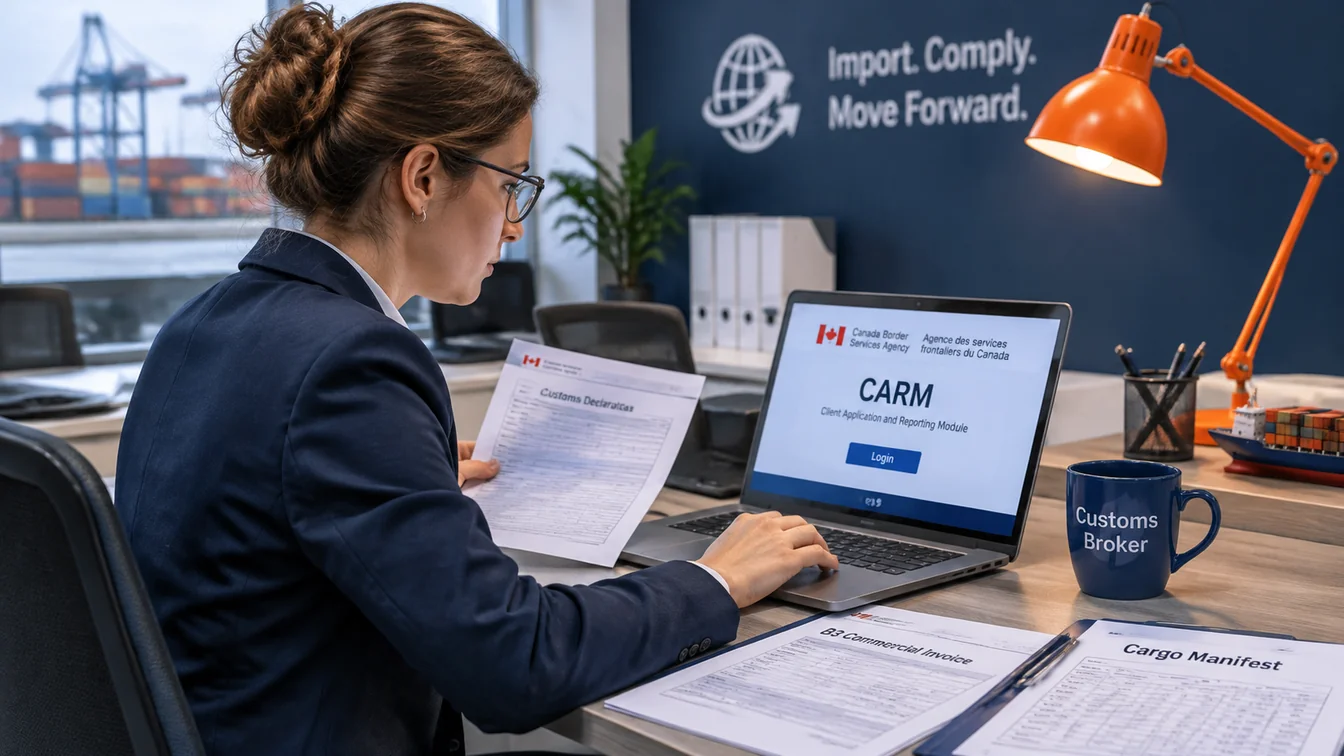
The importer’s CARM account and business number are the foundation of a commercial import, and the supporting documents must be consistent across the invoice, transport document, and CBSA declaration before the goods arrive.
- CARM Client Portal account and business number Register in the CBSA Assessment and Revenue Management portal and obtain a business number with an import-export (RM) program account; since January 1, 2026, a customs broker’s business number can no longer be used to release commercial goods on the importer’s behalf. Canada Border Services Agency administers CARM registration.
- Financial security for release prior to payment Post a customs bond or cash deposit to enrol in the Release Prior to Payment program; without the importer’s own security, goods wait until duty and tax are paid before release.
- Commercial invoice or Canada Customs Invoice Provide a full description of each item, quantity, unit value, currency, terms of sale, country of origin, and the importer’s name and address; vague descriptions and inconsistent values are a leading cause of CBSA holds.
- Tariff classification (10-digit Canadian Customs Tariff code) Classify each product line and confirm whether any anti-dumping, countervailing, or surtax measure applies to Chinese-origin goods; incorrect classification drives incorrect duty and can trigger penalties.
- Certificate of origin, when a preferential tariff is claimed Chinese-origin goods generally receive MFN treatment; a preferential rate applies only when the goods qualify under a relevant agreement and the origin certification is valid and retained.
- Transport document (bill of lading or air waybill) The carrier’s transport document enables the entry and must match the invoice, packing list, and CBSA declaration; the consignee name and delivery address should align with the importer of record.
- Packing list and importer authorisation for the broker A packing list supports examination and deconsolidation, while a power of attorney or written authorisation lets the licensed customs broker file the entry and transact with CBSA on the importer’s CARM account.
- Permits, licences, or certificates for regulated goods Food, health products, agricultural goods, vehicles, and certain controlled products require clearance from the relevant Canadian regulator in addition to the CBSA declaration; confirm the requirement before dispatch.
Common Causes of Canada Customs Delays
- Incomplete or inactive CARM registration; an unregistered importer cannot clear commercial goods through CBSA, and missing financial security blocks release prior to payment.
- Incorrect or unsupported HS classification, including a code that does not match the goods description or that triggers an anti-dumping or surtax measure the importer did not anticipate.
- Vague product descriptions, inconsistent invoice values, or a commercial invoice that does not carry the full description, quantity, unit value, and origin information CBSA requires.
- Missing pre-arrival data or a late eManifest submission, which pushes the shipment behind others in the CBSA queue.
- An unclear or inconsistent importer of record, including a consignee name that does not match the CARM account holder or a broker authorisation that is not in place.
- Regulated-product requirements that were not identified before dispatch, such as food, health, agricultural, or vehicle import conditions that require another government department’s clearance.
These issues are resolvable before the container sails or the air waybill is issued; confirming the CARM account, classification, invoice content, and regulatory status at the booking stage is more effective than correcting them after CBSA has detained the shipment.
Shipping to Amazon FBA Canada
Amazon operates a Canadian FBA route that receives inventory from China, but Amazon will not act as the importer of record for any FBA shipment, and all FBA inventory must move under Delivered Duty Paid terms; the seller must be named as importer of record or appoint a licensed customs broker, and the shipment must clear through CBSA before it reaches the fulfilment centre.
Canadian FBA sellers need an active CARM Client Portal account, a business number with an import-export account, and financial security in place before the first shipment clears; a non-resident seller importing under its own name registers as a non-resident importer and files the required record-custodian documentation. The commercial invoice, packing list, and carton labels must align with Amazon’s shipment plan, and the assigned fulfilment centre is the deliver-to party after CBSA release. Amazon Seller Central publishes the current FBA import requirements, and Amazon FBA coordination covers the booking, clearance handoff, and delivery appointment sequence.
Special Cargo, Packaging, and Insurance
Cargo Requiring Additional Review
- Lithium batteries and battery-powered devices, which require carrier acceptance checks and may be subject to dangerous-goods documentation depending on watt-hour rating and configuration.
- Dangerous goods, chemicals, liquids, aerosols, and cosmetics, which need classification, safety data, and carrier approval before booking.
- Food, health products, medical devices, and natural health products, which may require Canadian Food Inspection Agency or Health Canada clearance in addition to CBSA entry.
- Wood packaging and pallets, which must meet ISPM 15 heat-treatment or fumigation requirements and carry the correct mark.
- Oversized or temperature-controlled cargo, which requires equipment, handling, and delivery capability confirmed at both the origin and destination ends of the route.
- Controlled or restricted goods, including certain vehicles and products subject to permit-based import quotas, which require authorisation before shipment.
Packaging Checks
Packaging on a China-to-Canada shipment must survive ocean or air handling, potential LCL consolidation, rail vibration where inland movement follows, and the final trucking leg; carton strength, internal protection, and pallet condition should be checked against the actual handling sequence rather than against a generic export standard.
- Use double-wall or reinforced corrugated cartons for stacked or consolidated cargo, and confirm the carton compression strength is adequate for the container or LCL co-load.
- Protect internal contents with cushioning, dividers, or moulded inserts; loose-fill alone is insufficient for fragile or high-value goods that may be rehandled at a deconsolidation facility.
- Use heat-treated or fumigated wood pallets bearing the ISPM 15 mark, and avoid pallets with protruding fasteners or damaged deck boards that can fail during forklift handling.
- Add moisture protection such as desiccant or vapour barrier where the cargo is susceptible to condensation during a Trans-Pacific sailing or Canadian winter delivery.
- Apply clear handling marks, carton labels, and side marks that match the packing list and Amazon or warehouse receiving requirements, and record actual carton dimensions and weights for the bill of lading and delivery appointment.
Cargo Insurance
Carrier liability is limited by the terms of the bill of lading or air waybill and does not provide the same protection as all-risk cargo insurance; coverage, exclusions, deductible, insured value, claims evidence, and the period of cover should be confirmed against the specific shipment and route before departure. Cargo insurance review should be completed alongside the booking, not after the cargo has left the origin port.
Why Use a Freight Forwarder for Shipping from China to Canada?
A freight forwarder on the China-to-Canada route helps turn cargo facts into a workable shipment definition, matches a credible origin gateway and mode to the Canadian entry point and final delivery need, and keeps the commercial and operational handoffs aligned so the importer, broker, carrier, and delivery party are working from the same scope.
- Turning shipment facts into a movement definition
- The forwarder converts supplier location, commodity, dimensions, cargo-ready date, and final postcode into a defined scope that names the origin port, mode, Canadian entry gateway, and delivery endpoint. This definition is what makes cost and transit comparisons meaningful, and it changes when the supplier’s cargo-ready date moves or the delivery address is in a remote or appointment-restricted location.
- Matching credible transport and gateway choices
- The forwarder compares FCL, LCL, air, and express against the shipment definition and the actual destination region, rather than applying a single default mode. A shipment that looks like an LCL candidate on volume alone may be better served by FCL when the cargo is fragile or when the delivery window cannot absorb consolidation dwell, and the forwarder flags that trade-off before booking.
- Keeping commercial and operational handoffs coordinated
- The forwarder coordinates the supplier, carrier, customs broker, and delivery provider so that documents, release timing, and delivery appointments align. The importer of record remains responsible for the CBSA declaration and duty and tax payment; the forwarder does not replace the importer, the customs authority, or the product-compliance owner, but keeps the sequence visible so those responsibilities are exercised at the right handoff point.
How TJ Logistics Team Plans a China-to-Canada Shipment
- Reviewing the defined shipment and flagging gaps
- TJ Logistics Team reviews the commodity, HS classification, dimensions, weight, supplier location, cargo-ready date, and final Canadian postcode, and flags any missing information that would prevent a reliable gateway or mode recommendation. A missing classification or an unconfirmed delivery appointment is identified before a booking is proposed, because those gaps change the route and the clearance timeline.
- Comparing transport, gateway, and handoff options
- The team compares origin gateways against the supplier region, Canadian entry ports against the final delivery area, and modes against urgency and cargo form. The comparison includes the rail or truck connection from the Canadian port to the destination and the CBSA clearance handoff, so the recommended route reflects the full chain rather than a port-to-port figure. Door-to-door scope is evaluated where the importer wants a single service boundary.
- Recording the agreed service boundary before commercial arrangement
- The team records which party is responsible for supplier pickup, export handling, main transport, CBSA clearance, duty and tax, inland delivery, insurance, storage, and any examination or appointment cost, and confirms the importer of record’s CARM readiness before a formal commercial arrangement is prepared. This step keeps the quotation comparable and prevents a later dispute about what the price includes.
- Coordinating booking, documents, and the next operational decision
- After the buyer confirms the scope, TJ Logistics Team coordinates the carrier booking, commercial documents, cargo handoff, and the next operational decision if timing, route, documents, or receiving conditions change. The team does not guarantee carrier space, rates, or delivery outcomes; it keeps the handoffs coordinated so the importer, broker, and delivery party can act on accurate and timely information. Express shipping is reviewed where the shipment definition calls for a door-to-door parcel service rather than a freight booking.
China to Canada Shipping FAQ
How much does a 20ft container from China to Canada cost?
A 20GP FCL booking from Shanghai to Vancouver is listed at $4,321.08–$4,633.20 per container with a 17-day transit in the November 2026 review. That reference applies to the named route and container size; a 20GP from a different China origin port or to an inland Canadian destination is a separate booking scope and should be compared on its own route and delivery terms.
How long does sea freight from China to Canada take?
FCL sea freight from Shanghai to Vancouver carries a 17-day port-to-port reference, and LCL from China to Canada spans 22–45 days because of consolidation and deconsolidation dwell. Door-to-door time for a Toronto or Montreal destination adds rail from the West Coast and final trucking beyond the port-to-port figure, so the full delivery calendar should be built from the gateway handoff sequence rather than the sailing reference alone.
What is the most cost-effective way to ship from China to Canada?
FCL is the practical cost default for full-container volumes because the container stays sealed and the per-unit cost falls against LCL once the cargo fills a meaningful share of a 20GP or 40GP. LCL at $125–$175 per CBM is the cost-effective choice for smaller consignments that cannot justify a container, while air at $9.30/kg and express at $19.27/kg are justified by urgency or per-unit value rather than by the per-kilogram rate alone.
Which China port is best for shipping to Canada?
The closest major China export port to the supplier that also has a credible sailing toward the intended Canadian entry port is the normal default: Shenzhen/Yantian for Pearl River Delta suppliers, Shanghai or Ningbo for Yangtze River Delta suppliers, and Qingdao for Shandong and northern suppliers. The final delivery postcode can change that choice when an all-water service to Montreal or Halifax, or a Prince Rupert routing aligned with the CN corridor, produces a shorter or cheaper door-to-door plan than the geographically closest origin port.
Can I ship door-to-door from China to Canada?
Door-to-door shipping from China to Canada is available when the scope covers supplier pickup, China export handling, international transport, CBSA clearance, duty and tax responsibility, and final delivery to the Canadian address. The service boundary must be agreed before booking; a port-to-port FCL booking leaves inland rail, trucking, and destination handling outside the freight scope, while a door-to-door arrangement places those handoffs within one coordinated plan.
What documents are needed for Canada customs clearance from China?
Canada customs clearance for a China-origin shipment requires an active CARM Client Portal account with a business number, a commercial invoice or Canada Customs Invoice with full descriptions and values, a 10-digit tariff classification, a bill of lading or air waybill, and a packing list, plus a broker authorisation if a licensed customs broker files the entry. Regulated goods may also need permits or certificates, and a certificate of origin is needed only when a preferential tariff is claimed.
Do I need a CARM account to import from China into Canada?
Yes. Every commercial importer into Canada needs its own CARM Client Portal registration, a business number with an import-export account, and its own financial security to obtain release prior to payment; since January 1, 2026, a customs broker’s business number can no longer be used to release commercial goods on the importer’s behalf. The registration must be completed before the first shipment arrives, because an unregistered importer cannot clear goods through Canadian customs.
Why can two China-to-Canada shipping costs differ?
Two China-to-Canada shipping costs can differ because the origin port, Canadian entry gateway, container size, cargo weight and volume, sailing date, and agreed service scope change the booking basis even when the origin and destination countries are the same. A Shanghai-to-Vancouver 20GP reference is not directly comparable with a South China-to-Toronto door-to-door LCL booking, and the scope difference—port-to-port versus delivered and duty-paid—can matter more than the sailing rate itself.