

Reviewed by TJ Logistics Team — September 2026. This page is for planning only; schedules, routing, customs handling, and delivery timing must be reconfirmed against the exact cargo and destination postcode before dispatch. The current review window covers market conditions, cost data, customs procedures, tariff and tax rules, and marketplace requirements as available in September 2026; these can change and should be checked again before shipment. The review applies practical route-planning checks across supplier pickup, gateway and mode selection, customs handoff, and final delivery.
China to Poland Shipping Update
Shipping from China to Poland is best planned as one connected handoff: collect from the supplier at the right China gateway, select sea, rail-based, air, or express transport for the shipment profile, clear the goods within the EU customs territory through the agreed Polish customs setup, and complete delivery to the final Polish postcode.
For planning, the supplied references show ocean FCL at 25–31 days, LCL at 26–35 days, rail-based FCL at 12–15 days, air freight at 5–7 days, and express at 5–8 days. The faster choices may fit time-sensitive or lighter cargo, while containerized shipments usually need the supplier location, final postcode, and full delivery scope checked before a route is selected; sea freight services and rail freight services should be compared with the actual shipment profile.
Route Planning Summary
- How should I connect the supplier to the gateway?
- Match the supplier’s city and pickup distance to an origin port such as Shanghai, Ningbo-Zhoushan, Yantian, or Qingdao, then confirm the export handling and terminal cut-off needed for the booked service.
- Which transport mode applies?
- Use FCL or LCL for regular container cargo, rail-based service when the time target supports the available corridor, and air or express when speed or shipment size makes the higher transport cost commercially justified.
- What planning time should I use?
- Use the supplied transit references as planning inputs only; the exact start point, destination point, schedule, customs time, and final-mile scope still need confirmation.
- Who handles destination clearance?
- Agree in advance which importer, customs representative, or other authorized party will lodge the Polish import declaration and settle the applicable customs duty and import VAT.
- What should final delivery and the quote cover?
- Build the quote around the final postcode, delivery scope, cargo data, customs responsibility, and any storage, examination, appointment, insurance, duty, or tax requirements rather than comparing transport-only figures.
China to Poland Shipping Cost
There is no universal China-to-Poland shipping cost because the final amount changes with supplier location, cargo data, selected gateway and mode, customs responsibility, destination handling, and final delivery scope. The figures below are indicative shipping costs and cost references for planning, not carrier freight rates, TJ selling prices, or binding quotations.
| Shipping option | Indicative shipping cost | Supplied transit time | Main cost drivers |
|---|---|---|---|
| FCL 20GP | $2,610–$3,190 | 25–31 days | Container size, supplier pickup, origin handling, ocean routing, destination handling, and inland-delivery scope. |
| FCL 40GP | $4,275–$5,225 | 25–31 days | Container size, supplier pickup, origin handling, ocean routing, destination handling, and inland-delivery scope. |
| LCL | $33/cbm | 26–35 days | Chargeable volume, consolidation handling, supplier pickup, destination CFS handling, and inland-delivery scope. |
| Rail 20GP | $3,960–$4,840 | 12–15 days | Container size, rail corridor, terminal handoffs, border procedures, destination handling, and inland delivery. |
| Rail 40GP | $5,895–$7,205 | 12–15 days | Container size, rail corridor, terminal handoffs, border procedures, destination handling, and inland delivery. |
| Air freight | $5.2/kg | 5–7 days | Chargeable weight, airport handling, security requirements, routing, destination handling, and delivery scope. |
| Express | $9.37/kg | 5–8 days | Chargeable weight and parcel dimensions, courier routing, customs handling, and final delivery. |
Content and cost-data review month: September 2026. These indicative costs must be reconfirmed for the actual booking date, cargo, route, and service scope. The supplied transit times are planning references rather than guarantees, and their exact start and end points are not defined in the input.
Cost scope: The cost and transit inputs do not specify which charges are included. Confirm origin pickup, export and origin handling, main transport, destination handling, customs-clearance service, duty and tax, inland delivery, insurance, storage, examination, appointments, and applicable surcharges before comparing or approving a quotation.
Plan Your China to Poland Shipment
Send the supplier location, cargo type, package count, dimensions, CBM and gross weight, destination ZIP or postcode, delivery scope, cargo-ready date, customs requirements, and preferred transit time with your shipment request. Request a route-specific quote.
Final cost can change with the supplier’s pickup geography, cargo details, CBM or chargeable weight, destination ZIP or postcode, delivery scope, customs requirements, duties and taxes, destination charges, storage or examination, and insurance. Separate included charges from excluded charges before comparing two figures.
Poland Import Duty and Taxes
China-origin goods enter the EU customs territory, so the customs-duty framework is based on the EU Common Customs Tariff while Polish tax rules determine the applicable import VAT treatment. The standard Polish VAT rate is 23%, but the applicable rate for a particular product can differ. Duty and tax must therefore be checked for the actual goods rather than assigned as one route-wide percentage; see the EU customs-duty calculation guidance and current Polish VAT rates.
- Classify the goods. Confirm the EU Combined Nomenclature or TARIC classification because tariff treatment and product measures depend on the commodity code.
- Confirm customs value. Prepare a defensible customs value and make sure the commercial invoice, transport information, and supporting transaction documents are consistent.
- Check origin and trade measures. Confirm the stated origin and look for any applicable anti-dumping, safeguard, licensing, excise, or other measures for the exact product classification.
- Determine import VAT. Apply the Polish import VAT rules and the rate applicable to the goods; the standard rate is 23%, with reduced rates applying only where the product qualifies.
- Assign payment responsibility. Confirm who will declare and pay customs duty and import VAT, and whether the importer has an eligible VAT accounting arrangement before the shipment reaches the Polish entry point.
This is a simplified route-planning explanation, not tax or legal advice. Current official rules should be confirmed before entry, especially for regulated goods, trade measures, and the importer’s tax position.
China to Poland Shipping Time
The supplied transit references are 25–31 days for FCL 20GP and FCL 40GP, 26–35 days for LCL, 12–15 days for Rail 20GP and Rail 40GP, 5–7 days for air freight, and 5–8 days for express. These figures are planning references only. The input does not define whether they begin at supplier pickup or an origin terminal and whether they end at a Polish port, airport, terminal, or final delivery point.
For a working delivery plan, add the operational checkpoints that the selected scope actually includes: supplier readiness and pickup, origin export handling, international movement, Polish customs release, destination handling, and the inland leg to the final postcode. A planned air-freight service may reduce main-transport time for urgent cargo, while rail-based and ocean options need their actual corridor, terminal handoff, and delivery scope confirmed before a customer-facing commitment is made.
Shipping Methods from China to Poland
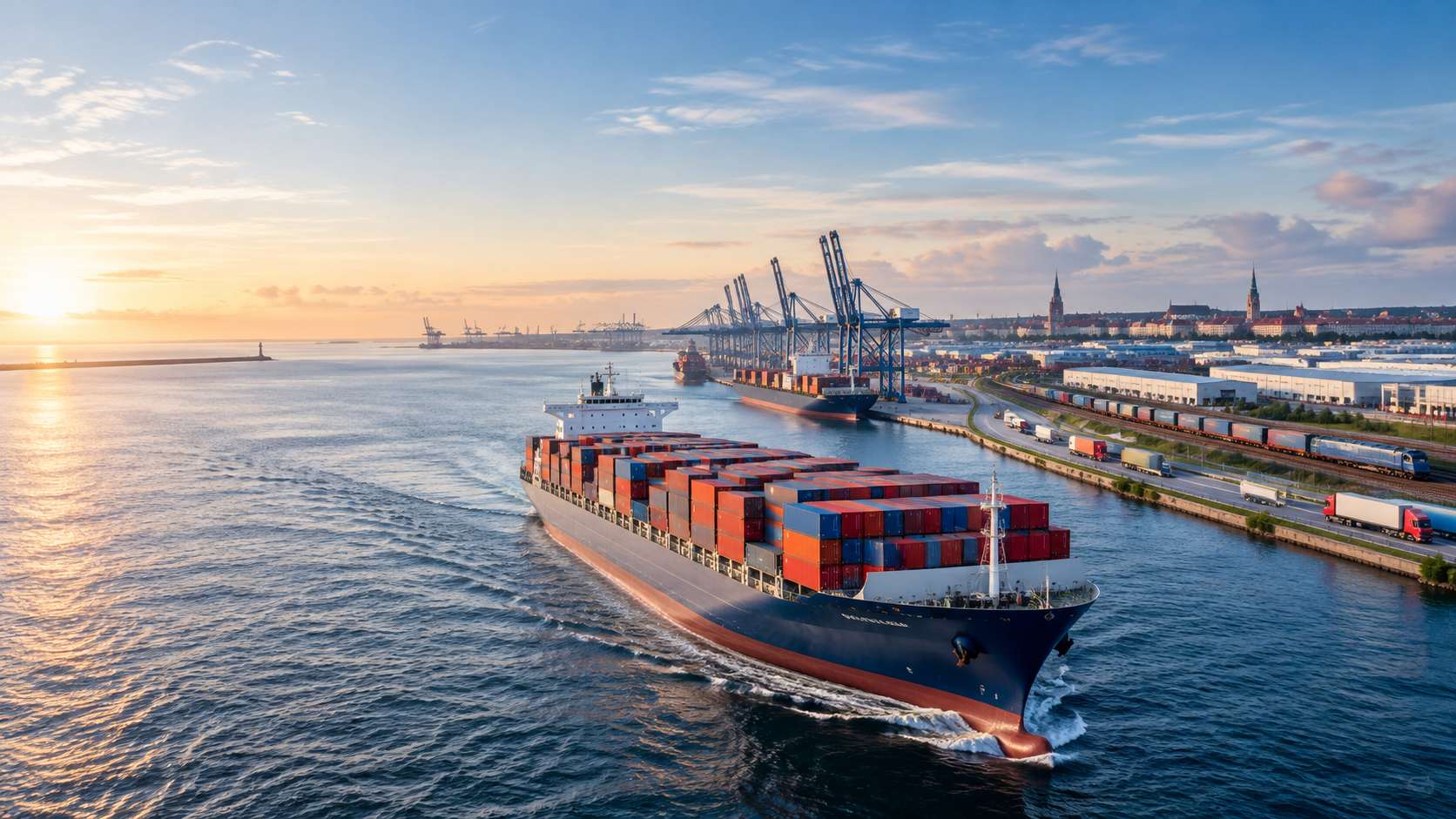
FCL is a practical starting point for full-container shipments when the cargo volume justifies dedicated equipment and the final delivery plan can be tied to the selected Polish gateway. Use sea freight when the shipment can work within the supplied ocean planning window.
LCL can fit smaller shipments that do not need a full container, but the route should be evaluated on chargeable volume, consolidation handling, destination CFS handling, and the final inland leg rather than the per-CBM figure alone.
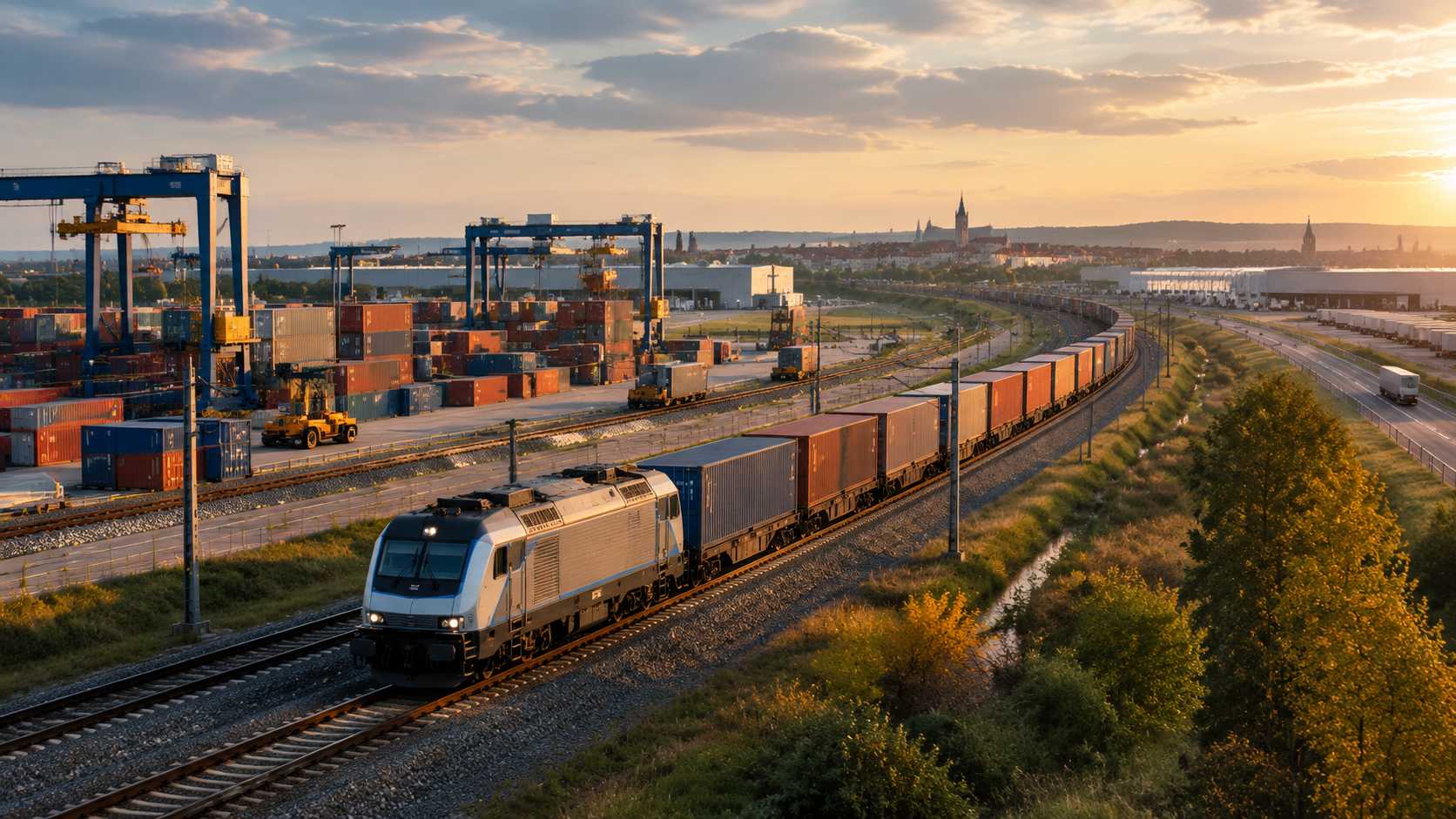
Rail-based shipping is relevant when a 12–15 day planning reference better matches the commercial deadline than the supplied ocean window. The actual China-to-Poland corridor, border handoffs, rail terminal, and final delivery arrangement must be confirmed for the booking; rail freight planning is therefore a route-specific choice, not a guaranteed direct rail promise.
Air freight and express are more suitable when delay carries a higher business cost, the cargo is relatively light or time-sensitive, or the shipment size supports parcel-based handling. A dedicated express-shipping service can be compared when parcel handling is the right fit. The supplied air and express figures use kilograms, so they should not be compared directly with container or LCL figures without a complete shipment scope.
Across all five options, the decision should use the supplier’s location, cargo dimensions and weight, final postcode, delivery scope, schedule, and cost of delay. Where a mixed sea/rail or other combined route is needed, multimodal freight planning can be assessed against the same final-delivery requirement.
Door-to-Door Shipping from China to Poland
A door-to-door Poland route should be designed backward from the final postcode, then connected to the supplier pickup, China export gateway, chosen main transport, Polish customs handoff, and final delivery. Door-to-door shipping can be structured around that sequence, but the quotation must still state exactly what is included.
-
Cargo and Compliance Review
Confirm the supplier location, product description, quantities, dimensions, weight, packaging, commodity code, and any product-specific restrictions before selecting the route. The cargo profile determines whether sea, rail-based, air, express, or a combined method is workable.
-
Route and Method Selection
Compare the practical origin gateway and transport mode against the final Polish postcode, delivery deadline, cargo size, and requested scope. Where a duty-and-tax-managed service is requested, confirm the responsibilities before using DDP shipping terminology in the quotation.
-
Supplier Coordination and Pickup
Align cargo-ready timing, pickup address, package data, and loading requirements with the supplier. The pickup point can materially change the inland cost and the practical choice of Shanghai, Ningbo-Zhoushan, Yantian, Qingdao, or another origin gateway.
-
China Export Handling
Complete booking, cargo handoff, export documentation, terminal or consolidation handling, and the origin gateway process required by the selected mode. The documents should match the physical cargo before the shipment leaves China.
-
International Transportation
Move the shipment through the selected ocean, rail-based, air, express, or multimodal corridor and verify the planned handoffs. The transport milestone should be tracked against the agreed scope rather than treated as the final delivery date.
-
Poland Import Clearance
Present the required declaration, EORI, classification, valuation, invoice, packing data, transport document, and product-specific permits or evidence through the agreed customs arrangement. The importer remains responsible for the accuracy of the declaration and applicable tax and duty obligations.
-
Final Delivery
After customs release and destination handling, arrange the inland move to the stated Polish postcode. Confirm whether delivery is to a warehouse, residence, Amazon facility, jobsite, or another location and whether an appointment, special equipment, or limited-access delivery is required.
-
Shipment Close-Out
Reconcile delivery evidence, customs records, destination charges, storage or examination items, and any insurance documentation. Close the shipment only after the final delivery scope and any outstanding exception have been resolved.
Main China to Poland Routes
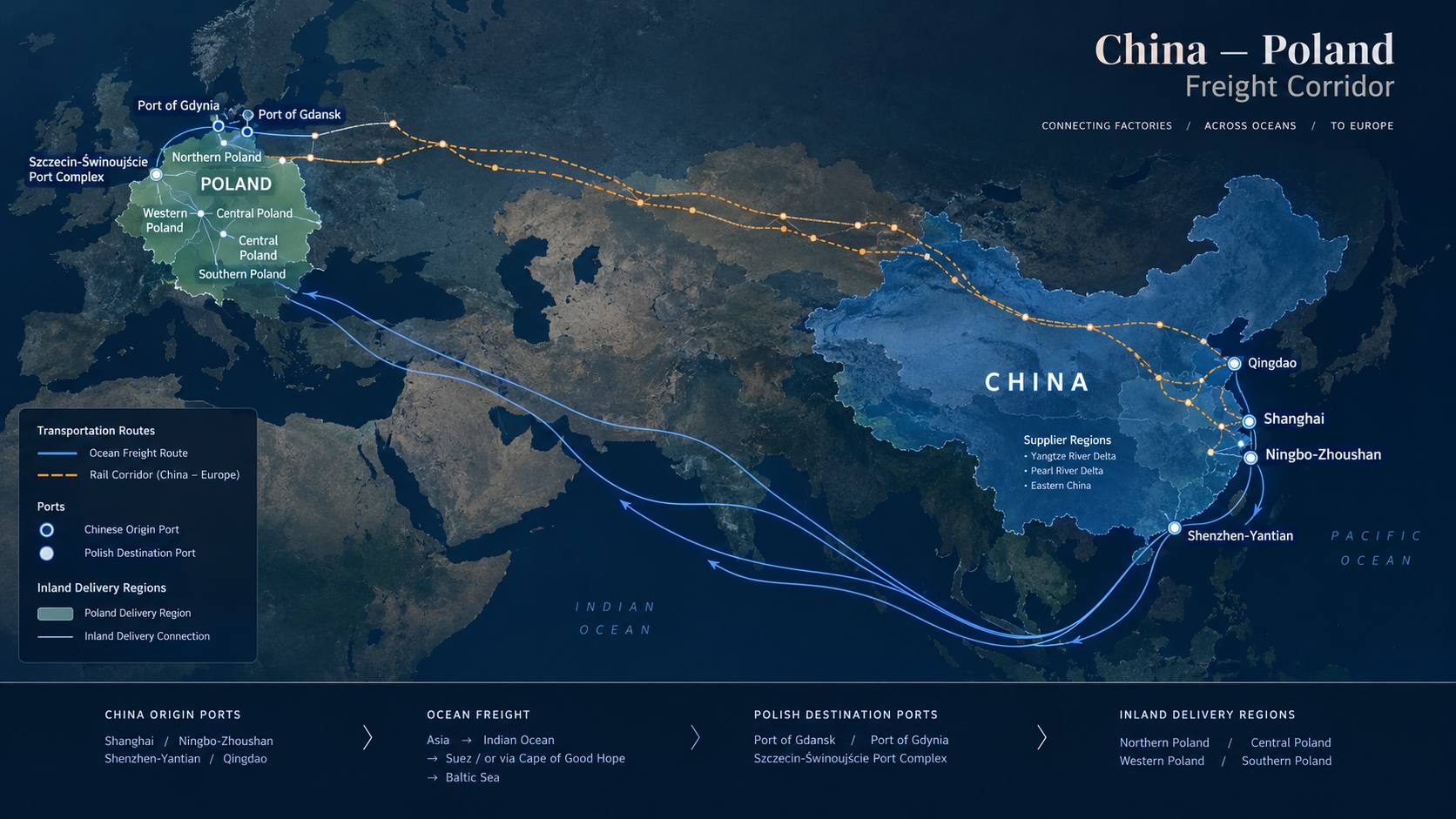
The practical route is the one that connects the supplier’s pickup point to a workable China gateway, then to a Polish destination gateway and the final postcode with acceptable transfers, inland distance, destination handling, and total route cost.
Major China Export Ports for Poland Shipping
- Shanghai
- Use for East China suppliers around the Yangtze River Delta and compare it closely when the cargo can reach the port efficiently. Current Port of Gdańsk schedules list regular container connections with Shanghai, making Gdańsk a relevant Polish gateway to compare for this origin.
- Ningbo-Zhoushan
- Fits Zhejiang-area and nearby East China suppliers when a shorter inland pickup to Ningbo-Zhoushan improves the overall route. Compare Gdańsk and Gdynia based on the confirmed sailing, destination handling, and inland delivery to the Polish postcode.
- Shenzhen (Yantian)
- Relevant for Pearl River Delta suppliers, especially containerized export cargo that can reach Yantian efficiently. Current Gdańsk connection information lists Yantian services, so compare that option with other Polish gateways using the actual booking schedule and final delivery scope.
- Qingdao
- Useful for Shandong and nearby North China supplier clusters. Current Gdańsk connection information lists Qingdao container services; for Polish delivery, compare the ocean schedule and the inland leg from Gdańsk or Gdynia to the final region.
- Xiamen
- Can be practical for Fujian suppliers where pickup to Xiamen is efficient. Compare the available service, transshipment pattern, and Polish destination gateway instead of assuming a direct call or a universal transit advantage.
- Tianjin Xingang
- Relevant for Tianjin and parts of North China when local pickup makes the gateway efficient. Use the confirmed carrier schedule to compare Gdańsk or Gdynia and then the inland route to the final Polish postcode.
Port Gdańsk currently publishes regular container connections with Shanghai, Ningbo, Yantian, Qingdao, Xiamen, and Tianjin Xingang among its Asia services, but the actual sailing, carrier, and cutoff must be checked for each shipment; see the current Port Gdańsk shipping connections.
Major Poland Import Ports for Cargo from China
- Port of Gdańsk
- Important for northern Poland and a major China-facing container gateway. Its Baltic Hub handles large container vessels and has established Asia connections, making Gdańsk a primary gateway to compare for Central and Northern Polish demand as well as other inland regions.
- Port of Gdynia
- Relevant for northern and northeastern deliveries where the container terminal and inland multimodal network produce a workable final route. Compare it with Gdańsk on the actual sailing, terminal handling, and inland move to the final postcode.
- Port of Szczecin
- Useful mainly for western Poland and cargo whose confirmed service reaches the Szczecin-Świnoujście complex through a suitable Baltic or North European connection. The port handles containers and offers intermodal handling, so compare it when the western inland leg improves the overall route.
- Port of Świnoujście
- A seaport serving northwestern Poland with general-cargo and intermodal functions. It should not be assumed to be a default China container gateway; compare it only when the cargo type and current booked service actually support the call or a connected routing through the Szczecin-Świnoujście complex.
Supplier Region to Destination Routing Logic
| Supplier region in China | Origin port to compare | Destination port and delivery region | Planning reason |
|---|---|---|---|
| Yangtze River Delta | Shanghai | Port of Gdańsk — Central and Northern Poland | Compare efficient supplier pickup to Shanghai with the confirmed China service, Gdańsk destination handling, and the inland move to Warsaw, Łódź, or another final postcode. |
| Zhejiang and nearby East China | Ningbo-Zhoushan | Port of Gdynia — Northern and Central Poland | Use when the supplier is materially closer to Ningbo-Zhoushan; compare Gdynia against Gdańsk after checking sailing availability, inland distance, destination charges, and delivery scope. |
| Pearl River Delta | Shenzhen (Yantian) | Port of Gdańsk — Central and Western Poland | Yantian can reduce the China pickup leg for South China suppliers; compare the actual Asia service and then the Polish inland route to Poznań, Wrocław, or Central Poland. |
| Shandong and North China | Qingdao | Port of Gdynia or Port of Gdańsk — North and Central Poland | Compare the local supplier-to-port move with the confirmed Baltic sailing, destination handling, and inland cost to the final postcode rather than assuming one Polish gateway always wins. |
| Fujian and adjacent Southeast China | Xiamen | Port of Gdańsk — Central, Southern, or Northern Poland | Consider Xiamen when the supplier pickup is efficient and the current service works; the final choice should reflect schedule, transshipment risk, Polish destination handling, and inland delivery. |
Destination Regional Delivery Logic
- North Poland
- Gdańsk or Gdynia can shorten the inland leg for demand in the Tricity and nearby northern areas. Compare terminal handling and the exact local delivery scope rather than assuming the nearest port is automatically cheaper.
- Central Poland
- Warsaw and Łódź require a meaningful inland leg after the Baltic gateway. Compare Gdańsk and Gdynia using the confirmed sailing, inland distance, destination charges, and whether truck or rail is included in the requested scope.
- West Poland
- Poznań, Wrocław, and nearby western markets may justify comparing Gdańsk or Gdynia with the Szczecin-Świnoujście complex when a suitable service and inland connection are available. The route choice should be based on the final postcode and total delivery scope.
- South Poland
- Katowice, Kraków, and the southern industrial belt can face a longer inland leg from Baltic ports. Compare gateway handling, inland rail or truck options, destination charges, and the required door-delivery scope before selecting the route.
How the Gateway Is Selected
- Supplier pickup distance: Compare the actual factory or warehouse location with the practical China export gateway.
- Confirmed service: Check the current sailing, rail corridor, flight, or express lane rather than assuming a direct connection.
- Destination gateway: Match Gdańsk, Gdynia, Szczecin, or another supported gateway to the final Polish region and handling scope.
- Inland handoff: Confirm whether the final leg is truck, rail-based, or another arrangement and who controls the handoff after customs release.
- Total route scope: Compare destination charges, customs responsibility, storage or examination risk, delivery appointments, insurance, and the final postcode before approving the route.

Poland Customs Clearance
China-origin goods enter the EU customs territory when they are imported into Poland, so the shipment follows EU customs rules together with Polish customs and tax procedures. The importer or authorized representative is responsible for accurate declarations, product compliance, and the agreed payment of customs duty and import VAT; the geographic scope for the customs rules discussed here is Poland within the EU customs territory.
What the Poland Importer Normally Needs
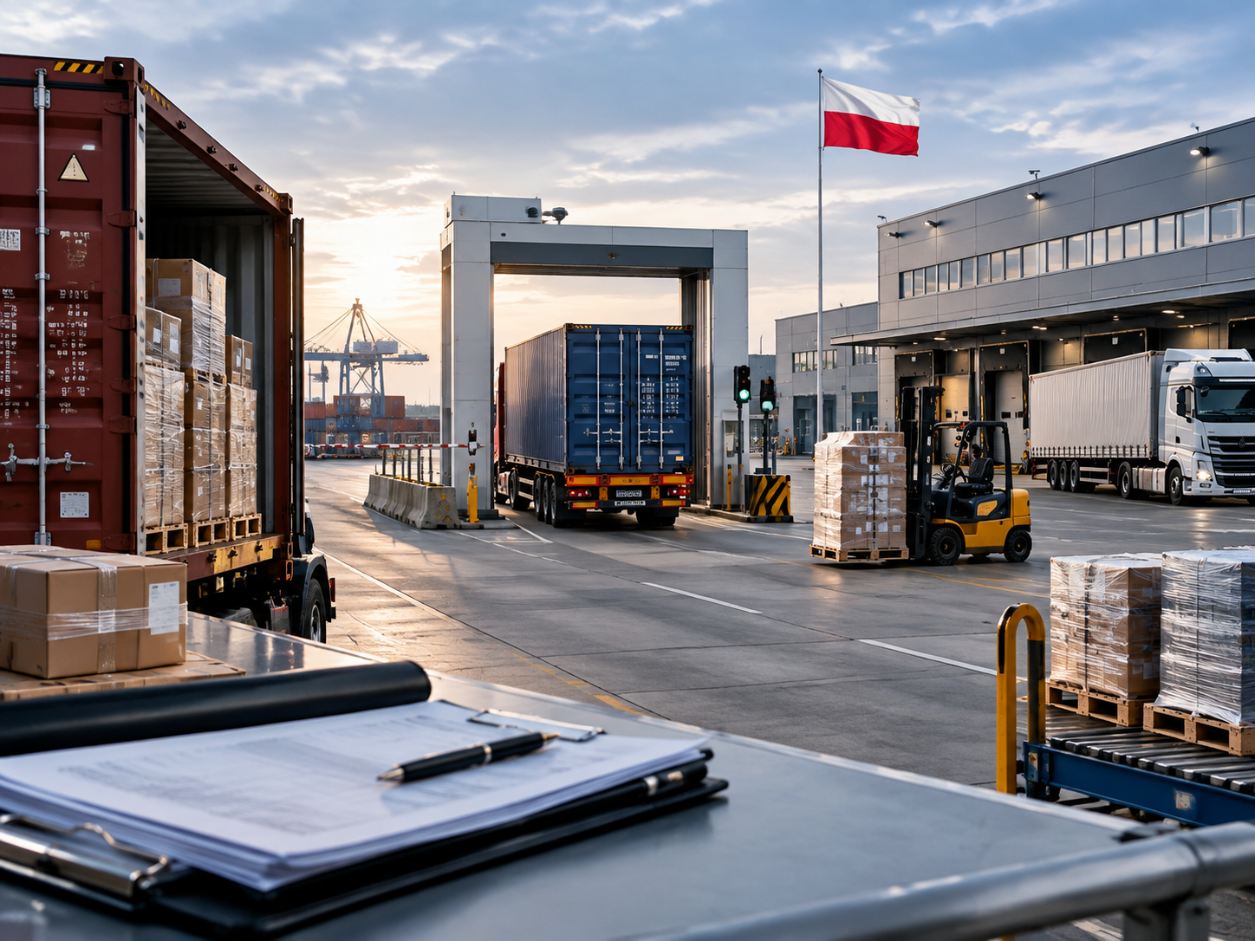
Before the shipment reaches the Polish entry point, the importer should make sure the identity, customs data, documents, and representation arrangements are ready for the actual product.
- EORI number An EORI is mandatory for EU customs operations; Poland’s official PUESC guidance explains how eligible Polish and third-country businesses obtain or use an EORI.
- PUESC access and registration Where Polish electronic customs procedures apply, confirm the relevant PUESC registration and system access before the declaration is lodged.
- Commercial invoice Provide a consistent description, quantities, transaction values, seller and buyer details, and other information needed to support the customs declaration.
- Packing list Keep package counts, carton or pallet structure, weights, dimensions, and product-level detail consistent with the physical shipment.
- Transport document Use the applicable bill of lading, rail document, air waybill, or express shipment record and ensure the consignee and routing data are consistent with the customs filing.
- Commodity code and customs value Confirm the EU tariff classification, customs value, and origin data used to determine customs duty and applicable measures.
- Product compliance evidence Prepare licences, conformity or safety evidence, certificates, or other product-specific documents when the commodity is subject to those controls.
- Customs representation If a customs broker or other representative lodges the declaration, confirm the authorization, importer identity, and the exact division of responsibility before arrival.
The official Polish EORI guidance on PUESC confirms the EORI requirement for import operations and explains the national registration process. When a representative handles the filing, the agreed customs-brokerage scope should be confirmed before the cargo arrives. Check the current PUESC and EU guidance again before dispatch because customs systems and procedures can be updated.
Common Causes of Poland Customs Delays
- Incorrect or incomplete commodity classification.
- Invoice values, quantities, weights, or descriptions that do not match the packing list or physical cargo.
- Missing, invalid, or mismatched EORI or importer details.
- Unclear customs representation or incomplete authorization for the filing party.
- Missing product licences, conformity evidence, certificates, or other required compliance documents.
- Origin, valuation, or trade-measure information that cannot be supported when requested.
- Customs examination, document checks, or destination handling that was not included in the planned delivery scope.
Resolve these issues before departure where possible. A clean supplier invoice and packing list, a confirmed importer setup, and an agreed customs handoff reduce avoidable questions after the shipment reaches Poland.
Shipping to Amazon FBA Poland
FBA shipments to Poland must satisfy both import requirements and Amazon’s current inbound workflow. Confirm the importer of record, EORI and tax setup, commodity code, customs data, unit and carton labels, shipment plan, package dimensions and weights, and the receiving or appointment instructions shown for the assigned fulfilment centre before dispatch. Amazon’s Poland FBA guidance states that sellers use shipping plans to send inventory to fulfilment centres and that VAT obligations can depend on the fulfilment model and country where inventory is stored; review the Amazon Poland FBA guidance and the current Seller Central instructions for the shipment.
For the freight leg, keep the FBA destination and delivery scope in the quotation from the start. A China-to-Amazon FBA shipping service should be planned around the actual Amazon shipment workflow rather than treating the fulfilment centre as an ordinary warehouse delivery.
Special Cargo, Packaging, and Insurance
Cargo Requiring Additional Review
- Lithium batteries and other battery-powered equipment.
- Dangerous goods and regulated chemicals.
- Liquids, aerosols, and products with leakage or flammability concerns.
- Food, cosmetics, supplements, and other products subject to product-specific controls.
- Medical goods or devices requiring regulatory documentation.
- Wood packaging that may be subject to regulated treatment and marking requirements.
- Oversized, heavy, or project cargo requiring special loading or delivery equipment; see project cargo shipping for the relevant route-planning context.
- Temperature-controlled, controlled, or otherwise restricted goods that need specific transport or import permissions.
Packaging Checks
Packaging should protect the product through China pickup, export handling, international movement, Polish terminal operations, customs examination if selected, and the final inland leg. Match the packing configuration to the transport method and destination handling plan rather than assuming factory packaging is sufficient.
- Carton strength: Verify that outer cartons can withstand stacking, vibration, and repeated handling.
- Internal protection: Secure the product against movement, impact, abrasion, and leakage.
- Pallets: Use stable pallets where the shipment scope or receiving facility requires palletized handling.
- Moisture protection: Add appropriate barriers or protection for cargo vulnerable to humidity or condensation.
- Handling marks: Make weight, orientation, fragility, or other required handling information visible where appropriate.
- Labels: Keep transport, product, and destination labels accurate, scannable, and consistent with the shipment record.
- Dimensions and weights: Verify actual packed measurements and weights before the quote and again before dispatch.
- Regulated wood packaging: Confirm treatment and marking requirements when solid-wood packaging or pallets are used.
Cargo Insurance
Carrier liability is not the same as cargo insurance. Confirm the coverage, exclusions, deductible, insured value, evidence requirements, and coverage period before dispatch, particularly when the shipment has high cargo value or special handling exposure. Cargo insurance support should be evaluated separately from the transport price and customs scope.
Choosing a China to Poland Freight Forwarder
When comparing freight-forwarding quotations, check whether each figure clearly identifies origin pickup, main transport, customs scope, destination charges, inland delivery, insurance, delivery scope, and the final ZIP code or postcode. Two quotations are not like-for-like when their route scope, units, or included charges differ.
Why Use a Freight Forwarder for China-to-Poland Shipping
- Supplier pickup coordination: One route owner can align factory readiness, pickup timing, package data, and origin gateway handoff.
- Mode and gateway comparison: The shipment can be evaluated across sea, rail-based, air, express, or multimodal options against the final postcode and deadline.
- Document-readiness checks: Commercial invoice, packing list, transport data, customs classification, and importer information can be aligned before departure.
- Origin and destination handoffs: The forwarder can coordinate the transfer from the China supplier to the booked gateway and then from the Polish gateway toward final delivery.
- Exception coordination: Status changes, customs questions, handling exceptions, or delivery problems can be routed through one operational contact.
- Scope clarity: The customer can see which pickup, customs, destination, inland, insurance, and delivery items are inside or outside the requested service.
A freight forwarder does not replace the importer of record, customs authority, legally required licensed customs representative, product-compliance owner, or legal and tax adviser.
Why Choose TJ for China-Poland Shipping
The useful starting point is a route built from the actual supplier location and final Polish postcode. TJ can compare the available route options where the shipment profile and requested scope make them appropriate. The quotation should identify the chosen mode, origin and destination handoffs, customs responsibility, and final delivery scope rather than relying on a generic transport label.
For a China-to-Poland quotation, send the supplier location, cargo type, package count, dimensions, CBM and gross weight, destination postcode, delivery scope, cargo-ready date, customs requirements, and preferred transit time. Send the shipment details for a route-specific freight quotation.
Frequently Asked Questions
How much does shipping from China to Poland cost?
The supplied indicative references are $2,610–$3,190 for FCL 20GP, $4,275–$5,225 for FCL 40GP, $33/cbm for LCL, $3,960–$4,840 for Rail 20GP, $5,895–$7,205 for Rail 40GP, $5.2/kg for air freight, and $9.37/kg for express. Their inclusion scope is not specified, so pickup, handling, customs, duty and tax, inland delivery, insurance, storage, examination, appointments, and surcharges must be confirmed.
How long does sea freight from China to Poland take?
The supplied planning reference is 25–31 days for both FCL 20GP and FCL 40GP, and 26–35 days for LCL. The input does not define whether those figures are port-to-port, terminal-to-terminal, or door-to-door, so the exact scope must be confirmed.
Which major China ports handle cargo for Poland?
Relevant gateways include Shanghai, Ningbo-Zhoushan, Shenzhen (Yantian), Qingdao, Xiamen, and Tianjin Xingang. Port Gdańsk’s current connection information lists regular container services with these Chinese ports, while the practical origin choice still depends on supplier pickup distance and the confirmed sailing.
Which Poland port should I compare for my final destination?
Start with Gdańsk and Gdynia for containerized China cargo, then compare Szczecin when the confirmed service and western-Poland inland leg fit the shipment. Gdańsk has current Asia container connections, while Gdynia has established container terminals and multimodal hinterland links; the final postcode determines which inland route should be priced.
Is rail or rail-based shipping from China to Poland available?
Yes, rail-based shipping is included in the supplied Poland route data at 12–15 days for both Rail 20GP and Rail 40GP. The actual corridor, border handoffs, destination terminal, and final delivery scope still need to be confirmed for the shipment.
What does the importer need before Poland customs clearance?
The importer normally needs a valid EORI, the required PUESC setup, a consistent commercial invoice and packing list, the transport document, the correct commodity code and customs value, and any product-specific licences or compliance evidence. Poland’s current PUESC guidance confirms the EORI requirement for import operations.