

Reviewed by TJ Logistics Team — September 2026. This route-planning page is for planning purposes only; reconfirm schedules, customs requirements, and delivery arrangements against the exact postcode, cargo, and booking date before dispatch. Market, cost, customs, tariff, tax, and marketplace information has been reviewed for the current September 2026 window. The review applies practical checks across supplier pickup, gateway and mode selection, customs handoff, and final delivery.
China to Iceland Shipping Update
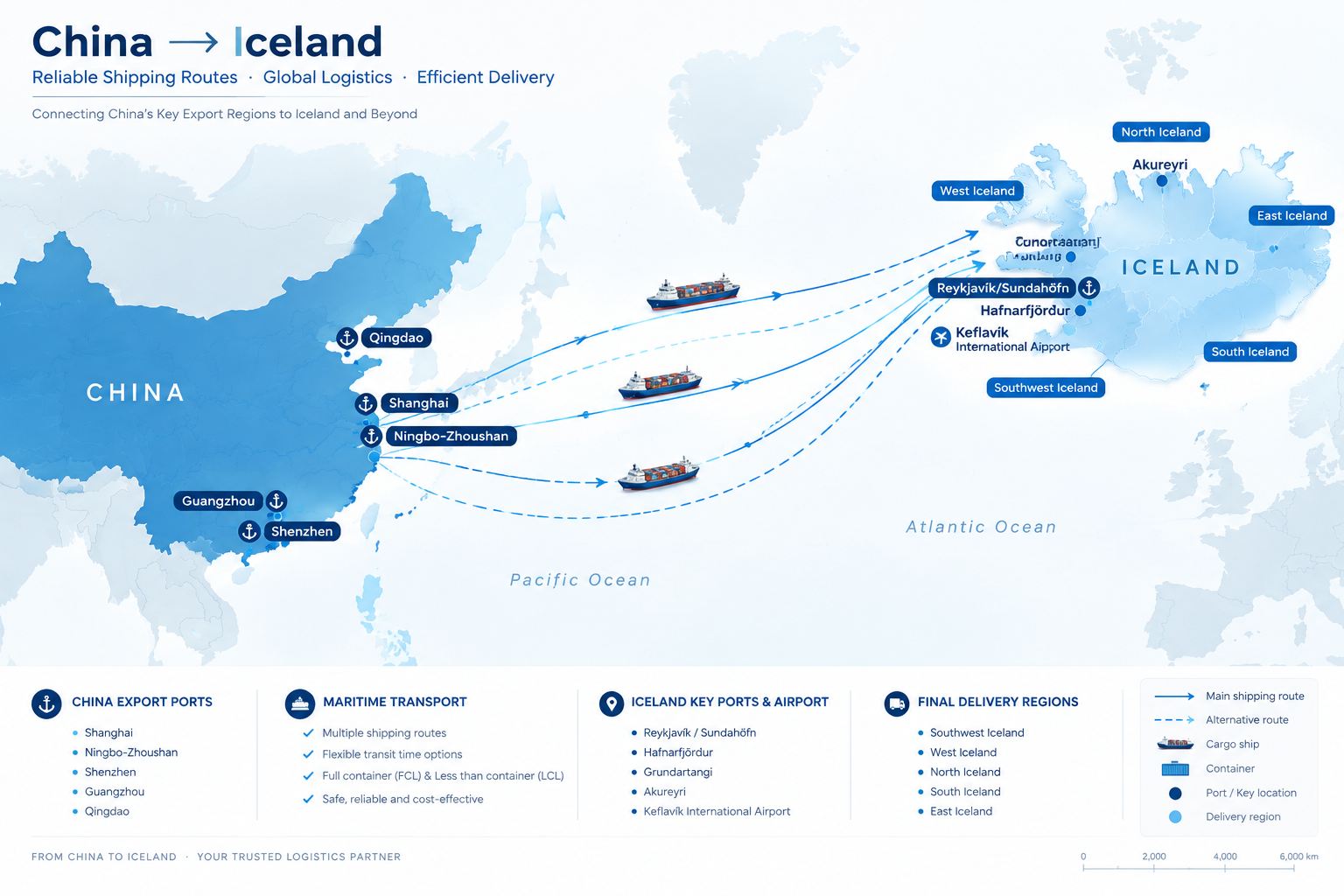
A China-to-Iceland shipment normally starts with pickup from the supplier in China, connects to a suitable export gateway, moves by the selected sea, air, express, or confirmed multimodal route, enters Iceland through an appropriate cargo gateway, clears Icelandic customs, and continues to the final delivery postcode. Sundahöfn in Reykjavík is Iceland’s largest import port, while Keflavík Airport is the main customs aerodrome for air cargo. Sea freight from China is generally the main option to compare for larger consignments, while air freight becomes more relevant when transit time is a priority.
The supplied planning references are 25–33 days for FCL 20GP and FCL 40GP, 26–37 days for LCL, 5–8 days for air freight, and 5–9 days for express. Those figures are planning references rather than delivery guarantees, and the input does not specify whether the timing starts at supplier pickup, an origin terminal, the main international departure, or another point. The final route should therefore be confirmed from the supplier address through customs and delivery to the Icelandic postcode.
Route Planning Summary
- Where should the supplier connect to the route?
-
Start with the supplier’s factory or warehouse location and compare the practical China export gateway after considering pickup distance, cargo readiness, available service, and the final Iceland delivery point.
- Which transport mode applies?
-
Compare FCL, LCL, air freight, and express according to cargo size, weight, deadline, and destination postcode. Rail is not a direct China-to-Iceland mode because Iceland has no rail connection.
- What planning time should be used?
-
Use the supplied 25–33 day FCL reference, 26–37 day LCL reference, 5–8 day air reference, or 5–9 day express reference, then confirm pickup, handling, customs, and final-mile timing separately.
- Who is responsible for destination clearance?
-
The importer remains responsible for the import transaction and applicable duties and taxes. A customs representative can handle declaration work when properly appointed for the shipment.
- What should the final quote cover?
-
The quotation should identify supplier pickup, origin handling, main transport, Iceland customs scope, destination charges, inland delivery, insurance where requested, and the agreed treatment of duties and taxes.
China to Iceland Shipping Cost
There is no single China-to-Iceland shipping cost for every cargo profile. The figures below are indicative cost references for this route, not carrier freight rates, TJ selling prices, or binding quotations. Reconfirm them for the actual booking date, cargo, route, and requested service scope.
| Shipping option | Indicative shipping cost | Supplied transit time | Main cost drivers |
|---|---|---|---|
| FCL 20GP | USD 3,626–4,397 | 25–33 days | Supplier pickup point, container handling, origin and destination charges, international routing, customs, inland delivery, and quotation scope |
| FCL 40GP | USD 5,437–6,629 | 25–33 days | Supplier pickup point, container handling, origin and destination charges, international routing, customs, inland delivery, and quotation scope |
| LCL | USD 60/m³ | 26–37 days | Cargo volume, pickup location, consolidation, origin and destination handling, customs, inland delivery, and quotation scope |
| Air freight | USD 5.33/kg | 5–8 days | Chargeable weight, supplier pickup, airport handling, routing, customs, destination handling, and final delivery scope |
| Express | USD 9.60/kg | 5–9 days | Chargeable weight, pickup and delivery postcode, express handling, customs scope, and final-mile delivery |
| Door-to-door shipping | No supplied cost; request a route-specific quote | No supplied transit time | Supplier pickup, selected transport mode, customs arrangement, destination handling, inland delivery, and exact delivery scope |
Cost scope: The supplied inputs provide cost and transit values but do not define which charges are included. Confirm origin pickup, export and origin handling, main transport, destination handling, customs-clearance service, duty and tax, inland delivery, insurance, storage, examination, appointments, and surcharges as relevant. The indicative figures must not be treated as port-to-port, airport-to-airport, door-to-door, all-inclusive, or duty-paid unless the confirmed quotation explicitly states that scope.
Plan Your China to Iceland Shipment
Send the supplier location, cargo type, package count, dimensions, CBM and gross weight, destination ZIP or postcode, delivery scope, cargo-ready date, customs requirements, and preferred transit time through Request a route-specific quote.
Final cost depends on supplier location, cargo details, CBM or chargeable weight, destination postcode, delivery scope, customs requirements, duties and taxes, destination charges, storage or examination, and insurance. Separate the charges included in the confirmed quotation from those that remain payable by the importer, consignee, or another party.
Iceland Import Duty and Taxes
Iceland’s import charges depend on the goods rather than a single universal import rate. The Directorate of Customs states that import charges can include customs duties, excise duties, value added tax, and other applicable charges, with treatment determined under the Icelandic customs tariff and the circumstances of the shipment.
How Import Charges Are Planned
- Confirm the product’s commodity classification under the Icelandic customs tariff and make sure the goods description supports the classification.
- Establish the customs value using the commercial and transport documentation required for the declaration.
- Check whether customs duty or excise duties apply to the specific product, including any relevant exemption or preferential-origin treatment.
- Confirm the applicable Iceland VAT treatment. The official 2026 tax information lists a standard VAT rate of 24% and a reduced rate of 11% for specified goods and services.
- Confirm who will declare the goods and who will pay the import charges before departure, because transport scope and importer tax responsibility are separate issues.
This is a simplified shipment-planning explanation and is not tax advice. Confirm the classification, valuation, duty, VAT, and any special treatment against current official guidance before entry.
For current import-charge guidance, review the Iceland Customs information on import duties and charges. The current 2026 VAT figures are published by the Icelandic Directorate of Internal Revenue.
China to Iceland Shipping Time
The supplied planning reference is 25–33 days for FCL 20GP, 25–33 days for FCL 40GP, 26–37 days for LCL, 5–8 days for air freight, and 5–9 days for express. These values should be used for planning, not as guaranteed delivery commitments. Because the input does not define the timing scope, confirm whether the figure covers the main transport leg only or includes supplier pickup, origin handling, customs, and final delivery.
For sea shipments, the actual route clock can include supplier pickup, China export handling, international transportation, arrival at an Icelandic gateway, customs processing, destination handling, and inland delivery. For air and express shipments, the international movement is shorter in the supplied references, but airport handling, customs, and final-mile delivery still need to be scheduled. The customs location should also be aligned with the physical cargo route rather than selected independently of the final delivery postcode.
Shipping Methods from China to Iceland
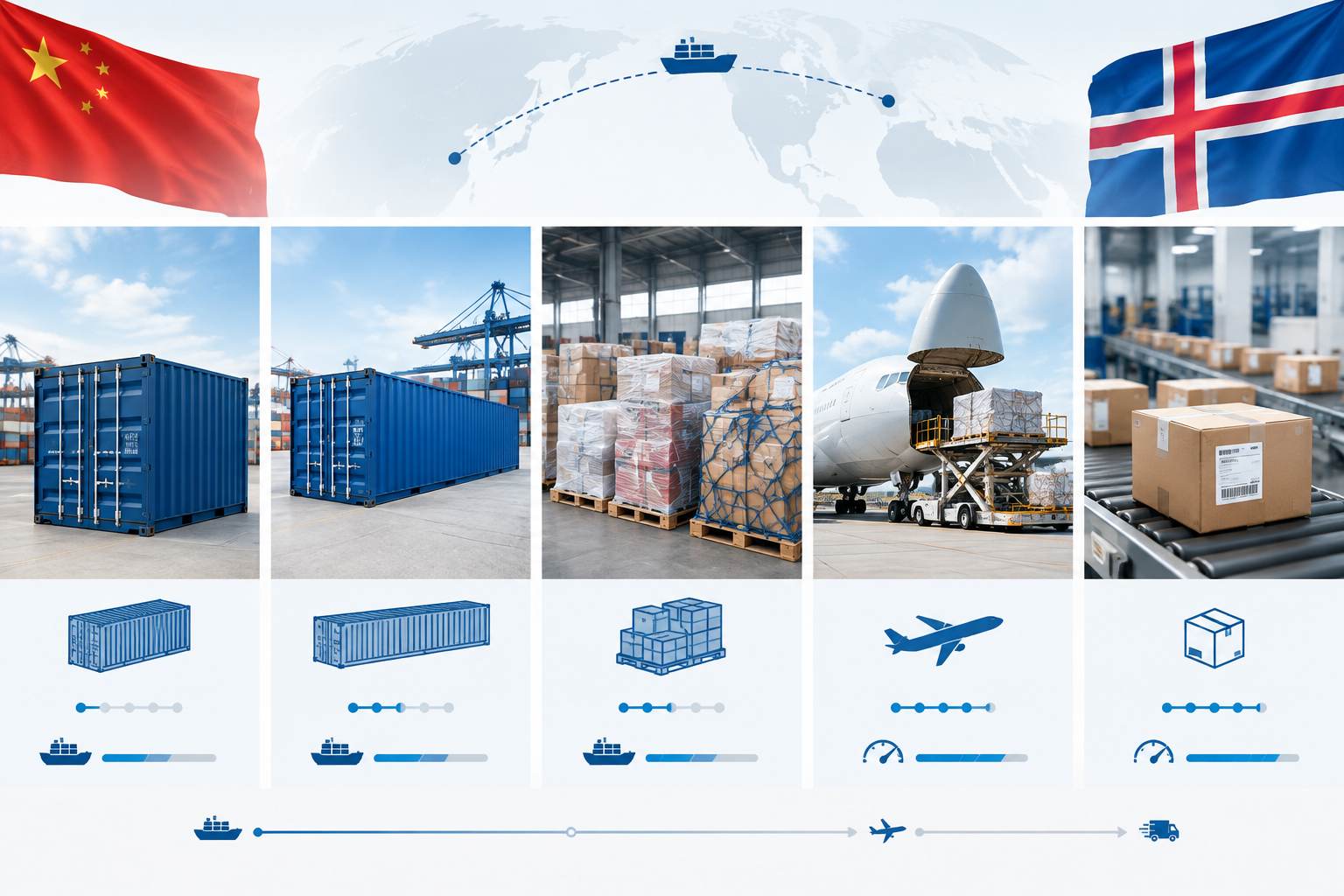
FCL is the main option to compare when the shipment can use a dedicated container efficiently and the delivery deadline allows sea transport. LCL is suitable for smaller consignments that do not require a full container, but consolidation and destination handling form part of the route. Air freight is relevant when the supplied 5–8 day planning reference fits the required schedule, while express uses the supplied 5–9 day reference for time-sensitive smaller shipments.
There is no direct rail connection to Iceland. A rail-based arrangement would therefore have to be a confirmed multimodal route using rail on a mainland segment and another transport mode to complete the Iceland leg. Where that structure is commercially relevant, compare the complete routing through rail freight planning and multimodal freight, rather than treating rail as a direct China-to-Iceland service.
The final method should be selected from the supplier’s location, cargo size and weight, final Iceland postcode, required delivery scope, available schedule, and the operational cost of waiting. A larger shipment may justify FCL while a smaller shipment may fit LCL, and urgent cargo may justify comparing air or express against the consequences of a longer sea schedule.
Door-to-Door Shipping from China to Iceland
A door-to-door plan connects the China supplier address through transport, Iceland customs, destination handling, and final delivery to the agreed postcode. The commercial scope still needs to identify responsibility for duties, taxes, destination charges, storage, examinations, and other exceptions. Door-to-door shipping can be arranged where that complete scope is requested and confirmed.

Cargo and Compliance Review
Confirm the product description, packaging, quantities, dimensions, gross weight, commodity classification, and any import or product-control requirements before the supplier releases the cargo.
Route and Method Selection
Compare the China export gateway and appropriate FCL, LCL, air, express, or confirmed multimodal route against the Iceland destination postcode and required delivery scope.
Supplier Coordination and Pickup
Coordinate pickup from the supplier factory or warehouse, verify the cargo-ready date, and make sure package marks and shipment data match the commercial documents.
China Export Handling
Complete consolidation or container loading as applicable, prepare the transport documentation, and complete export procedures before the international movement begins.
International Transportation
Move the shipment using the confirmed transport mode and route. Schedule changes, handling conditions, transshipment, and other operational events can affect the planning window.
Iceland Import Clearance
Submit the required customs declaration and supporting documents, address applicable import charges, and obtain customs release before the cargo enters the final delivery stage.
Final Delivery
After customs release and destination handling, deliver the cargo to the agreed Icelandic postcode while checking access, appointment, storage, or special-delivery conditions.
Shipment Close-Out
Confirm proof of delivery, reconcile applicable destination and customs charges, retain the shipment documents, and close any damage or exception process.
Main China to Iceland Routes
The practical route connects the supplier location in China to the final Icelandic postcode while considering pickup distance, origin gateway, transport schedule, destination handling, customs, and inland delivery. Iceland’s Ports of Faxaflói identify Sundahöfn as the country’s largest import port and operate major cargo facilities across Reykjavík, Akranes, Grundartangi, and Borgarnes.
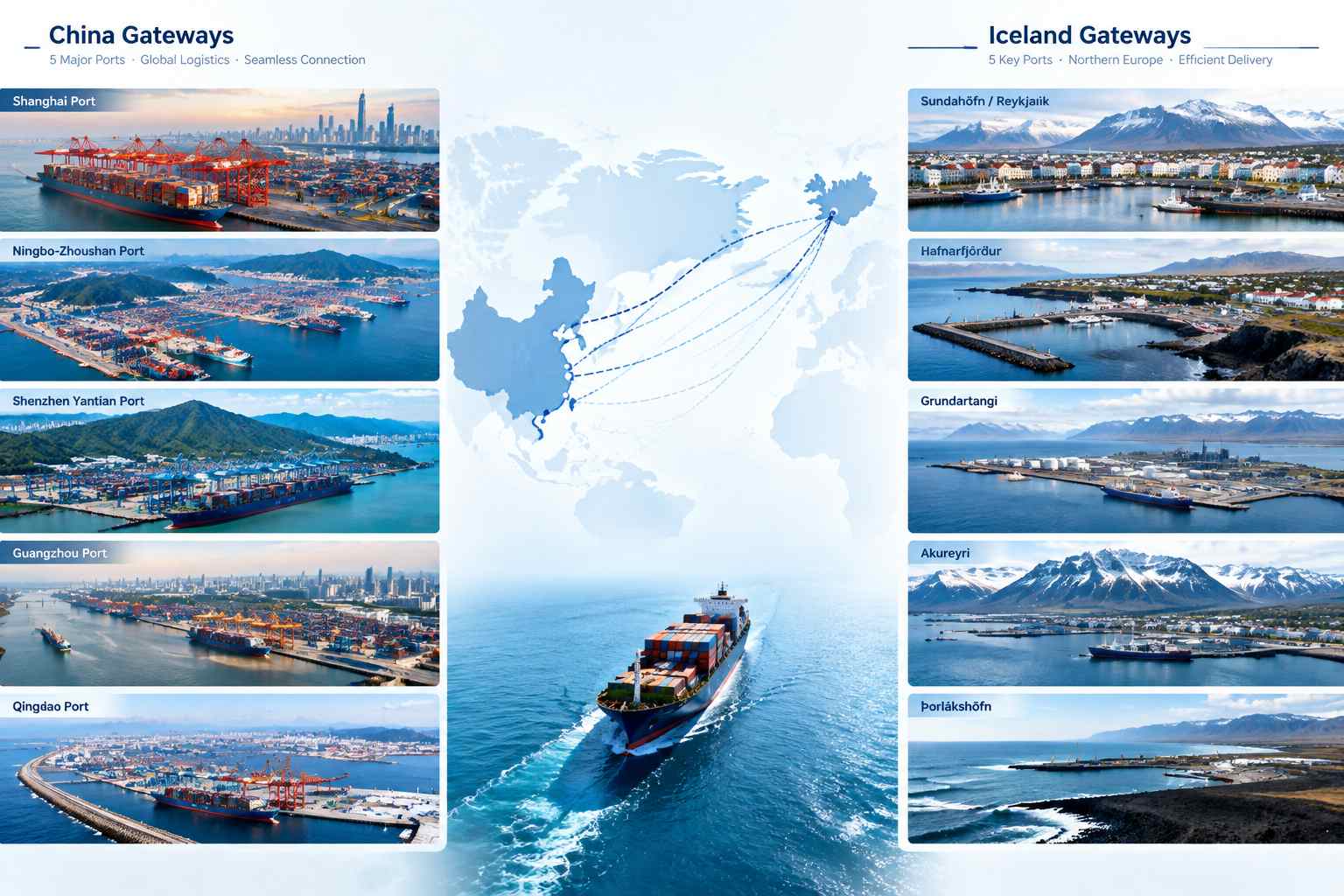
Major China Export Ports for Iceland Shipping
- Shanghai Port
- Relevant to suppliers in Shanghai, Jiangsu, Zhejiang, and the wider Yangtze River Delta. Compare it where factory pickup is practical and the confirmed ocean routing provides a workable connection toward Iceland.
- Ningbo-Zhoushan Port
- A major comparison point for Ningbo and southern Zhejiang manufacturing areas. It becomes particularly relevant when the supplier is geographically closer to Ningbo or when the confirmed service and pickup scope differ from Shanghai.
- Shenzhen Yantian Port
- Relevant to South China suppliers around Shenzhen, Dongguan, Huizhou, and nearby manufacturing clusters. Its practical value depends on supplier pickup distance, consolidation requirements, and the available onward schedule.
- Guangzhou Port
- Useful for Pearl River Delta suppliers whose factories have a practical inland connection to Guangzhou. Compare it with other South China gateways based on total pickup and international-route scope rather than the port alone.
- Qingdao Port
- Relevant to northern China and Shandong-area suppliers. It can be compared where factory geography, cargo handling, and the available international connection make a northern China gateway practical.
Major Iceland Import Ports for Cargo from China
- Sundahöfn, Reykjavík
- Located in the capital area and identified by the Ports of Faxaflói as Iceland’s largest import port. It is a key gateway to compare for Reykjavík and much of southwest Iceland.
- Hafnarfjörður
- A southwest Iceland port in the capital-region logistics area. Compare it where the confirmed cargo service and final delivery geography make it practical for southwest destinations.
- Grundartangi
- An industrial cargo gateway in western Iceland. It can be relevant where western or industrial destinations make a Grundartangi-oriented route more practical than a longer inland move from Reykjavík.
- Akureyri
- A northern Iceland cargo gateway inside Eyjafjörður. For North Iceland destinations, compare an Akureyri-oriented option with a southwest gateway followed by longer inland transportation.
- Þorlákshöfn
- A southern Iceland port that can be considered where a confirmed service and final delivery geography make it a practical alternative to a capital-area gateway.
| Supplier region in China | Origin port to compare | Destination port and delivery region | Planning reason |
|---|---|---|---|
| Yangtze River Delta, including Shanghai and nearby Jiangsu and Zhejiang suppliers | Shanghai Port | Sundahöfn, Reykjavík for southwest and capital-region deliveries | Compare supplier pickup distance, current international service, destination handling, customs scope, and inland delivery to the final postcode. |
| Ningbo and southern Zhejiang manufacturing areas | Ningbo-Zhoushan Port | Sundahöfn, Reykjavík or another confirmed southwest gateway | Useful where the factory is closer to Ningbo; confirm the actual sailing pattern, transshipment, destination handling, and final-mile scope. |
| Pearl River Delta and South China manufacturing areas | Shenzhen Yantian Port | Sundahöfn, Reykjavík for southwest demand or Akureyri for a specifically confirmed northern routing | Compare factory pickup, consolidation, international routing, destination charges, and the inland route from the selected Iceland gateway. |
| Shandong and northern China production areas | Qingdao Port | Akureyri for North Iceland delivery where service is confirmed, or Sundahöfn for southwest delivery | Compare the northern supplier pickup with the actual international schedule and the inland distance from the Iceland gateway to the final postcode. |
| Guangdong manufacturing clusters with practical Guangzhou access | Guangzhou Port | Sundahöfn, Reykjavík and southwest Iceland | Compare factory pickup distance, available international service, destination handling, customs, and final-mile scope rather than selecting the origin port on geography alone. |
Destination Regional Delivery Logic
- Southwest Iceland
- Reykjavík and the surrounding capital area should normally be compared through the southwest port cluster, particularly Sundahöfn and, where appropriate, Hafnarfjörður. The final postcode determines the inland delivery scope.
- West Iceland
- Compare a capital-area gateway with Grundartangi or another confirmed gateway when the destination is in western Iceland. The inland move after customs should be included in the total route comparison.
- North Iceland
- Akureyri is a practical gateway for northern destinations where an applicable service is available. Compare it with southwest routing when a longer inland connection could change total cost, handling, or schedule.
- South and East Iceland
- Compare southwest gateways with other confirmed Icelandic cargo gateways where the actual service exists. Consider the final postcode, inland travel, destination charges, and delivery scope rather than the port-to-port leg alone.
How the Gateway Is Selected
Fix the origin and destination gateways only after checking the complete route:
- Supplier pickup distance and cargo-ready timing in China.
- Current carrier or consolidator service and whether transshipment is required.
- Final Iceland postcode and inland distance after customs release.
- Destination handling, storage, inspection, and appointment requirements.
- Whether the quotation scope is port-to-port, terminal-to-door, or full door-to-door.
For sea cargo entering the capital-region supply chain, the Ports of Faxaflói cargo information identifies Sundahöfn as Iceland’s largest import port. Air cargo planning should separately confirm the customs and handling arrangements at the airport gateway.
Iceland Customs Clearance
Iceland customs rules apply to goods imported into Iceland. The importer must ensure that the goods are correctly declared, the required documents are available, applicable import charges are addressed, and any product-specific requirements are satisfied. Iceland Customs requires import documents to be submitted in connection with the import declaration and states that cargo is subject to customs-control procedures before it can be released for domestic disposal.
What the Iceland Importer Normally Needs
Prepare the customs file before the cargo reaches Iceland so declaration, release, and delivery can proceed without avoidable document gaps.
- Importer identity and registration Confirm the Icelandic importer’s applicable customs and tax identifiers and the party authorized to conduct the customs transaction.
- Commercial invoice The invoice should identify the seller and buyer, issue information, quantities, packaging, goods description, prices, currency, and applicable delivery or payment conditions. See the Iceland Customs import-document guidance for the required invoice information.
- Packing list Provide package counts, marks, weights, dimensions where relevant, and a shipment breakdown that can be matched against the physical cargo and invoice.
- Commodity code Confirm the tariff classification before dispatch because the code affects customs treatment, duty, tax, and product-specific controls.
- Transport document Keep the bill of lading, air waybill, or other transport document consistent with the commercial shipment information.
- Freight and customs-value evidence Retain supporting records for customs valuation and freight information when required for the declaration.
- Origin evidence and special permits Provide origin evidence where preferential treatment is claimed and obtain any licence, certificate, or authorization required for the product.
- Customs representation authorization Where an agent is used, ensure the importer has properly authorized the customs representative for the relevant declaration and shipment scope.
Common Causes of Iceland Customs Delays
- Vague product descriptions that do not support accurate classification.
- Invoice, packing list, and transport-document information that does not match.
- Incorrect commodity classification.
- Missing or unsupported customs-value information.
- Missing licences, certificates, origin evidence, or product-specific documents.
- Unclear responsibility for import duties and VAT.
- Cargo arriving before the declaration and supporting documents are ready.
Resolve document and classification issues before departure wherever possible. The importer, supplier, transport provider, and customs representative should agree on the declaration data before the cargo enters the Icelandic customs process.
Shipping to Amazon FBA Iceland
Iceland is not one of the countries listed as a Pan-European FBA inventory-storage country by Amazon’s current Europe FBA information. Amazon identifies France, Germany, Italy, Spain, and Poland for Pan-European FBA inventory placement, so a shipment intended for Iceland should first establish where the inventory will physically enter customs and where Amazon fulfillment will actually occur.
Where inventory is being shipped to an Amazon fulfillment center in another European country, the import requirements of that physical entry country apply, and the seller must also satisfy Amazon’s current inbound requirements. These can include the shipment plan, SKU and carton labels, carton requirements, importer arrangements, commodity classification, VAT position, and delivery instructions. Review Amazon FBA shipping support alongside the applicable Amazon Seller Central requirements before dispatch. Amazon’s current Pan-European FBA information confirms that participating storage countries and listing requirements can change, so the actual destination should be checked before each inventory shipment.
Special Cargo, Packaging, and Insurance
Cargo Requiring Additional Review
- Lithium batteries and other battery-powered products that may require transport declarations or carrier approval.
- Dangerous goods and chemicals requiring classification, documentation, packaging, or specialized transport handling.
- Liquids, aerosols, and products with leakage, pressure, or contamination risks.
- Food, cosmetics, and medical products that may have additional Icelandic import or regulatory requirements.
- Wood packaging materials that may be subject to applicable plant-health requirements.
- Oversized, overweight, fragile, or temperature-controlled cargo requiring specialized handling.
- Controlled or otherwise regulated products for which an import licence or other authorization may be required.
Packaging Checks
Packaging should be designed for the complete China-to-Iceland route rather than only the initial factory pickup. Sea cargo can experience repeated handling, consolidation, moisture exposure, and warehouse transfer, while air and express shipments can move through multiple rapid handling points.
- Use carton strength suitable for the cargo weight and expected stacking conditions.
- Protect internal components against movement and impact.
- Use pallets or other unitization when required by the confirmed handling plan.
- Use moisture protection for cargo and packaging that are sensitive to condensation or weather.
- Keep carton marks and shipping labels consistent with the commercial documents.
- Confirm accurate package dimensions and gross weights before booking.
- Check applicable requirements for regulated wood packaging before cargo leaves the supplier.
Cargo Insurance
Carrier liability is not the same as cargo insurance. Confirm the insured value, covered risks, exclusions, deductible, evidence requirements, claim procedure, and coverage period before the shipment moves. Where separate protection is needed, review cargo insurance options rather than assuming the transport provider’s liability is equivalent to insurance coverage.
Choosing a China to Iceland Freight Forwarder
Compare freight-forwarding quotations using the same route scope. Each quotation should clearly identify supplier pickup, main transport, customs scope, destination charges, inland delivery, insurance, delivery scope, and the final Iceland postcode. Two figures are not directly comparable when their units, route stages, or included charges differ.
Why Use a Freight Forwarder for China-to-Iceland Shipping
A route-specific forwarder can coordinate the separate stages of the China-to-Iceland shipment:
- Coordinate supplier pickup with the selected China gateway and cargo-ready date.
- Compare applicable sea, air, express, or confirmed multimodal routes against the final Iceland postcode.
- Coordinate consolidation or container loading where appropriate to the shipment profile.
- Check invoice, packing-list, transport-document, and customs information before arrival.
- Coordinate origin and Iceland destination handoffs where those services are included in the agreed scope.
- Coordinate shipment status and exceptions when schedules or delivery conditions change.
A forwarder does not replace the importer of record, Iceland Customs, a legally required customs representative, the product-compliance owner, or the importer’s legal and tax adviser. The forwarder’s role is to coordinate the transport and agreed service scope around those responsibilities.
Why Choose TJ for China-Iceland Shipping
TJ can structure the route around the supplier location, cargo profile, final Iceland postcode, and requested delivery scope, then compare applicable sea freight, express shipping, and other confirmed transport options rather than assuming one method fits every shipment.
Where the shipment requires broader delivered coordination, the route can also be assessed for DDP shipping or other confirmed delivery arrangements, subject to the actual importer, customs, tax, and product-compliance requirements. For unusual cargo or project-style movements, a dedicated project cargo shipping assessment may also be appropriate.
Request a China-to-Iceland freight quotation with the supplier location, cargo type, package count, dimensions, CBM and gross weight, final postcode, cargo-ready date, customs requirements, preferred transit time, and requested delivery scope. The confirmed quotation should state the transport stages, customs responsibility, destination charges, and final-mile terms before booking.
Frequently Asked Questions
How much does shipping from China to Iceland cost?
The supplied indicative references are USD 3,626–4,397 for FCL 20GP, USD 5,437–6,629 for FCL 40GP, USD 60/m³ for LCL, USD 5.33/kg for air freight, and USD 9.60/kg for express. The input does not specify which origin, destination, customs, or delivery charges are included, so these are planning references rather than formal quotations.
How long does sea freight from China to Iceland take?
The supplied planning time is 25–33 days for FCL 20GP and FCL 40GP and 26–37 days for LCL. The timing scope is not defined, so confirm whether it covers the international movement only or a wider route including pickup, customs, and final delivery.
Which major China ports handle cargo for Iceland?
Shanghai, Ningbo-Zhoushan, Shenzhen Yantian, Guangzhou, and Qingdao are practical China gateways to compare according to supplier geography. Shanghai and Ningbo-Zhoushan are particularly relevant to Yangtze River Delta suppliers, Shenzhen Yantian and Guangzhou to South China production, and Qingdao to northern China and Shandong-area suppliers.
Which Iceland port should I compare for my final destination?
Sundahöfn in Reykjavík is the key comparison point for southwest and capital-region deliveries, while Akureyri is relevant to North Iceland. Hafnarfjörður, Grundartangi, and Þorlákshöfn can also be compared where the confirmed service and final postcode make the resulting inland route practical.
Can I ship from China to Iceland door-to-door?
Yes, a door-to-door route can be structured from the China supplier address through transport, Iceland customs, and final delivery. The confirmed quote must state whether customs clearance, duties and taxes, destination charges, insurance, storage, and inland delivery are included.
What documents are required to ship from China to Iceland?
The Iceland import file generally includes a commercial invoice and transport document, with freight documentation, a packing list or shipment information, origin evidence when preferential treatment is claimed, and any import licence or product certificate required for the specific goods. Iceland Customs specifically lists an invoice, transport document, freight-charge documentation, applicable origin evidence, and other relevant documents as part of the import declaration process.