

Reviewed by TJ Logistics Team October 2026. Market, cost, customs, tariff, and marketplace information was reviewed for this month; product-specific requirements and transport conditions can change. This review applies practical route-planning checks across supplier pickup, gateway and mode selection, customs handoff, and final delivery.
Shipping from China to Kyrgyzstan: Route Update
China → Bishkek, Kyrgyzstan (via Kazakhstan), using FCL 20GP rail-road multimodal transport, has an indicative reference of $2,970–$3,630/container and 6–7 days. This is the starting comparison when the shipment requires a full container and the intended delivery area is Bishkek.
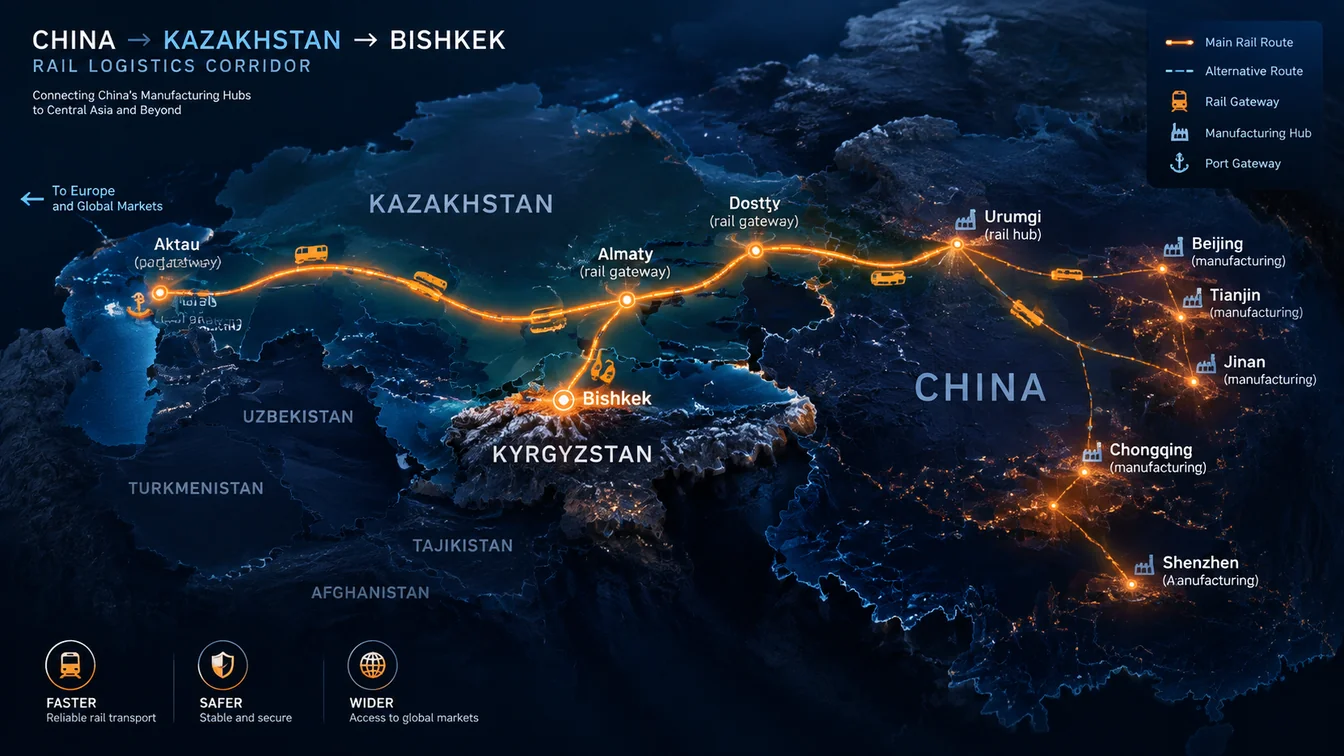
For other shipments, the practical choice is a route that connects the supplier to a usable China gateway, crosses the relevant border or transfer point, and reaches the Kyrgyzstan delivery address. Rail-road multimodal transport is a natural starting point for general containerized cargo, while air freight and express are alternatives for eligible time-sensitive goods; the multimodal freight service supports evaluation of combined transport legs.
Route Planning Summary
- How should the shipment move from the supplier to the origin gateway?
- For a Bishkek-bound shipment, begin with the supplier’s actual address and compare collection to a suitable inland rail or road gateway; a coastal port or airport is useful only when the planned mode and onward route support it.
- Which transport mode applies?
- Rail-road FCL or rail-led multimodal LCL is a practical starting point for general cargo, while eligible urgent shipments can use air freight or express; the sea-led Riga option is a distinct route with a different transit profile.
- Which planning time should be used?
- Use the reference for the exact origin, method, and route selected; the Kazakhstan-led, Xi’an, air, express, and Riga entries describe different transport configurations and should not be averaged together.
- Who is responsible for Kyrgyzstan import clearance?
- The importer remains responsible for accurate import information, applicable duties and taxes, and product compliance, even when a customs representative or freight forwarder coordinates the declaration process.
- What determines final delivery and service scope?
- The named receiving address, customs-release arrangements, unloading requirements, and agreed delivery boundary determine whether the movement ends at a terminal, commercial premises, warehouse, or another destination.
China to Kyrgyzstan Shipping Cost
These are indicative shipping costs and planning transit references reviewed for October 2026. Each reference applies only to its named route, shipping method, and unit.
| Shipping route | Shipping method | Price | Transit time |
|---|---|---|---|
| China → Bishkek, Kyrgyzstan (via Kazakhstan) | FCL 20GP (rail-road multimodal) | $2,970–$3,630/container | 6–7 days |
| China → Bishkek, Kyrgyzstan (via Kazakhstan) | FCL 40GP (rail-road multimodal) | $4,320–$5,280/container | 6–7 days |
| Xi’an, China → Kyrgyzstan | FCL 40HQ (rail/multimodal) | $4,400–$5,300/container | 12–15 days |
| Shantou, China → Bishkek (via Riga, Latvia) | LCL (sea + rail/road multimodal) | $345/CBM | 53 days |
| Guangzhou, China → Bishkek (Manas/FRU), Kyrgyzstan | Air freight | From $11.50/kg | 3–7 days |
| China → Kyrgyzstan (destination city not specified) | Express | $13.20/kg | 3–5 days |
| China → Kyrgyzstan (via Kazakhstan; endpoints not specified) | Rail-led multimodal LCL | $150/CBM | 6–7 days |
Cost scope: The indicative cost references apply to the route, method, and unit shown; they are not carrier freight rates, market averages, selling prices from TJ Logistics Team, or binding quotations. The actual booking, cargo, and agreed service scope determine the commercial arrangement, including responsibility for relevant pickup, handling, customs, duty and tax, inland delivery, insurance, storage, examination, appointment, and surcharge items.
Kyrgyzstan Import Duty and Taxes
For commercial imports from China into Kyrgyzstan, customs duty follows the applicable Eurasian Economic Union (EAEU) tariff classification, while Kyrgyzstan import VAT and any excise taxes depend on the goods and current rules. The Kyrgyzstan customs guidance explains how the EAEU Unified Customs Tariff establishes item-specific import duty rates and how import taxes may apply.
Calculate the import liability for China-to-Kyrgyzstan cargo in this order:
- Classify the product under the applicable EAEU commodity nomenclature code, then check the duty rate and any restrictions or trade measures associated with that classification.
- Establish the customs value using the transaction and supporting commercial documents, applying the valuation rules relevant to the goods and declaration.
- Determine the applicable import duty and any additional trade remedies, permits, or product-specific controls; Chinese origin alone does not determine a universal duty rate.
- Calculate Kyrgyzstan import VAT, applicable excise, and other customs payments. Government tax guidance updated in June 2026 reports a standard VAT rate of 12%, including for imports, although exemptions and product-specific treatment may apply; see the tax guidance from the National Investment Agency.
This is a simplified route-planning explanation, not tax advice. The importer or its appointed customs professional should verify the commodity code, customs value, applicable tariff measures, and tax treatment before dispatch or entry.
China to Kyrgyzstan Shipping Time
China → Bishkek, Kyrgyzstan (via Kazakhstan), using FCL 20GP rail-road multimodal transport, has a supplied planning reference of 6–7 days. The corresponding FCL 40GP entry uses the same stated window, while other origins and transport configurations have different timing references.
- China → Bishkek, Kyrgyzstan (via Kazakhstan), FCL 20GP (rail-road multimodal): 6–7 days.
- China → Bishkek, Kyrgyzstan (via Kazakhstan), FCL 40GP (rail-road multimodal): 6–7 days.
- Xi’an, China → Kyrgyzstan, FCL 40HQ (rail/multimodal): 12–15 days.
- Shantou, China → Bishkek (via Riga, Latvia), LCL (sea + rail/road multimodal): 53 days.
- Guangzhou, China → Bishkek (Manas/FRU), Kyrgyzstan, air freight: 3–7 days.
- China → Kyrgyzstan (destination city not specified), express: 3–5 days.
- China → Kyrgyzstan (via Kazakhstan; endpoints not specified), rail-led multimodal LCL: 6–7 days.
Each window is a planning reference, not a delivery guarantee. Supplier readiness, consolidation cutoff, international transfers, border processing, customs release, and any separately arranged final-mile movement can affect the actual delivery schedule when they fall outside the referenced transport scope.
Shipping Methods from China to Kyrgyzstan
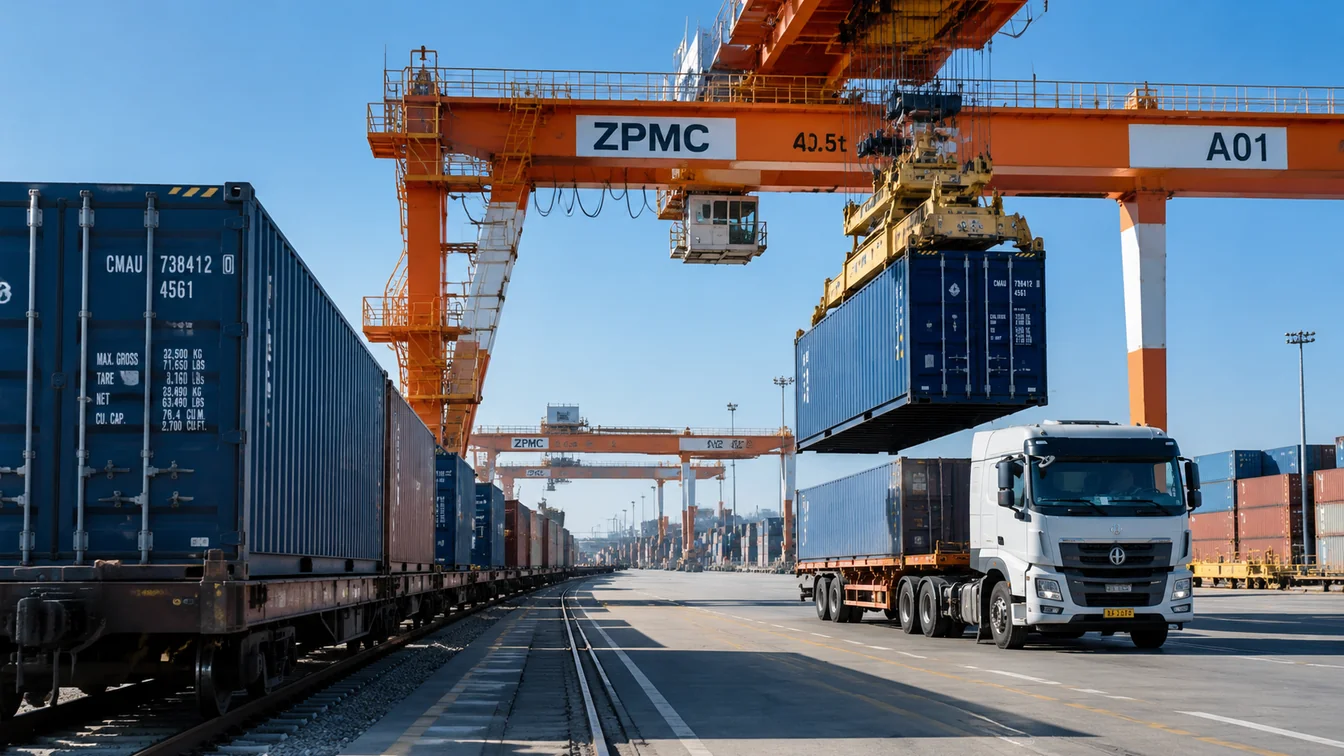
Rail-road multimodal transport is a practical starting point for general containerized cargo to Bishkek; change the mode when shipment urgency, cargo dimensions, actual or chargeable weight, supplier access, or final delivery requirements favor another route.
- FCL containers
- Choose FCL when the shipment is planned for a dedicated 20GP, 40GP, or 40HQ container because a container-based rail or road movement can avoid some consolidation handoffs. The practical fit changes with equipment availability, cargo dimensions, loading access, permitted weight, and the unloading arrangements at the destination. Compare the supplier’s pickup location with the available terminal before selecting the container route. See the rail freight service for the rail-based part of a potential movement.
- LCL consolidated cargo
- Choose LCL when the shipment is a part-load and can meet the applicable consolidation cutoff because it avoids requiring a dedicated container. Rail-led LCL via Kazakhstan and sea-led LCL via Riga are different route configurations, so select the one that fits the shipment’s urgency and planned onward connection rather than treating the two references as interchangeable. A sea-led option can be assessed through the sea freight service.
- Air freight
- Choose air freight when the cost of delay is high and the shipment’s chargeable weight, dimensions, and cargo characteristics suit air transport because an air movement can reduce the international transit portion compared with a longer sea-led route. The supplied air entry names Guangzhou and Bishkek, so check actual cargo acceptance, the airport handoff, and onward delivery to the final address. See the air freight service page.
- Express shipping
- Choose express when an urgent parcel or sample is eligible for courier handling because parcel networks can suit small, time-sensitive consignments. The selection changes with chargeable weight, package dimensions, contents, restricted-goods rules, recipient address, and whether delivery is available to the final postcode. The express shipping service is the relevant option to evaluate for eligible shipments.
- Rail-based multimodal transport
- Choose a rail-based multimodal route when cargo can move through an available rail terminal and the planned border interchange, because it provides another option for containerized or consolidated goods that are not suited to express or air handling. The exact origin terminal, rail-road transfers, selected Kazakhstan gateway, and final receiving area determine whether a specific configuration is practical. The Xi’an entry is a separate origin-specific configuration, not proof of a direct railway from every Chinese supplier to Kyrgyzstan.
Door-to-Door Shipping from China to Kyrgyzstan
Door-to-door shipping from China to Kyrgyzstan can connect supplier pickup, China export handling, international transport, import-clearance arrangements, and final delivery when those responsibilities are included in the agreed service scope. The door-to-door shipping service is relevant when the required endpoint is a named receiving address rather than a transport terminal alone.
-
Cargo and Compliance Review
Review the goods, packaging, dimensions, weight, origin address, consignee, intended use, and any applicable handling or import restrictions. Resolve product-classification or acceptance issues before choosing the transport path.
-
Route and Method Selection
Match the cargo to a viable origin gateway and transport method, such as a Kazakhstan-led rail-road route, the Xi’an rail/multimodal configuration, Guangzhou air freight, express, or a separately arranged sea-led path. The selected origin and destination must support the actual service.
-
Supplier Coordination and Pickup
Arrange collection around the supplier’s address, ready date, loading access, packing status, and cargo measurements. The collection plan must correspond to the chosen gateway and the time when the cargo can actually be handed over.
-
China Export Handling
Prepare the required commercial and transport information for export handling and check that the goods description, quantities, packing details, and declared values are consistent. Complete the applicable origin-side procedures before the shipment enters the international transport leg.
-
International Transportation
Move the cargo along the agreed route through its actual rail, road, air, sea, or transfer points. For a route involving Kazakhstan or Riga, the transport plan should distinguish the selected crossings and transfers rather than describing the journey as an unverified direct service.
-
Kyrgyzstan Import Clearance
Arrange the agreed clearance handoff using the importer’s declaration information, product documents, and applicable duty and tax calculations. The importer remains responsible for its statutory obligations even when a customs representative assists with the filing and release process.
-
Final Delivery
After the relevant release and transport handoff, arrange movement to the named Kyrgyzstan destination. Access for the delivery vehicle, the receiving facility, unloading equipment, opening hours, and any appointment requirement can change the final-mile plan.
-
Shipment Close-Out
Collect the available delivery record and reconcile the shipment documents with the actual handoffs. Retain the relevant transport, customs, payment, and condition evidence if a discrepancy or cargo claim needs to be reviewed.
Main China to Kyrgyzstan Routes
The most practical China-to-Kyrgyzstan route normally starts at a gateway that limits supplier-side movement while fitting the destination region and the actual onward connection into this landlocked country. The comparison changes when a coastal port adds an unplanned transfer, a different border crossing is needed, or the final postcode makes an apparently convenient entry gateway less practical.

Major China Export Ports for Kyrgyzstan Shipping
- Shantou Port
- For suppliers in the eastern Guangdong and Chaoshan area, Shantou is the origin port named in the sea-led LCL reference to Bishkek via Riga. This option is relevant when the supplier is near the port and the full onward inland route can be arranged; it should not be treated as a direct seaport connection to Kyrgyzstan.
- Guangzhou Port and Nansha
- For suppliers in Guangzhou and nearby Pearl River Delta manufacturing areas, Guangzhou Port’s Nansha area can be compared when a sea-led shipment has an actual onward connection. If the shipment requires the specified air route instead, compare collection to Guangzhou Baiyun Airport rather than moving cargo to a seaport without an operational reason.
- Shenzhen Yantian Port
- For container cargo from Shenzhen and nearby Dongguan, Yantian is an origin port to compare when the contracted route includes an appropriate sea and onward inland movement. For cargo moving by land or rail-road multimodal transport, a suitable inland terminal and border corridor may avoid unnecessary repositioning to the coast.
- Shanghai Port
- For suppliers in the Yangtze River Delta, Shanghai is a coastal gateway to compare when the actual service combines the supplier’s location with a documented international and inland route. A rail-based option from a nearer inland terminal may be more suitable when the shipment does not need an ocean leg.
- Ningbo-Zhoushan Port
- For suppliers in Ningbo and nearby Zhejiang manufacturing areas, Ningbo-Zhoushan can be compared with Shanghai according to pickup distance, equipment access, and the available end-to-end routing. The selected port should be supported by the planned onward connection to Kyrgyzstan, not chosen only by its name.
- Qingdao Port
- For suppliers in Shandong and northern China, Qingdao is a coastal option to compare where an actual sea-led and inland service is arranged. The supplier’s warehouse location and the chosen rail-road or sea-led connection determine whether it is preferable to a nearer inland origin gateway.
Main Gateway Ports for Kyrgyzstan Cargo
Kyrgyzstan is landlocked and has no seaport, so its usual China freight comparison centers on overland border and rail gateways rather than a domestic port of entry. Port of Riga is relevant to the specifically named Shantou sea-led LCL route; other shipments should be planned around their actual Kazakhstan transit or China–Kyrgyzstan road crossing.
- Port of Riga, Latvia
- Use Riga as the sea gateway only when the Shantou-to-Bishkek LCL path is being arranged with its actual onward inland route and transfer points documented. Riga is an intermediate seaport in this configuration, not a port in Kyrgyzstan, and this path is distinct from the Kazakhstan-led land and rail option.
- Dostyk–Alashankou rail gateway
- Compare this China–Kazakhstan rail-border interchange when the intended rail-led route uses that crossing before continuing overland toward Kyrgyzstan. Kazakhstan’s government transport guidance identifies Dostyk–Alashankou as a railway crossing for China–Kazakhstan freight; the selected service must actually use it.
- Altynkol–Khorgos rail gateway
- Compare this rail-border interchange with Dostyk–Alashankou when the chosen China–Kazakhstan rail service supports the intended equipment and onward connection. The actual transfer arrangement and route allocation determine whether this gateway fits the shipment.
- Torugart road crossing
- Torugart is a China–Kyrgyzstan road-border gateway to examine for a road-based route that is permitted and operational for the cargo. It is not interchangeable with a shipment priced for transit via Kazakhstan; the selected carrier must establish the actual crossing and onward road movement.
- Irkeshtam road crossing
- Irkeshtam is another China–Kyrgyzstan land gateway to compare for suitable road freight. The origin region, permitted transport arrangement, border status, and receiving city determine whether this corridor is practical for the shipment being planned.
Supplier Region to Destination Routing Logic
| Supplier region in China | Origin port to compare | Destination port and delivery region | Planning reason |
|---|---|---|---|
| Eastern Guangdong and Chaoshan | Shantou Port | Port of Riga, Latvia, followed by the documented inland route to Bishkek and the Chuy region | Use the Shantou → Riga → inland-to-Bishkek pattern only for the specified sea-led LCL route when the supplier is nearby and the longer routing is acceptable. The onward corridor and transfer arrangement must be named before dispatch. |
| Shaanxi and the Xi’an supplier region | Xi’an rail terminal or another suitable inland rail gateway | Dostyk–Alashankou or Altynkol–Khorgos, Kazakhstan, followed by inland delivery to Bishkek and Chuy | Use Xi’an rail/multimodal handling when it fits the supplier’s location and the available equipment configuration. Pickup distance, the selected border interchange, and the final postcode can change the preferred arrangement. |
| Guangzhou and the Pearl River Delta | Guangzhou Baiyun Airport for air cargo | Manas International Airport, Bishkek, followed by delivery in the Chuy region or elsewhere in Kyrgyzstan | Use Guangzhou Baiyun Airport → Manas → final delivery for eligible time-sensitive cargo when chargeable weight, product acceptance, and receiving arrangements suit air transport. Manas changed its IATA code from FRU to BSZ; the supplied price-route label retains FRU. The Manas Airport code notice records the change. |
| Yangtze River Delta, including Shanghai and Zhejiang | Shanghai Port or Ningbo-Zhoushan Port | Documented inland connection through the selected Kazakhstan rail gateway to Bishkek and Chuy, or a separately arranged sea-led route | Use a supplier-near origin gateway and a confirmed onward connection rather than diverting goods to the coast without a transport reason. A different final delivery region or missing inland connection can change the comparison. |
| Shenzhen and Dongguan | Shenzhen Yantian Port | Port of Riga, Latvia, only for a separately arranged sea-led itinerary; otherwise compare the selected Kazakhstan rail-road gateway and inland delivery to Bishkek | Use Yantian → a documented sea gateway → inland delivery to Bishkek only when the complete route is actually arranged. Shorter supplier pickup, schedule fit, the selected mode, and the final receiving address can favor an inland route instead. |
Destination Regional Delivery Logic
- Bishkek and Chuy Region
- For a Bishkek delivery, compare routes that complete customs handoff and the receiving-site transfer in the northern destination area. The final address, truck access, unloading requirements, and whether delivery is to a terminal or premises determine the last-mile arrangement.
- Osh and the Southern Region
- For Osh and nearby southern destinations, compare the selected border entry with the onward road leg to the receiving city. The best practical path can change with origin gateway, border access, road routing, and whether the service includes final delivery rather than ending at an inland handoff.
- Jalal-Abad and the Southwest
- For Jalal-Abad and surrounding areas, the inland route after entry can materially affect delivery arrangements. Confirm the actual destination postcode and vehicle route before comparing an entry through Kazakhstan with a suitable direct land corridor.
- Issyk-Kul and Naryn
- For Issyk-Kul and Naryn deliveries, compare the final road leg and access to the specific receiving location, including any mountain-road or seasonal operating constraints. A route that reaches Bishkek does not by itself establish the final delivery scope for these regions.
How the Gateway Is Selected
Choose the gateway by comparing the whole movement to the receiving area, not the port or terminal name alone.
- Supplier access: compare collection distance and cargo-loading conditions at the supplier’s actual warehouse with the available inland terminal, seaport, or airport.
- Mode compatibility: match FCL, consolidated LCL, air, express, or a sea-led route to the cargo’s dimensions, weight, handling requirements, and urgency.
- International handoff: establish the actual rail-border interchange, road crossing, or sea-to-land transfer in the planned route instead of assuming that a named gateway establishes a direct service.
- Border and transfer readiness: use the Kazakhstan government transport guidance to understand the named China–Kazakhstan rail crossings, then align the chosen service with its actual interchange.
- Final delivery: compare the onward road leg, destination postcode, receiving access, and agreed delivery endpoint after customs release.
Kyrgyzstan Customs Clearance
Commercial imports from China into Kyrgyzstan require an accurate import declaration, supporting commercial and transport documents, applicable product compliance, and correct payment or allocation of import taxes. Kyrgyzstan applies the EAEU customs framework to imports from China, while Kyrgyzstan-specific tax and product-control requirements still need to be addressed for the intended entry and release. Customs brokerage support can assist with the agreed documentation and declaration handoff, but it does not transfer the importer’s statutory obligations.

A DDP shipping arrangement should be used only when the contractual allocation of import clearance, duty and tax payment, and legally permitted importer responsibilities is resolved for the actual shipment; the term alone does not establish that every party can perform those roles.
What the Kyrgyzstan Importer Normally Needs
For commercial cargo from China, prepare a consistent import file before the goods leave the supplier so that the declaration and the documents carried with the selected transport mode describe the same shipment.
- Importer identification and representation Provide the consignee’s legal and applicable tax-registration information, together with authorization for a customs representative where one is appointed or legally required.
- Commodity code and goods description Choose the appropriate EAEU commodity nomenclature code and provide a product description that matches the actual material, use, model, quantity, and commercial records. The EAEU Customs Code sets out the union’s customs framework and declaration requirements.
- Customs value and origin information Keep the sales, valuation, payment, and origin information consistent with the proposed declaration. Provide supporting documents where the origin, applicable trade measures, or valuation requires them.
- Commercial invoice Show the seller, buyer, goods descriptions, quantities, currency, and transaction values accurately so that the shipment data can be matched to the customs declaration and transport record.
- Packing list Record package counts, gross and net weights where relevant, dimensions, and package marks in a way that matches the shipped cargo and invoice.
- Transport document Prepare the document appropriate to the booked movement, such as a road consignment note, rail consignment note, air waybill, or bill of lading. The selected mode and its actual handoffs determine the relevant document.
- Permits and conformity documents Obtain applicable EAEU conformity documents, licences, sanitary, veterinary or phytosanitary certificates, or other product-specific authorizations before dispatch when the goods are subject to those requirements.
- Payment and release readiness Make the applicable import duty, VAT, excise, and customs-payment arrangements based on the correct classification and valuation. Ensure the importer or authorized representative can complete the required release steps.
Common Causes of Kyrgyzstan Customs Delays
- The commercial invoice, packing list, transport document, and declaration contain different product descriptions, quantities, weights, or values.
- The commodity code does not match the actual goods or leads to missing product restrictions or supporting documents.
- Required conformity documents, licences, certificates, or sanitary and phytosanitary approvals are incomplete or unavailable.
- The importer or consignee details are inconsistent, or the appointed representative lacks the necessary authorization.
- The declared origin, customs value, or product category raises a question about applicable trade measures or additional duties.
- The selected crossing or transport arrangement encounters a current operating restriction, transfer problem, or vehicle-permission issue.
- Packaging, shipping marks, cargo measurements, or the physical shipment do not match the submitted records, creating a need for review or inspection.
Resolve these issues before supplier collection and export handling wherever possible. A consistent invoice, packing list, transport record, classification, and product-compliance file gives the importer a more usable basis for the first customs review.
Special Cargo, Packaging, and Insurance
Special cargo moving from China to Kyrgyzstan should be screened before route selection because product restrictions, carrier acceptance, handling requirements, and packaging can change which transport method and border route are suitable.
Cargo Requiring Additional Review
- Batteries and battery-powered equipment: establish the battery type, configuration, packaging, documentation, and acceptance conditions for the selected air, road, rail, or consolidated service.
- Dangerous goods, chemicals, and liquids: prepare the applicable safety data, classification, packaging, and transport information; acceptance depends on the product and selected carrier or route.
- Food, cosmetics, and medical goods: check any relevant import authorization, conformity, sanitary, labelling, or product-registration requirements before dispatch.
- Wood packaging: check the applicable treatment, marking, and phytosanitary requirements for regulated wood packaging used in international transport.
- Oversized or heavy cargo: provide complete dimensions, gross weight, lifting points, loading method, and unloading requirements early because equipment, route access, permits, or handling arrangements may change. The project cargo shipping service is relevant when non-standard cargo requires additional route and handling review.
- Temperature-controlled cargo: define the required temperature range, monitoring, power or connection needs, and any handling requirements at transfer points before selecting the transport chain.
- Controlled or dual-use goods: check applicable export controls, import licences, end-use requirements, and other restrictions before the supplier releases the shipment.
Packaging Checks
China-to-Kyrgyzstan packaging should protect the goods through every planned transfer and the actual road or rail handling in the selected itinerary. The packing method must match the cargo’s fragility, stackability, moisture sensitivity, weight, and handling needs rather than being selected by transport mode alone.
Before collection, check that the package is ready for the planned handling and transport path.
- Carton strength and internal protection match the product weight, fragility, and expected handling.
- Pallets, crates, and load securing are suitable for the selected container, vehicle, or consolidated handling method.
- Moisture protection is suitable for the goods and the anticipated transport and storage conditions.
- Shipping marks, recipient labels, package counts, and handling instructions are legible and consistent with the shipment documents.
- Outer dimensions, gross weight, and any non-stackable or lifting requirements are recorded accurately before transport selection.
- Wood packaging complies with the applicable treatment, marking, and plant-health requirements where required.
Cargo Insurance
Carrier liability is not the same as cargo insurance, and the practical protection depends on the actual policy wording and shipment. Before dispatch, establish the insured value, coverage period, applicable exclusions, deductible, required evidence, and whether the agreed coverage follows the full route and its transfer points. The cargo insurance service is relevant when insurance arrangements need to be reviewed for the planned movement.
Choosing a Freight Forwarder for Shipping from China to Kyrgyzstan
A freight forwarder helps China-to-Kyrgyzstan buyers turn cargo facts into a usable shipment definition, select a credible end-to-end route, and keep commercial and operational handoffs aligned. Its value comes from resolving route-specific coordination problems, not from replacing the importer or customs authority.
- A usable shipment definition
- An incomplete shipment request can lead to the wrong equipment, gateway, or service boundary; turning the request into a defined cargo movement gives the buyer a practical basis for comparing viable routes. The definition may need to change if the supplier, packing, or receiving location changes.
- A workable corridor
- A route that looks convenient on a city list may not have the required terminal, border, or onward delivery connection; comparing supplier geography, cargo suitability, and the intended destination narrows the options to operationally credible paths. The preferred corridor can change with urgency, equipment, and the final postcode.
- Clear handoffs and responsibilities
- Unclear responsibility for export documents, import declarations, tax payments, or final delivery can leave a shipment waiting at a handoff; documenting the responsible parties makes the next decision explicit. This coordination does not replace the importer of record, a legally required licensed representative, a product-compliance owner, or professional legal and tax advice.
How TJ Logistics Team Plans a China-to-Kyrgyzstan Shipment
- Shipment definition review
- TJ Logistics Team reviews the supplier location, goods description, packing, shipment dimensions and weight, handling needs, consignee, and delivery area. Missing information that prevents a reliable method or routing decision is flagged before the next step.
- Route and gateway comparison
- TJ Logistics Team compares credible rail-road, rail-based multimodal, air, express, and separately arranged sea-led configurations against the defined shipment. The comparison considers the actual origin gateway, border or transfer points, destination handoff, and final receiving requirements rather than assuming direct service.
- Service-boundary documentation
- TJ Logistics Team records the agreed operational boundary and the parties responsible for the next handoffs before a formal commercial arrangement is prepared. This makes the distinction between transport coordination, customs responsibilities, tax payment, and final delivery explicit.
- Coordination after scope acceptance
- After the buyer accepts the agreed scope, TJ Logistics Team coordinates the applicable booking information, supplier handoff, commercial documents, and next operational decision. Changes to cargo readiness, documents, route availability, or receiving conditions are flagged for review rather than treated as guaranteed outcomes.
China to Kyrgyzstan Shipping FAQ
How much does a 20ft container from China to Kyrgyzstan cost?
China → Bishkek, Kyrgyzstan (via Kazakhstan), FCL 20GP using rail-road multimodal transport, is shown at $2,970–$3,630/container in the October 2026 cost-data review. This reference applies to that named route and container method; a different container size or destination is a different comparison.
How long does LCL shipping from China to Kyrgyzstan take?
The Shantou, China → Bishkek, Kyrgyzstan route via Riga, Latvia, using LCL sea + rail/road multimodal transport, is listed at 53 days. It is a sea-led routing and should not be used as the timing estimate for a Kazakhstan-led rail-road shipment.
What is the most cost-effective way to ship from China to Kyrgyzstan?
For a full container moving to Bishkek, begin by comparing the Kazakhstan-led rail-road FCL option because its per-container reference fits a containerized movement. For smaller consolidated cargo, compare the applicable LCL route; air freight and express are alternatives when urgency, cargo eligibility, and the cost of delay justify them, not directly equivalent price comparisons.
Which China port or gateway is best for shipping to Kyrgyzstan?
The best starting point is normally a suitable gateway close to the supplier that supports the planned mode and the complete route to Kyrgyzstan. Xi’an has a named rail/multimodal reference, Guangzhou has a named air route to Bishkek, and the Shantou route uses Riga as a sea gateway; the final delivery region and onward connection determine which comparison is practical.
Which border gateway should be compared for cargo entering Kyrgyzstan?
Kyrgyzstan has no seaport, so rail-led services transiting Kazakhstan can be compared through the Dostyk–Alashankou or Altynkol–Khorgos rail gateways. A suitable road route may instead use Torugart or Irkeshtam, subject to the actual service, cargo acceptance, and current crossing arrangements.
Can I ship door-to-door from China to Kyrgyzstan?
Door-to-door shipping can be arranged when the agreed scope connects supplier pickup, export handling, the selected international route, Kyrgyzstan import-clearance responsibilities, and delivery to a named address. The importer and duty-and-tax payer must be assigned explicitly, and terminal delivery should not be mistaken for delivery to a warehouse or residence.
What documents should be prepared before shipping from China to Kyrgyzstan?
Prepare a commercial invoice, packing list, transport document matching the booked mode, accurate commodity classification and customs-value information, importer details, and any product-specific conformity documents, licences, or certificates. The EAEU customs framework applies to commercial imports from China, while the specific documents depend on the goods and the selected entry procedure.
How are import duty and VAT calculated for China-to-Kyrgyzstan shipments?
Kyrgyzstan import duty depends on the applicable EAEU commodity code, customs value, origin, and any relevant trade measures. Government tax guidance updated in June 2026 reports a standard import VAT rate of 12%, including for imports, while exemptions and product-specific rules may apply; the importer should verify the treatment in force before entry.