

Reviewed by TJ Logistics Team — November 2026. This review checks the China–Malaysia route against current market, cost, customs, tariff, and marketplace information available for November 2026. The review applies practical route-planning checks across supplier pickup, gateway and mode selection, customs handoff, and final delivery for Malaysia-bound cargo.
Shipping from China to Malaysia: Route Update
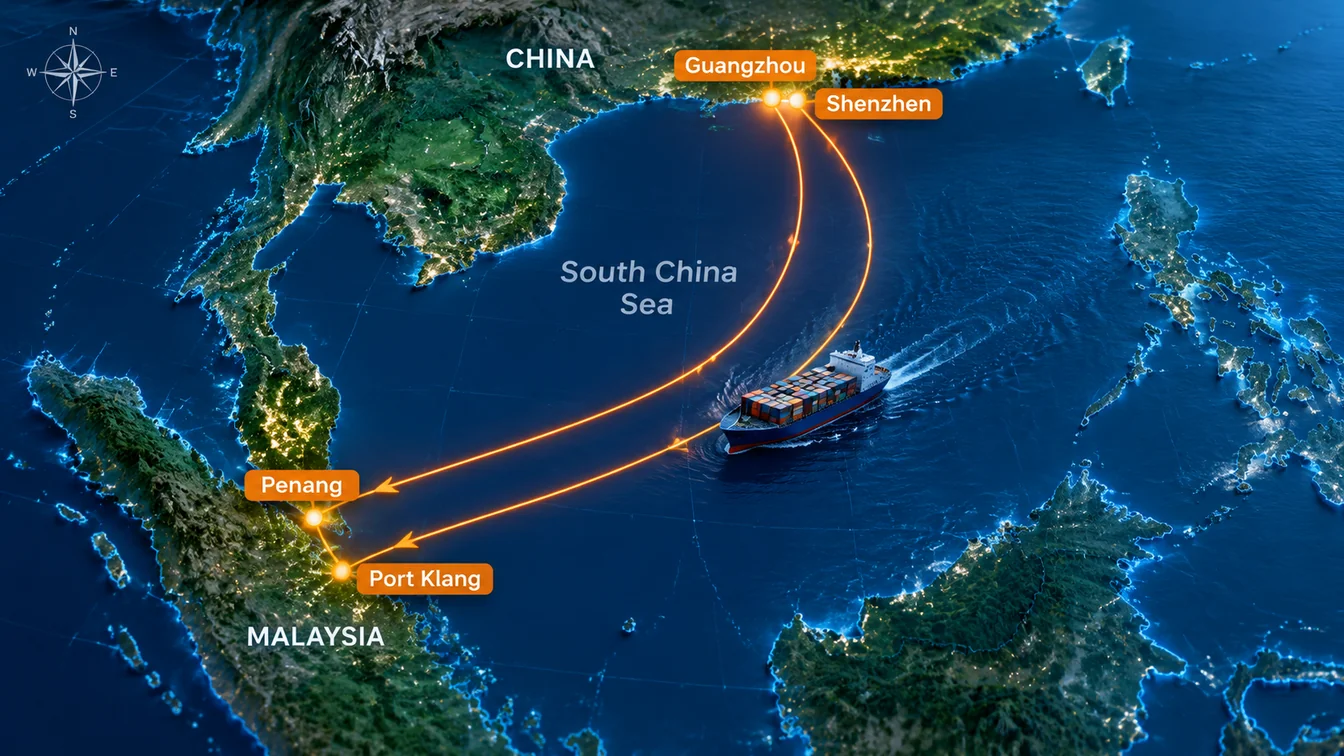
A 20GP container from China to Malaysia costs $550–$1,200 with a 6–12 day transit reference on the supplied FCL route, making sea freight the default starting point for most commercial cargo moving from a China supplier through an origin port, across the South China Sea, into Port Klang or another Malaysian gateway, through JKDM clearance, and onward to the final address. Air freight from Shenzhen Bao’an to Kuala Lumpur International Airport at $2.50–$7.00/kg with a 1–2 day transit reference is the practical alternative when urgency outweighs per-kilogram cost.
The most common planning choice for China-to-Malaysia shipments is FCL sea freight via Port Klang for full-container volumes, with LCL or air freight reserved for smaller or time-sensitive cargo; the second lead paragraph of this route page links each option to the shipment condition that actually changes the decision. Sea freight and air freight service pages carry the scope details behind those two defaults.
Route Planning Summary
- How does cargo move from a China supplier to the Malaysian gateway?
- The supplier releases cargo to a China export port or airport — most commonly Shenzhen, Guangzhou, Shanghai, Ningbo, or Qingdao by sea — where export handling and the international leg begin. The practical origin choice is the export gateway closest to the supplier that still offers a sailing or flight toward the Malaysian entry area your consignee needs.
- Which transport mode should a China-to-Malaysia shipment use?
- FCL sea freight is the default for full-container volumes because the supplied 20GP reference is $550–$1,200 and the 40HQ reference is $1,100–$1,950; LCL at $20–$60/CBM suits smaller consignments, and air freight at $2.50–$7.00/kg from Shenzhen Bao’an to KLIA fits urgent cargo under roughly a few hundred kilograms.
- What planning time should a China-to-Malaysia shipment allow?
- Sea freight carries a 6–12 day transit reference for FCL and 9–15 days for LCL, while air freight is referenced at 1–2 days and express at 2–5 days. Those are transport-window references; supplier pickup, export handling, Malaysian customs clearance, and final delivery sit outside them and must be planned separately.
- Who is responsible for Malaysian customs clearance?
- The Malaysian importer of record is legally responsible for the declaration, duty, and sales tax, and a foreign seller cannot act as importer of record without a local entity or a licensed customs broker. In practice a licensed forwarding agent submits the K1 declaration through RMCD’s electronic system on the importer’s behalf.
- Does the service cover final delivery beyond the Malaysian gateway?
- Port-to-port and airport-to-airport movements end at the Malaysian gateway, while door-to-door scope adds destination clearance and inland delivery to the final postcode. The agreed scope determines whether Port Klang, Penang, Pasir Gudang, or an East Malaysia feeder leg is the handoff point.
China to Malaysia Shipping Cost
The table below provides route-specific indicative shipping costs and planning transit references for the November 2026 review. Each reference applies to the named route, method, and unit shown in its row.
| Shipping route | Shipping method | Price | Transit time |
|---|---|---|---|
| China → Malaysia | FCL 20GP | $550–$1,200/柜 | 6–12 days |
| China → Malaysia | FCL 40GP | $1,000–$1,800/柜 | 6–12 days |
| China → Malaysia | FCL 40HQ | $1,100–$1,950/柜 | 6–12 days |
| China → Malaysia | LCL | $20–$60/CBM | 9–15 days |
| Shenzhen Bao’an International Airport, China → Kuala Lumpur International Airport, Malaysia | Air freight | $2.50–$7.00/kg | 1–2 days |
| China → Malaysia | Express | $5.00–$7.60/kg | 2–5 days |
Cost scope: The indicative cost references above apply to the route, method, and unit shown; they are not carrier freight rates, market averages, TJ selling prices, or binding quotations. The actual booking, cargo, and agreed service scope determine the commercial arrangement, including responsibility for relevant pickup, handling, customs, duty and tax, inland delivery, insurance, storage, examination, appointment, and surcharge items.
Malaysia Import Duty and Taxes
The amount payable on a China-to-Malaysia shipment depends on the commodity code, customs value, origin, applicable trade measures, product category, and current rules; Malaysia does not apply one universal import rate. Import duty on most goods ranges from 0% to 60% depending on the HS classification, and sales tax on imports is commonly 5% or 10% under the Sales Tax Act 2018.
- Identify the correct 8-digit ASEAN Harmonised Tariff Nomenclature code for the product, because the HS code determines the import duty rate, the SST treatment, and whether a permit or SIRIM approval is triggered.
- Establish the CIF customs value — the goods price plus international freight and insurance to the Malaysian port of entry — because Malaysian import duty is assessed on CIF, not on the invoice price alone.
- Calculate import duty as CIF value × the applicable duty rate from the Customs Duties Order; many raw materials and some electronics enter at 0%, while finished consumer goods can attract materially higher rates.
- Calculate sales tax on the CIF value plus import duty at the applicable 5% or 10% rate; sales tax is a final cost with no input tax credit for most importers.
- Check whether excise duty applies to the product category — alcohol, tobacco, motor vehicles, and certain luxury items carry excise on top of duty and SST — and confirm any exemption or preferential rate claim under an applicable FTA before the K1 declaration is submitted.
This explanation is simplified and is not tax or legal advice; the Royal Malaysian Customs Department makes the final assessment on each K1 declaration, and rates and exemptions can change. Current guidance should be checked against the MySST portal and the RMCD HS Explorer before dispatch.
China to Malaysia Shipping Time
FCL sea freight from China to Malaysia carries a 6–12 day transit reference, and that window applies to the China → Malaysia FCL route shown in the supplied cost table. LCL sea freight carries a 9–15 day reference, because consolidation and deconsolidation add handling time at both ends.
Air freight from Shenzhen Bao’an International Airport to Kuala Lumpur International Airport is referenced at 1–2 days, the shortest transport window on this route, while express service is referenced at 2–5 days. Those air and express windows cover the international movement only; supplier pickup, export screening, Malaysian customs clearance, and final delivery are separate planning increments.
The practical timing decision on this route usually turns on how much of the total door-to-door time sits outside the transport window. For sea freight, Malaysian customs clearance at Port Klang can clear in a matter of hours for a well-prepared green-lane declaration but can extend to several days when documents are incomplete or the HS code is questioned; for air freight, KLIA clearance and final delivery add time after the flight lands. Plan the supplier release date against the transport window plus the clearance and delivery increments your scope includes, not against the sailing or flight time alone.
Shipping Methods from China to Malaysia
- FCL sea freight
- Choose FCL when the shipment fills or nearly fills a container, because the per-container cost reference of $550–$1,200 for 20GP and $1,100–$1,950 for 40HQ is designed for exclusive container use and avoids LCL consolidation handling. The condition that changes this is cargo that is large but not container-filling, where LCL may avoid paying for unused space; the choice turns on actual volume, cargo dimensions, and whether the supplier can load a full container at origin.
- LCL sea freight
- Choose LCL when the shipment is smaller than a container load, because the $20–$60/CBM reference charges for the cubic metres used rather than for a full container. The condition that changes this is cargo that is time-sensitive or fragile enough that consolidation handling and the 9–15 day transit reference become unacceptable, or cargo whose dimensions make LCL handling impractical.
- Air freight
- Choose air freight when the shipment is urgent and the chargeable weight is moderate, because the Shenzhen Bao’an to KLIA reference of $2.50–$7.00/kg buys a 1–2 day transport window. The condition that changes this is a shipment whose chargeable weight makes air cost disproportionate to cargo value, or cargo that contains batteries or regulated items requiring additional screening before it can fly.
- Express
- Choose express when the shipment is small, time-critical, and door-delivered, because the $5.00–$7.60/kg reference and 2–5 day window fit parcels and sample shipments that need a simple handoff. The condition that changes this is a shipment large enough that per-kilogram express pricing exceeds the air freight or LCL alternative, or cargo outside the express carrier’s accepted commodity list.
- Rail-led multimodal
- The supplied table does not carry a usable cost or transit value for a Chengdu-origin rail-led multimodal option to Malaysia, so this page does not present it as a bookable method for this route. Malaysia is served primarily by sea and air from China, and rail should only be considered where a verified multimodal corridor and commercial service exist for the specific cargo and destination.
Door-to-Door Shipping from China to Malaysia
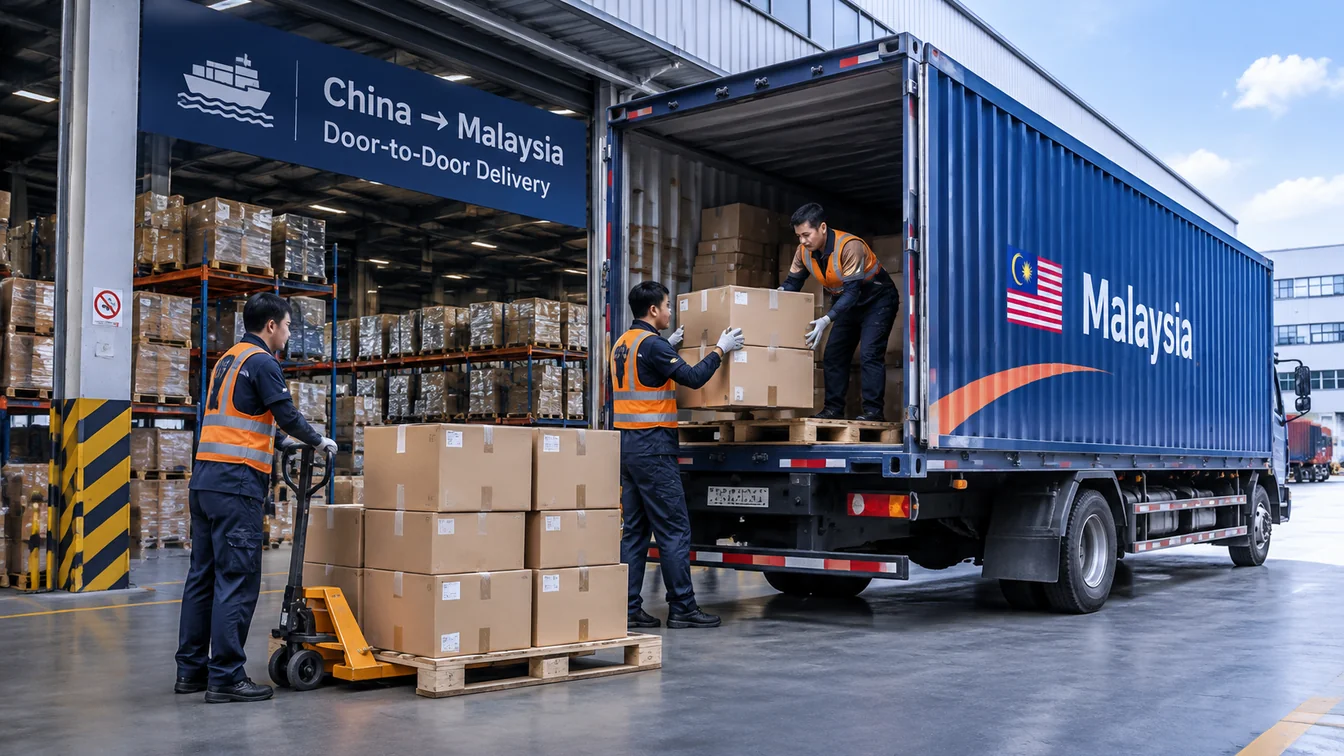
Door-to-door scope on the China-to-Malaysia route strings the supplier pickup, China export handling, international movement, Malaysian import clearance, and final delivery into one coordinated sequence. The eight steps below show where each handoff sits.
-
Cargo and Compliance Review
Review the product, HS code, declared value, weight and dimensions, and any regulated-cargo condition before booking, because a SIRIM-controlled electrical item or a battery-containing product changes the documents and the mode eligibility on this route.
-
Route and Method Selection
Select the origin gateway and transport mode against the supplier location, cargo size, urgency, and final Malaysian delivery area; a Shenzhen supplier shipping to Klang Valley and a Shanghai supplier shipping to Penang can produce different sensible defaults.
-
Supplier Coordination and Pickup
Coordinate the cargo ready date, pickup address, export carton marks, and handover documents with the China supplier so the cargo reaches the booked gateway in time for the sailing or flight.
-
China Export Handling
Complete China export declaration and, where applicable, provide the Certificate of Origin or Form E needed to support a preferential duty claim at Malaysian import; the export leg is also where carrier booking, VGM, and security filing deadlines sit.
-
International Transportation
Move the cargo by the selected mode — FCL, LCL, air freight, or express — from the China gateway to the Malaysian gateway named in the booking, tracking the transport window against the planning reference.
-
Malaysia Import Clearance
Submit the K1 declaration through the licensed forwarding agent, pay import duty and sales tax where assessed, and respond to any RMCD query or inspection before the cargo is released from Port Klang, Penang, Pasir Gudang, or KLIA.
-
Final Delivery
Arrange inland trucking from the released gateway to the consignee address, taking account of the final postcode, delivery appointment requirements, and whether the destination is in Peninsular Malaysia or requires an East Malaysia feeder and onward delivery.
-
Shipment Close-Out
Confirm proof of delivery, reconcile any destination charges or examination costs outside the agreed scope, and close the shipment file with the importer’s records.
Main China to Malaysia Routes
The most practical China-to-Malaysia route normally starts at the China export gateway that limits supplier-side movement while fitting the final Malaysian delivery area and a credible destination handling point. For most Peninsular Malaysia importers, that means a South China or East China seaport sailing to Port Klang, with Penang, Pasir Gudang, or Tanjung Pelepas compared when the final delivery region or carrier schedule makes them more efficient; the condition that changes the comparison is the final postcode plus the current sailing or flight options at the time of booking.
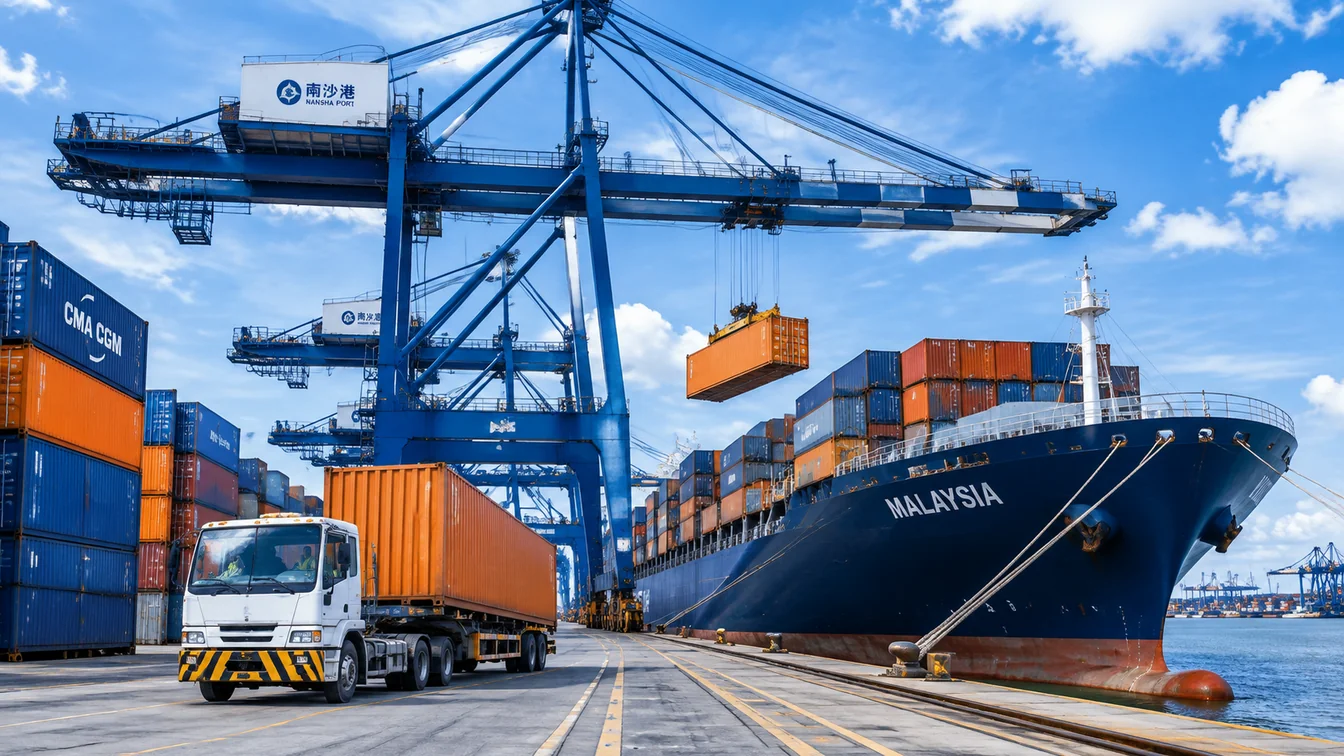
Major China Export Ports for Malaysia Shipping
- Shenzhen (Yantian and Shekou)
- Shenzhen is the highest-frequency South China option for Malaysia-bound containers, serving suppliers in the Pearl River Delta manufacturing belt and offering direct sailings to Port Klang with the shortest ocean transit on the corridor. Compare Yantian or Shekou when the supplier is in Shenzhen, Dongguan, or Huizhou and the consignee is in Klang Valley or another Peninsular Malaysia destination.
- Guangzhou (Nansha)
- Nansha serves suppliers across the wider Pearl River Delta and offers direct sailings to Port Klang, giving a second South China gateway when Shenzhen equipment or schedule availability does not fit. Compare Nansha when the supplier is in Guangzhou, Foshan, or Zhongshan and the booking needs a South China departure.
- Xiamen
- Xiamen is a practical departure point for Fujian-based suppliers and carries direct sailings to Port Klang, making it relevant for cargo originating in the Xiamen–Quanzhou–Zhangzhou cluster rather than trucking that cargo to Shenzhen or Guangzhou.
- Shanghai
- Shanghai serves East China suppliers and offers frequent direct sailings to Port Klang, with a longer ocean transit than the South China gateways but strong schedule depth. Compare Shanghai when the supplier is in the Yangtze River Delta and the final delivery area is served well from Port Klang.
- Ningbo
- Ningbo is another East China option with direct Port Klang service and broad carrier coverage, relevant for Zhejiang-based suppliers and for bookings where Shanghai space or equipment is constrained. It follows the same East China transit pattern as Shanghai.
- Qingdao
- Qingdao serves North China suppliers and offers direct sailings to Port Klang with a longer ocean transit than the South and East China ports. Compare Qingdao when the supplier is in Shandong or the surrounding region and the cargo can absorb the longer sea window.
Major Malaysia Import Ports for Cargo from China
- Port Klang (Northport and Westports)
- Port Klang is Malaysia’s primary container gateway and the default entry point for most China-origin cargo destined for Kuala Lumpur, Selangor, and the wider Klang Valley. It handles the majority of the country’s container traffic and offers the deepest carrier coverage on the China–Malaysia corridor; compare Port Klang first unless the final delivery region makes another gateway clearly more efficient.
- Penang Port
- Penang Port serves northern Peninsular Malaysia — Penang, Kedah, Perlis, and Perak — and is the relevant gateway for consignees in the Bayan Lepas electronics cluster and the northern industrial belt. Compare Penang when the final delivery postcode is in the north and the sailing schedule supports a direct or feeder connection from the China origin port.
- Johor Port (Pasir Gudang)
- Pasir Gudang serves the Iskandar Malaysia economic corridor and Johor’s industrial parks, and it is the practical gateway for consignees in southern Peninsular Malaysia east of Singapore. Compare Pasir Gudang when the final delivery is in Johor and the China booking can connect through a direct or Singapore-linked service.
- Tanjung Pelepas (PTP)
- Tanjung Pelepas is primarily a transshipment hub near the Singapore Strait but also handles direct import cargo for Johor-based industries. Compare PTP when the carrier’s China service calls there directly or when a transshipment routing through the hub suits the sailing schedule and the final Johor delivery.
- Kuantan Port
- Kuantan serves the Pahang industrial belt and the Malaysia–China Kuantan Industrial Park, with container capability that is smaller than the west-coast ports. Compare Kuantan only when the final delivery is in the east-coast industrial corridor and the carrier service supports the routing.
- East Malaysia ports (Kuching, Kota Kinabalu, Bintulu)
- Sabah and Sarawak ports are served almost exclusively by transshipment from Singapore, Port Klang, or PTP, so a China-origin shipment to East Malaysia normally clears at the transshipment gateway and moves onward by feeder. Compare the East Malaysia port only after the feeder schedule and the final delivery scope are confirmed.
Supplier Region to Destination Routing Logic
| Supplier region in China | Origin port to compare | Destination port and delivery region | Planning reason |
|---|---|---|---|
| Pearl River Delta (Shenzhen, Dongguan, Huizhou) | Shenzhen (Yantian or Shekou) | Port Klang for Klang Valley and central Peninsular Malaysia | Shenzhen offers the shortest direct ocean transit to Port Klang and the highest sailing frequency, making it the default when the supplier is in the PRD and the consignee is in the Klang Valley; confirm current sailing and equipment availability before fixing the booking. |
| Pearl River Delta west (Guangzhou, Foshan, Zhongshan) | Guangzhou (Nansha) | Port Klang for Klang Valley or Penang for northern delivery | Nansha keeps supplier-side trucking short for western PRD factories and still offers direct Port Klang sailings; compare Penang when the final delivery postcode is in the north and a direct or feeder connection is available. |
| Fujian (Xiamen, Quanzhou, Zhangzhou) | Xiamen | Port Klang for central Malaysia, or Penang for northern delivery | Xiamen avoids trucking Fujian cargo to Shenzhen or Guangzhou and carries direct Port Klang service; the destination choice follows the final delivery region rather than a fixed port default. |
| Yangtze River Delta (Shanghai, Ningbo, Zhejiang) | Shanghai or Ningbo | Port Klang for Klang Valley and central Malaysia | East China ports have a longer ocean transit than South China but deeper schedule depth, which can offset the extra sea time when the supplier is in the YRD and Port Klang delivery is the priority; compare current sailing frequency and equipment before choosing between Shanghai and Ningbo. |
| Shandong and North China | Qingdao | Port Klang for Peninsular Malaysia delivery | Qingdao is the practical origin for Shandong suppliers and has direct Port Klang sailings with a longer ocean window; the route makes sense when the supplier location outweighs the extra sea time and the final delivery can absorb the longer planning window. |
Destination Regional Delivery Logic
- Klang Valley and central Peninsular Malaysia
- Port Klang is the natural gateway for Kuala Lumpur, Selangor, and the surrounding industrial and commercial areas because it sits about 40 km southwest of Kuala Lumpur and offers the broadest carrier coverage. Final delivery from Port Klang is typically by truck, and the postcode-level delivery address plus any appointment requirement determines the inland cost and timing.
- Northern Peninsular Malaysia
- Penang Port is the relevant gateway for Penang, Kedah, Perlis, and northern Perak, particularly for the Bayan Lepas electronics cluster. Compare Penang when the final delivery is in the north and a direct or feeder service from the China origin port fits the sailing schedule; otherwise Port Klang plus northbound trucking may still be the practical option.
- Southern Peninsular Malaysia (Johor)
- Pasir Gudang and Tanjung Pelepas serve the Iskandar Malaysia corridor and Johor’s industrial parks, with Pasir Gudang handling mixed container and bulk cargo and PTP offering direct import capability alongside its transshipment role. Compare the two Johor gateways against the carrier’s actual China service and the final delivery address rather than assuming one is always faster.
- East Malaysia (Sabah and Sarawak)
- Kuching, Kota Kinabalu, and Bintulu are served by transshipment from Singapore, Port Klang, or PTP, so the planning question is the feeder schedule and the onward delivery scope rather than a direct China call. Add the transshipment and feeder time to the China–Malaysia main leg when setting the delivery expectation.
How the Gateway Is Selected
- Match the China origin port to the supplier’s actual location first, because trucking Fujian cargo to Shenzhen or Shandong cargo to Shanghai adds cost and time without changing the Malaysian entry point.
- Match the Malaysian gateway to the final delivery postcode, comparing Port Klang, Penang, Pasir Gudang, and PTP only where the carrier’s current service actually supports the routing.
- Check the current sailing or flight frequency and equipment availability for the specific week of the booking, because a port that normally works well can lose its advantage when the sailing rolls or equipment is short.
- Compare the destination handling and inland cost at the gateway level, since a slightly longer ocean leg to a closer import port can still produce a lower total landed route cost than a shorter ocean leg plus long inland trucking.
- Confirm whether the cargo is regulated and requires SIRIM approval, an Approved Permit, or another agency clearance, because a permit condition can override the gateway comparison and should be resolved before booking.
Malaysia Customs Clearance
Malaysia customs clearance requires a registered importer, an accurate K1 declaration filed through the Royal Malaysian Customs Department’s electronic system, supporting commercial and transport documents, and payment of any assessed import duty and sales tax. The rules apply across Peninsular Malaysia, Sabah, and Sarawak, and the importer of record remains legally responsible for the accuracy of the declaration.
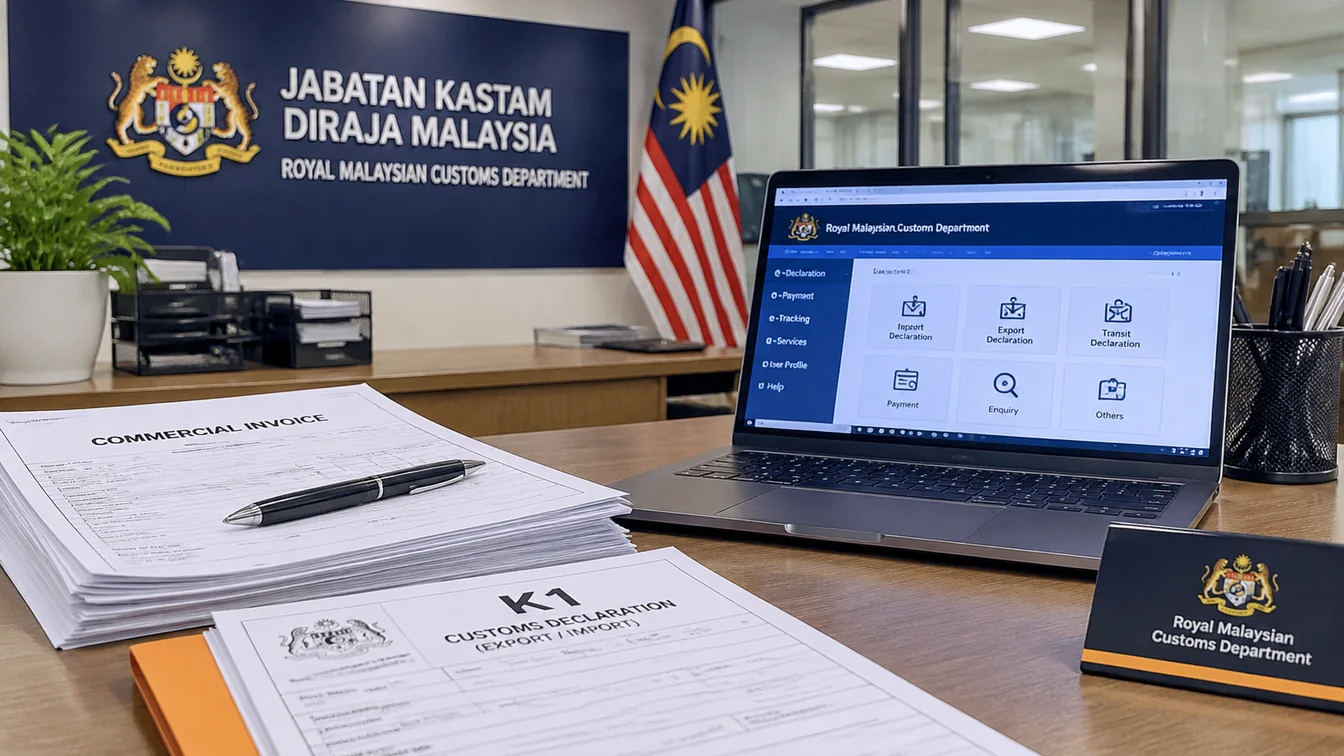
What the Malaysia Importer Normally Needs
A Malaysia-bound shipment normally needs the following preparation items before the K1 declaration can clear; the exact set depends on the product and whether a permit or preferential rate is claimed.
- Registered importer identity A Malaysian importer of record must be identified with an active SSM company registration or equivalent; foreign entities cannot act as importer of record without a local entity or a licensed customs broker, and the importer’s tax number is used in the declaration.
- Commercial invoice The supplier’s invoice must state the transaction value, unit price, currency, detailed goods description, and Incoterms, because it is the primary basis for the CIF customs value used in duty and SST assessment.
- Packing list The packing list must match the invoice and the physical cartons, showing package counts, net and gross weights, dimensions, and shipping marks; discrepancies between the invoice, packing list, and K1 declaration are a common cause of holds.
- Bill of lading or airway bill The transport document identifies the carrier, route, destination gateway, and consignee, and the original bill of lading is required to take delivery of sea cargo.
- HS code and tariff classification The 8-digit AHTN code determines the import duty rate, the SST treatment, and whether a SIRIM approval, Approved Permit, or other agency clearance is required; an incorrect code can trigger penalties or seizure.
- Certificate of origin where a preferential rate is claimed A valid Form E under the ACFTA or another applicable preferential certificate is required to claim a reduced or zero duty rate under a trade agreement; a preferential rate is not applied automatically without the certificate.
- Import permit or SIRIM approval for controlled goods Electrical and electronic products on the controlled list require SIRIM approval and labelling before clearance, and other controlled categories such as certain food, chemicals, or telecommunications equipment require an Approved Permit from the relevant regulator.
- Licensed forwarding agent authorization A licensed customs broker or forwarding agent is normally authorized to submit the K1 declaration through RMCD’s electronic system on the importer’s behalf, and the importer should confirm the agent’s licence and the scope of authorization.
Common Causes of Malaysia Customs Delays
- An incorrect or unsupported HS code, which can change the duty and SST assessment and trigger a manual review or penalty assessment.
- Invoice, packing list, and K1 declaration values or descriptions that do not match each other or the physical cargo.
- A missing SIRIM approval or Approved Permit for a controlled product, which prevents the K1 from clearing until the permit is produced.
- An importer that is not registered or has no active tax identity in the RMCD system, which blocks the declaration from being lodged.
- A missing or invalid Certificate of Origin when a preferential duty rate is claimed, causing the assessment to default to the non-preferential rate.
- Cargo selected for inspection or examination, which adds time at the gateway and may generate storage or examination charges.
- Incomplete or inconsistent document formatting when the K1 and supporting files are uploaded, which can return the declaration for correction before it is processed.
Resolve these issues before cargo departure rather than at the Malaysian gateway, because a port hold or declaration correction adds time and cost that the transport window cannot absorb.
Shipping to Amazon FBA Malaysia
Amazon FBA Malaysia is a genuine route for sellers using Amazon’s Malaysia marketplace, and the sales tax treatment on imported goods sold through Amazon is handled at the platform level. Amazon states that from 1 January 2024 a 10% sales tax applies to purchases from Amazon stores that are imported into Malaysia, and Amazon calculates, collects, and remits that sales tax for both FBA and seller-fulfilled shipments; an Import Fees Deposit is charged on shipments above RM500. Sellers should still confirm the importer-of-record arrangement, the product’s SIRIM or permit status, and the shipment-plan and labelling requirements before booking, because the marketplace tax collection does not replace Malaysian import clearance requirements.
For the physical shipment, the FBA route follows the same China export, Malaysian gateway, and JKDM clearance chain as any commercial import; the Amazon fulfillment center destination determines the final delivery postcode and therefore the gateway comparison. Amazon FBA service scope can be reviewed against the shipment’s labelling, appointment, and destination requirements.
Special Cargo, Packaging, and Insurance
Cargo Requiring Additional Review
- Lithium batteries and battery-containing products, which normally require a Safety Data Sheet and UN38.3 test report before booking and may face carrier restrictions on air freight.
- Electrical and electronic products on Malaysia’s controlled list, which require SIRIM approval and labelling before they can clear customs.
- Chemicals, liquids, and powders, which may require a 16-section Safety Data Sheet and a restricted-goods review before acceptance.
- Food, cosmetics, and medical goods, which may require MAQIS inspection or another agency permit and can face additional clearance steps.
- Wood packaging, which must meet ISPM 15 treatment and marking requirements for entry into Malaysia.
- Oversized or temperature-controlled cargo, which changes equipment, handling, and delivery planning at both the origin and destination gateways.
- Controlled or strategic goods, which require screening under the Strategic Trade Act 2010 and a permit before export or import.
Packaging Checks
Packaging on the China-to-Malaysia route must survive ocean or air handling, potential transshipment, and the final inland leg, and it must allow customs inspection without damaging the goods. Use export-grade cartons or crates appropriate to the cargo weight, internal protection for fragile items, and pallets that can be handled at the gateway; protect against moisture during the sea leg, mark handling instructions clearly, and label cartons with the shipping marks and destination details that match the invoice and packing list.
- Carton strength and closure appropriate to the stacked weight and the handling the cargo will receive.
- Internal cushioning and separation for fragile or multi-item cartons.
- Pallet condition and dimensions compatible with gateway and truck handling.
- Moisture protection for sea freight and any transshipment exposure.
- Clear handling marks and destination labels that match the shipping documents.
- ISPM 15 treatment and marking for any solid wood packaging.
- Accurate dimensions and weights, because chargeable weight and LCL measurement depend on them.
Cargo Insurance
Carrier liability is not the same as cargo insurance: carrier liability is limited by the transport convention and does not cover all loss or damage scenarios, while cargo insurance covers the insured value subject to the policy’s terms. Confirm the coverage, exclusions, deductible, insured value, claims evidence, and coverage period before the shipment moves, particularly for high-value electronic cargo or cargo that will be transshipped. Cargo insurance service scope should be matched to the specific shipment rather than assumed.
Why Use a Freight Forwarder for Shipping from China to Malaysia?
A freight forwarder helps a China-to-Malaysia buyer turn cargo facts into a workable shipment definition, choose a credible route and gateway, and keep the commercial and operational handoffs aligned from supplier release through Malaysian clearance and final delivery. The three entries below show where that coordination changes the route decision.
- Defining the shipment before booking
- A forwarder turns the supplier’s cargo description, dimensions, weight, HS code, and delivery address into a shipment definition that can be quoted and booked, which matters on this route because a battery-containing or SIRIM-controlled product changes the mode and document set. The condition that may change the definition is a product classification or regulatory status that is discovered after the first review.
- Matching route and mode to the actual need
- A forwarder compares FCL, LCL, air, and express options against the cargo size, urgency, supplier location, and final Malaysian postcode so the buyer sees which gateway and mode combination actually fits, rather than treating every option as interchangeable. The condition that changes the match is a sailing roll, equipment shortage, or a permit requirement that makes the first-choice gateway impractical for the booking week.
- Coordinating commercial and operational handoffs
- A forwarder keeps the supplier, carrier, licensed Malaysian customs agent, and final-delivery party aligned so the export documents, K1 declaration, duty and tax payment, and delivery appointment happen in the right order. The condition that changes the coordination is a customs query or inspection that requires the importer or supplier to produce additional evidence before release.
How TJ Logistics Team Plans a China-to-Malaysia Shipment
- Shipment definition review
- TJ Logistics Team reviews the defined shipment — product, HS code, value, weight and dimensions, origin city, destination postcode, and required delivery date — and flags any information gap that prevents a reliable next decision, such as an unconfirmed SIRIM status or a missing consignee registration.
- Route and gateway comparison
- TJ Logistics Team compares credible origin gateways, transport modes, Malaysian entry points, and final-delivery handoffs against that definition, including whether Port Klang, Penang, Pasir Gudang, or another gateway actually fits the final address and the booking window. Multi-modal freight service scope is relevant when the routing involves a transshipment or feeder leg.
- Service boundary recording
- TJ Logistics Team records the agreed service boundary — which party is responsible for pickup, export handling, main transport, Malaysian clearance, duty and tax, inland delivery, insurance, and any examination or storage item — before a formal commercial arrangement is prepared, so the buyer can see what the scope does and does not include.
- Booking and handoff coordination
- After the buyer confirms the agreed scope, TJ Logistics Team coordinates booking information, commercial documents, cargo handoff, and the next operational decision if timing, route, document, or receiving conditions change. Customs brokerage service scope is relevant at the Malaysian clearance handoff, and door-to-door service scope applies when the agreed movement extends beyond the gateway.
China to Malaysia Shipping FAQ
How much does a 20ft container from China to Malaysia cost?
A 20GP container on the China → Malaysia FCL route carries an indicative cost reference of $550–$1,200 per container with a 6–12 day transit reference as of the November 2026 review. That reference applies to the FCL 20GP method and container unit shown; the actual booking price depends on the origin port, carrier space, cargo weight, and the agreed service scope.
How long does sea freight from China to Malaysia take?
FCL sea freight from China to Malaysia carries a 6–12 day transit reference, and LCL carries a 9–15 day reference, as shown in the supplied route data. The FCL reference applies to the China → Malaysia FCL route and includes the ocean movement window; supplier pickup, export handling, Malaysian customs clearance, and final delivery are separate timing increments outside that window.
What is the most cost-effective way to ship from China to Malaysia?
FCL sea freight is normally the most cost-effective default for full-container volumes on the China–Malaysia route, with a 20GP reference of $550–$1,200 and a 40HQ reference of $1,100–$1,950. LCL at $20–$60/CBM can be more economical for smaller consignments that do not fill a container, but the comparison depends on actual volume and cargo handling requirements rather than on the headline unit price alone.
Which China port is best for shipping to Malaysia?
The practical China origin default for Malaysia is the export gateway closest to the supplier that still offers a suitable sailing toward the Malaysian entry area, which for a Pearl River Delta supplier normally means Shenzhen (Yantian or Shekou) and for a Fujian supplier normally means Xiamen. The final Malaysian delivery postcode is the condition that can change the choice: a northern Peninsular delivery may favour a service into Penang Port, while a Klang Valley delivery normally keeps Port Klang as the comparison point.
Which Malaysian port should I compare for Klang Valley delivery?
Port Klang is the correct first comparison for Klang Valley delivery from China because it is Malaysia’s primary container gateway and sits about 40 km southwest of Kuala Lumpur, with the broadest carrier coverage on the China–Malaysia corridor. The condition that can change the comparison is the final delivery postcode and the current sailing schedule — if the consignee is closer to another gateway or the booking week’s service calls elsewhere, that alternative should be priced against Port Klang plus inland trucking.
Can I ship door-to-door from China to Malaysia?
Door-to-door shipping from China to Malaysia is available when the agreed scope includes Chinese export handling, international transport, Malaysian import clearance, duty and tax responsibility, and final inland delivery to the consignee address. The material condition is the final delivery location: Peninsular Malaysia addresses can usually be served by truck from the releasing gateway, while Sabah and Sarawak addresses require a transshipment and feeder leg that changes the timing and cost of the door-to-door scope.
What documents should be prepared before shipping from China to Malaysia?
A Malaysia-bound commercial shipment normally needs a commercial invoice, packing list, bill of lading or airway bill, the correct 8-digit HS code, and a K1 declaration filed by a licensed forwarding agent; a Form E or other Certificate of Origin is added when a preferential duty rate is claimed. Regulated products also need SIRIM approval or an Approved Permit before the K1 can clear, so the permit status should be confirmed before the cargo leaves China rather than at the Malaysian gateway.
Why can two China-to-Malaysia shipping costs differ?
Two China-to-Malaysia quotes can differ because they may cover different origin ports, different service scopes, and different inclusion boundaries — one may be port-to-port while another includes Malaysian clearance and inland delivery, and one may quote a 20GP while another quotes a 40HQ. The practical check is to compare the named route, method, container or weight unit, and the agreed service scope line by line rather than comparing the headline number alone.