

Reviewed by TJ Logistics Team — October 2026. Market, shipping-cost, customs, tariff, and marketplace information is reviewed for this month; regulatory and commercial conditions may change. The review applies practical route-planning checks across supplier pickup in China, origin-gateway and transport-mode selection, customs handoff in Romania, and final delivery.
Shipping from China to Romania: Route Update
For Shanghai-origin FCL 20GP cargo moving to Constanța, Romania, the indicative shipping-cost reference is $3,759/container, with a planning transit of 35–60 days. The operational route begins with supplier collection or cargo handover in China, continues through the selected export gateway and international sea freight service, and ends with Romanian import clearance and delivery to the agreed destination.
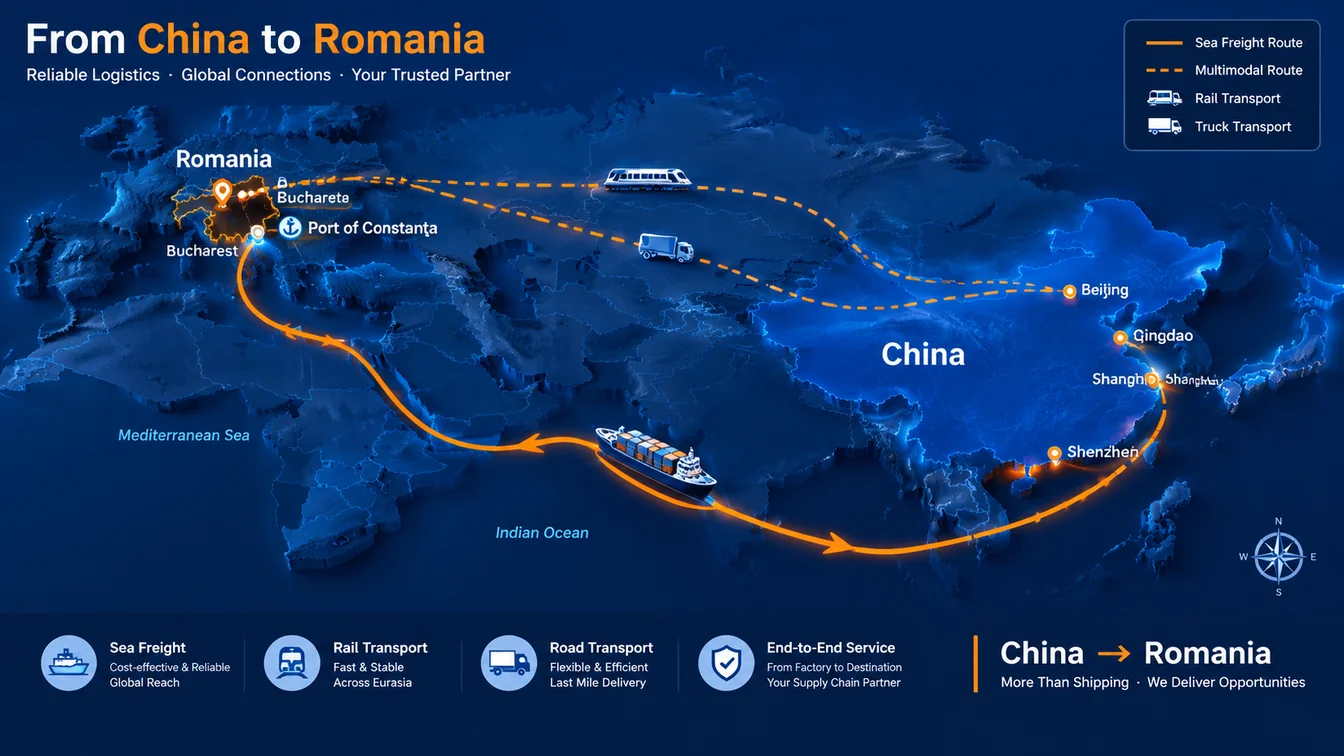
For consolidated cargo that does not require a full container, compare LCL through Constanța; for urgent shipments, compare air freight to Bucharest Airport (OTP) or express from Chengdu, while rail-led multimodal transport is another option for suitable cargo. The supplier’s location, cargo dimensions, chargeable weight, receiving postcode, and customs arrangements determine which route provides the most workable end-to-end plan.
Route Planning Summary
- How should the supplier connect to the export gateway?
- Match the collection point to the supplier’s actual location and compare Shanghai, Ningbo-Zhoushan, Shenzhen/Yantian, Qingdao, Guangzhou/Nansha, or another suitable origin gateway according to pickup requirements and available transport arrangements.
- Which transport method fits the shipment?
- Use FCL or LCL sea freight for suitable non-urgent cargo, air freight for time-sensitive commercial freight, express for eligible parcels, or rail-led multimodal transport when its transfer and delivery arrangements fit the shipment.
- How should transit time be planned?
- Use the supplied reference matching the actual FCL, LCL, air, express, or rail-led multimodal route; the separate route labels must not be combined into a single nationwide transit estimate.
- Who handles Romanian import clearance?
- The party responsible for importation must arrange the customs declaration, required EORI identification, product compliance, and applicable duty and VAT payments, directly or through an appropriately authorized representative.
- What determines final-delivery scope?
- The agreed destination address, postcode, customs arrangement, unloading requirements, access restrictions, and receiving appointments determine the final-mile plan and the responsibilities included in the service.
China to Romania Shipping Cost
The table provides route-specific indicative shipping costs and planning transit references reviewed for October 2026. Each reference applies to its named route, method, and unit.
Content and cost-data review month: October 2026.
| Shipping route | Shipping method | Price | Transit time |
|---|---|---|---|
| Shanghai, China → Constanța, Romania | FCL 20GP | $3,759/container | 35–60 days |
| Shanghai, China → Constanța, Romania | FCL 40GP | $4,768/container | 35–60 days |
| Shanghai, China → Constanța, Romania | FCL 40HQ | $4,768/container | 35–60 days |
| China → Constanța, Romania | LCL | $39.38/CBM | 26–34 days |
| China → Bucharest Airport (OTP), Romania | Air freight | $4.33/kg | 5–6 days |
| Chengdu, China → Romania | Express | $10.99/kg | 6–8 days |
| China → Bucharest, Romania | Rail LCL (rail-led multimodal) | $230/CBM | 28–35 days |
Cost scope: These indicative cost references apply to the route, method, and unit shown; they are not carrier freight rates, market averages, TJ selling prices, or binding quotations. The actual booking, cargo, and agreed service scope determine the commercial arrangement, including responsibility for origin pickup, export and destination handling, customs clearance, duty and tax, inland delivery, insurance, storage, examination, appointments, and surcharges.
Romania Import Duty and Taxes
Import duty and VAT on goods shipped from China to Romania depend on the commodity code, customs value, country of origin, applicable trade measures, product category, and current rules. Romania applies the EU Common Customs Tariff, while the Romanian VAT treatment applicable to the imported goods determines the import VAT calculation.
Use this four-step calculation process to prepare the Romanian import budget before dispatch:
- Classify the product using the correct customs commodity code. Check the applicable duty, restrictions, and trade measures in the official EU TARIC database using the product description and origin information.
- Determine the customs value from the applicable valuation rules and supporting transaction documents. Import VAT normally uses the customs value plus applicable duties and other includable charges; the EU import VAT valuation rules explain the relevant taxable base.
- Check product-specific measures and import restrictions before shipment. Goods from China can be subject to additional measures, licensing requirements, or product controls depending on the commodity and current legislation.
- Apply Romanian import VAT using the rate appropriate to the goods. As of October 2026, the standard Romanian VAT rate is 21%, while an 11% reduced rate applies to qualifying categories; the official EU VAT rates guidance provides the current country-level reference.
This calculation is a simplified import-budgeting explanation, not tax advice. The importer or its tax adviser should determine the applicable classification, customs valuation, VAT treatment, and eligibility for any relief before the goods enter free circulation.
China to Romania Shipping Time
For the Shanghai, China → Constanța, Romania route, the supplied FCL 20GP, FCL 40GP, and FCL 40HQ planning transit reference is 35–60 days; the China → Constanța LCL reference is 26–34 days.
Other supplied route-specific transit references are:
- Air freight: China → Bucharest Airport (OTP), Romania, 5–6 days.
- Express: Chengdu, China → Romania, 6–8 days.
- Rail LCL (rail-led multimodal): China → Bucharest, Romania, 28–35 days.
These figures are planning references rather than guaranteed delivery dates. The practical schedule depends on the actual service used and the timing of cargo readiness, origin handling, international movement, destination release, and any separately arranged final delivery. For the selected booking, distinguish the transport segment covered by the transit reference from any pickup, customs, or delivery stages outside that segment.
Shipping Methods from China to Romania
For containerized commercial cargo without an urgent deadline, FCL or LCL sea freight through Constanța is a sensible starting comparison; air freight, express, and rail-led multimodal transport serve different shipment and timing requirements. The appropriate choice depends on shipment volume, actual and chargeable weight, dimensions, handling constraints, supplier location, delivery postcode, and the consequences of delay.

- Full container load (FCL)
- Choose FCL when the shipment needs a dedicated container, because containerized cargo can be planned as a single equipment movement from origin handling through the maritime gateway. The choice between 20GP, 40GP, and 40HQ must follow the cargo’s dimensions, usable loading space, weight, and receiving constraints.
- Less than container load (LCL)
- Choose LCL when cartons, pallets, or other cargo can move as a consolidated shipment, because a full container is not required for the movement. Check whether the cargo’s dimensions, packaging, handling restrictions, and delivery requirements are acceptable for the consolidation service to Constanța.
- Air freight
- Choose air freight when delivery urgency outweighs the advantages of a slower transport mode, because the supplied route reference is directed to Bucharest Airport (OTP). Compare actual gross weight with chargeable weight, shipment dimensions, airport handoff requirements, and the final Romanian delivery plan.
- Express shipping
- Choose express shipping when eligible parcels or compact shipments need a courier-oriented service, because the provided express reference starts in Chengdu and is stated for Romania. Service acceptance, parcel dimensions, chargeable weight, remote-area delivery, and any product restrictions determine whether the method fits.
- Rail-led multimodal transport
- Choose a rail-led multimodal service when the cargo suits a planned rail-based international movement and the available transfer arrangements support the delivery deadline. Compare the complete routing, transfer points, cargo handling, and destination-terminal arrangements through the relevant rail freight service and multimodal freight service scopes rather than assuming a direct train to the final address.
Door-to-Door Shipping from China to Romania
Door-to-door shipping connects a China supplier with a Romanian delivery address when collection, transport, customs responsibilities, and final-mile arrangements are included in the agreed service scope. The following sequence provides the operational checkpoints for coordinating the shipment.
-
Cargo and Compliance Review
Document the goods, package count, dimensions, gross weight, cargo readiness, and handling requirements. Check any regulated-product restrictions and the Romanian importer’s readiness before assigning an origin gateway or booking method.
-
Route and Method Selection
Match the supplier’s location and shipment characteristics to FCL, LCL, air freight, express, or rail-led multimodal transport. Select an origin gateway and a destination handoff that suit the actual delivery area and required timetable.
-
Supplier Coordination and Pickup
Arrange the agreed cargo handover or collection with the supplier, including readiness, loading access, packaging completion, and the documents needed for export processing. Specify whether the supplier or logistics provider is responsible for the collection stage.
-
China Export Handling
Prepare the export shipment information, match package and weight details to the shipping documents, and coordinate the applicable origin handling. Cargo that needs special declarations or transport acceptance must be addressed before departure.
-
International Transportation
Move the shipment through the selected ocean, air, express, or rail-led multimodal arrangement. Keep the planned destination gateway and the next transfer or terminal handoff aligned with the agreed route.
-
Romania Import Clearance
The importer or its properly authorized customs representative handles the applicable declaration, classification, customs value, product controls, and duty and VAT responsibilities. The shipment should not be treated as released for delivery until the applicable customs formalities are complete.
-
Final Delivery
Arrange the domestic movement from the released destination gateway or terminal to the specified Romanian address. The door-to-door shipping service scope should make the delivery address, unloading, access, appointment, and other receiving requirements explicit.
-
Shipment Close-Out
Record delivery completion, retain the applicable transport and customs records, and resolve outstanding handling or delivery discrepancies with the responsible parties. The final record should reflect the actual service stages completed rather than assuming that arrival at a port or airport equals final delivery.
Main China to Romania Routes
The most practical China-to-Romania route normally begins at an export gateway that limits supplier-side movement while offering a suitable way to reach the destination gateway and final delivery region. The comparison changes when pickup geography, available transport arrangements, cargo equipment, destination handling, or the final Romanian postcode alters the complete movement.
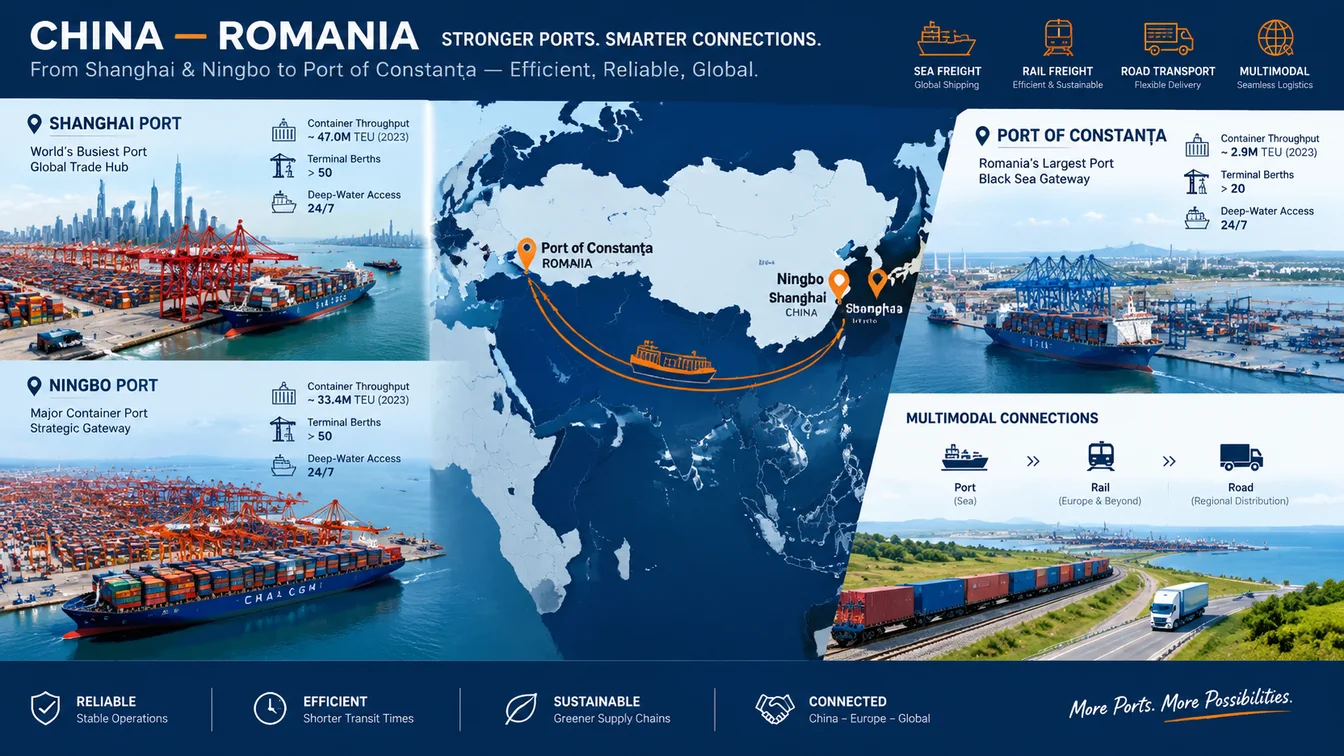
Major China Export Ports for Romania Shipping
- Port of Shanghai
- Compare Shanghai for suppliers in Shanghai and the surrounding Yangtze River Delta, including Jiangsu and nearby eastern China manufacturing areas. The supplied FCL reference specifically names Shanghai to Constanța, making that city pair a relevant starting point for containerized cargo planning, subject to the actual origin service and destination arrangement.
- Port of Ningbo-Zhoushan
- Compare Ningbo-Zhoushan for suppliers in Zhejiang and neighboring production areas when local pickup and export handling favor this gateway. Constanța remains the principal Romanian maritime entry to compare, but the proposed service and origin positioning determine whether this port fits the shipment better than Shanghai.
- Port of Shenzhen (Yantian)
- Compare Yantian for container cargo originating in Shenzhen and the eastern Pearl River Delta. It can be evaluated against Guangzhou/Nansha for suppliers elsewhere in Guangdong, using the actual pickup point, cargo readiness, equipment availability, and offered international routing.
- Port of Qingdao
- Compare Qingdao for suppliers in Shandong and northern China where moving cargo south to another export gateway would add an unnecessary inland leg. The Constanța route should be checked against the proposed transport arrangement and final Romanian delivery region rather than assuming a particular direct sailing.
- Port of Guangzhou (Nansha)
- Compare Guangzhou/Nansha for suitable shipments from Guangzhou, Foshan, and adjacent manufacturing areas. Nansha and Yantian offer different origin pickup positions, so the preferred gateway depends on supplier geography, cargo handling, and the actual available route to Romania.
- Port of Xiamen
- Compare Xiamen for cargo originating in Fujian and neighboring coastal production areas. A routing through Constanța can be evaluated where the proposed transport arrangement and destination handling fit the cargo, while the supplier’s pickup distance determines whether another eastern or southern China port is more practical.
Major Romania Import Ports for Cargo from China
Constanța is Romania’s principal maritime gateway to compare for general containerized cargo from China, while Midia and Mangalia are alternatives only when their relevant terminal and cargo-handling capabilities suit the shipment. The Maritime Ports Administration of Constanța provides the official port context for these maritime facilities.
- Port of Constanța
- Compare Constanța first for standard containerized China cargo when the proposed maritime routing and onward delivery arrangement match the shipment. It is relevant to deliveries around Bucharest, southeastern Romania, and other inland destinations that can be served from the port using the agreed road or rail connection.
- Port of Midia
- Compare Midia when the shipment’s industrial, bulk, or other specific handling needs match the available port facilities. It should not automatically replace Constanța for general container cargo; cargo acceptance and the onward movement to the Romanian delivery region are the deciding factors.
- Port of Mangalia
- Compare Mangalia for cargo that fits the available terminal and handling arrangements, including suitable specialized or project shipments. The origin route, intended handling method, and domestic distribution plan must support its use instead of a general container gateway.
Supplier Region to Destination Routing Logic
| Supplier region in China | Origin port to compare | Destination port and delivery region | Planning reason |
|---|---|---|---|
| Shanghai, Jiangsu, and surrounding Yangtze River Delta | Port of Shanghai | Port of Constanța → Bucharest, Ilfov, or southeastern Romania | Start with Shanghai for nearby suppliers and compare the available movement through Constanța to the final delivery area; local collection distance and the actual international service can change the preferred route. |
| Zhejiang and Ningbo-area suppliers | Port of Ningbo-Zhoushan | Port of Constanța → Bucharest or central Romania | Start with Ningbo-Zhoushan when supplier geography supports a shorter origin movement; compare Shanghai when its specific transport arrangement, cargo handling, or destination handoff better fits the shipment. |
| Shenzhen and the eastern Pearl River Delta | Port of Shenzhen (Yantian) | Port of Constanța → Bucharest or Transylvania | Start with Yantian for suitable Shenzhen-origin containers, then compare inland movement to the final Romanian region; pickup geography, transport availability, and destination handling may favor another gateway. |
| Guangzhou, Foshan, and the western Pearl River Delta | Port of Guangzhou (Nansha) | Port of Constanța → southern or central Romania | Start with Nansha where supplier collection favors Guangzhou-area handling, then compare Yantian using the actual cargo position, available routing, and final delivery requirements. |
| Shandong and northern China | Port of Qingdao | Port of Constanța → western or central Romania | Start with Qingdao for suitable northern suppliers and compare the complete inland-to-port and onward Romanian movement; the selected port should follow actual transport arrangements and the destination postcode. |
Destination Regional Delivery Logic
- Bucharest and Ilfov
- For general ocean cargo, compare delivery from Constanța to the specified Bucharest-area address; for urgent air cargo, the Bucharest Airport (OTP) route is the relevant supplied gateway reference. The final method depends on cargo urgency, customs release, destination access, and the agreed domestic delivery stage.
- Southeastern Romania and the Black Sea region
- Compare delivery from Constanța when the final address lies in the southeast and the maritime gateway fits the cargo. The actual destination may favor a direct domestic distribution arrangement, but the service must account for the receiving address and any handling or access restrictions.
- Central Romania and Transylvania
- Compare Constanța-based inland delivery for ocean cargo against an available rail-led multimodal arrangement when its route and final handoff fit the shipment. Supplier collection, transfer handling, destination-terminal location, and final truck movement determine the practical choice.
- Western and northwestern Romania
- Compare the complete route to the final postcode, including the inland journey from the maritime gateway or the destination handoff available under a rail-led multimodal service. The appropriate route depends on the actual transfer arrangement, domestic delivery requirements, and receiving schedule rather than the gateway name alone.
How the Gateway Is Selected
Select the gateway by testing the complete supplier-to-destination movement, not just the international transport segment.
- Supplier pickup: Match the actual factory or warehouse location to the export port or cargo airport and the collection arrangement.
- Ocean handling: Compare the available FCL or LCL route through Constanța with the cargo’s equipment, loading, and handling needs.
- Air gateway: Use Bucharest Airport (OTP) as the supplied destination for the air-freight reference and distinguish airport handling from the delivery address.
- Rail-led multimodal transfer: Review the proposed transfer points, destination-terminal handoff, and onward Romanian delivery rather than assuming a direct train to the consignee.
- Final postcode: Evaluate the domestic delivery distance, truck access, receiving appointment, and agreed customs-clearance location before selecting the route.
Romania Customs Clearance
Imports from China enter the EU customs territory through Romanian or other applicable EU customs procedures, with the importer responsible for the information, product requirements, and tax arrangements required for release. Romanian customs procedures operate within the EU customs framework, while the specific port, airport, or other entry point determines where the relevant shipment is presented and processed.

What the Romanian Importer Normally Needs
Prepare the following information before the shipment leaves China so the import declaration and product checks can be handled using consistent cargo details.
- EORI number The importer or other party conducting the relevant customs operation must have the appropriate Economic Operators Registration and Identification number. The official EU EORI guidance explains who needs the identifier and how it is assigned.
- Commodity code Use a correct customs classification based on the actual product, materials, and intended use. The classification determines the applicable duty and can trigger product-specific controls or additional trade measures.
- Commercial invoice Provide an accurate description, seller and buyer details, transaction value, currency, and other information required to support customs valuation and import declaration data.
- Packing list Record package counts, packaging types, dimensions, and gross and net weights consistently with the cargo and transport documents.
- Transport document Prepare the applicable bill of lading, sea waybill, air waybill, rail document, or express shipment documentation so the shipment, consignee, and cargo details can be matched.
- Customs value and origin evidence Supply the transaction and supporting valuation information, and accurately declare the country of origin. Shipping from China does not by itself establish eligibility for preferential duty treatment.
- Product compliance and permits Prepare applicable conformity documents, licences, test reports, certificates, or other records for products subject to EU safety, chemical, electrical, food, medical, or other regulatory requirements.
- Importer and representative authorization Establish who submits the declaration, who provides the required EORI and tax information, who pays applicable import charges, and whether a customs representative has the necessary authorization.
For shipments requiring an external customs-handling arrangement, the customs brokerage service scope should be aligned with the importer’s legal responsibilities and the actual entry procedure. An operational service arrangement does not automatically transfer the importer’s legal or tax obligations.
Common Causes of Romania Customs Delays
- A vague, inconsistent, or incorrect commodity description that prevents reliable classification.
- An invoice, customs value, country of origin, or transaction record that does not support the declaration.
- Missing EORI information or unclear authorization for the party lodging the customs declaration.
- Product-specific licences, conformity records, or safety documentation missing for regulated goods.
- Package counts, declared weights, dimensions, or transport documents that do not match the physical shipment.
- Unresolved duty, VAT, or payment arrangements that prevent release under the intended import procedure.
- Customs examination, prohibited or restricted goods, or packaging and handling issues that require additional action.
Resolve identified document, classification, authorization, and product-control issues before the shipment leaves China. Where the intended entry or final delivery depends on customs release, a late change to importer instructions or supporting documents can delay the next handling stage.
Special Cargo, Packaging, and Insurance
Special cargo should be reviewed before the China-to-Romania transport method is assigned because cargo characteristics can restrict carrier acceptance, packaging, documentation, handling, and destination delivery. The required treatment must match the actual product and the rules applicable to its transport and importation.
Cargo Requiring Additional Review
- Batteries and battery-powered goods: Establish the battery chemistry, configuration, installation status, applicable test documentation, and transport classification before booking.
- Dangerous goods and chemicals: Supply the correct classification, safety data, packaging information, and transport declarations required for the product and selected mode.
- Liquids, food, and cosmetics: Check leakage protection, composition, intended use, shelf-life requirements where relevant, and applicable EU product and import controls.
- Medical goods and controlled products: Determine whether the goods require special authorization, conformity documentation, traceability, or controlled handling before shipment.
- Wood packaging: Check whether wooden pallets, crates, or dunnage are subject to applicable ISPM 15 treatment and marking requirements for entry into the EU.
- Oversized or heavy cargo: Verify dimensions, weight, lifting requirements, container or vehicle suitability, and loading or unloading access. Relevant project cargo shipping arrangements may need to be evaluated for cargo that cannot use standard equipment.
- Temperature-controlled cargo: Establish the required temperature range, monitoring, packaging, and handling capability through all applicable transfer and storage stages.
Packaging Checks
Packaging must protect the goods throughout supplier pickup, loading, international transportation, customs handling, and final delivery in Romania. Its design should suit the cargo’s fragility, stacking exposure, moisture sensitivity, weight, and handling method.
- Use carton strength and internal cushioning appropriate to the product’s weight, fragility, and likely handling conditions.
- Secure pallets, restrain movement, and protect exposed edges and vulnerable components against impact.
- Use suitable moisture protection for the product and route, particularly where condensation or changing environmental conditions could cause damage.
- Apply clear handling marks and labels that match the goods, package orientation, and any required special-handling instructions.
- Record package dimensions and weights accurately so the cargo can be accepted, loaded, and delivered using suitable equipment.
- Use compliant regulated wood packaging and required treatment marks where applicable to the goods and import procedure.
Cargo Insurance
Carrier liability is not the same as cargo insurance, and liability limits may not cover the full commercial value of damaged or lost goods. Before transport, determine the insured value, covered transit period, exclusions, deductible, evidence requirements, and claims procedure for the actual shipment; the cargo insurance service is the relevant scope to review for this decision.
Why Use a Freight Forwarder for Shipping from China to Romania?
A freight forwarder helps a China-to-Romania buyer solve three practical problems: turning cargo facts into a workable shipment definition, selecting a credible route for the goods and destination, and aligning the commercial and operational handoffs between the supplier, transport providers, customs parties, and receiver.
- Turning the order into a workable movement
- Incomplete shipment information can prevent a reliable transport decision; a forwarder organizes the relevant cargo, origin, destination, handling, and timing details into a defined movement. The next decision changes when product restrictions, cargo dimensions, or the supplier’s readiness affect acceptance.
- Matching the route to the delivery need
- A route that works for one supplier or Romanian delivery region may not fit another; a forwarder compares credible gateway and transport arrangements against the cargo’s actual origin, urgency, and final postcode. The selected method changes when equipment, transfers, or destination handling are unsuitable.
- Keeping handoffs aligned
- Unclear responsibility can create delays between collection, international transport, customs, and final delivery; a forwarder helps document the next action and the party responsible for it. Importer obligations and product-compliance decisions remain with the legally responsible parties.
How TJ Logistics Team Plans China-to-Romania Shipments
- Shipment definition review
- TJ Logistics Team reviews the available cargo description, dimensions, weights, supplier location, destination, and required delivery scope, then flags information gaps that prevent a reliable route or handling decision.
- Route and gateway comparison
- TJ Logistics Team compares suitable origin gateways, transport methods, proposed international routing, and destination handoffs against the defined shipment, including the delivery requirements for the Romanian destination region.
- Service-boundary documentation
- TJ Logistics Team records the agreed service stages and the parties responsible for collection, transport, customs instructions, destination handling, and delivery before a formal commercial arrangement is prepared. The agreed scope determines which activities are actually covered.
- Operational handoff coordination
- After the buyer confirms the agreed scope, TJ Logistics Team coordinates the relevant booking information, cargo handoff, commercial documents, and subsequent operational decisions if the route, timing, document requirements, or receiving conditions change.
China to Romania Shipping FAQ
How much does LCL shipping from China to Romania cost?
The October 2026 content and cost-data review records an indicative LCL shipping cost of $39.38/CBM for China → Constanța, Romania. This is the cost reference for that named route and method.
How long does sea freight from China to Romania take?
For Shanghai, China → Constanța, Romania, the supplied FCL 20GP, FCL 40GP, and FCL 40HQ planning reference is 35–60 days; the China → Constanța LCL reference is 26–34 days. These references represent different shipping methods and route labels, so use the one matching the actual shipment.
Which China port or gateway is best for shipping to Romania?
The usual starting point for ocean cargo is the major export port closest to the supplier that offers a suitable routing toward Constanța. Shanghai and Ningbo-Zhoushan are relevant to eastern China suppliers, Yantian to many Shenzhen-area suppliers, and Qingdao to Shandong; pickup location, available service, equipment, and final delivery area can change the comparison.
Is rail freight a practical option from China to Romania?
Yes, rail-led multimodal transport is an available planning option for China-to-Bucharest LCL cargo. The route should be treated as a multimodal movement with a defined transfer and destination-terminal handoff, not as a guarantee of a single direct train to the Romanian consignee.
Can I ship door-to-door from China to Romania?
Door-to-door shipping from China to Romania can be arranged when the agreed scope covers the required pickup, international movement, customs handoff, and final-address delivery. The importer or another legally responsible party must still be clearly designated for customs declarations and applicable import charges under the agreed arrangement.
What documents should be prepared before shipping from China to Romania?
Prepare a consistent commercial invoice, packing list, applicable transport document, correct commodity classification, customs valuation information, origin details, and any product-specific permits or conformity records. The Romanian importer or authorized representative should also have the appropriate EORI information and customs instructions ready for the intended entry procedure.
What import taxes apply to goods shipped from China to Romania?
Romanian imports from China are assessed under the applicable EU customs tariff and Romanian import VAT rules. As of October 2026, Romania’s standard VAT rate is 21%, with an 11% reduced rate for qualifying categories; the actual duty and tax treatment depends on the commodity code, customs value, origin, product category, and current measures.
Does a Romanian importer need an EORI number for shipments from China?
An EORI number is required for the relevant customs operations conducted within the EU customs territory. The Romanian importer or the party responsible for the applicable customs operation should have the correct identifier and representative authorization ready before the shipment reaches its import-clearance stage.