

Reviewed by TJ Logistics Team — October 2026. This review covers route-planning conditions, indicative shipping costs, customs and tariff guidance, and relevant marketplace information as of October 2026; operating conditions and official rules may change. The review applies practical checks across supplier pickup, gateway and transport-mode selection, customs handoff, and final delivery in Switzerland.
Shipping from China to Switzerland: Route Update
For a full-container shipment, China to Switzerland via Rotterdam/Antwerp (FCL port-to-port stage) has an indicative FCL 20GP cost reference of $2,655–$3,245 per container and a 25–32 day planning transit reference. A workable sea freight route also needs a defined onward movement from the European gateway into Switzerland.
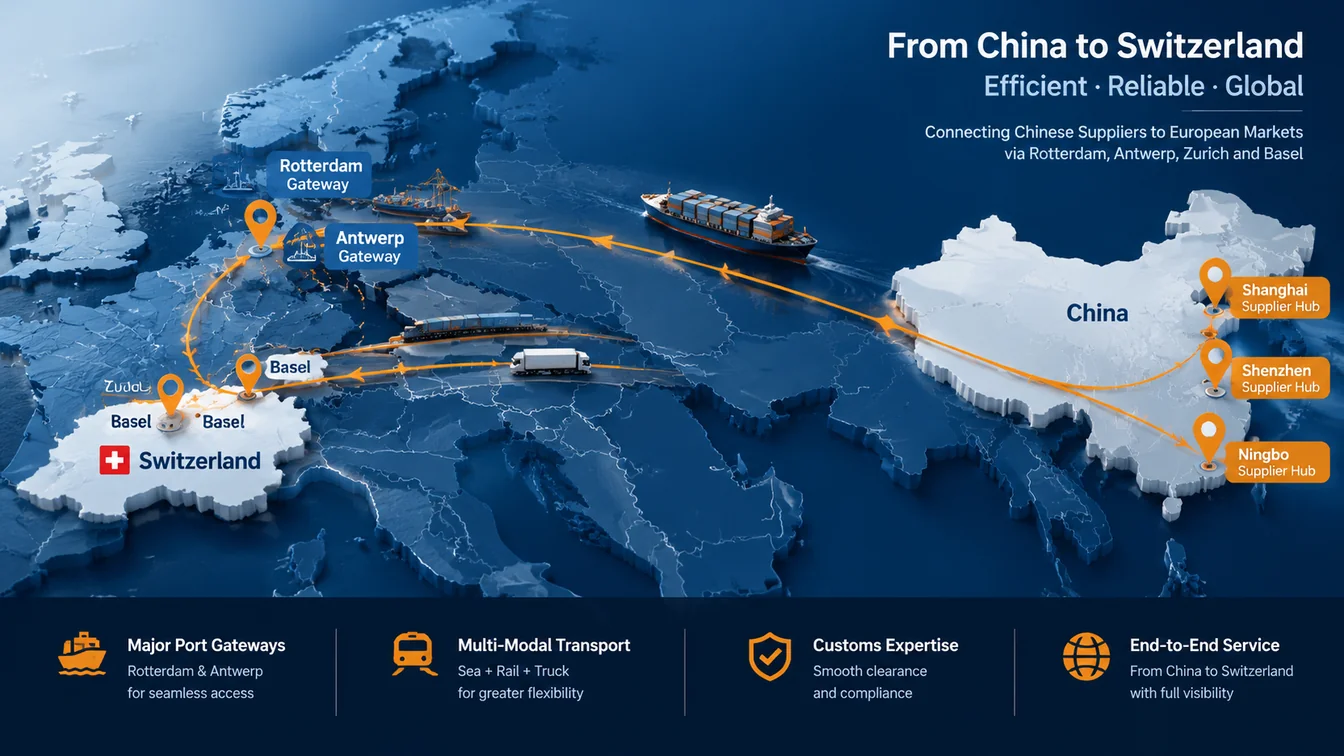
The practical route begins with pickup at the Chinese supplier, followed by export handling and ocean, air, or rail-dominant multimodal transportation to an appropriate European gateway or Zurich Airport (ZRH). Swiss import clearance and final delivery then depend on the agreed customs arrangement, destination postcode, cargo requirements, and receiving conditions.
Route Planning Summary
- How should the supplier be routed to the gateway?
- Match the supplier’s actual pickup address to a suitable Chinese export port, airport, or rail departure point, then plan the onward connection into Switzerland.
- Which transport method fits the shipment?
- Use FCL or LCL for suitable containerized ocean cargo, air freight for urgent airport-bound cargo, express for an agreed DDP door-to-door movement, or rail-dominant multimodal transport when the rail-hub connection suits the shipment.
- How should the delivery time be planned?
- Use the reference for the exact method and route scope, then account for any separate export handling, Swiss import clearance, inland transfer, and final delivery not covered by that reference.
- Who is responsible for Swiss customs clearance?
- The Swiss importer remains responsible for the import arrangement and its obligations, even when an appointed customs representative or logistics provider handles declaration tasks.
- What determines the final-delivery scope?
- The agreed service must name the collection point, transport and customs handoffs, Swiss delivery address, and responsibility for receiving, unloading, and any required appointment.
China to Switzerland Shipping Cost
The October 2026 table provides route-specific indicative shipping costs and planning transit references. Each reference applies to its named route, method, and unit.
| Shipping route | Shipping method | Price | Transit time |
|---|---|---|---|
| China → Switzerland via Rotterdam/Antwerp (FCL port-to-port stage) | FCL 20GP | $2,655–$3,245/container | 25–32 days |
| China → Switzerland via Rotterdam/Antwerp (FCL port-to-port stage) | FCL 40GP | $3,780–$4,620/container | 25–32 days |
| China → Zurich/Geneva, Switzerland via European gateway | FCL 40HQ | $3,780–$4,620/container | 25–32 days |
| China → Basel, Switzerland via Rotterdam/Antwerp | LCL | $125/CBM | 26–36 days |
| China → Zurich Airport (ZRH), Switzerland | Air freight | $4.20/kg | 5–7 days |
| China → Switzerland (DDP, door-to-door) | Express | $7.57/kg | 5–8 days |
| China → Switzerland via European rail hub (rail-dominant multimodal, 20GP) | Rail-dominant multimodal, 20GP | $4,276–$5,227/container | 12–17 days |
Cost scope: These indicative cost references apply to the route, method, and unit shown; they are not carrier freight rates, market averages, TJ selling prices, or binding quotations. The actual booking, cargo, and agreed service scope determine the commercial arrangement, including responsibility for relevant pickup, handling, customs, duty and tax, inland delivery, insurance, storage, examination, appointment, and surcharge items.
Switzerland Import Duty and Taxes
Swiss import charges depend on the commodity code, customs value, origin, product category, applicable trade measures, and rules in force at import. As of October 2026, Switzerland generally applies zero import customs duties to industrial products within HS chapters 25–97, subject to specified exceptions, while import VAT remains separate and agricultural products can still attract customs duties.
Use this four-step check to prepare a China-to-Switzerland shipment for customs assessment:
- Classify the goods. Determine the applicable Swiss eight-digit tariff number and check the relevant origin, product description, and intended use in the Swiss Tares tariff database.
- Check customs duty. Swiss industrial tariffs were abolished from 1 January 2024 for covered industrial products, including goods in HS chapters 25–97 except specified products classified as agricultural goods. Agricultural products and applicable exceptions may still be dutiable. Review the current Swiss industrial tariff guidance.
- Determine import VAT. The normal Swiss VAT rate is 8.1%, while a reduced rate of 2.6% applies to qualifying categories. The correct rate and taxable base must be established for the actual goods and import declaration using the current Swiss VAT rates guidance.
- Check other controls. Verify any product-specific authorizations, restrictions, excise charges, or regulatory requirements before the shipment leaves China.
This is a simplified route-planning explanation, not tax or legal advice. The applicable classification, taxable base, duties, and product controls should be determined for the actual shipment under the rules in force at Swiss entry.
China to Switzerland Shipping Time
For China-to-Switzerland FCL shipments, the supplied planning reference for the FCL port-to-port stage via Rotterdam/Antwerp is 25–32 days for both FCL 20GP and FCL 40GP.
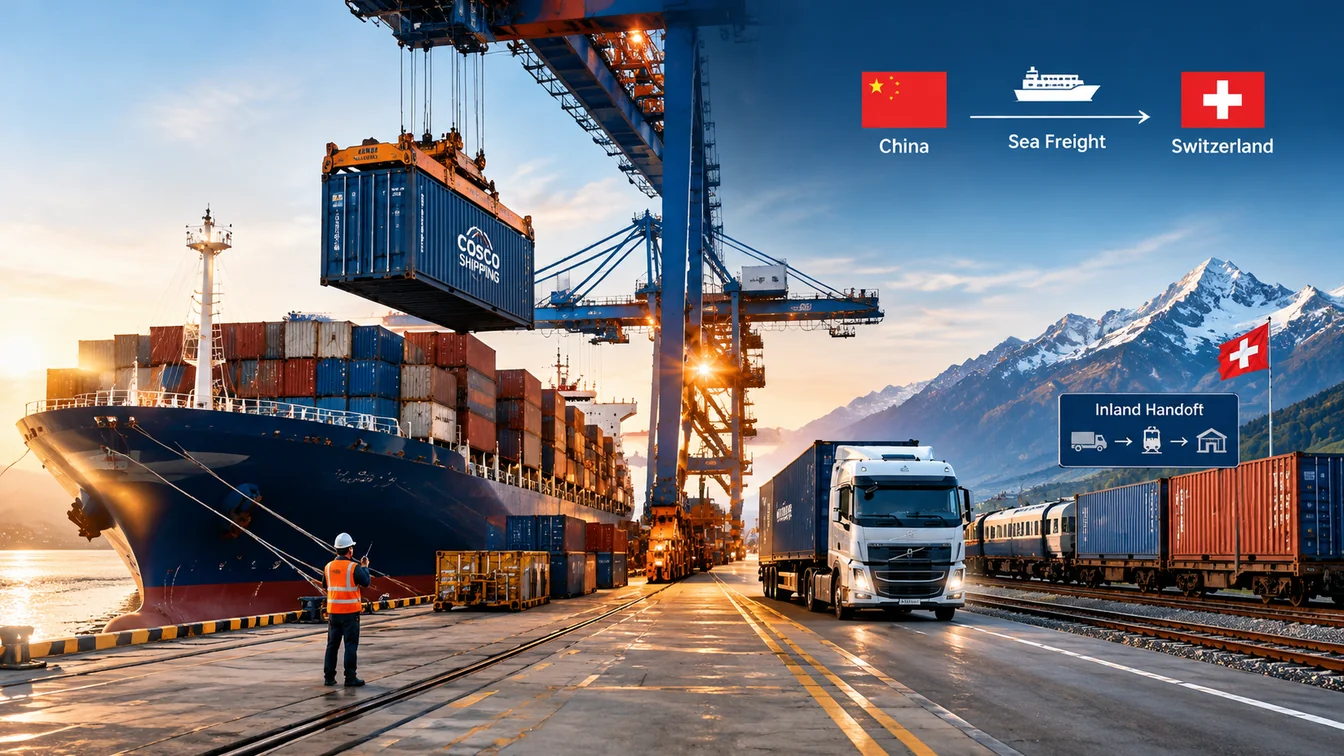
- FCL 20GP and FCL 40GP via Rotterdam/Antwerp
- The stated port-to-port stage has a planning reference of 25–32 days.
- FCL 40HQ via a European gateway to Zurich/Geneva
- The supplied planning reference is 25–32 days for the named route.
- LCL via Rotterdam/Antwerp to Basel
- The supplied planning reference is 26–36 days for the named route and method.
- Air freight to Zurich Airport (ZRH)
- The supplied airport-destination planning reference is 5–7 days.
- Express with DDP door-to-door scope
- The supplied China-to-Switzerland planning reference is 5–8 days.
- Rail-dominant multimodal, 20GP, via a European rail hub
- The supplied planning reference is 12–17 days.
The route scope matters when scheduling receipt. The FCL reference covers the specifically named port-to-port stage, and the air-freight reference ends at Zurich Airport rather than automatically representing delivery to a warehouse. The express entry is explicitly labelled DDP, door-to-door; customs release and any separate inland movement must be incorporated into the overall delivery plan where they fall outside the applicable reference.
Shipping Methods from China to Switzerland
Choose the method by matching the supplier’s cargo, shipment dimensions, urgency, and required delivery endpoint to a workable China-to-Switzerland movement.
- Choose FCL when the shipment needs a dedicated 20GP, 40GP, or 40HQ container movement, because containerized ocean cargo can be routed through a suitable European seaport before onward delivery into Switzerland. Change the choice when supplier pickup distance, equipment availability, cargo dimensions, delivery dates, or special handling makes another method more suitable.
- Choose LCL when the goods can move as consolidated cargo without requiring exclusive container use, because a shipment can be routed through Rotterdam/Antwerp toward Basel without booking an entire container. Review cargo dimensions, packing integrity, handling sensitivity, and the consignee’s receiving requirements before using a consolidated movement.
- Choose air freight when the delivery deadline makes faster airport-bound transportation important, because the supplied route specifically names Zurich Airport (ZRH). Compare actual weight, chargeable weight, carton dimensions, product restrictions, and the final postcode; airport arrival and delivery to a Swiss warehouse are different endpoints. See the air freight service for the relevant transport option.
- Choose express when time-sensitive cargo needs a compatible express movement with a defined DDP door-to-door scope, because this route includes an explicitly labelled China-to-Switzerland DDP door-to-door express option. Check actual and chargeable weight, dimensions, cargo acceptance, Swiss import arrangements, and the named receiving address. The express shipping service and DDP shipping service are relevant when defining the agreed handling and import responsibilities.
- Choose rail-dominant multimodal transport when the delivery plan calls for a rail-based alternative to ocean transport without requiring air freight, because the stated option uses a European rail hub and needs a planned onward connection into Switzerland rather than assuming direct rail service to every Swiss address. Compare the supplier’s access to the departure point, equipment compatibility, available schedule, cargo handling needs, and final postcode through the rail freight service and multimodal freight service.
Door-to-Door Shipping from China to Switzerland
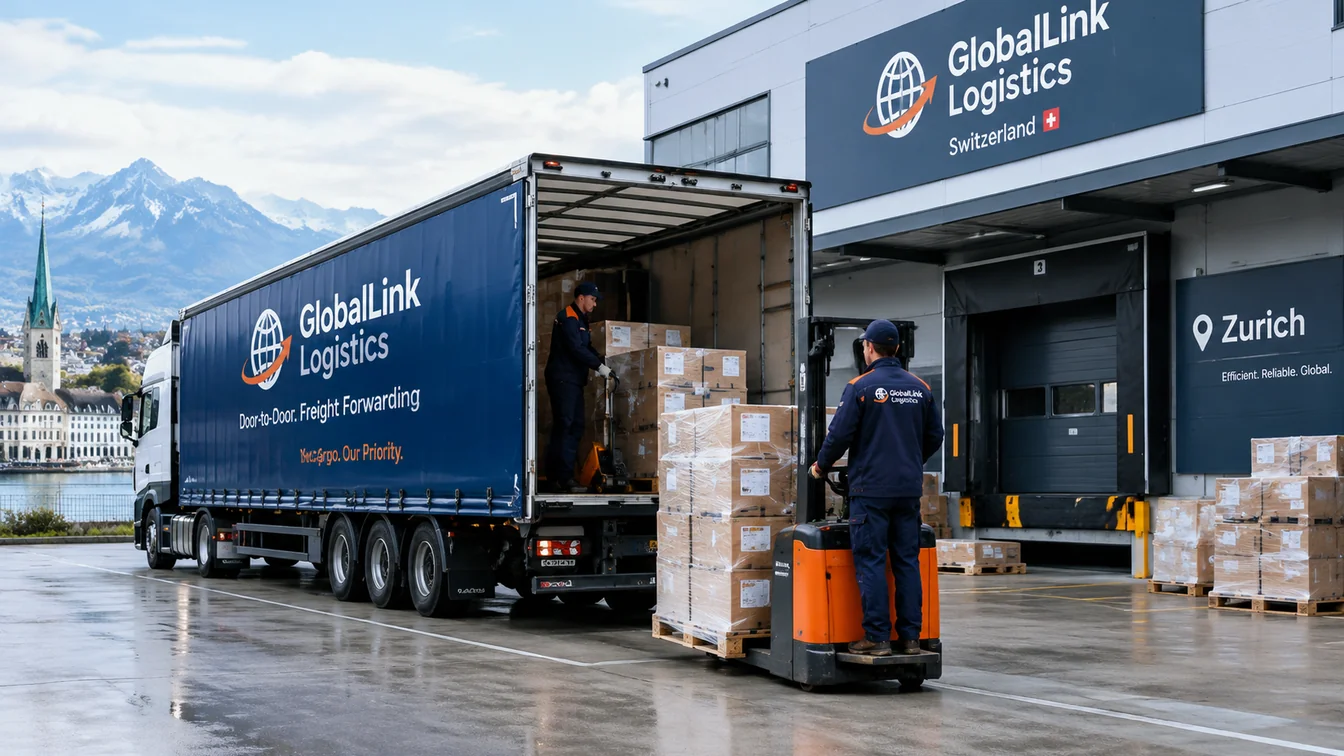
A China-to-Switzerland door-to-door movement must connect supplier pickup, China export handling, the selected international route, Swiss import clearance, and delivery to the named receiving address. The door-to-door shipping service is relevant when the intended collection and delivery points and the responsibilities between them can be defined.
-
Cargo and Compliance Review
Record the goods description, packaging, dimensions, weights, intended use, and delivery requirements. Flag any product restrictions, dangerous-goods characteristics, or documentation gaps that could change transport acceptance or Swiss import preparation.
-
Route and Method Selection
Match the supplier location and shipment form to FCL, LCL, air freight, express, or rail-dominant multimodal transportation. Define the origin gateway, the European seaport or rail hub where applicable, and the onward connection to the Swiss delivery region.
-
Supplier Coordination and Pickup
Arrange the agreed collection point, cargo readiness, packing completion, loading access, and handover documents with the Chinese supplier. Confirm whether the pickup location and cargo condition match the planned equipment and transport method.
-
China Export Handling
Prepare the commercial and transport documents required for the selected movement and complete the applicable China export formalities. Align the cargo description, quantities, weights, packaging, and shipping instructions before the international handoff.
-
International Transportation
Move the shipment using the agreed ocean, air, express, or rail-dominant multimodal route. For ocean and rail-based plans entering through Europe, include the relevant terminal transfer and onward inland movement required to reach Switzerland.
-
Switzerland Import Clearance
Arrange the Swiss import declaration, commodity classification, applicable taxes and duties, and any necessary product authorizations through the responsible importer or appointed declarant. Where the cargo moves through a European gateway, the shipment plan must also account for the relevant customs-transit arrangements into Switzerland.
-
Final Delivery
Coordinate the inland leg to the consignee’s Swiss address or warehouse, including receiving hours, unloading access, delivery appointments, and any special handling. Check that the agreed service ends at the actual required delivery point rather than an intermediate terminal or airport.
-
Shipment Close-Out
Record the delivery evidence and outstanding shipment documents, and resolve discrepancies in quantities, packaging, damage reports, or agreed handoffs. Close the movement using the actual delivery result and the responsibilities documented for the shipment.
Main China-to-Switzerland Routes and Gateways
The most practical China-to-Switzerland route normally begins at a gateway that limits supplier-side movement while matching the final delivery area and a credible onward connection into Switzerland. The comparison can change with the supplier’s pickup address, available ocean or rail service, terminal handling, equipment, schedule, and final postcode.
Major China Export Ports for Switzerland Shipping
- Shanghai
- Compare Shanghai for suppliers in Shanghai, Jiangsu, and nearby parts of the Yangtze River Delta. It is a major container export gateway for manufactured cargo, with Rotterdam or Antwerp available as European gateways to compare for an onward Swiss delivery plan. The supplier’s distance from the terminal and the actual carrier service determine whether this is preferable to another regional port.
- Ningbo-Zhoushan
- Compare Ningbo-Zhoushan for suppliers around Ningbo, Zhejiang, and other nearby manufacturing clusters. Containerized consumer goods and industrial products can be evaluated against European gateway routing through Rotterdam or Antwerp, while pickup distance, terminal cutoff, and the booked service may favour Shanghai for a particular supplier.
- Shenzhen/Yantian
- Compare Shenzhen’s Yantian terminal for Pearl River Delta suppliers, including exporters of electronics and other manufactured products. A suitable ocean service through Rotterdam or Antwerp can be connected to inland Swiss delivery, but supplier location within Guangdong and cargo readiness can change the better departure gateway.
- Qingdao
- Compare Qingdao for suppliers in Shandong and parts of northern China, including industrial and machinery exporters. A route through an appropriate European gateway can feed onward delivery in Switzerland; compare the supplier’s inland distance, cargo handling needs, and available service with southern or eastern China options.
- Guangzhou Nansha
- Compare Guangzhou Nansha for suppliers around Guangzhou and the inland Pearl River Delta. It provides another container export gateway to evaluate for European-bound cargo, particularly when supplier pickup is more practical there than at Yantian. Terminal availability and the booked sailing or onward transfer should determine the final choice.
- Xiamen
- Compare Xiamen for suppliers in Fujian and surrounding manufacturing areas. It can be assessed for containerized goods destined for Switzerland through a suitable European entry port, with supplier pickup distance, cargo type, and the actual transport service deciding whether it is a better fit than another Chinese gateway.
Main Gateway Ports for Switzerland Cargo
Switzerland is landlocked and has no seaport, so ocean shipments from China enter through a seaport in another country before moving inland to Switzerland. The European port is a gateway for the movement, not a Swiss seaport; the onward transfer and Swiss import-clearance arrangement must be part of the route plan.
- Port of Rotterdam, Netherlands
- Compare Rotterdam for containerized cargo using the Rhine and European inland transport network toward Basel, Zurich, and other Swiss delivery regions. It is explicitly named in the supplied FCL and LCL routes. The actual ocean service, inland connection, and required delivery postcode determine whether Rotterdam is the appropriate entry gateway.
- Port of Antwerp, Belgium
- Compare Antwerp for China-origin cargo with a suitable ocean service and planned rail or road movement through the European hinterland into Switzerland. It is also explicitly named in the supplied FCL and LCL routes. Terminal handling, available onward transport, and the final Swiss receiving area can change the comparison with Rotterdam.
- Port of Hamburg, Germany
- Compare Hamburg when a suitable China-origin service and onward rail or road arrangement through Germany fit the shipment. The route should be evaluated against Rotterdam and Antwerp using the available service, inland transfer, destination area, and full delivery requirements rather than assuming that one northern European gateway is always preferable.
- Port of Genoa, Italy
- Compare Genoa for a potential southern approach when the cargo’s final destination is in southern Switzerland, particularly Ticino, and a suitable inland connection through northern Italy and the Alpine region is available. The ocean service, border or transit arrangements, and final postcode must support this routing choice.
- Basel Rhine port terminals, Switzerland
- Basel’s Rhine port terminals are inland ports, not seaports. Where the booked service supports it, a Rhine-barge or intermodal arrangement can form part of the onward movement from a North Sea gateway into the Basel region. Compare this plan with road or rail transfer according to the actual service, terminal handoff, and delivery requirement.
Supplier Region to Destination Routing Logic
Compare the complete supplier-to-consignee path rather than selecting a port from the departure or arrival side alone. The following examples connect relevant China supplier regions with candidate export gateways, European entry ports, and Swiss delivery regions; they are planning patterns, not claims of guaranteed direct service.
| Supplier region in China | Origin port to compare | Destination port and delivery region | Planning reason |
|---|---|---|---|
| Pearl River Delta, Guangdong | Shenzhen/Yantian or Guangzhou Nansha | Rotterdam or Antwerp → Basel and northwestern Switzerland | Compare Yantian or Nansha against the supplier’s pickup location, then the booked European entry gateway and inland delivery to Basel. Pickup distance, terminal cutoff, service availability, and the receiving postcode may change the preferred sequence. |
| Yangtze River Delta, including Zhejiang and Jiangsu | Shanghai or Ningbo-Zhoushan | Rotterdam or Antwerp → Zurich and central Switzerland | Compare Shanghai and Ningbo-Zhoushan using the supplier’s address and actual export service, then plan the European gateway and inland connection to the Zurich or central Swiss delivery area. Terminal handling and final delivery requirements can change the comparison. |
| Shandong and northern China | Qingdao | Hamburg, Rotterdam, or Antwerp → Basel and northern Switzerland | Compare Qingdao with a European entry port that has a workable onward connection toward the final Swiss postcode. The chosen ocean service, terminal handoff, inland rail or truck movement, and cargo requirements may matter more than the nominal distance between ports. |
| Fujian and southeastern China | Xiamen | Antwerp or Rotterdam → Geneva and western Switzerland | Compare Xiamen against the actual supplier pickup and available export service, then evaluate the European gateway and onward movement to western Switzerland. Final postcode, inland routing, and the required receiving arrangements can change the preferred path. |
Destination Regional Delivery Logic
- Basel and northwestern Switzerland
- Compare Rotterdam and Antwerp for the relevant ocean service and the onward transfer into the Basel region. Basel’s Rhine port terminals can be relevant to a supported inland-waterway movement, but terminal handling and the actual delivery address determine whether barge, rail, or road is appropriate.
- Zurich and central Switzerland
- Compare the planned European gateway and inland connection against the final postcode and receiving conditions. Zurich Airport (ZRH) is the named destination for the supplied air-freight route, while containerized cargo needs its own onward movement from the selected European port or inland terminal.
- Geneva and western Switzerland
- Compare gateway choice against the final delivery address and the onward road or rail path into western Switzerland. A route through Rotterdam or Antwerp should be evaluated using actual service availability, the inland handoff, and destination handling rather than assuming that the nearest-looking port gives the shortest completed movement.
- Ticino and southern Switzerland
- Compare a northern European gateway with a feasible southern approach such as Genoa only when the relevant ocean service and onward Alpine connection are available. The final postcode, crossing arrangements, and required delivery scope determine whether this comparison is worthwhile.
How the Gateway Is Selected
A workable China-to-Switzerland gateway choice must connect the actual supplier with a feasible Swiss delivery and customs arrangement.
- Supplier access: Check the real pickup address, cargo readiness, loading arrangements, and distance to Shanghai, Ningbo-Zhoushan, Shenzhen/Yantian, Qingdao, Guangzhou Nansha, or Xiamen as relevant.
- International service: Compare the actual ocean, airport, or rail-based routing available for the shipment instead of treating a named port or rail hub as proof of a direct service.
- European-to-Swiss handoff: For a shipment entering through Rotterdam, Antwerp, Hamburg, or Genoa, map the onward inland movement and the applicable customs-transit arrangements into Switzerland.
- Final delivery address: Compare the last inland leg, receiving hours, unloading access, appointment needs, and special handling at the actual Swiss postcode.
- Required service boundary: Decide whether the movement ends at an airport or terminal, at a Swiss customs handoff, or at the recipient’s address, and align the operating parties with that endpoint.
Switzerland Customs Clearance
Commercial goods imported from China into Switzerland require the appropriate Swiss import declaration and supporting information, even when the international movement first enters Europe through Rotterdam, Antwerp, Hamburg, or another gateway. Swiss import requirements apply to the Swiss entry arrangement; arrival at a port in another country does not, by itself, complete Swiss import clearance.

What the Switzerland Importer Normally Needs
The Swiss importer or appointed declarant should prepare the following information before the shipment leaves China so that the declaration, tax assessment, and any applicable product controls can be handled against consistent cargo details. A customs brokerage service can support the declaration process within the agreed responsibilities.
- Importer identity and UID The responsible Swiss business should have its importer details ready and arrange the appropriate customs-declaration access or representation. The Federal Office for Customs and Border Security describes the registration requirements in its Swiss UID customs-registration guidance.
- Swiss commodity code Use the appropriate eight-digit Swiss tariff number for each declared product so the correct duty treatment, other charges, and product-control requirements can be determined.
- Commercial invoice Prepare a consistent description of the goods, quantities, values, currency, seller, buyer, and country of origin. The declared description must match the cargo being shipped.
- Packing list Provide the package count, packing details, marks, dimensions, and gross and net weights needed for the cargo and declaration records.
- Transport and transit documents Prepare the applicable bill of lading, air waybill, rail transport document, or other movement record. For cargo entering through another European country, include the customs-transit documentation required for the onward Swiss movement.
- Customs value and tax information Ensure that the declared value and relevant transport or other valuation elements are supported by the commercial documents, and determine the applicable Swiss import VAT and any product-specific charges.
- Product permits and compliance evidence Check any required licence, authorization, certificate, conformity evidence, or other import control for goods such as food, plant or animal products, chemicals, medicines, and regulated equipment.
- Origin and supporting records Keep reliable origin information and any documents required for the actual product or trade procedure. Preferential-origin evidence is not a universal requirement for ordinary imports of covered industrial goods, but specific export, re-export, or product-control circumstances can change the documentation needed.
Common Causes of Switzerland Customs Delays
- The commercial invoice describes the goods too broadly for reliable classification or does not match the physical cargo.
- Quantities, package counts, dimensions, or weights differ between the invoice, packing list, and transport documents.
- The Swiss commodity code is missing, incorrect, or inconsistent with the actual product and its intended use.
- The importer, appointed declarant, declaration access, or allocation of customs responsibilities is not ready for the planned movement.
- Required product authorizations, certificates, restrictions, or other controls have not been addressed before dispatch.
- Transit documents or handoff instructions are incomplete for a shipment moving from a European gateway into Switzerland.
- The declared value or supporting valuation records are inconsistent, delaying assessment of import VAT or other applicable charges.
Resolve these issues before the cargo departs China whenever possible. For shipments entering through a European seaport, the origin documents, European transit handoff, Swiss import declaration, and final delivery instructions should describe one consistent movement.
Special Cargo, Packaging, and Insurance
Cargo Requiring Additional Review
- Batteries and dangerous goods: Confirm classification, packaging, marking, declarations, and acceptance under the chosen ocean, air, express, or rail-based method before dispatch.
- Chemicals and liquids: Check composition, safety documentation, packaging compatibility, leakage controls, and any Swiss import restrictions or authorizations.
- Food and agricultural products: Review any applicable import permits, inspection, sanitary, phytosanitary, labelling, and customs-duty requirements before booking.
- Cosmetics and medical goods: Establish the applicable Swiss product-compliance, documentation, and import-control requirements for the specific product and intended use.
- Wood packaging: Check whether the packaging and its wood treatment or marking must meet applicable import requirements.
- Oversized or heavy cargo: Confirm package dimensions, weight distribution, handling equipment, loading access, route restrictions, and the feasibility of the European-to-Swiss inland leg. The project cargo shipping service is relevant where the cargo needs this type of specialized planning.
- Temperature-controlled cargo: Determine the required temperature range, monitoring, transfer arrangements, and handling conditions at each relevant handoff.
- Controlled or restricted goods: Verify the applicable authorization, import restrictions, end-use conditions, and transport acceptance before the cargo is released for shipment.
Packaging Checks
Packaging for a China-to-Switzerland shipment must protect the goods during origin handling, international transport, gateway transfer, and inland delivery. The package dimensions and weights must also match the transport documents and the receiving site’s handling capability.
Check these packaging points before the supplier hands the cargo to the transport operator:
- Carton strength and internal protection: Use packaging that supports the actual cargo weight and foreseeable handling conditions.
- Pallet stability: Secure the load for lifting and movement, and check pallet dimensions against the selected equipment and receiving facilities.
- Moisture protection: Protect moisture-sensitive cargo against the conditions expected during transport and transfers.
- Handling marks and labels: Apply the marks and labels needed for safe handling, cargo identification, and any applicable regulated-goods requirements.
- Dimensions and weights: Measure the packed shipment and align each package record with the invoice, packing list, and transport instructions.
- Regulated wood packaging: Check treatment and marking requirements for applicable wood packaging before export and entry.
Cargo Insurance
Carrier liability is not the same as cargo insurance and may not cover the full commercial value of a damaged, lost, or delayed shipment. Before dispatch, establish the intended insured value, coverage period, exclusions, deductible, required evidence, and claims documentation. The cargo insurance service is relevant when defining the insurance arrangement for the movement.
Choosing a Freight Forwarder for China-to-Switzerland Shipping
A freight forwarder helps a buyer solve three connected problems: turning the shipment request into a usable movement definition, matching that definition to a credible route, and keeping the commercial and operational handoffs aligned. For a landlocked destination such as Switzerland, the onward transfer from a European gateway and the Swiss import arrangement are particularly important parts of the plan.
- A shipment definition that can be executed
- Incomplete movement information can make a proposed transport path impractical. A defined description of the cargo, origin, destination, and service endpoint gives the parties a consistent basis for planning; the next decision changes when cargo characteristics or receiving conditions affect acceptance.
- A route that fits the real delivery need
- A port, airport, or rail hub is useful only when its onward connection suits the shipment. Comparing credible gateways against supplier location, cargo handling, urgency, and the final Swiss postcode helps avoid planning an international leg without a workable inland continuation.
- Clear operational handoffs
- Unclear responsibilities can delay cargo release or final receipt. Documenting who coordinates each agreed handoff clarifies the next action, while the importer and other legally responsible parties retain their respective customs, compliance, and tax obligations.
How TJ Logistics Team Plans a China-to-Switzerland Shipment
- Review the defined shipment
- TJ Logistics Team reviews the supplier location, cargo description, packed dimensions, weights, destination postcode, and required service endpoint, then flags information gaps that prevent a reliable transport or handling decision.
- Compare workable routes
- TJ Logistics Team compares credible ocean gateways, the onward European-to-Swiss connection, and relevant air or rail-dominant multimodal alternatives against the shipment’s cargo, timing needs, and delivery requirements. The selected route must be compatible with the actual goods and available handoffs.
- Document the agreed boundary
- TJ Logistics Team records the agreed movement scope, operating handoffs, and responsible parties for the next operational steps before a formal commercial arrangement is prepared. The documented responsibilities should distinguish transport coordination from importer, declaration, tax, and product-compliance obligations.
- Coordinate after scope approval
- Once the buyer confirms the agreed scope, TJ Logistics Team coordinates the relevant booking information, commercial documents, supplier handoff, and next shipment decisions. If cargo details, route conditions, documentation, or receiving arrangements change, the affected operational step is flagged for resolution before proceeding where necessary.
China to Switzerland Shipping FAQ
How much does a 20ft container from China to Switzerland cost?
The October 2026 indicative cost reference for FCL 20GP from China to Switzerland via Rotterdam/Antwerp (FCL port-to-port stage) is $2,655–$3,245 per container, with a 25–32 day planning transit reference. The figure applies to the named route and method, rather than automatically representing a complete delivery to a Swiss address.
How long does sea freight from China to Switzerland take?
The FCL port-to-port stage via Rotterdam/Antwerp has a 25–32 day planning reference for FCL 20GP and FCL 40GP, while the separately named LCL route from China via Rotterdam/Antwerp to Basel has a 26–36 day reference. The final delivery plan must account for any separate inland movement and customs handoff not covered by the applicable timing scope.
Which China port should I compare for shipping to Switzerland?
Start with a suitable major export gateway near the supplier that can support the required international service and onward delivery. Shanghai or Ningbo-Zhoushan are useful comparisons for Yangtze River Delta suppliers, Shenzhen/Yantian or Guangzhou Nansha for the Pearl River Delta, and Qingdao for suppliers in Shandong; the actual pickup address and booked service determine the final choice.
Which European gateway should I use for cargo to Switzerland?
Rotterdam and Antwerp are the primary gateways to compare for the supplied FCL and LCL routes to Switzerland. Hamburg or Genoa may be worth evaluating when the actual international service and onward inland connection fit the shipment, but Switzerland itself has no seaport, so the selected European port must connect to the Swiss delivery region.
Will Swiss customs charge import duty on goods from China?
Switzerland generally applies zero import customs duties to covered industrial products in HS chapters 25–97, subject to specified exceptions, following the abolition of industrial tariffs in 2024. Agricultural products and applicable exceptions can still attract duties, and import VAT remains separate; the correct treatment depends on the product’s Swiss tariff classification.
What documents should I prepare before shipping from China to Switzerland?
Prepare a consistent commercial invoice, packing list, applicable bill of lading or other transport document, Swiss eight-digit commodity code, importer and declarant details, and any required product authorizations. A shipment entering through a European gateway also needs the applicable transit arrangements for its onward movement into Switzerland.
Can I ship door-to-door from China to Switzerland?
Yes, a China-to-Switzerland movement can be planned door-to-door when the agreed service connects supplier pickup, the selected transport route, Swiss import clearance, and the named delivery address. The supplied express option is specifically labelled DDP, door-to-door; other methods need their collection, customs, inland, and final-delivery responsibilities defined for the actual arrangement.
Can rail-based shipping from China reach Switzerland?
A rail-dominant multimodal option is listed for China-to-Switzerland cargo via a European rail hub using 20GP equipment. It should be planned as a rail-based international movement with an onward European-to-Swiss handoff, rather than treated as proof of direct rail service to every Swiss delivery address.