

Reviewed by TJ Logistics Team — November 2026. This route page applies practical planning checks across supplier pickup, China gateway selection, mode fit, US customs handoff, and final delivery for China-to-USA cargo. Market conditions, tariff measures, and port operations reviewed for November 2026 may change before booking; treat all cost and transit references as planning inputs rather than confirmed outcomes.
Shipping from China to USA: Route Update
A Shanghai (CNSHA) to Los Angeles (USLAX) FCL 20GP shipment currently has an indicative cost reference of $4,463.64–$4,596.48 per container with a 15-day planning transit, while LCL from Shenzhen, Ningbo, or Shanghai to Los Angeles or Long Beach is referenced at $95–$155 per CBM over 15–19 days. These figures sit at the start of the operational chain that runs from a China supplier’s door through an origin gateway, an applicable transport mode, a US entry point, CBP clearance, and delivery to the final US address.
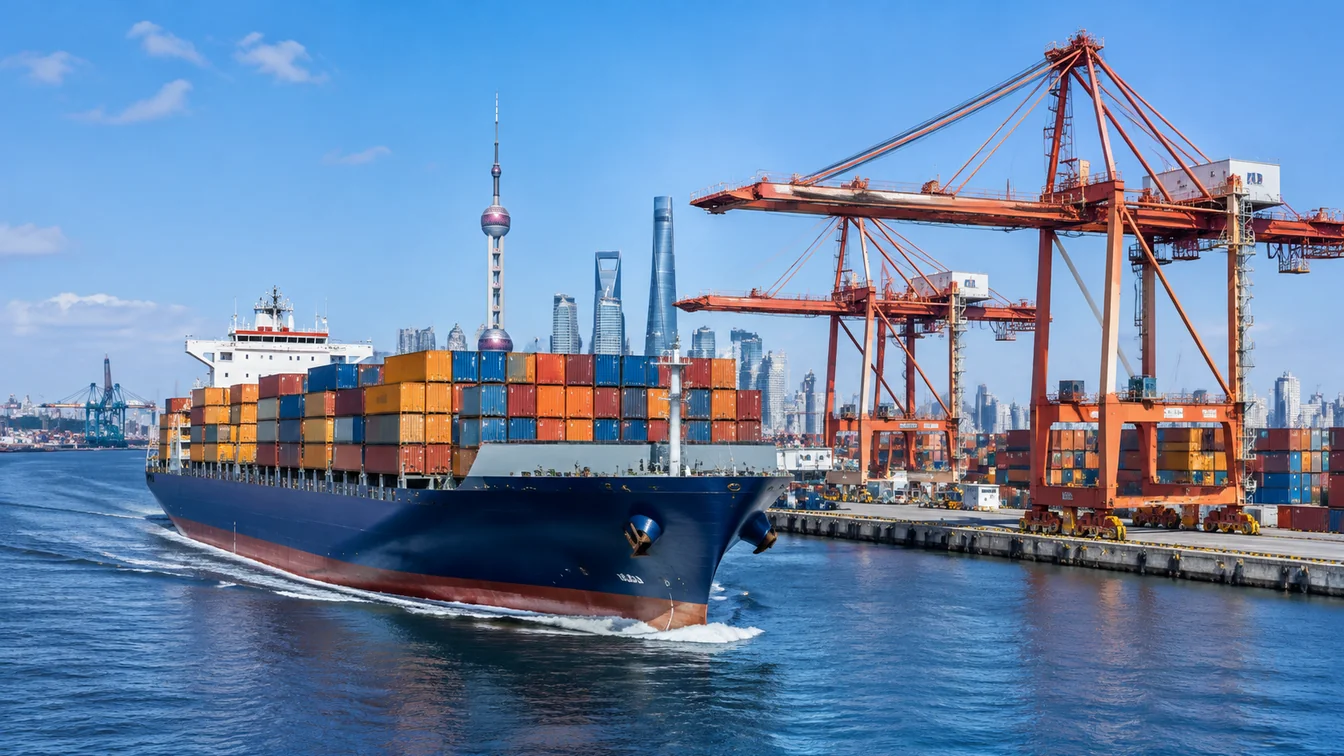
FCL suits full-container volumes where the supplier can load at one origin port, LCL consolidates smaller cargo through a warehouse network, and air freight or express fits time-sensitive or low-weight shipments that cannot absorb ocean transit. The route decision ultimately turns on cargo dimensions, required delivery date, and whether the buyer or a third party will act as the US importer of record. Sea freight and air freight options should be compared against the shipment’s actual pickup region and final ZIP code before any booking step begins.
Route Planning Summary
- How does cargo move from my China supplier to the first gateway?
- The supplier’s province determines which China export port limits inland movement. Suppliers in Zhejiang or Jiangsu normally route through Ningbo-Zhoushan or Shanghai, while Guangdong suppliers often use Shenzhen/Yantian or Shekou. Trucking or feeder service from the factory to the named port is a separate execution step and must be defined in the pickup scope before cargo leaves the supplier.
- Which transport mode fits a China-to-USA shipment?
- FCL is the practical default for shipments that fill or nearly fill a 20GP or 40GP container, because the cost reference is per container and the cargo stays sealed from origin to destination. LCL, air freight, and express are credible alternatives when volume, weight, or urgency rules out a full container, but each carries a different unit basis and handling profile.
- What planning time should I use for a China-to-USA shipment?
- A Shanghai–Los Angeles FCL 20GP reference carries a 15-day transit, and the supplied LCL reference for Shenzhen/Ningbo/Shanghai–Los Angeles/Long Beach is 15–19 days. Air freight from Shanghai to Los Angeles is referenced at 3–6 days, and express at 2–5 working days. These are transport-segment planning references, not door-to-door guarantees; US customs release and inland delivery add further time that depends on the entry port and final destination.
- Who is responsible for US customs clearance?
- The US importer of record (IOR) is legally responsible for accurate declaration and duty payment. A licensed customs broker files entry on the IOR’s behalf, but the IOR must be registered with CBP through Form 5106 and may need a customs bond. Foreign entities acting as IOR face additional restrictions under 2026 enforcement and should confirm eligibility before dispatch.
- What does final delivery from the US gateway involve?
- Final delivery from a US seaport or airport requires a defined inland scope: port or terminal pickup, drayage or trucking, and delivery to a warehouse, FBA fulfillment center, or commercial address. Door-to-door service can combine these steps under one arrangement, but the exact handoff points—where carrier responsibility ends and the delivery agent’s responsibility begins—must be recorded before the shipment arrives.
China to USA Shipping Cost
The following table provides route-specific indicative shipping costs and planning transit references for China-to-USA movements in the November 2026 review. Each reference applies to the named route, method, and unit shown.
| Shipping route | Shipping method | Price | Transit time |
|---|---|---|---|
| Shanghai (CNSHA), China → Los Angeles (USLAX), USA | FCL 20GP | $4,463.64–$4,596.48/柜 | 15 days |
| Shanghai (CNSHA), China → Los Angeles (USLAX), USA | FCL 40GP | $8,034.12–$8,274.96/柜 | 15 days |
| Shanghai (CNSHA), China → Los Angeles (USLAX), USA | FCL 40HQ | $8,115.12–$8,358.12/柜 | 15 days |
| Shenzhen / Ningbo / Shanghai, China → Los Angeles / Long Beach, USA | LCL | $95–$155/CBM | 15–19 days |
| Shanghai, China → Los Angeles, USA | Air freight | $7.20–$7.90/kg | 3–6 days |
| China → USA | Express | $20.49/kg | 2–5 working days |
Cost scope: The indicative cost references above apply to the route, method, and unit shown and are not carrier freight rates, market averages, TJ selling prices, or binding quotations. The actual commercial arrangement for a China-to-USA booking depends on the confirmed cargo, the agreed service scope, and the responsibility allocation for origin pickup, export handling, main transport, US customs entry, duty and tax, destination charges, inland delivery, insurance, storage, examination, delivery appointments, and applicable surcharges. These references are cost planning inputs for November 2026, not a quotation for any specific shipment.
USA Import Duty and Taxes
US import duty on China-origin goods is calculated as the customs value multiplied by the combined rate that applies to the exact HTSUS classification on the date of entry. That combined rate typically stacks the general (MFN) duty rate with Section 301 China measures and, where the product is covered, Section 232 tariffs on steel, aluminum, or copper; there is no single “China rate” for all goods.
The following steps outline the practical duty-calculation sequence for a China-to-USA shipment. This explanation is simplified and is not tax or legal advice; a licensed customs broker should confirm the final classification and duty amount before entry.
- Classify the product under the correct HTSUS subheading. The ten-digit HTSUS code determines the base MFN rate and whether Section 301 or Section 232 measures apply. USITC maintains the official HTSUS for classification lookup.
- Check the current Section 301 China status for that HTS code. Section 301 lists add 7.5% to 25% on many China-origin goods, with higher rates for certain products such as electric vehicles; a Section 301 forced-labor measure of 12.5% also applies to China-origin entries as of the 2026 review period. Coverage varies by code and should be verified against current CBP and USTR guidance.
- Identify any Section 232 or other product-specific measure. Steel, aluminum, copper, and derivative products may carry additional Section 232 duties layered on top of the MFN and Section 301 rates.
- Determine the customs value CBP assesses duty on. The customs value is generally the price paid or payable for the goods, with adjustments defined by CBP valuation rules; freight and insurance are not automatically included in the dutiable value for all transaction types.
- Calculate the estimated duty and confirm entry-date rules. Duty is the customs value multiplied by the combined rate. Because Section 301 and Section 232 measures change through executive action, confirm the effective rate on the CBP entry date rather than relying on a prior shipment’s rate.
China to USA Shipping Time
A Shanghai–Los Angeles FCL 20GP shipment carries a 15-day planning transit reference in the supplied data, and that value applies to the ocean leg from the named origin port to the named destination port. The same 15-day reference is shown for 40GP and 40HQ containers on that route, because the transit value is route-and-method specific rather than container-size specific.
LCL from Shenzhen, Ningbo, or Shanghai to Los Angeles or Long Beach is referenced at 15–19 days, reflecting the additional consolidation and devanning steps that LCL involves at both origin and destination. Air freight from Shanghai to Los Angeles is referenced at 3–6 days, and express from China to the USA at 2–5 working days; those shorter references cover the air or express transport segment but do not include US customs release or final delivery time.
Port and terminal conditions can extend the practical time between vessel arrival and container availability. In the 2026 review period, vessel waiting times and container dwell at the San Pedro Bay ports have at times extended beyond the ocean transit reference, and CBP holds on some China-linked cargo have increased inspection-related delays at Los Angeles and Long Beach. A planning schedule for a China-to-USA shipment should therefore treat the supplied transit as the international movement reference and add separate allowance for US customs release and inland pickup at the chosen gateway.
Shipping Methods from China to USA
Choose FCL when the shipment fills or nearly fills a 20GP, 40GP, or 40HQ container, because the container stays sealed from the China origin port through to the US destination port and the cost reference is per container rather than per CBM or kilogram. The condition that changes this choice is cargo volume below the practical fill threshold, where LCL may avoid paying for unused container space. FCL remains separately identifiable by container size in the cost module because 20GP, 40GP, and 40HQ carry different per-container references even when the transit reference is the same.
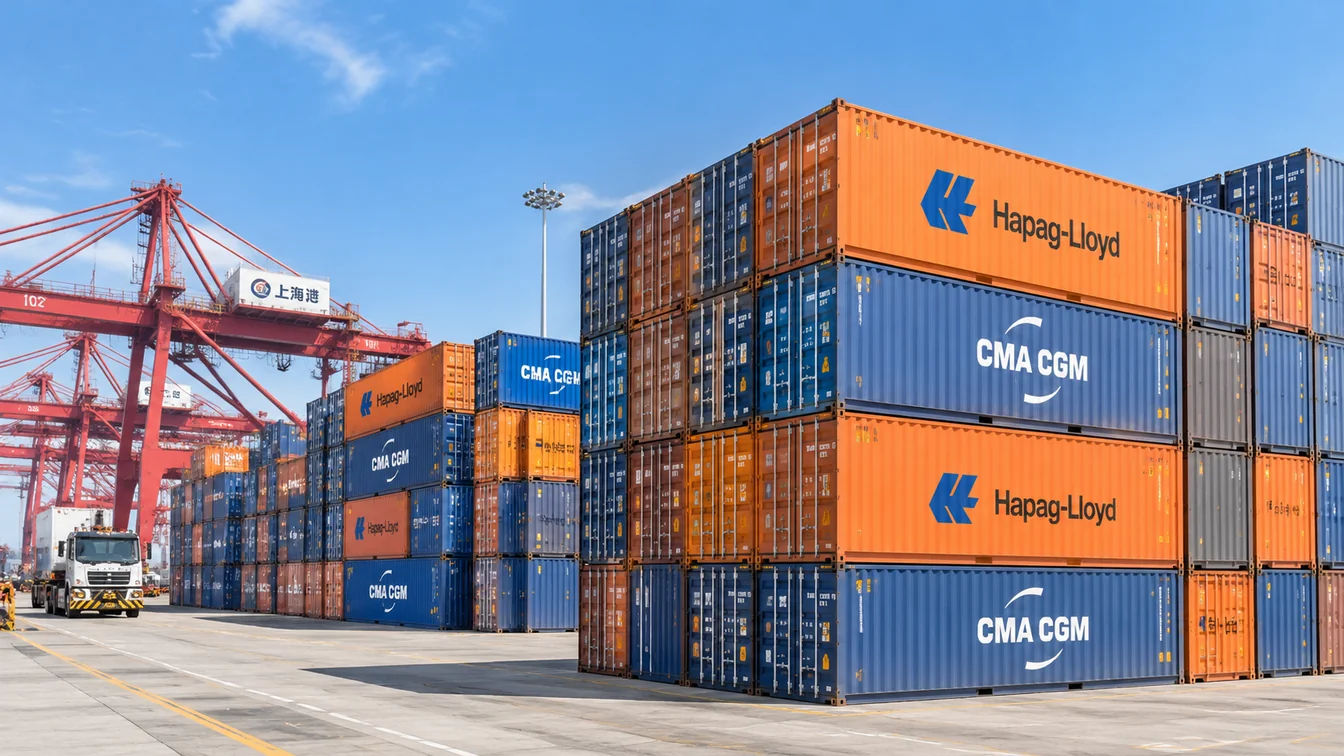
Choose LCL when cargo volume is below a full container but the shipment is not urgent enough for air freight, because LCL consolidates multiple shippers’ cargo and charges per CBM rather than per container. The condition that changes this choice is a required delivery date that cannot absorb the 15–19 day LCL reference plus consolidation and devanning time, or cargo that is too fragile or too high-value for shared container handling. LCL from Shenzhen, Ningbo, or Shanghai moves through a consolidator’s warehouse before ocean carriage and is devanned at Los Angeles or Long Beach.
Choose air freight when the shipment is time-sensitive and the chargeable weight justifies the per-kilogram reference, because Shanghai–Los Angeles air freight is referenced at 3–6 days against the 15-day FCL reference. The condition that changes this choice is cargo that is low in value relative to air freight cost, or cargo whose dimensions produce a volumetric weight that makes the effective per-kilogram cost higher than the quoted weight band. Air freight service scope should be defined before comparing it with express.
Choose express when the shipment is small, urgent, and requires door-to-door handling of low-weight parcels, because express is referenced at 2–5 working days and $20.49/kg across China-to-USA. The condition that changes this choice is a shipment whose total weight or dimensions exceed express carrier limits, or cargo that requires formal customs entry rather than the simplified processing express typically uses. Express shipping is generally not the practical mode for palletized or container-load cargo.
Rail is not a credible direct mode for a China-to-USA shipment because no land rail corridor connects the two countries. Rail-based multimodal options that route through a third country exist in some trade lanes, but they are not a standard China-origin door-to-USA option and are not included in the supplied cost table. Multi-modal freight arrangements should be reviewed only when a specific inland or third-country routing genuinely fits the cargo and final destination.
Door-to-Door Shipping from China to USA
Door-to-door shipping for a China-to-USA movement combines supplier pickup, China export handling, international transport, US customs entry, and final delivery into a sequenced scope rather than five disconnected services. The eight steps below represent the handoff points that should be agreed before cargo leaves the supplier’s premises.
-
Cargo and Compliance Review
The shipment’s HTSUS classification, product admissibility, and any regulated-cargo status are confirmed before booking, because a classification or compliance problem discovered at the US port cannot be fixed by changing the transport mode. The review covers whether the goods require FDA, EPA, CPSC, or other agency review, and whether the packaging and labeling meet US import requirements.
-
Route and Method Selection
The China origin gateway and US destination gateway are selected against the supplier’s province, cargo volume, required delivery date, and final ZIP code. This step compares FCL, LCL, air, and express on their actual unit basis and service scope rather than treating unlike cost references as directly interchangeable, and records the chosen mode’s transit reference as the international movement baseline.
-
Supplier Coordination and Pickup
The pickup appointment, loading window, and cargo-ready date are coordinated with the China supplier, and the origin port or consolidator’s warehouse is confirmed as the receiving point. Pickup geography matters: a supplier in Zhejiang may load at Ningbo-Zhoushan with less inland trucking than a supplier in Shandong using Shanghai, and that difference affects the total route plan even when the ocean transit reference is identical.
-
China Export Handling
China export declaration, port terminal handling, and the handoff to the ocean carrier or air carrier are completed at the named origin gateway. The export documents—commercial invoice, packing list, and bill of lading or air waybill—must be consistent with the US import declaration that will follow, because a mismatch between the two sides creates a customs delay that no transport mode can recover.
-
International Transportation
The main transport segment runs from the China origin gateway to the US destination gateway under the mode selected in step two: ocean FCL or LCL to a US seaport, air freight to a US airport, or express to the final delivery address. The supplied transit reference for that specific route and method is the planning baseline for the international movement, and carrier schedules and routing should be confirmed as the booking date approaches.
-
USA Import Clearance
CBP entry is filed by a licensed customs broker on behalf of the US importer of record, with duty, tax, and any applicable Section 301 or Section 232 measures assessed at the time of entry. The IOR must be registered through CBP Form 5106 and must have the required bond; 2026 enforcement has increased scrutiny of IOR identity data and restricted foreign IOR access to informal entry, so the importer role should be resolved before the shipment arrives. Customs brokerage coordination covers the document handoff and the broker’s filing, but the IOR remains legally responsible for the declaration.
-
Final Delivery
Final delivery from the US gateway to the consignee’s warehouse, FBA fulfillment center, or commercial address is a separate inland scope that includes terminal pickup, drayage or trucking, and any delivery appointment required by the receiving facility. A shipment destined for an Amazon fulfillment center needs an appointment and labeling that meet Amazon’s current inbound rules, while a commercial warehouse delivery may require a dock appointment and a delivery window. Door-to-door service scope should state where this inland step begins and who arranges it.
-
Shipment Close-Out
Proof of delivery, the final entry summary, and any post-entry duty or examination adjustment are reconciled after delivery. If CBP issues a post-summary correction or the carrier assesses detention or demurrage, that outcome is documented against the agreed service boundary so the responsible party and any follow-up action are clear. The close-out step does not create a new commercial arrangement; it confirms what was executed against the one already agreed.
Main China to USA Routes
The most practical China-to-USA route normally starts at the China export gateway that limits supplier-side inland movement while still offering a credible service toward the US entry region that matches the final delivery ZIP code. That default changes when the supplier’s province, the required equipment, or the destination region’s inland connection makes a different origin or entry gateway produce a better total route plan.
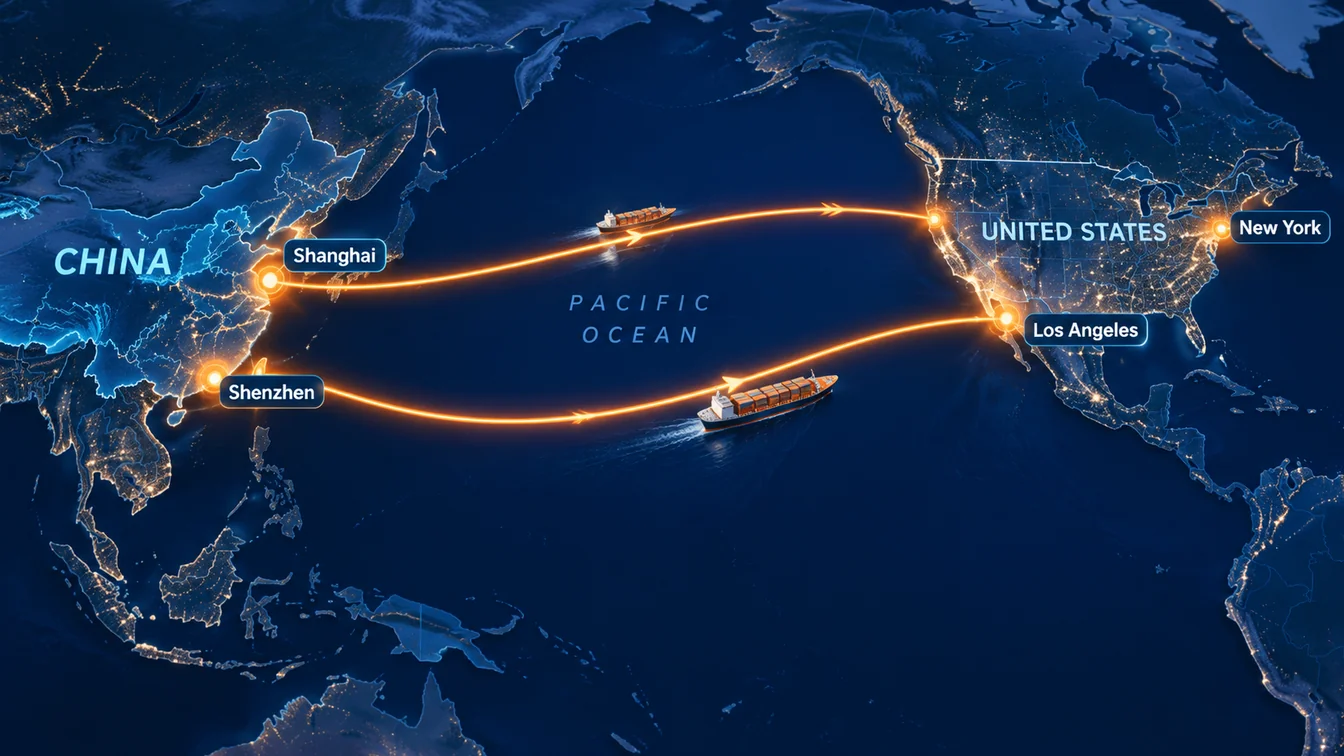
Major China Export Ports for USA Shipping
- Shanghai (CNSHA)
- Shanghai serves suppliers across Jiangsu, Zhejiang, and the Yangtze River Delta and offers frequent ocean services to both West Coast and East Coast US gateways. It is a practical origin for FCL cargo from eastern China and appears in the supplied cost table as the origin for the Shanghai–Los Angeles FCL and air freight references. Cargo from inland provinces can reach Shanghai by feeder or truck, but that inland leg adds time and cost outside the port-to-port transit reference.
- Ningbo-Zhoushan (CNNGB)
- Ningbo-Zhoushan is a deep-water port in Zhejiang that handles high container volumes and serves suppliers in Ningbo, Yiwu, and surrounding manufacturing clusters. It is a common LCL consolidation point for smaller shipments and a credible FCL alternative to Shanghai for Zhejiang-origin cargo, with ocean services toward Los Angeles, Long Beach, and East Coast ports. The choice between Ningbo and Shanghai for a Zhejiang supplier usually turns on equipment availability and sailing schedule rather than a universal port ranking.
- Shenzhen/Yantian (CNYTN)
- Shenzhen/Yantian is the principal export gateway for Guangdong electronics, consumer goods, and e-commerce cargo and offers frequent sailings to the US West Coast. Suppliers in the Pearl River Delta normally face less inland trucking to Yantian or Shekou than to Shanghai or Ningbo, which matters when pickup cost and cargo-ready timing are part of the route decision. The supplied LCL reference includes Shenzhen as an origin option, reflecting its role as a consolidation hub for South China cargo.
- Qingdao (CNQIN)
- Qingdao serves Shandong and northern China suppliers and handles agricultural products, machinery, and manufactured goods on ocean services to US gateways. It is a practical origin for cargo from Qingdao, Jinan, and the broader Shandong peninsula, and can be compared with Shanghai when the supplier is closer to Qingdao and the sailing schedule fits the required delivery window. Not every Qingdao-origin route has the same sailing frequency as Shanghai, so schedule fit should be checked against the specific US gateway and booking date.
Major USA Import Ports for Cargo from China
- Port of Los Angeles (USLAX)
- Los Angeles is the largest US container gateway on the trans-Pacific and the first entry point for much China-origin ocean cargo destined for the West Coast and inland points reached by rail. It is the destination gateway named in the supplied FCL and air freight references, and its adjacent rail connections make it a practical comparison for cargo moving to the Midwest as well as Southern California. CBP holds on some China-linked cargo have increased inspection-related dwell at Los Angeles and Long Beach in the 2026 review period, so customs release time should be planned separately from the ocean transit.
- Port of Long Beach (USLGB)
- Long Beach shares the San Pedro Bay complex with Los Angeles and handles a large share of US inbound container volume, with strong rail and truck connections to inland destinations. The supplied LCL reference pairs Los Angeles and Long Beach as destination options, reflecting their role as a combined gateway for consolidated cargo. Port congestion and vessel waiting time at Long Beach can affect container availability independently of the ocean transit, so the port-to-door schedule should include a terminal dwell allowance.
- Port of New York and New Jersey (USNYC / USEWR)
- New York and New Jersey is the primary East Coast gateway for China-origin cargo destined for the Northeast and Mid-Atlantic, with a large consumer market and direct inland connections by truck and rail. It is a practical entry point when the final delivery ZIP code is in the Northeast and an all-water or East Coast service avoids the cross-country inland leg from a West Coast port. Dwell time at New York/New Jersey is typically shorter than at the San Pedro Bay ports, but total transit from China is longer than a West Coast routing and should be compared against the delivery date requirement.
- Port of Savannah (USSAV)
- Savannah serves the Southeast US and has become a major gateway for e-commerce and distribution cargo moving into Georgia, Florida, and the Carolinas. It is a credible entry point when the final delivery region is the Southeast and a East Coast all-water service fits the schedule; Savannah’s congestion level has generally been lower than the West Coast peaks, but total China-to-Savannah transit is longer than a Los Angeles routing. The port’s inland rail and truck network supports distribution to Atlanta and other Southeast hubs.
Supplier Region to Destination Routing Logic
| Supplier region in China | Origin port to compare | Destination port and delivery region | Planning reason |
|---|---|---|---|
| Zhejiang / Jiangsu (Yangtze Delta) | Ningbo-Zhoushan or Shanghai | Los Angeles / Long Beach → West Coast or Midwest by rail | A Yangtze Delta supplier has short inland access to Ningbo or Shanghai and can choose between the two based on sailing schedule and equipment; West Coast entry plus rail suits Midwest delivery when the rail schedule is reliable. This pattern can change if the final ZIP code is in the Northeast, where an East Coast gateway may avoid a cross-country inland leg. |
| Guangdong / Pearl River Delta | Shenzhen/Yantian or Shekou | Los Angeles / Long Beach → West Coast or Midwest by rail | South China suppliers normally limit inland trucking by using Yantian or Shekou, and the frequent trans-Pacific services make Los Angeles/Long Beach the default first entry point. The comparison should shift to an East Coast gateway if the final delivery region is the Northeast and the ocean schedule supports it, or if a specific equipment type is unavailable at the West Coast origin. |
| Shandong / Northern China | Qingdao | Los Angeles / Long Beach → West Coast or Midwest by rail | Qingdao reduces supplier-side inland movement for Shandong cargo, and West Coast entry keeps the ocean leg on the trans-Pacific lane; rail from Los Angeles serves Midwest points without an East Coast diversion. This pattern can change when the required sailing frequency from Qingdao is lower than from Shanghai for the specific US gateway, or when the final destination is in the Southeast and an East Coast service is more direct. |
| Yangtze Delta or South China with Northeast delivery | Shanghai or Ningbo-Zhoushan or Shenzhen/Yantian | New York and New Jersey → Northeast delivery region | An East Coast all-water service to New York/New Jersey can be more practical than a West Coast discharge plus cross-country rail when the final ZIP code is in the Northeast, because it avoids the inland rail leg and shortens the post-clearance delivery distance. The trade-off is a longer ocean transit than a West Coast routing; the comparison should weigh total route time and inland cost, not ocean transit alone. |
| South China or Yangtze Delta with Southeast delivery | Shenzhen/Yantian or Shanghai | Savannah → Southeast delivery region | Savannah provides a Southeast entry point for cargo whose final delivery region is Georgia, Florida, or the Carolinas, and can reduce inland distance compared with a West Coast discharge plus rail. The all-water transit to Savannah is longer than a Los Angeles routing, so this pattern fits when delivery timing can absorb the longer ocean leg and the Southeast inland distance is the dominant cost factor. |
Destination Regional Delivery Logic
- West Coast
- West Coast delivery from a China origin normally uses Los Angeles or Long Beach as the entry gateway, because those ports sit on the trans-Pacific lane and have direct truck and rail connections to California, Arizona, Nevada, and the Pacific Northwest. The ocean transit is shorter than an East Coast routing, but terminal dwell and customs holds at the San Pedro Bay ports can extend the post-arrival schedule. West Coast delivery is the practical default when the final ZIP code is in California or a nearby state and the delivery date can tolerate port and customs variability.
- East Coast
- East Coast delivery can use New York/New Jersey or Savannah as the entry gateway, depending on whether the final ZIP code is in the Northeast or the Southeast. An all-water service to an East Coast port avoids the cross-country inland rail leg from a West Coast discharge, but the ocean transit from China is longer than a Los Angeles routing. The comparison should weigh total route time and inland cost rather than ocean transit alone.
- Midwest
- Midwest delivery typically requires comparing a West Coast gateway plus inland rail, an East Coast gateway plus inland truck or rail, or another credible gateway plus inland connection, based on the final ZIP code, the rail schedule, destination charges, and the total landed route cost. No single gateway is universally best for the Midwest; a Chicago or Ohio delivery may favor a different entry point than a Kansas or Missouri delivery, and the comparison should be made per shipment rather than from a regional label.
How the Gateway Is Selected
Gateway selection for a China-to-USA shipment should follow the supplier-to-final-delivery chain rather than a port-by-port ranking. The checks below cover the factors that most often change the comparison.
- Supplier inland distance to the China origin port. A supplier closer to Ningbo than Shanghai may still use Shanghai if the sailing schedule or equipment availability is better; the inland trucking or feeder cost and time should be compared alongside the ocean schedule.
- US destination region and final ZIP code. A West Coast ZIP code normally points to Los Angeles/Long Beach; a Northeast ZIP code may justify an East Coast all-water service even with a longer ocean transit; a Midwest ZIP code requires a rail-versus-truck comparison that depends on the specific inland point.
- Equipment availability and sailing frequency. A 40HQ container may be more readily available at one China origin port than another on a given booking date, and a less frequent sailing from a closer port can still delay the overall route.
- Customs and terminal conditions at the US gateway. CBP holds on China-linked cargo and terminal dwell at Los Angeles/Long Beach can add time that a different gateway may avoid, but the alternative gateway’s own dwell and inland cost must be included in the comparison.
- Agreed delivery scope. A port-to-port booking ends at the US gateway, while a door-to-door booking adds inland delivery and possibly an FBA appointment; the gateway choice should match the scope that has actually been agreed.
USA Customs Clearance
US customs clearance requires a registered US importer of record, an accurate entry declaration, and payment of applicable duty and tax before CBP releases the cargo. The rules apply to the US customs territory, which includes the 50 states, the District of Columbia, and Puerto Rico; separate customs regimes apply in US territories and freely associated states and should not be assumed to follow the same entry process.
What the USA Importer Normally Needs
The following requirements are the practical starting set for a China-origin commercial import into the United States. Product-specific licenses or agency approvals may add requirements beyond this list.
- Importer of Record (IOR) registration The IOR must be registered with CBP through Form 5106, which assigns an importer number linked to an EIN, SSN, or CBP-assigned ID. CBP Form 5106 guidance sets out the required identity data; 2026 enforcement has increased scrutiny of IOR accuracy and restricted foreign IOR access to informal entry.
- Customs bond A customs bond is generally required for formal entry, and the bond amount must be sufficient for the importer’s activity. The IOR remains legally liable for duty and compliance even when a broker files the entry.
- HTSUS classification The ten-digit HTSUS code determines the MFN duty rate and whether Section 301 or Section 232 measures apply. Classification should be supported by product specifications and, where needed, a binding ruling or broker advice. USITC HTSUS is the official classification reference.
- Commercial invoice and packing list The invoice must state the seller, buyer, goods description, quantity, unit value, total value, origin, and terms of sale. The packing list must match the invoice and the transport document; inconsistencies among the three are a common cause of CBP requests for information.
- Transport document The ocean bill of lading or air waybill identifies the consignee and the cargo and is used by the broker to file entry. The consignee and IOR roles must be accurate and must not misrepresent Amazon or another party as the importer.
- Product-specific certificates or licenses Food, drugs, cosmetics, medical devices, electronics, and other regulated products may require FDA, EPA, CPSC, or FCC clearance before CBP releases the entry. The requirement depends on the product, not on the transport mode.
- Customs broker authorization A licensed customs broker files the entry under a power of attorney from the IOR. The broker is the filing agent, not the legal importer; the IOR remains responsible for the accuracy of the declaration and payment of duty.
Common Causes of USA Customs Delays
- HTSUS misclassification. A code that does not match the product’s actual composition or function can trigger a CBP request for information, a reclassification, or a post-entry adjustment, any of which delays release.
- Invoice and value discrepancies. A commercial invoice that is inconsistent with the packing list or the transport document, or a declared value that does not reflect the transaction, is a common reason for CBP examination.
- IOR identity or bond issues. An IOR record that is incomplete, inaccurate, or not linked to a valid bond can prevent entry from being accepted; CBP’s 2026 enforcement has increased the risk of IOR number voiding for inaccurate Form 5106 data.
- Missing product-specific approvals. A shipment that requires FDA, EPA, or other agency review but arrives without the necessary information or certificate can be held until the agency’s requirements are satisfied.
- Section 301 or Section 232 coverage questions. A product whose HTS code is subject to an additional tariff measure may require additional declaration data; an unresolved coverage question can delay the entry summary.
- China-origin cargo inspections. CBP has increased holds on some China-linked cargo at Los Angeles and Long Beach, and an examination adds terminal dwell and potential demurrage beyond the normal release timeline.
These issues are most efficiently resolved before the shipment departs the China origin port, because a correction at the US entry point adds time and cost that cannot be recovered by changing the inland delivery plan. The importer, broker, and China-side document preparer should confirm the declaration data against the physical cargo and the transport documents before the vessel or aircraft departs.
Shipping to Amazon FBA USA
Amazon FBA is a relevant fulfillment route for China-origin sellers delivering inventory to US fulfillment centers, and the shipment must meet Amazon’s current inbound requirements before it reaches the fulfillment center. The US seller—not Amazon and not the freight forwarder—is the importer of record for FBA inventory, and Amazon will not act as IOR or consignee without written authorization.
Since January 1, 2026, Amazon has discontinued its US FBA prep and item-labeling services. Every unit must arrive at the fulfillment center with its FNSKU label applied, any required polybagging or bubble wrapping completed, and the correct FBA carton label on each shipping box. Carton labels should be placed on a flat side surface rather than the top or bottom, and labels must not be obscured by tape or overlapping cartons. Amazon fulfillment centers operate on an appointment basis; the carrier or forwarder must book the delivery appointment through Amazon’s designated system, and a shipment without a valid appointment or compliant labels risks rejection or inbound defect fees.

The FBA shipment plan should be aligned with the freight booking before cargo leaves China. The seller provides the fulfillment center code, carton count, and FNSKU status to the logistics partner, and the forwarder coordinates the delivery appointment and the final-mile handoff. Amazon FBA shipping scope covers the logistics coordination to the assigned fulfillment center, but the seller remains responsible for product compliance, labeling accuracy, and the customs declaration as IOR. Amazon’s official inbound requirements should be checked against the specific fulfillment center and shipment plan before dispatch.
Special Cargo, Packaging, and Insurance
Cargo Requiring Additional Review
- Batteries and battery-containing products. Lithium batteries and products with installed batteries may require UN 38.3 test documentation, SDS, and carrier approval before air or ocean booking; some carriers restrict stand-alone battery shipments.
- Dangerous goods and chemicals. Flammable liquids, aerosols, oxidizers, and other regulated dangerous goods require proper classification, packing, marking, and documentation; they cannot be tendered as general cargo.
- Liquids, food, cosmetics, and medical goods. These categories may require FDA prior notice, ingredient or labeling review, or other agency approval before CBP release, and the compliance requirement exists independently of the transport mode.
- Wood packaging. Solid wood packing material must meet ISPM 15 heat-treatment or fumigation requirements and carry the IPPC mark; non-compliant wood packaging can cause the shipment to be refused or re-exported.
- Oversized or temperature-controlled cargo. Cargo outside standard container or pallet dimensions, or cargo requiring a temperature-controlled environment, needs a specialized equipment and routing review before a rate or transit commitment is practical.
- Controlled goods. Items subject to export controls, sanctions, or licensing requirements on the China side or the US side require a compliance review before booking; a freight forwarder does not replace the exporter’s or importer’s legal responsibility for those controls.
Packaging Checks
Packaging for a China-to-USA shipment should protect the cargo through multiple handling points—supplier loading, China terminal handling, ocean or air carriage, US terminal handling, and final delivery—rather than only the first leg. The checks below are practical starting points, not a substitute for a product-specific packaging specification.
These packaging checks apply to both FCL and LCL cargo, with additional attention to LCL because consolidated cargo is handled alongside other shippers’ goods.
- Carton strength and closure. Use corrugated board rated for the stacked load and the intended handling, and seal cartons with sufficient tape so they do not open during transloading.
- Internal protection. Use void fill, dividers, or molded inserts to prevent product movement; fragile items should be individually wrapped or cushioned.
- Pallet condition and stacking. Pallets should be structurally sound and loaded within their rated capacity; overhanging cartons and unstable stacking increase damage risk and can be refused at a US receiving dock.
- Moisture protection. Ocean containers can experience condensation; moisture-sensitive cargo should use desiccant, liners, or sealed inner packaging as appropriate.
- Handling marks and labels. Shipping marks should identify the carton, quantity, and any handling instructions, and the carton label should be placed where it remains visible after stacking.
- Dimensions and weights. Record the actual carton dimensions and gross weight; LCL charges and air chargeable weight depend on measured data, not on the supplier’s estimate.
- Regulated wood packaging. Any solid wood pallet or crate must carry the ISPM 15 IPPC mark; engineered wood products are exempt from the treatment requirement but should still be inspected for damage.
Cargo Insurance
Cargo insurance is a separate coverage from the carrier’s liability, and the carrier’s liability limit is typically far below the cargo’s commercial value. Insurance coverage should be arranged for the full shipment value before the cargo leaves the supplier, and the policy should be reviewed for exclusions, deductible, insured value, required evidence of loss, and the coverage period from origin pickup through final delivery. Cargo insurance scope should be confirmed against the specific route, mode, and cargo type; a certificate of insurance is not a guarantee that a particular loss will be covered.
Why Use a Freight Forwarder for Shipping from China to USA?
A freight forwarder helps a China-to-USA buyer turn cargo facts into a workable shipment definition, select a credible route and gateway for that definition, and keep the commercial and operational handoffs aligned from supplier pickup through US delivery. The forwarder does not replace the importer of record, the customs authority, the licensed customs broker’s filing responsibility, or the product-compliance owner.
- Defining the shipment before comparing routes
- A China-to-USA shipment is only comparable when the cargo’s dimensions, weight, HTSUS classification, cargo-ready date, and final delivery ZIP code are defined together. The practical resolution is a shipment definition that lets FCL, LCL, air, and express be compared on their actual unit basis rather than on a headline rate. The condition that can change the definition is regulated cargo, wood packaging, or an unresolved IOR arrangement, any of which may add a compliance step before the route comparison is meaningful.
- Matching transport and gateway choices to the real route
- The practical resolution is to narrow the route using supplier province, origin gateway, US entry gateway, and final delivery region together, so the selected mode and port pair fit the cargo and the delivery requirement rather than a generic lane. The condition that can change the match is a sailing schedule change, equipment availability at the China origin, or a US gateway dwell that shifts the total route time; those factors should be rechecked at booking rather than assumed from a prior shipment.
- Keeping commercial and operational handoffs aligned
- A China-to-USA shipment crosses several responsibility boundaries—supplier to origin port, origin port to carrier, carrier to US terminal, terminal to customs broker, and gateway to final delivery—and the forwarder’s role is to document where each handoff occurs and which party is responsible for the next action. The condition that can change the handoff plan is a customs examination, a delivery appointment change, or a post-entry duty adjustment; those events require a documented next step rather than an assumption that the original plan still applies.
How TJ Logistics Team Plans a China-to-USA Shipment
- Review the defined shipment and flag information gaps
- TJ Logistics Team reviews the cargo dimensions, weight, HTSUS classification, cargo-ready date, supplier location, and final US delivery ZIP code, and flags any missing input that prevents a reliable route or scope decision. The review does not create a commercial commitment; it identifies what must be clarified before the next planning step.
- Compare credible transport, gateway, and handoff options
- TJ Logistics Team compares FCL, LCL, air, and express references against the defined shipment and checks which China origin gateway and US entry gateway produce a coherent route for the final delivery region. The comparison includes the agreed service boundary and the handoff points where responsibility changes, so the buyer can see what each option actually covers.
- Record the agreed service boundary before a formal arrangement
- Before a formal commercial arrangement is prepared, TJ Logistics Team documents the agreed scope: which party handles origin pickup, export clearance, main transport, US customs entry, duty payment, and final delivery. The record is intended to prevent a later mismatch between the service assumed by the buyer and the service actually included in the arrangement.
- Coordinate booking information and next operational steps after scope confirmation
- After the buyer confirms the agreed scope, TJ Logistics Team coordinates the booking information, commercial documents, cargo handoff, and the next operational decision if timing, routing, documents, or receiving conditions change. Multi-modal freight coordination is used when the agreed route combines ocean, rail, or truck segments; the coordination role does not guarantee a carrier booking or an outcome, and the responsible parties for each handoff remain as recorded.
China to USA Shipping FAQ
How much does a 20ft container from China to USA cost?
A Shanghai (CNSHA) to Los Angeles (USLAX) FCL 20GP shipment has an indicative cost reference of $4,463.64–$4,596.48 per container for November 2026, with a 15-day planning transit. That reference applies to the named route, method, and container size; it is not a carrier freight rate or a formal quotation, and the actual booking cost depends on the confirmed cargo and the agreed service scope.
How long does sea freight from China to USA take?
FCL from Shanghai to Los Angeles is referenced at 15 days, and LCL from Shenzhen, Ningbo, or Shanghai to Los Angeles or Long Beach is referenced at 15–19 days. Those values cover the ocean transport segment and the LCL consolidation or devanning steps, but they do not include US customs release or inland delivery, which add time depending on the entry gateway and final destination.
What is the most cost-effective way to ship from China to USA?
FCL is the practical cost default for a shipment that fills or nearly fills a 20GP or 40GP container, because the cost reference is per container and the cargo stays sealed from the China origin port to the US destination port. LCL is more cost-effective when the cargo volume is below a practical full-container load, because it charges per CBM rather than per container; air freight and express are cost-effective only when urgency or low shipment weight makes their per-kilogram reference competitive with the total cost of the slower mode.
Which China port is best for shipping to USA?
The practical default is the China export port closest to the supplier that also has a suitable sailing toward the US entry region for the final delivery ZIP code. A Zhejiang or Jiangsu supplier normally compares Ningbo-Zhoushan and Shanghai; a Guangdong supplier normally compares Shenzhen/Yantian and Shekou; a Shandong supplier normally starts with Qingdao. No single port is universally best, because inland distance, sailing frequency, equipment availability, and US gateway fit change the comparison for each shipment.
Can I ship door-to-door from China to USA?
Door-to-door service for a China-to-USA shipment can combine supplier pickup, China export handling, international transport, US customs entry, and final delivery under one agreed scope. The service boundary should state whether the price includes US duty and tax, inland delivery, and any FBA appointment, because those items are not automatically included in every door-to-door arrangement. The importer of record remains legally responsible for the customs declaration even when a forwarder coordinates the door-to-door movement.
What documents should be prepared before shipping from China to USA?
A China-to-USA commercial shipment normally needs a commercial invoice, packing list, ocean bill of lading or air waybill, HTSUS classification, and the US importer of record’s CBP Form 5106 registration and bond. Product-specific certificates or agency approvals may be required depending on the goods, and the invoice, packing list, and transport document should be consistent before cargo leaves the China origin port.
Why can two China-to-USA shipping costs differ?
Two China-to-USA shipping costs can differ because they may use different routes, methods, units, or service scopes rather than because one provider is cheaper for the same shipment. A per-container FCL reference, a per-CBM LCL reference, and a per-kilogram air reference are not directly comparable, and a door-to-door scope that includes US duty and inland delivery covers more than a port-to-port reference. Comparing costs for the same defined shipment and the same agreed scope is the only reliable way to evaluate the difference.