

EXW vs FCA: The Practical Choice
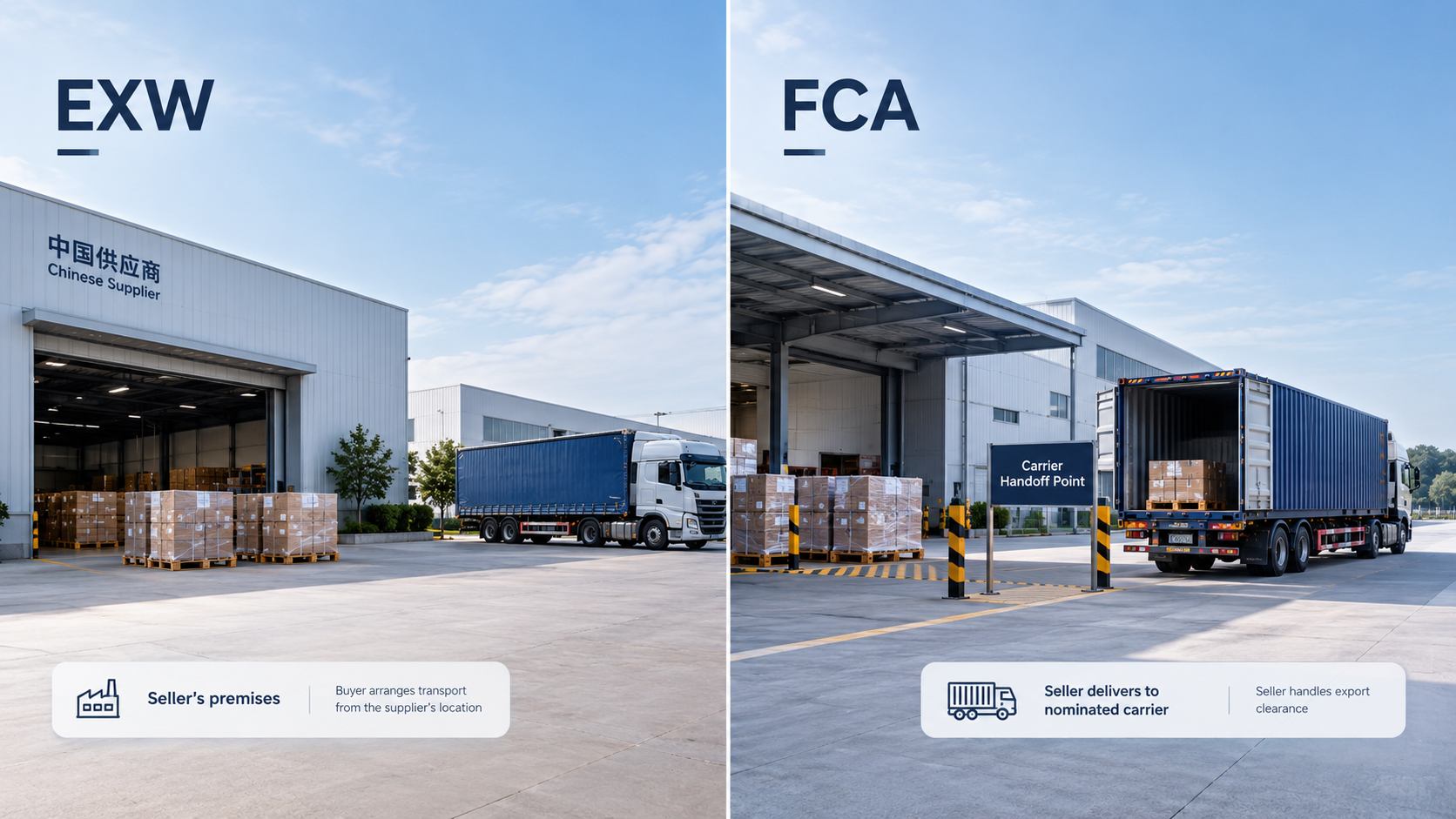
Choose EXW when the buyer is prepared to take responsibility from the named seller location, including the arrangements needed to move the cargo onward and handle export formalities where applicable. Choose FCA when the seller should complete delivery to the buyer’s nominated carrier at an agreed point and handle export clearance where required. The fact most likely to change the answer is the named delivery point and who can practically perform the export process. A buyer that controls a coordinated international transport plan may use either structure, but the handoff must match what the seller and buyer can actually execute. EXW places an earlier operational burden on the buyer, while FCA creates a more defined seller-to-carrier handoff in the seller’s country. The comparison should therefore focus on the delivery point, loading arrangement, export clearance, main-carriage booking, risk transfer, and what happens after the carrier receives the cargo.
For China purchasing, the choice also affects how the freight quotation should be built. Do not compare a supplier’s product price under one term with a logistics quotation built around the other term until the same origin responsibilities and destination scope have been included.
Build a Fair EXW and FCA Comparison
A fair comparison starts with identical commercial and logistics assumptions. EXW and FCA do not describe the transport mode itself, so the buyer should hold the cargo, route, destination, and downstream transport plan constant while changing the delivery responsibility.
| Comparison input | What to align | Why it matters | Buyer verification |
|---|---|---|---|
| Cargo and origin | Same supplier location and cargo profile | Changes pickup, loading, and handling requirements | Confirm the exact pickup location and cargo condition |
| Delivery point | Named place under each term | Defines the operational handoff | Confirm the named place and precise point |
| Transport plan | Same downstream mode and route | Prevents a term comparison from becoming a mode comparison | Keep the planned carriage unchanged |
| Clearance role | Same export and import responsibilities | Changes who must perform and coordinate customs work | Confirm the party able to complete each required formal step |
| Destination scope | Same terminal, warehouse, or final delivery point | Prevents hidden destination work from changing the quote basis | State whether the quote stops at a terminal or continues to the final address |
The central question is not which label sounds cheaper. It is whether the stated delivery point and responsibilities create a workable handoff for the actual shipment.
Option Profiles and Buyer Fit
EXW fits a buyer that can take over logistics at the seller’s named location. Under the standard EXW rule, the seller makes the goods available at the named place rather than completing delivery to a carrier. The buyer then arranges the onward carriage and assumes the related responsibilities from the agreed delivery point. The seller does not have an obligation under EXW to clear the goods for export, although the seller may provide assistance with information or documents when requested and subject to the applicable arrangement.
FCA fits a buyer that wants a defined seller-to-carrier handoff. Under FCA, the seller delivers the goods to the buyer’s nominated carrier or another nominated party at the named place. When the named place is the seller’s premises, the seller loads the buyer-arranged collecting vehicle. When the named place is elsewhere, the seller brings the goods to that place and makes them available to the nominated carrier in accordance with the rule. Export clearance, where applicable, is handled by the seller.

FCA is also useful when the downstream plan may involve more than one transport mode because the rule can be used regardless of the selected mode or combination of modes. That separation lets the buyer evaluate the onward transport plan independently, including multimodal freight arrangements where the route requires multiple transport stages.
After the delivery point is fixed, the buyer can separately align the international carriage with the required service. For a port-based plan, sea freight may be the relevant downstream service. For time-sensitive air cargo, the buyer can review air freight options. Where a rail corridor is appropriate, rail freight can be assessed after the FCA or EXW handoff is defined.
Core Decision Matrix: FCA vs EXW
| Option | Strong Fit | Weak Fit | Main Trade-Off | What to Verify |
|---|---|---|---|---|
| EXW | Buyer can manage pickup and export process from the named seller location | Buyer cannot practically arrange export formalities or local pickup control | Earlier buyer responsibility and a less defined seller-to-carrier handoff | Seller location, loading arrangement, export process, pickup authority, onward carriage |
| FCA at seller premises | Buyer wants the seller to load the collecting vehicle and handle export formalities | Seller cannot support the required pickup or export process | More seller involvement before the carrier handoff | Loading responsibility, nominated carrier, named point, export documents |
| FCA at another named point | Buyer needs delivery to a carrier or agreed logistics point in the seller’s country | The parties have not clearly defined the named point or unloading boundary | More movement occurs before the buyer’s carrier takes charge | Exact place, transfer point, carrier instructions, unloading arrangement |
| Either term | Parties can document the handoff and build the same downstream scope into the logistics plan | Supplier quote and freight quote use different delivery assumptions | The term alone does not determine final destination service | Full origin-to-destination quote scope and responsibility split |
FCA does not automatically mean door delivery, and EXW does not automatically mean a particular transport mode. The selection is useful only when the named delivery point matches the physical movement of the shipment. The decisive control point is the handoff: identify where the seller’s responsibility ends, who takes the cargo next, and which party has the practical ability to perform the required export steps.
Field note: When a supplier offers EXW, ask for the exact pickup location and loading arrangement before comparing it with an FCA proposal. A change in the named place can alter the work that occurs before the main carrier receives the cargo.
Cost and Quote-Scope Trade-Offs
Do not treat the supplier’s EXW or FCA product price as the freight cost. The two structures move different origin responsibilities between seller and buyer, so a fair logistics comparison must rebuild the shipment from the same physical starting point to the same destination scope.
Under EXW, the buyer may need to account for activities between the seller’s named location and the point where international carriage takes over, together with the export-related work that the buyer is expected to handle under the chosen arrangement. Under FCA, the seller performs the delivery obligation to the named handoff point and handles export clearance where applicable, while the buyer normally arranges the main carriage after delivery.
A freight quote therefore needs more than a headline transport charge. The quote should identify the origin pickup scope, origin handling, export-related work, main carriage, destination handling, customs brokerage where applicable, inland delivery, and any exclusions. The same destination postcode, delivery scope, cargo description, package information, dimensions, weight or volume data, cargo-ready timing, and required service level should be used when comparing offers.
The buyer should also separate the transport method from the delivery term. The same EXW or FCA arrangement can be followed by sea, air, rail, express, or a multimodal plan, so a lower supplier-side figure does not by itself establish a lower total shipment charge.
Note: Freight rates and total shipment charges change with cargo details, route, service scope, carrier conditions, timing, destination handling, and applicable responsibilities. Compare current quotes only after their scope has been aligned.
Time, Handoffs, and the Delivery Cycle
Neither EXW nor FCA creates a universal transit time because the term defines responsibility and delivery rather than the transport schedule. The buyer should distinguish the main transport segment from the total delivery cycle before comparing proposals.
The main transport segment begins after the shipment reaches the applicable carrier handoff and depends on the selected route and mode. The total delivery cycle can also include supplier readiness, pickup coordination, consolidation or cargo receipt, export processing, terminal transfers, main carriage, destination handling, import customs, deconsolidation where relevant, appointment requirements, and final inland delivery.
For that reason, a quote should state whether any timing statement covers only the principal transport movement or the complete shipment cycle to the agreed destination. Approximate timing should be confirmed against the actual route, service scope, cargo readiness, carrier schedule, customs process, and destination delivery conditions rather than treated as a commitment.
When FCA is used, the buyer should pay particular attention to the planned carrier handoff because the shipment cannot be managed against an international booking assumption if the cargo is not ready for the agreed delivery point. When EXW is used, the buyer should verify the pickup and export process before relying on the main-carriage schedule.
These distinctions matter for both ocean and air plans. They also matter when the buyer combines transport stages or uses a final-address delivery service after the international movement.
Responsibility and Service Boundaries
The delivery term should remain separate from the transport service and from the final destination scope. A buyer can have FCA cargo moving by sea, air, rail, or a combined route without changing the basic role of the delivery term.
Supplier prepares the cargo
The seller prepares the goods and commercial documents required under the sales contract, with packaging and marking handled according to the agreed arrangement.
Delivery point is established
The parties identify the exact named place and point where the delivery obligation is fulfilled. This point must be operationally specific rather than a vague reference to a city or industrial area.
Carrier handoff is confirmed
The buyer and seller confirm who nominates the carrier, who physically moves the cargo to the handoff point, and who handles loading or unloading at that boundary.
Export role is aligned
Under FCA, the seller handles export clearance where applicable. Under EXW, the buyer should verify that the selected structure is workable for the required export process.
Main carriage is arranged
The buyer or its logistics provider builds the international transport plan after the agreed delivery point, using the same route and service assumptions across competing quotes.
Destination scope is completed
Import clearance, duties and taxes, destination handling, and final delivery are separate responsibilities that must be stated explicitly instead of being inferred from EXW or FCA.
Customs brokerage is a separate operational service from the delivery term, so the buyer should define who will coordinate the relevant clearance work and provide the required shipment information. A dedicated customs brokerage service can sit within that wider shipment plan when needed.
Insurance is also separate from the delivery term. Neither EXW nor FCA by itself tells the buyer that the seller must arrange cargo insurance. The buyer should therefore confirm the intended risk-transfer point and insurance arrangement independently, with cargo insurance planning considered as its own scope where appropriate.
Likewise, a final-address service is a separate logistics scope. When the buyer wants the shipment delivered beyond the main transport handoff, the quotation should identify that destination scope explicitly rather than treating FCA as a door-delivery promise. A door-to-door shipping arrangement can be evaluated after the delivery term and handoff have been defined.
Selection Rules and Quote Preparation
Use the following rules to turn the comparison into a shipment-specific decision. Each rule depends on an operational condition rather than on a universal threshold.
Start with the handoff. Choose the structure that places delivery at a point the responsible party can actually control and document.
Lean toward FCA when export execution matters. FCA is more suitable when the seller should handle the applicable export clearance and deliver to the buyer’s nominated carrier under a defined handoff.
Use EXW only when buyer-side pickup is practical. Confirm that the buyer can coordinate collection and the export process required for the shipment structure.
Recheck the choice when the named place changes. A change from the seller’s premises to another delivery point can change loading, local transport, and handoff responsibilities.
Compare the complete scope. Ask every provider to show the same origin work, international carriage, destination handling, customs role, and final delivery boundary before comparing the commercial result.
Prepare the quote request with the supplier’s exact location, cargo type, package count, dimensions, gross weight or volume, destination postcode, delivery scope, cargo-ready date, customs requirements, preferred transport mode, and required timing. Those inputs allow the logistics provider to translate the chosen delivery term into an executable shipment plan.
Illustrative example (not a customer case): A buyer purchases finished goods from a manufacturer in China and already controls a coordinated international freight plan. The seller offers EXW from the factory, but the buyer cannot comfortably manage the export process from that location. The buyer asks the supplier to quote FCA to a defined carrier handoff instead. The commercial comparison then shifts from a factory pickup arrangement to a documented seller-to-carrier delivery point, while the downstream carrier and destination scope remain separately aligned.
The example does not establish a universal preference. It shows how a change in practical responsibility can change which structure fits the shipment.
Mistakes and Controls
The most common comparison error is to treat EXW and FCA as if they were different freight modes. They are delivery structures that determine where the seller’s delivery responsibility ends and how certain origin responsibilities are allocated.
Common mistake: A buyer compares an EXW supplier quotation with an FCA logistics quotation without adding the missing origin activities to the EXW side. The result can make one option appear cheaper simply because the two quotations stop at different operational points.
Another problem occurs when the named place is too broad. A location such as a city or industrial zone may not tell the carrier where the goods will be handed over, who will load them, or who will arrange the movement to that point. The quote should state the actual delivery location and the relevant handoff condition.
Destination handling also needs its own check. Import clearance, duties and taxes, terminal charges, deconsolidation, appointment coordination, and inland delivery can remain outside the delivery-term comparison. The buyer should ask the provider to show exactly where its responsibility ends.
Category confusion creates another avoidable error. EXW versus FCA should not be mixed with a comparison between sea and air, FCL and LCL, or port-to-port and door-to-door service. Those are separate choices that can be evaluated after the delivery responsibility has been defined.
Risk alert: Recheck the shipment plan when the supplier cannot perform the assumed export process, the named handoff point changes, or the destination quote excludes handling that the buyer expected to be included.
Disclosure: This page provides general freight comparison guidance and may mention freight services available through this website. Actual cost, timing, service scope, customs requirements, carrier conditions, and destination handling depend on the shipment and can change. Confirm the current shipment plan before booking.
Key Takeaways
EXW places the buyer in an earlier operational position at the named seller location.
FCA creates a defined delivery-to-carrier handoff and includes applicable export clearance responsibility on the seller side.
The named delivery point can change the practical workload even when the cargo and route stay the same.
The delivery term does not determine the transport mode or final-address service.
A fair quote comparison must use the same origin scope, route, destination scope, and responsibility assumptions.
The buyer should confirm the handoff, export role, destination handling, and required shipment inputs before selecting the structure.
FAQ
What is the main difference between EXW and FCA?
The main difference is the delivery boundary. EXW places the goods at the buyer’s disposal at the named place, while FCA requires the seller to deliver the goods to the buyer’s nominated carrier or other nominated party at the named point.
Is FCA better than EXW for international shipments?
There is no universal answer. FCA may fit better when the seller should handle applicable export clearance and deliver to a defined carrier handoff. EXW may fit when the buyer can practically manage pickup and the required export process.
Does FCA include international freight?
FCA defines the seller’s delivery obligation to the named handoff point. It does not by itself mean that the seller pays for the buyer’s main international carriage.
Who arranges transport under EXW?
The buyer is responsible for arranging carriage from the named EXW delivery point. The buyer should therefore confirm that the required pickup and export process can be carried out in practice.
What should I check on an FCA quote?
Check the named delivery point, loading arrangement, export clearance scope, nominated carrier, onward freight, destination handling, customs role, and final delivery boundary.
Can EXW or FCA be used with sea freight?
Yes. The delivery term and transport mode are separate decisions. The buyer can evaluate the appropriate sea, air, rail, express, or combined transport service after defining the delivery handoff.
Should destination customs and final delivery be included in the comparison?
They should be shown in the quote scope, even when they are outside the delivery term itself. This prevents the buyer from comparing offers that stop at different points in the shipment.
What shipment information should I provide for an EXW vs FCA comparison?
Provide the supplier location, cargo details, package and dimension information, gross weight or volume, destination postcode, delivery scope, cargo-ready timing, customs requirements, transport preference, and the exact named handoff point under each option.
Disclaimer: Freight comparison information on this page is general planning guidance, not a binding quotation, carrier commitment, customs ruling, legal opinion, or delivery guarantee. Suitability depends on cargo, route, scope, timing, provider terms, and destination conditions. Confirm current shipment requirements before booking.