
What a VAT ID is and what it is used for
A VAT ID, also called a VAT number or VAT registration number, is a unique identifier issued by a national tax authority to a business or other eligible entity registered for Value Added Tax. It identifies a party’s VAT registration and supports VAT invoicing, tax reporting, and certain cross-border business transactions. Before a shipment moves, match that number to the legal entity that holds the relevant VAT registration and confirm which customs identifier the declaration requires.
The shipper supplies accurate party and document data; the importer confirms its registration and authorizes the broker; the broker files or coordinates the declaration; the authority makes the final decision. The most important variable is often the importer of record. The buyer, consignee, warehouse receiving the cargo, and VAT-registered entity may be different parties. Settle that role before the commercial invoice is finalized, because a valid number attached to the wrong entity can still create a correction at entry.
What is a VAT ID used for?
A VAT ID serves several practical purposes. It identifies a business or legal entity registered for VAT and helps establish its tax status. It appears on applicable VAT invoices to identify the registered supplier and, in certain transactions, the customer. Businesses use their VAT registration details when submitting VAT returns and reporting taxable transactions. A VAT ID also helps parties establish VAT registration status when trading across borders. Where local VAT rules permit, a registered business may use its VAT records to support a claim for eligible input VAT, but registration alone does not make every purchase deductible.
A VAT ID does not mean VAT has already been paid, and it is not a customs clearance approval. The business must still meet the applicable invoicing, reporting, and deduction requirements in the relevant jurisdiction. Some forms label the field VAT code or VAT identification no.; the underlying identifier is still the VAT registration number issued by the tax authority.
Who needs a VAT ID?
Not every business involved in international shipping automatically needs a VAT ID. The requirement depends on the business’s activities, the location of the taxable transaction, the business establishment, and the VAT registration rules in the relevant country. Local thresholds, exemptions, and special schemes also affect the answer. A domestic tax number is not automatically a cross-border VAT identification number, and a customs registration number is not automatically a VAT ID.
Businesses generally need to consider VAT registration when they carry out taxable activities in a jurisdiction where registration is required. Common situations include making taxable supplies, purchasing goods from another country within a regional VAT system, receiving or supplying services under reverse-charge rules, storing inventory overseas, selling to customers in other countries, or importing goods into another jurisdiction. Each situation has its own registration logic, and a simplified reporting scheme does not necessarily remove every national registration requirement.
| Business scenario | What to check |
|---|---|
| Selling taxable goods or services locally | Local registration rules, thresholds, and exemptions |
| Purchasing goods across a regional VAT border | Acquisition reporting and VAT identification requirements |
| Receiving or supplying reverse-charge services | Buyer VAT identification and reporting obligations |
| Storing inventory in an overseas fulfillment center | Local registration for storage and subsequent sales |
| Selling to consumers in other countries | Distance-sale rules and any available simplified scheme |
| Importing goods into another jurisdiction | Import VAT treatment and the importer’s VAT position |
A business should confirm its registration obligation with the relevant tax authority or a qualified VAT adviser. International shipping alone does not create a VAT registration obligation; the commercial activity and the place of taxation drive the analysis.
VAT ID format and common business identifiers
VAT ID formats vary by jurisdiction, and there is no single international format that applies to every country. Within the European Union, VAT identification numbers generally begin with a two-letter country code followed by a country-specific combination of digits or characters. The European Commission publishes VAT identification number guidance that points to national formats. The table below shows typical structures in selected EU Member States; it explains numbering format only and does not confirm active registration.
| Country | Prefix | Typical structure |
|---|---|---|
| Germany | DE | DE plus nine digits |
| France | FR | FR plus two alphanumeric characters plus nine digits |
| Italy | IT | IT plus eleven digits |
| Netherlands | NL | NL plus nine digits, B, and two digits |
| Ireland | IE | IE plus eight or nine characters, depending on registration type |
| Sweden | SE | SE plus twelve digits |
Outside the EU, VAT registration numbers follow the rules of the issuing jurisdiction, and some countries use different tax registration terminology. A format check does not prove that a number is registered or active. The exact format should be checked against the issuing country’s current tax authority guidance, and a business should not assume that adding a country prefix to a domestic tax number creates a valid VAT ID.
Is a VAT ID the same as a VAT registration number?
In most business contexts, VAT ID, VAT number, and VAT registration number refer to the same type of tax registration identifier. The terminology may vary between countries, but the purpose is to identify a person or legal entity registered for VAT. A VAT registration number should not be confused with a general business registration number, corporate tax number, or customs identification number.
VAT ID vs. EORI number vs. Tax ID
Businesses in international trade are often asked for several numbers. These identifiers serve different purposes and should not be treated as interchangeable. A VAT ID identifies a party’s VAT registration. An EORI number identifies an economic operator for customs operations in the applicable customs territory. A general tax identification number identifies a taxpayer under a country’s domestic tax system. The European Commission explains EORI registration and use separately from VAT registration.
| Identifier | Primary purpose | Typical issuing authority |
|---|---|---|
| VAT ID | Identifies a business or legal entity registered for VAT | National tax authority |
| EORI number | Identifies an economic operator for customs operations | Customs authority |
| Tax ID | Identifies a taxpayer under domestic tax rules | National tax authority |
Can a VAT ID replace an EORI number? No. A VAT ID and an EORI number serve different purposes and cannot automatically replace one another. A business involved in importing or exporting goods may need both identifiers, depending on its role and the applicable customs requirements. Having one does not automatically mean the company has the other.
Which VAT ID belongs in shipping documents?
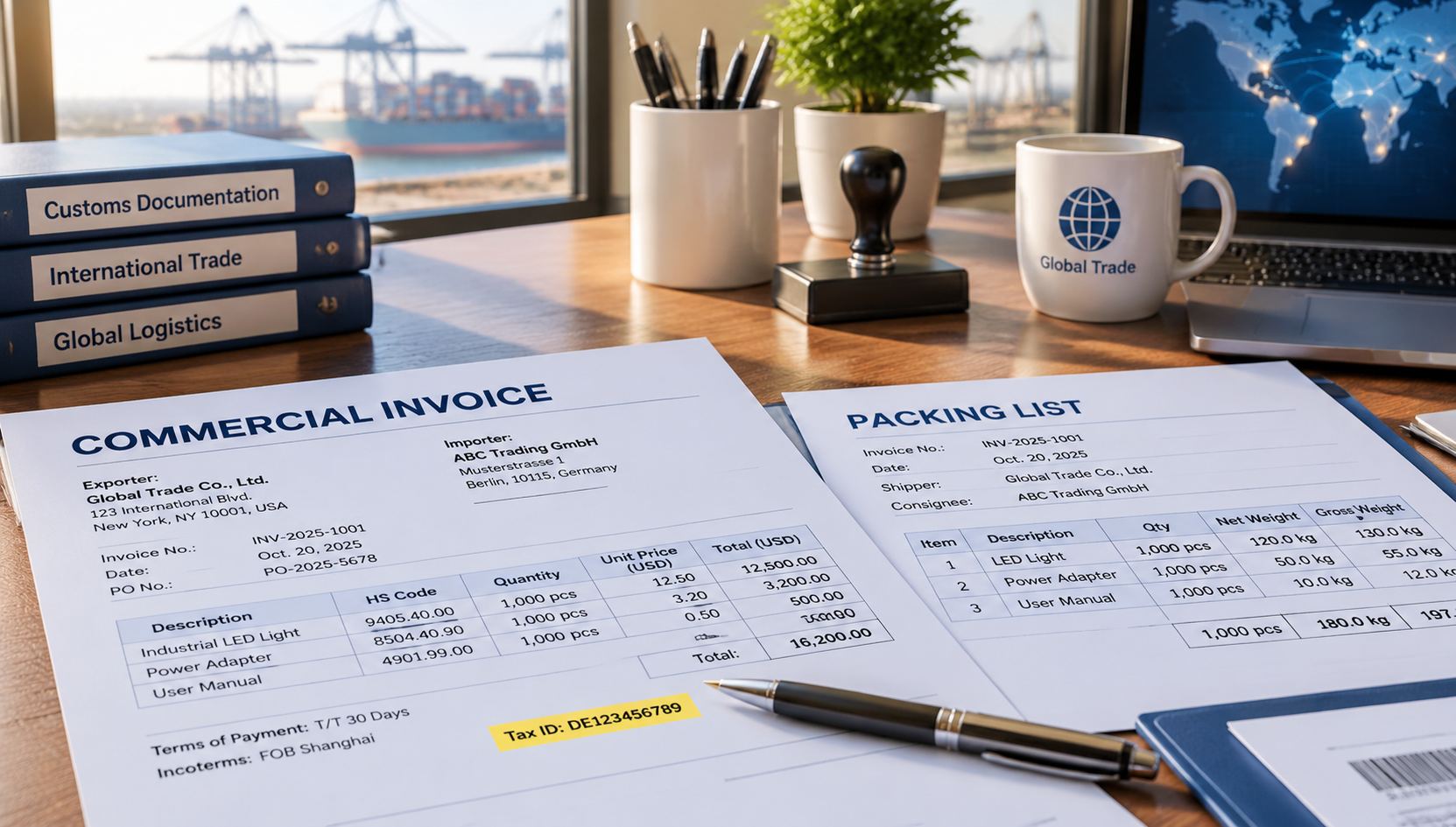
The VAT ID shown in shipping and customs documents should correspond to the legal entity whose VAT registration is relevant to the transaction. That entity may be the buyer, importer of record, seller, or another VAT-registered party, depending on the transaction and applicable rules. The commercial invoice, packing list, transport document, and customs declaration do not necessarily need to show the same legal entity in every party field. What matters is that each party is accurately identified according to its actual role.
| Party | Action | Boundary |
|---|---|---|
| Exporter or shipper | Supplies party, invoice, and shipment data | Does not determine the importer’s tax liability |
| Importer of record | Confirms registration details and authorizes the broker | Remains responsible for the accuracy of its tax position |
| Customs broker | Reviews declaration data and files or coordinates the entry | Liability depends on the representation arrangement and applicable law |
| Carrier or forwarder | Transmits shipment data and may verify identifiers at handoff | Does not substitute for importer or broker review |
Direct and indirect customs representation determine how a representative acts on behalf of an importer. Under Article 77(3) of the EU Union Customs Code, an indirect customs representative may be jointly liable for the customs debt, including applicable customs duties. However, customs debt and import VAT are not legally identical. In Case C-714/20, the Court of Justice of the European Union clarified that Article 77(3) alone does not make an indirect representative liable for import VAT; such liability may arise where the relevant Member State has explicitly designated the representative as liable for import VAT under national law. Confirm the representation arrangement and applicable national rules before assuming who is responsible for import VAT.
The commercial invoice should clearly identify the seller and buyer and include any additional importer or tax details required by the applicable rules. The packing list and transport document should accurately identify the parties responsible for shipment and delivery. Where the consignee is different from the importer, make that distinction clear in the shipping instructions and broker authorization. For ecommerce shipments routed to a fulfillment center, confirm the seller account, importer of record, and warehouse receiving entity as separate roles; an Amazon FBA delivery scope does not by itself establish who holds the import VAT position.
Field note: A VAT ID can be correctly formatted and still fail at entry if the associated legal name or address does not match the party record used in the declaration. Check the number and the entity identity together, not the number alone.
Product information supports customs classification and the assessment of applicable duties, VAT rates, exemptions, and import restrictions. However, product classification alone does not establish whether a business must register for VAT. Registration requirements depend on the transaction, the parties involved, the place of taxation, and the destination jurisdiction’s rules. The shipper should provide an accurate commodity description, quantity, declared value, and other required product data so the broker can prepare the entry and compare the invoice with the packing list.
How to verify a VAT ID
The correct verification method depends on the country that issued the number. There is no single international database that verifies every country’s VAT registration. Checking the number’s structure alone cannot confirm that the business is actively registered or that the number is suitable for a particular transaction.
Confirm the issuing country and number format
Ask the importer to provide its VAT ID and identify the country that issued it. Compare the number with the official format published by the relevant tax authority. Do not assume that all countries use the same prefix, number length, or character structure.
Use the official verification service for the issuing jurisdiction
For VAT numbers used in qualifying cross-border transactions within the European Union, the European Commission’s VAT Information Exchange System (VIES) can check whether a business is registered for intra-EU trade. VIES is a search tool rather than a standalone VAT registration database; when a number is submitted, the system retrieves information from the relevant national VAT database. A valid result indicates that the VAT registration information exists in the relevant national system and that the number is recognized for intra-EU transactions.
A valid result does not confirm that a business has paid all its taxes, has no outstanding tax liabilities, or is authorized to act as the importer for a particular shipment. An invalid result does not always mean that a business has never registered for VAT. The number may not yet be activated for intra-EU transactions, the registration may still be under review, or the national database may not have been updated. If the result is invalid or unavailable, check the number again and ask the business to contact its national tax authority for confirmation. For VAT numbers issued outside the EU, use the relevant national tax authority’s official registration or verification service.
Check the registered entity details and retain the record
Where available, compare the registered entity information with the importer’s legal name and address. A valid number should not automatically be treated as proof that the correct business entity has been identified for the shipment. Keep the verification date, result, VAT ID supplied by the importer, and any written confirmation received from the broker or tax authority. This record helps demonstrate that the VAT number was checked at the time of the transaction. A VAT ID check is not a customs clearance approval or a determination of the importer’s tax liability.
How to get a VAT ID
To obtain a VAT ID, a business generally registers with the tax authority in the country where it has a VAT registration obligation. The process and required documents vary by jurisdiction. A VAT ID is issued by the relevant tax authority, not automatically generated by a freight forwarder, carrier, or customs broker. A third-party adviser may assist with an application, but the registration must follow the issuing jurisdiction’s rules.
Determine where registration is required
Identify the countries where the business makes taxable supplies, stores inventory, or conducts other activities that trigger registration obligations. Confirm the place of taxation and whether a simplified scheme applies.
Prepare the business information
Commonly requested information may include the legal name, registered address, business registration details, ownership information, and a description of business activities. Some authorities ask for details of taxable supplies, expected transactions, local operations, inventory storage, or a local tax representative. Businesses established outside the country may be asked to provide additional documents or appoint a fiscal representative, depending on local VAT legislation.
Submit the application and respond to queries
Apply through the relevant national tax authority or its authorized process. Some jurisdictions require additional forms or supporting documents, and the authority may request clarification before completing the review. Check the official tax authority’s document requirements before submitting; do not assume the requirements are identical across countries.
Receive, verify, and retain the number
After the application is reviewed, the tax authority issues the VAT identification number under its procedures. Check the issued number through the appropriate official verification service and retain the registration confirmation for invoicing, tax reporting, and relevant business transactions.
VAT ID preparation workflow
The sequence below organizes the VAT and customs identifier check around the documents and handoffs that exist in a typical cross-border movement. It is a preparation sequence, not a promise of clearance or tax treatment.
Identify the importer of record and the VAT-registered entity
Confirm which legal entity holds the import position and which entity’s VAT registration the transaction relies on.
Confirm the required tax and customs identifiers
Obtain the VAT ID and any customs identifier the destination requires, then check the issuing jurisdiction, format, and registration status.
Verify the number through the official route
Use the issuing country’s official verification service and keep the result with the party details supplied by the importer.
Align each document to the party role
Compare seller, buyer, consignee, importer, and delivery location across the invoice, packing list, transport document, and broker instructions.
Give the broker written authorization
State the legal entity, VAT ID, customs identifier, and representation arrangement instead of relying on a prior shipment’s data.
Retain the verification and handoff record
Keep the verification result, importer confirmation, and document set that shows which entity and number were used.
How an incorrect VAT ID can affect cross-border shipping
An incorrect or unverified VAT ID can delay customs preparation when the importer’s identity or tax registration details cannot be reconciled with the shipment documents. The declaration may stall, the broker may issue a correction request, and the importer may have to re-confirm its registration while the cargo waits. Depending on the shipment and service terms, storage, demurrage, rebooking, or return costs may arise.

When a quote is presented as DDP shipping, confirm who is importer of record, which VAT ID and customs identifiers support the declaration, and whether the quoted delivery scope includes destination tax handling. Do not treat a service that excludes duties and taxes as DDP. A delivery scope that includes warehouse acceptance or final-mile handoff does not by itself change the importer or VAT identity. Confirm the VAT-registered entity, importer of record, required customs identifiers, and broker instructions before the goods are dispatched.
Common VAT ID mistakes and prevention
The most common VAT ID failure is not an invalid number in isolation. It is a valid number attached to the wrong party. A consignee may be a warehouse operator while the importer of record is a separate selling entity. A marketplace may collect VAT on certain consumer sales, but the seller may still need a local registration where inventory is stored. When those roles are not separated, the invoice and the declaration point to different parties.
Common mistake: Using the consignee’s VAT ID because the consignee receives the cargo, without confirming that the consignee is also the importer of record. The number may be valid, but the declaration may not match the tax position or the broker authorization.
Late review is another recurring trigger. A shipper that receives the VAT ID after the invoice is finalized and the transport document is issued has fewer options to correct the data set without reissuing documents. Missing product or transaction data can also surface as an identifier problem when the broker cannot match the commodity to the importer’s registration. Prevention is consistent: settle the importer identity, the VAT ID, the customs identifier, and the document roles before the shipment is tendered.
Disclosure: This page provides general logistics and customs-preparation information and may mention freight services available through this website. Actual requirements, authority decisions, duties, taxes, document obligations, service scope, and delivery conditions depend on the shipment, jurisdiction, commodity, transaction, and current rules. Confirm current requirements before booking or filing.
Preparation decision and coordination
Four preparation rules apply before a broker reviews the shipment. First, identify the importer of record and the VAT-registered entity before drafting the invoice. Second, obtain written confirmation of the VAT ID and any required customs identifier from the responsible party. Third, verify the number through the issuing country’s official route and keep the result. Fourth, give the broker written authorization naming the legal entity, identifiers, and representation arrangement. The practical default is to use the importer’s VAT ID where the transaction requires it, not the consignee’s number automatically. The changing fact is that roles, registration obligations, and identifier requirements vary by jurisdiction and transaction.
Illustrative example (not a customer case): A seller invoices goods to a buyer, while the buyer appoints a separate fulfillment company to receive the shipment at its warehouse. The buyer is identified as importer of record and provides the relevant VAT and customs registration details. The invoice identifies the seller and buyer, while the transport document identifies the fulfillment company as the delivery party. The warehouse’s receiving authority is documented separately from the importer’s tax identity. Before shipment, the broker confirms that the declaration uses the correct importer and identifiers, and the carrier confirms the warehouse delivery instructions. The preparation objective is to identify each legal entity and role correctly, not to force every document to name the same party.
Key Takeaways
A VAT ID identifies a business’s VAT registration; it is not a customs identifier or a clearance approval.
Confirm the importer of record separately from the buyer, consignee, and warehouse receiving party.
Keep VAT and customs identifiers distinct, and check the required set for the destination and transaction.
Verify the number through the issuing country’s official route and compare the result with the legal entity identity.
Give the broker written instructions before filing and retain the verification and handoff record.
FAQ
What is a VAT ID?
A VAT ID is a unique number issued by a tax authority to identify a business or legal entity registered for Value Added Tax. It supports VAT identification, invoicing, and reporting. The format, prefix, and registration requirements depend on the issuing jurisdiction, so a number valid in one country may not follow another country’s rules.
Is a VAT code the same as a VAT ID?
In most contexts, a VAT code refers to the same registration identifier as a VAT ID or VAT number. The wording may vary by form, portal, or country. What matters is that the number belongs to the correct legal entity and is verified through the issuing tax authority’s official service.
Is a VAT ID the same as an EORI number?
No. A VAT ID identifies a party’s VAT registration, while an EORI number identifies an economic operator for customs operations in the applicable customs territory. A business involved in cross-border imports may need both identifiers depending on its role and the entry procedure. Confirm the required set with the importer or broker.
How can I check whether a VAT ID is valid?
Use the official tax authority verification service for the country that issued the number. For eligible EU cross-border transactions, VIES can check whether a business is registered for intra-EU trade. Keep the verification result and ask the importer to confirm with the national tax authority if the result is invalid or unclear.
Do all countries use the same VAT ID format?
No. VAT ID formats vary by country and may use different country prefixes, letters, and number lengths. Always check the official format published by the issuing tax authority instead of assuming that a number valid in one country follows the requirements of another. A format check alone does not confirm active registration.
Does every cross-border shipment need a VAT ID?
No. Whether a VAT registration is required and whether a VAT ID must appear on a particular document depend on the destination jurisdiction, the transaction, the parties involved, and applicable tax rules. Customs identification requirements should be checked separately from VAT registration requirements.
Can a consignee use its VAT ID when another entity is the importer?
A consignee’s VAT ID should not be used automatically just because it receives the cargo. Confirm which entity is registered for VAT, which party acts as importer of record, and which identifier the transaction and declaration require. If a warehouse or fulfillment company only receives the shipment, document its delivery role separately from the importer’s tax identity.
How do I get a VAT ID?
A business generally registers with the tax authority in the country where it has a VAT obligation. The process varies by jurisdiction and may require legal name, address, business registration details, and activity information. The tax authority issues the number after review; a forwarder, carrier, or broker does not issue it.
Disclaimer: This page is general operational guidance, not legal, customs, tax, insurance, product-safety, regulatory, classification, or licensing advice. Requirements, authority decisions, responsibilities, charges, and deadlines depend on the controlling documents, product, jurisdiction, transaction, service terms, and current official guidance. Confirm current shipment requirements with the relevant authority, licensed broker, carrier, or qualified adviser.