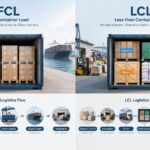

The quote decision behind a shared container
Buyers who compare LCL shipping from China usually hold two or three quotes and one question: which of them can move this cargo to the required delivery point, and what is still missing before approval? Consolidation makes that question harder. A less-than-container-load shipment shares a container with other shippers’ cargo, and each forwarder may price a different part of the move. One quote may end at the origin port, another may include supplier pickup, and a third may leave destination handling for the consignee to arrange. Until the cargo data, route, handoffs, service level, and included work match across the freight quotes, the totals describe different shipments. The sections below show how to align that scope first, which charge bases move the price, how transit time builds up, and which facts to confirm in writing before approving a booking.
Align the scope before you compare LCL quotes
A forwarding desk checks quote fields in a fixed order, because each field limits the next. The cargo-ready date comes first, since it decides which consolidation cutoff the cargo can meet. Pickup, commercial responsibilities, route, cargo basis, destination handoff, and quote date follow in the order shown below. Consolidated cargo normally passes through a container freight station (CFS), the warehouse where the forwarder receives, checks, and loads it.
| Field | What to state | Why it matters | Who confirms |
|---|---|---|---|
| Cargo-ready date | Date cartons are packed and released | Sets the consolidation cutoff | Supplier |
| Pickup and origin handling | Pickup address, contact, loading hours, or CFS delivery | Decides trucking and receiving lines | Supplier and forwarder |
| Commercial responsibilities | Named trade term and place, export clearance, importer of record, duties and taxes | Shows which party arranges and pays each handoff | Buyer and supplier |
| Route and service level | Ports, sailing type, transshipment tolerance | Changes schedule and cutoff exposure | Buyer and forwarder |
| Cargo and weight basis | Cartons, packed dimensions, gross weight | Sets the chargeable measure | Shipper and forwarder |
| Destination handoff and delivery | CFS or port release, customs entry, address, appointment | Separates destination work from freight | Consignee and broker |
| Quote date and inclusions | Validity condition, included lines, exclusions | Shows what needs a revision | Forwarder |
Put each field in the written quote request, and have the forwarder repeat it on the quotation. A quote that omits a field still assumes an answer, and a competing forwarder may have assumed a different one. A named trade term and place, such as EXW at the supplier’s address or FOB at an agreed port, tells the forwarder which origin lines to quote and which the supplier arranges. Ask for the validity condition too: how long the quote holds and which changes require a revision.
How consolidation changes the charge basis
An LCL freight line usually rests on a weight-or-measure (W/M) basis instead of a container rate. The forwarder compares the cargo’s measured volume in cubic meters (CBM) with its gross weight converted at the ratio stated on the quote, then charges on the larger figure, subject to the tariff’s minimum charge and rounding method. In variable form: chargeable measure = the larger of measured volume or gross weight divided by the quote’s conversion ratio.

Illustrative calculation only, not a quote or a standard ratio: assume a conversion ratio of 1,000 kg per CBM.
Shipment A. 2.4 CBM and 1,600 kg. The weight equals 1.6 CBM, so the chargeable measure is 2.4 CBM.
Shipment B. 1.2 CBM and 1,800 kg. The weight equals 1.8 CBM, so the chargeable measure is 1.8 CBM.
Dense cargo therefore prices on weight, and bulky cargo on volume. Two forwarders can quote the same per-CBM figure and still produce different totals when their ratios, rounding methods, minimum charges, or handling lines differ, so ask whether the per-CBM figure includes CFS handling or whether handling appears as its own line.
Other cost drivers follow the handoff each one affects. Origin handling changes with the pickup location, loading access, and whether the supplier delivers to the CFS or the forwarder collects. The sailing type changes the schedule, because direct and transshipment routings can carry different cutoffs. Cargo with batteries, liquids, magnets, or oversized pieces may need extra documents, special packing, or another service.
The main leg is ocean freight, so the booking choice shapes every downstream date. Buyers who want to test consolidation against a full-container booking can review the sea freight service and request both options on the same cargo-ready date.
Packing lists can show carton dimensions before palletizing or outer wrap is added. Get the final packed dimensions and weight from the supplier, because the receiving warehouse may measure the cargo as it arrives, and a gap between the two figures can change the chargeable measure.
How long does LCL shipping from China take?
LCL transit time covers more than the ocean voyage between two ports. Before the voyage, cargo must reach the origin CFS and meet the consolidation cutoff. After the vessel arrives, the container must be unloaded, the cargo separated from other shippers’ freight, and the shipment released for delivery. Each stage adds time, and each one belongs to a different handoff.

Pickup and CFS receiving. Time to collect the cargo or have the supplier deliver it, plus receiving and document checks.
Consolidation. Time between receiving and the sailing cutoff, until the shared container is loaded and dispatched.
Ocean transit. Voyage time from departure to arrival, including any transshipment the route requires.
Destination deconsolidation. Time to unload the container, separate each shipment, and make the cargo available at the destination CFS.
Customs release and delivery. Time for import clearance, cargo release, local transport, and any delivery appointment.
Ask the forwarder what the stated transit time covers: port to port, CFS to CFS, or the complete door-to-door move. A vessel arrival date does not mean your cargo is ready for collection. Request the estimated origin cutoff, sailing date, destination arrival, CFS availability, and delivery date, then note which stage each date closes. Transit estimates belong to a specific route and sailing, so treat any figure without a stated start and end point as incomplete.
What each quote line includes and who confirms it
A quote line helps only when the buyer knows which handoff it covers and who can verify it. Mark each line below as included, excluded, or unconfirmed before approving the quote.
Pickup and origin handling. Confirm whether the quote covers supplier trucking, CFS receiving, and export-side coordination. The supplier confirms readiness, and the forwarder confirms the lines.
Main ocean leg. Confirm the ports, the sailing type, and the charge basis. The forwarder states the assumptions and the validity condition.
Destination handling. Confirm what the quote includes after vessel arrival. The destination agent or consignee confirms what applies.
Customs entry coordination. Confirm who files the entry, who supplies the commercial invoice and packing list, and who pays duties and taxes. The buyer and the customs broker confirm these points.
Final delivery. Confirm the address type, appointment requirement, and access limits the quote assumes. The consignee confirms the receiving conditions.
Accessorials and storage. Confirm which extras, such as redelivery or storage, the quote excludes and what triggers them. The forwarder names each trigger.
An ocean freight rate does not necessarily cover every service required after vessel arrival. Depending on the destination and service scope, destination charges can include CFS deconsolidation, warehouse handling, documentation, cargo release, and local delivery, while customs clearance, duties and taxes, inspections, and storage may sit outside the quoted total. Ask the forwarder which items are included, which are excluded, and which depend on actual destination charges.
Buyers who want one party to coordinate the move from supplier pickup through final delivery can request a door-to-door service. The label alone does not settle scope, so ask which lines sit behind it, who handles each handoff, and what the consignee must still arrange.
Destination entry deserves its own question, because release at destination depends on the filing being handled. A customs brokerage service can coordinate the entry, but the buyer still supplies accurate documents and confirms whether duties and taxes are quoted or billed separately.
A buyer who wants delivery, clearance, and the payment of duties and taxes inside one quoted scope can ask about DDP shipping. It fits when one party should arrange destination clearance, and it fits poorly when the buyer already uses its own customs broker or must pay duties from its own account. A DDP quote should state the customs value and classification it assumes, who supplies the documents, and what the forwarder re-quotes if those facts change.
Note: A freight quote is tied to the cargo, handoffs, route, service level, timing, and destination work stated in it. Carrier and handling conditions can change. Align the scope first, then request confirmation for the specific shipment.
Options that fit the shipment
Compare an alternative only when it changes cost, handoffs, or delivery control for this cargo, and ask each forwarder to quote the same cargo, cargo-ready date, and delivery point.
Full container load (FCL) is the first comparison, and no universal volume threshold makes it automatically cheaper. LCL suits shipments that do not fill a container and can wait for CFS receiving and consolidation. As volume grows, per-CBM freight and handling lines can add up, while a full container is priced on a different basis, so the break-even point depends on the route, container availability, destination handling, and local charges. Request LCL and FCL quotes with the same cargo-ready date, pickup location, route, customs scope, and delivery point, then compare total scope and schedule instead of the ocean freight line alone.
Air freight suits cargo where the delivery date matters more than the freight line, such as urgent replenishment or high-value goods, and it is a weaker fit for heavy or bulky cargo. Air pricing follows chargeable weight, so ask how the forwarder measures the cartons, and review the air freight service alongside the ocean quote.
Express shipping works for small, urgent parcels that move on a courier’s terms. The mismatch shows up when the shipment has many cartons or heavy pieces, because parcel limits may no longer apply. Review the express shipping service for piece, weight, and size limits, and ask who handles import clearance.
Rail freight can serve cargo that starts in inland China and ships to a destination reached by a rail corridor, but it becomes a weak fit when either end lacks rail access or the cargo is too small to consolidate on the lane. Ask whether the rail freight service accepts consolidated cargo from your origin. Multi-modal freight, such as an ocean leg followed by rail or truck, fits destinations inland from the discharge port. Request it as a single scope from a multi-modal freight service, so each transfer appears as its own line and the quote states who owns each handoff.
Where consolidated quotes go wrong and what can grow
Quote gaps often trace to a missing fact rather than a wrong rate. An incomplete pickup address leaves the trucking line unsupported, and a moved cargo-ready date can push cargo past the consolidation cutoff. A packing list that disagrees with the measured cargo can change the chargeable measure and may require a document correction before release. A quote that omits destination handling leaves that work without an owner.
A common mistake is comparing totals that end at different points. A quote that stops at the destination port and one that ends at the consignee’s dock are different offers, and the missing destination work can reappear as a separate line after the cargo sails.
Delivery access needs its own check. Consolidated cargo normally reaches a destination warehouse before final delivery, so the quote should say whether the consignee has a dock, whether a lift-equipped truck is needed, and who books the appointment. Marketplace fulfillment centers set their own labeling and appointment rules, so a quote for Amazon FBA delivery should state who prepares the labels and who books the receiving slot. A missed appointment can lead to redelivery or storage, so ask how the quote handles each.
Unusual size or weight calls for an early decision. Oversized, heavy, or irregular pieces may not qualify for consolidation, and a quote built for cartons can fail when the pieces differ from the description. If the shipment includes such pieces, ask whether project cargo shipping fits better than a consolidated service before approving any quote.
Shared containers also add handling points. Cargo passes through the CFS, loads with other shippers’ freight, and unloads again at destination before delivery. Carrier liability can be limited and may not match the invoice value, so ask whether cargo insurance is quoted as a separate line, what loss or damage it covers, and who files a claim.
Risk alert: If the cargo is not ready before the consolidation cutoff, it may roll to a later sailing, and the quoted schedule and handling lines may need to be re-confirmed.
Inputs to send with your quote request
Send the same checklist to every forwarder, grouped by the party who supplies each item, so the returned quotes describe one scope.
Cargo information
Product description, carton or pallet count, packed volume in CBM, gross weight in kg, package dimensions, and handling needs. The shipper and supplier provide these, and the desk checks them against the packing list.
Origin information
Supplier city and pickup address, cargo-ready date, preferred origin port or CFS, named trade term and place, and export clearance responsibility. The supplier and buyer confirm them, and the desk verifies truck and cutoff availability.
Destination information
Destination port or CFS, delivery address, customs broker or importer of record, appointment rules, and whether duties and taxes belong in the quote. The consignee and buyer provide these so the desk can scope the destination lines.
Service requirements
Preferred sailing, transshipment tolerance, the service end point (port to port, CFS to CFS, or door to door), and the quote validity you need. The buyer decides, and the forwarder states what each choice assumes.
Special handling
Batteries, liquids, magnets, fragile goods, or stacking limits. The shipper discloses them early, and the forwarder confirms whether the consolidation service accepts the cargo and what extra documents or packing it needs.
Quote format
A charge breakdown covering pickup, origin handling, ocean freight, destination handling, customs coordination, and final delivery. The forwarder returns it, and any unknown line stays marked pending instead of assumed included.
For cargo from more than one supplier, ask whether each supplier can deliver to one nominated CFS and how the forwarder will track each supplier’s packing information and receiving confirmation, because the total chargeable measure can be checked only after every carton arrives. Once the inputs are ready, send an inquiry with all of them together so the forwarding desk can review one complete scope.
Where to start and what changes the recommendation
Start with an LCL quote that runs from supplier pickup through the destination handoff you can actually receive, with every line listed and every exclusion stated. That scope exposes the pickup, CFS, destination, and delivery work that a headline freight figure can omit. Three facts change the recommendation: a cargo volume near container size points toward an FCL comparison, a tight cargo-ready date points toward air or express, and special handling needs may point toward a different service altogether.
Illustrative example (not a customer case): A buyer holds two quotes for the same cartons. Forwarder A lists supplier pickup, origin CFS handling, the ocean leg, destination CFS handling, and final delivery, and it excludes customs clearance. Forwarder B lists origin CFS handling and the ocean leg, excludes pickup and final delivery, and leaves destination CFS handling unconfirmed. Both quotes cover the same ocean shipment, but they do not describe the same end-to-end service. The buyer asks Forwarder B to mark each missing line as included or excluded before comparing totals.
Key Takeaways
Scope first. Align cargo-ready date, pickup, commercial responsibilities, route, destination handoff, and included work before you compare any two LCL quotes.
Charge basis. Ask for the conversion ratio, minimum charge, rounding method, and handling lines behind every per-CBM figure.
Transit scope. Ask whether a stated transit time covers port to port, CFS to CFS, or the complete door-to-door move.
Line ownership. Mark every quote line as included, excluded, or unconfirmed, and name the party who verifies it.
Risk triggers. A missed cutoff, mismatched packing data, or a delivery access gap is a reason to request a revised quote.
Quote preparation. Send cargo, origin, destination, service, and handling inputs together so one scope drives every quote.
FAQ
How do I request LCL shipping from China quotes that I can compare?
Send every forwarder the same cargo details, cargo-ready date, pickup address, destination port, and delivery point. Ask each one to list pickup, origin handling, the ocean leg, destination handling, and delivery as included, excluded, or unconfirmed. Identical inputs produce quotes that describe the same move, so differences between them point to real scope gaps instead of missing information.
What does consolidation mean for my shipment?
Consolidation means the forwarder combines your cartons or pallets with other shippers’ cargo in one container. Your cargo goes to a container freight station, where it is received, checked, and loaded, then unloaded at a destination station before delivery. This extra handling adds steps that a full-container shipment may not have, so ask the forwarder to describe each station and who runs it.
How much does an LCL shipment cost?
The total depends on the chargeable measure, the route, origin and destination handling, and the service end point the quote covers. Pickup, customs clearance, destination CFS handling, and final delivery may be priced separately. Send each forwarder the same cargo data and delivery requirements, then ask for a breakdown that marks every line as included or excluded.
How long does an LCL shipment take from pickup to delivery?
The timeline includes supplier pickup, CFS receiving, consolidation, ocean transit, destination deconsolidation, customs release, and final delivery. The exact span depends on the sailing, any transshipment, warehouse cutoffs, and destination handling. Ask the forwarder to separate port-to-port transit from the estimated door-to-door delivery, and to say which stages the stated time covers.
Is there a minimum charge for LCL shipments?
Many LCL services apply a minimum chargeable measure or freight amount, even when the actual shipment is smaller. The minimum depends on the forwarder, route, and tariff, so ask to see it stated on the quote. Ask whether the minimum is stated in CBM, how the chargeable measure is rounded, and whether destination handling carries its own minimum.
Does an LCL quote include destination CFS handling?
Not necessarily. Some quotes include destination CFS handling and cargo release, while others cover only the ocean leg or charges up to the destination port. Ask whether deconsolidation, warehouse handling, documentation, cargo release, customs clearance, and final delivery are included or billed separately, and who confirms each one.
Who confirms whether my cargo can ship in a consolidated container?
The forwarder confirms acceptance, but it needs accurate information from the shipper first. Share the product description, materials, and any battery, liquid, or magnet content early. The forwarder then checks whether the consolidation service accepts the cargo and what documents or packing it requires. Restricted or unusual cargo may need a different service, so raise it before any booking.
Why do two LCL quotes for the same cargo differ?
Differences often come from scope. One quote may start at the supplier’s door while another starts at the CFS, and one may include destination handling while another stops at the port. The conversion ratio, minimum charge, sailing type, and validity condition can also differ. Compare the stated assumptions line by line before you compare the totals.
Disclaimer: This page is general quote-planning guidance, not a binding quotation or delivery commitment. Actual charges and handoffs depend on the cargo, route, timing, provider confirmation, and destination conditions. Where duties, customs, tax, insurance, or contract questions apply, confirm them with the relevant party before booking.