

Less Than Container Load (LCL) is a sea-freight method for shipments that do not require a full container. Instead of reserving an entire container, the cargo shares container space with shipments from other exporters. The practical consequence is that the shipment passes through consolidation and deconsolidation points before it reaches the final destination. Those extra handling stages make accurate cargo information, packaging, documentation, and delivery instructions especially important.
For a shipper, the key question is not simply whether the cargo is smaller than a container. The decision depends on the shipment’s volume, packaging, handling characteristics, origin and destination, required delivery arrangement, and the available consolidation service. Before booking, confirm the cargo dimensions and weight, pickup and delivery locations, commodity details, documentation requirements, and whether the proposed LCL service covers the required origin and destination points.
How LCL Cargo Moves Through the Supply Chain
LCL works by combining compatible shipments into a shared container and separating them again after the ocean movement. The exact handoff points vary by service, but the underlying sequence follows the same operational logic: cargo is prepared, collected or delivered to a consolidation facility, grouped with other shipments, loaded into a container, transported by sea, unloaded at the destination consolidation facility, separated, cleared as required, and delivered onward.
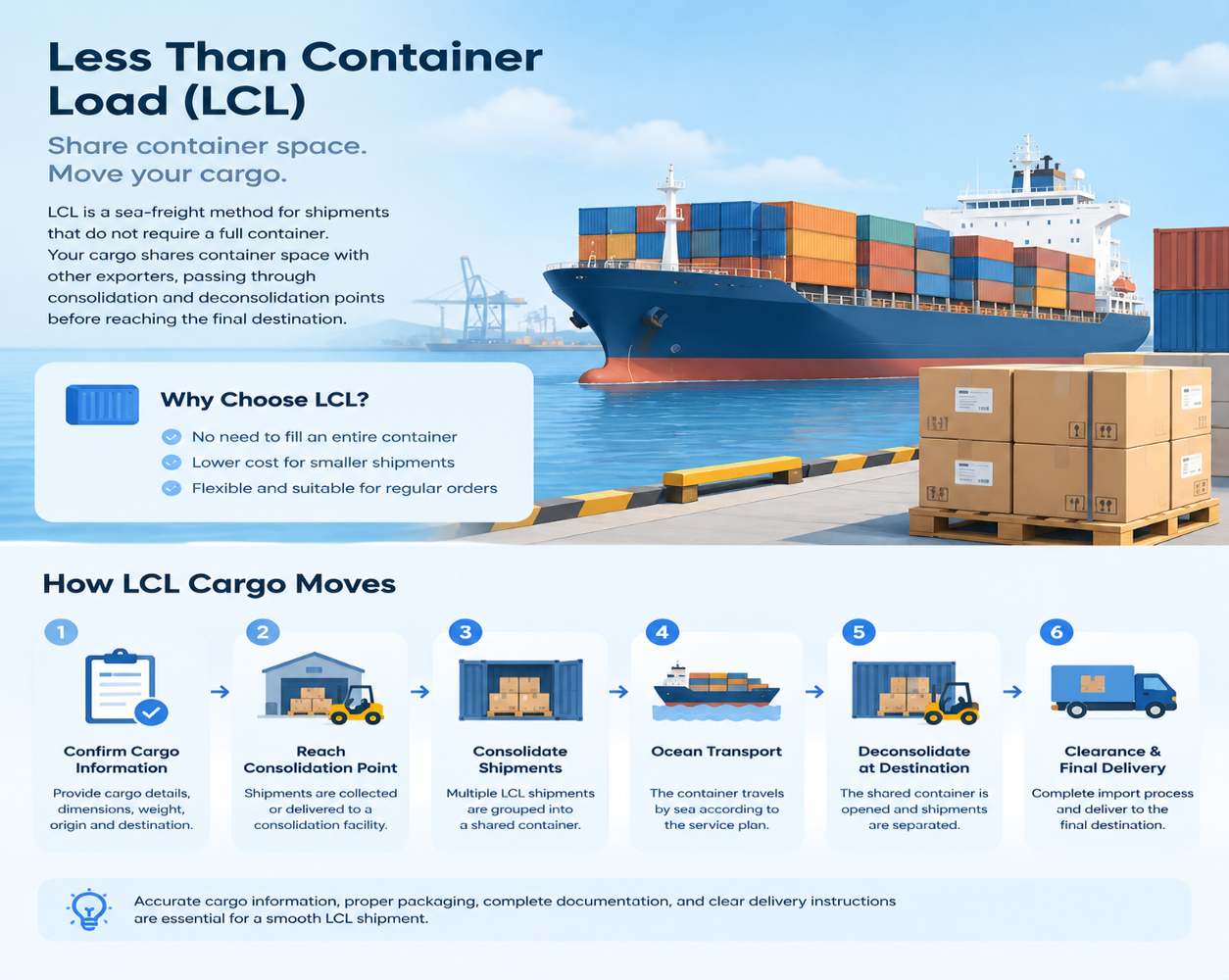
Cargo information is confirmed
The shipper provides the cargo description, packages, dimensions, gross weight, pickup or receiving details, and destination information. These inputs allow the logistics provider to determine whether the shipment is suitable for the planned service and how it should be handled.
Cargo reaches the consolidation point
The shipment is either collected from the shipper or delivered to a designated consolidation facility. Packaging should be suitable for warehouse handling because the cargo may be moved alongside other customers’ freight.
Shipments are consolidated
The consolidation operator combines multiple LCL shipments into a container according to the service plan and cargo-handling requirements. Proper package identification helps the operator distinguish each shipment during loading and later separation.
The consolidated container moves by sea
The shared container enters the ocean-freight network. Transit timing depends on the route, sailing schedule, transshipment arrangements, port operations, and other service conditions that should be confirmed for the specific shipment.
Cargo is deconsolidated
At the destination side, the shared container is opened at a destination facility and the individual shipments are separated. This stage creates another important handling point before final delivery.
Customs and onward delivery are completed
The shipment follows the applicable import process and then moves to its final delivery point when the required conditions are satisfied. The exact responsibility for customs clearance, local handling, and delivery depends on the booked service and transaction arrangement.
For broader ocean-freight planning, sea freight services provide the underlying transport mode, while the LCL arrangement determines how cargo is consolidated and handled within that network.
What LCL Changes for the Shipper
The main difference between LCL and a dedicated container movement is control over the container itself. With a full-container shipment, one shipper generally plans the container around its own cargo. With LCL, the container is shared, so the shipper also depends on consolidation, warehouse handling, and deconsolidation operations.
The main operational consequence is that the shipment passes through more than one physical handling environment before final delivery. That makes cargo preparation, identification, and service-scope confirmation particularly important.

| Area | LCL consideration | What to confirm |
|---|---|---|
| Cargo space | Container space is shared | Chargeable shipment inputs |
| Handling | More consolidation stages | Packaging and handling needs |
| Documentation | Shipment details must remain identifiable | Required shipping documents |
| Delivery | Destination deconsolidation may precede delivery | Final delivery scope |
| Scheduling | Depends on consolidation and sailing plans | Current routing and cutoff |
This structure can make LCL useful when the shipment does not justify dedicated container space, but the additional handling means the shipper should evaluate more than ocean transit alone.
When LCL Is a Good Fit
LCL generally fits shipments that need ocean transport but do not use enough cargo space to make a dedicated container the preferred option. It can also suit businesses that ship smaller quantities on a recurring basis and want to move cargo without waiting until they can fill a container.
Smaller shipments: LCL can accommodate cargo that does not occupy a practical share of a full container.
Regular replenishment: Businesses can move smaller batches when inventory requirements do not justify a full-container shipment.
Flexible shipment planning: The shipper can evaluate shared-container transport instead of reserving an entire container for a relatively small load.
LCL becomes a weaker fit when the cargo is unusually fragile, difficult to stack, oversized for the intended consolidation process, highly sensitive to handling, or large enough that a dedicated container provides a more appropriate operational solution. Those conditions should be evaluated with the logistics provider before booking rather than inferred from volume alone.
LCL Trade-Offs and Alternatives
The central LCL trade-off is shared capacity versus additional handling. A smaller shipment may not need an entire container, but the cargo usually enters a consolidation network where warehouse handling and separation are part of the movement.
A full-container option may become more attractive when the shipment volume is substantial, the cargo benefits from dedicated container handling, or the shipper places greater value on controlling the container loading process. Air freight or express shipping may be considered when delivery requirements are more time-sensitive, although the appropriate alternative depends on cargo characteristics, route, cost objectives, and service availability.
The fairest comparison should use the same origin, destination, cargo description, package count, dimensions, gross weight, delivery scope, and required timing. Comparing an LCL ocean quote with a different service scope can produce a misleading conclusion even when the headline price appears lower.
Information to Confirm Before Booking
LCL planning depends heavily on accurate shipment inputs because the cargo must be handled and identified within a shared logistics flow. The shipper should provide information that allows the service provider to evaluate the cargo and prepare the shipment correctly.
| Input | Purpose | Responsible party |
|---|---|---|
| Package dimensions | Space and handling assessment | Shipper |
| Gross weight | Shipment planning and documentation | Shipper |
| Commodity description | Handling and compliance review | Shipper |
| Origin and destination | Routing and service coverage | Both parties |
| Delivery requirements | Defines the final service scope | Shipper |
The shipper should also confirm packaging suitability, cargo markings, required documents, applicable customs procedures, cargo restrictions, warehouse receiving requirements, and the current cutoff or routing information with the provider handling the shipment. The exact requirements can vary by commodity, route, facility, and service arrangement.
Common LCL Mistakes and Operator Checks
Common mistake: Providing only the total shipment weight while leaving out package dimensions. LCL planning depends on the physical characteristics of the cargo, so incomplete dimensions can lead to an inaccurate assessment of space, handling, or service suitability. Provide package-level dimensions and weights when requested, and confirm how the provider will assess the shipment.
Operator check: Treat packaging as part of the transport plan, not merely as a warehouse concern. Shared-container cargo can pass through consolidation and deconsolidation facilities, so cartons, crates, pallets, labels, and markings should be suitable for repeated handling and easy identification.
Another frequent planning error is comparing a basic port-to-port LCL movement with a service that includes pickup, customs handling, destination handling, and final delivery. Before comparing quotations, identify exactly which stages each option includes and which party is responsible for the remaining handoffs.
Disclosure: This guide provides general logistics information and may refer to services relevant to the topic. Carrier terms, customs requirements, fees, service coverage, and operating conditions can change. Confirm current requirements and responsibilities before acting.
Key Takeaways
LCL allows smaller shipments to move by sea without requiring the shipper to use an entire container.
The shipment normally passes through consolidation and deconsolidation stages, creating additional handling points.
Accurate dimensions, weight, commodity information, packaging, and delivery details are essential before booking.
LCL is not automatically the best option for every small shipment; cargo characteristics and the complete service scope also matter.
Compare alternatives using the same origin, destination, cargo data, delivery scope, and timing requirements.
LCL Cargo FAQ
What does Less Than Container Load mean?
Less Than Container Load, commonly abbreviated as LCL, means a shipment shares container space with cargo from other shippers instead of occupying a dedicated container. The cargo is consolidated before ocean transport and separated at the destination.
How does LCL cargo move from origin to destination?
The typical flow is cargo preparation, pickup or delivery to a consolidation facility, consolidation into a shared container, ocean transport, destination deconsolidation, applicable clearance procedures, and onward delivery. The exact handoffs depend on the booked service.
Is LCL only for very small shipments?
No. LCL is generally intended for cargo that does not require a full container, but suitability depends on more than volume. Packaging, cargo characteristics, route, handling requirements, and the economics of the available service should also be considered.
Why are cargo dimensions important for LCL?
Dimensions describe how much physical space the shipment occupies and help the provider plan consolidation and handling. Weight alone does not fully describe the shipment, so provide accurate package dimensions and confirm which shipment measurements the provider requires.
Does LCL involve more handling than a dedicated container?
LCL normally involves consolidation and later deconsolidation, which creates additional handling stages compared with a shipment moving in a dedicated container. Packaging and labeling should therefore support safe handling and clear identification throughout the process.
When should a shipper consider a full-container shipment instead?
A full-container option may deserve comparison when the cargo occupies a substantial amount of container capacity, requires dedicated loading conditions, or the complete service scope makes it operationally preferable. The decision should use shipment-specific volume, cargo, route, and cost inputs.
Can LCL include pickup and final delivery?
It can, depending on the service purchased. Pickup, destination handling, customs-related services, and final delivery should be identified separately when reviewing the quotation so that the shipper understands the complete scope and remaining responsibilities.
What should I confirm before booking LCL cargo?
Confirm the package count, dimensions, gross weight, commodity description, origin, destination, packaging, required documents, delivery scope, and any cargo-specific restrictions. The provider should also confirm current routing, receiving instructions, cutoff information, and applicable service requirements.
Disclaimer: This article is general informational guidance, not a binding quotation, legal opinion, customs ruling, carrier commitment, or delivery guarantee. Requirements, charges, service terms, and responsibilities can vary by route, cargo, contract, carrier, and jurisdiction. Confirm current requirements before booking or filing.