
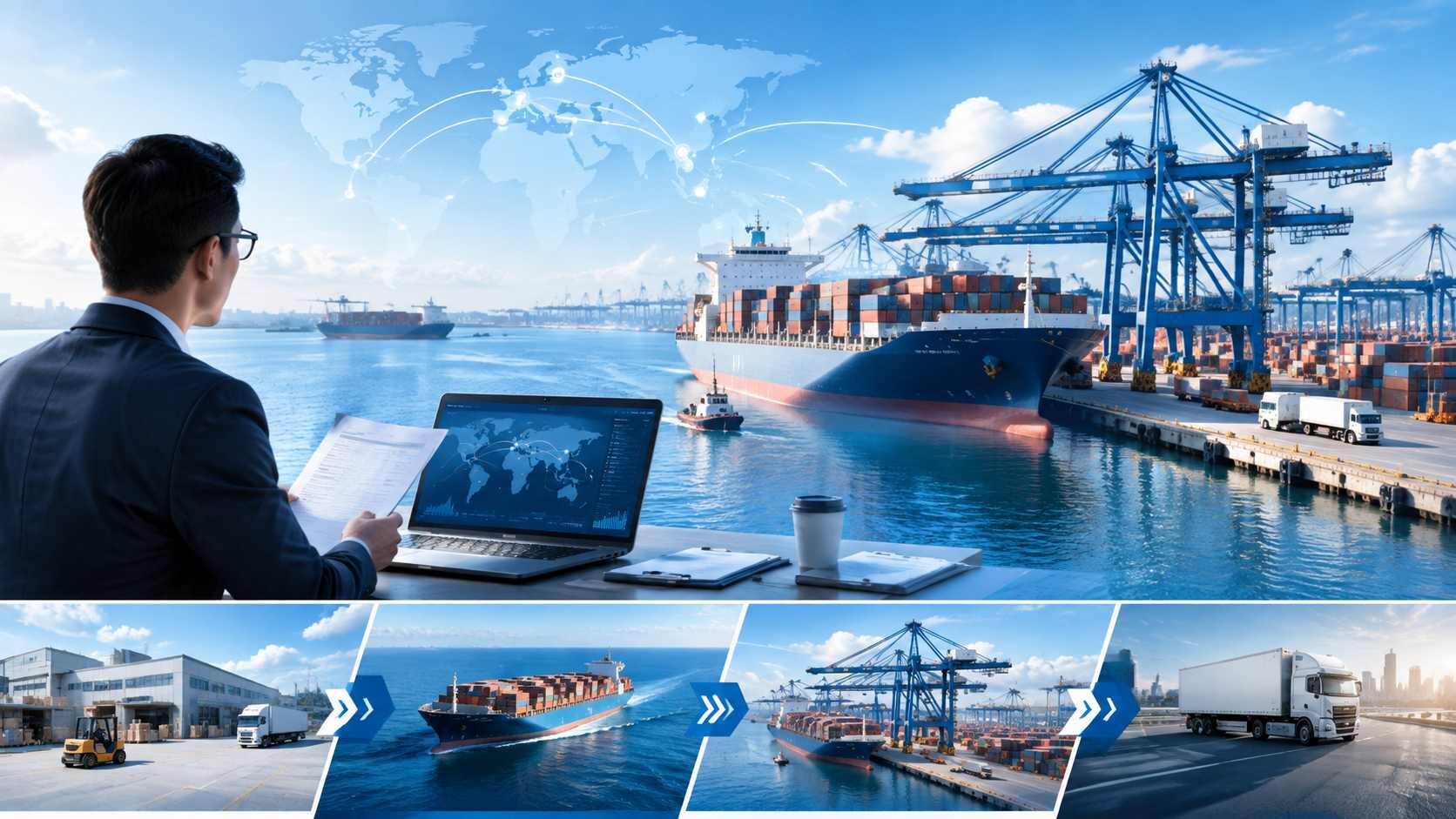
An ocean freight forwarder coordinates the commercial and operational steps needed to move cargo by sea, typically between the shipper, carrier, origin and destination partners, customs providers, terminals, and other service parties. The forwarder may arrange bookings, documentation, cargo handoffs, shipment tracking, and related transport services, depending on the agreed scope. The practical value is coordination: the shipper has a defined party to manage the shipment plan and resolve routine handoffs rather than arranging every transport stage separately.
The forwarder does not automatically control every part of the shipment. Carrier schedules, port operations, customs decisions, cargo readiness, document accuracy, and destination requirements can sit with different parties. Before booking, confirm the service scope, cargo details, shipping terms, origin and destination responsibilities, required documents, and which party handles each exception. Those inputs determine whether a forwarding arrangement fits the shipment.
What an Ocean Freight Forwarder Controls
A forwarder primarily controls coordination within the service it has agreed to provide. The exact boundary varies by shipment, but the work usually centers on planning the movement and connecting the required parties.
| Area | Typical forwarder role | Key verification point |
|---|---|---|
| Booking | Arrange space with a carrier | Confirmed sailing and service scope |
| Documentation | Coordinate shipment documents | Names, quantities, routing, and cargo data |
| Pickup | Arrange inland movement when included | Address, timing, equipment, and access |
| Customs | Coordinate with the responsible customs party | Importer, exporter, broker, and filing scope |
| Tracking | Provide shipment status through available channels | Milestones, carrier updates, and exception handling |
The forwarder is therefore best understood as an operational coordinator rather than a universal substitute for the carrier, importer, exporter, customs authority, or cargo owner. A quotation should be reviewed by responsibility rather than price alone. The useful question is not only “What does it cost?” but also “Which party is responsible at each handoff?”
For example, customs filing may be arranged through a separate specialist even when the forwarder manages the overall shipment. A dedicated customs brokerage service can be relevant when the customs portion requires a clearly defined specialist role.
How the Forwarding Process Usually Works

The process begins with shipment information that is complete enough for the provider to assess routing, equipment, documentation, and handling needs. Incomplete inputs often create avoidable changes later.
Define the shipment
Provide origin, destination, cargo description, quantity, weight, dimensions, packaging, readiness date, and any special handling requirements.
Confirm service scope
Identify which party handles pickup, export procedures, ocean booking, destination handling, customs work, delivery, and exception coordination.
Review the routing
Compare available sailing options, transit expectations, transshipment points where applicable, and the operational fit for the cargo.
Prepare documents
Check commercial and shipping information against the actual cargo so the parties receive consistent data before departure and filing.
Coordinate handoffs
Manage the agreed pickup, terminal or consolidation handoff, vessel movement, and subsequent destination stages.
Close the shipment
Verify delivery or final handoff, resolve outstanding documentation or charges, and retain the records needed for future shipments.
Each step depends on the previous one. A routing selected before cargo details are confirmed may have to be changed when the actual dimensions, weight, commodity, or readiness date becomes known. The completion criterion is not simply a booking confirmation; the shipment plan should also have clearly assigned responsibilities and consistent cargo information.
When a Forwarder Is a Good Fit
Multi-party shipments: A forwarder can be useful when a shipment requires coordination among suppliers, inland carriers, terminals, ocean carriers, brokers, and destination providers.
Recurring commercial cargo: A defined forwarding workflow can help procurement and logistics teams standardize booking inputs, documentation, and handoffs across repeat shipments.
Cross-border complexity: A forwarder may add value when the shipper needs one operational coordinator across several transport stages instead of arranging each stage independently.
The fit becomes weaker when the shipment is exceptionally simple and the shipper already has direct carrier arrangements, internal logistics resources, and established local handling. The appropriate comparison is therefore based on total coordination needs, not on whether a forwarder is inherently better than direct booking.
Trade-Offs and Alternatives
Using an ocean freight forwarder can reduce the number of operational interfaces the shipper manages, but it also introduces another commercial and coordination layer. Direct carrier arrangements may provide a more direct relationship for shippers with sufficient volume and internal capability, while a forwarder may be more practical when the shipment involves several providers or transport stages.
| Consideration | Forwarder model | Direct carrier model |
|---|---|---|
| Coordination | Centralized through the forwarder | Managed more directly by the shipper |
| Carrier relationship | Often mediated by the forwarder | Direct with the carrier |
| Inland services | May be integrated into the plan | Often arranged separately |
| Exception handling | Forwarder can coordinate multiple parties | Shipper may manage each party directly |
| Best comparison basis | Scope, responsibility, and total cost | Scope, responsibility, and total cost |
Neither model is automatically superior. Compare equivalent routing, cargo assumptions, included services, destination responsibilities, documentation support, local charges, and exception handling. A lower quoted transport rate may not represent a lower total operating cost when excluded services must be arranged separately.
Information to Confirm Before Booking
The forwarder needs accurate shipment inputs to assess the service correctly. The shipper or exporter normally provides the commercial cargo information, while the forwarder and other responsible parties verify the parts that fall within their agreed scope.
| Input | Why it matters | Who should confirm |
|---|---|---|
| Cargo details | Supports routing and handling assessment | Shipper |
| Package dimensions | Supports equipment and space planning | Shipper |
| Readiness date | Determines feasible departure options | Shipper and forwarder |
| Customs scope | Defines filing and brokerage responsibility | Importer/exporter and responsible broker |
| Delivery scope | Clarifies destination handoff and final transport | Shipper and forwarder |
Special cargo requires additional confirmation before booking. Classification, packaging, labeling, equipment, and handling requirements can vary by commodity and route. The party responsible for the relevant filing or service should confirm the current requirement rather than relying on a generic forwarding assumption.
Insurance is another separate decision. When financial exposure warrants it, review the intended coverage, exclusions, insured party, declared value, and claims process before shipment. A dedicated cargo insurance service may be relevant when insurance needs to be handled as a distinct workstream.
Common Mistakes and Operator Checks
Common mistake: The shipper requests a rate without providing final cargo dimensions or an accurate readiness date. The quoted option may then require revision when the actual shipment details become available. Prevent this by submitting verified cargo data and clearly stating whether the figures are final or estimated.
Operator check: Read the quote as a scope document. Identify what is included, what is excluded, which party performs customs work, where responsibility changes hands, and which charges require separate confirmation. This check often reveals differences that a headline freight rate does not show.
A second common issue occurs when the shipper assumes that the forwarder controls carrier, terminal, customs, and destination outcomes equally. Those parties operate under different rules and responsibilities. Escalate exceptions to the party that controls the affected stage while keeping the forwarder informed when the forwarding scope includes coordination.
Disclosure: This guide provides general logistics information and may refer to services relevant to the topic. Carrier terms, customs requirements, fees, service coverage, and operating conditions can change. Confirm current requirements and responsibilities before acting.
Key Takeaways
Use a forwarder when centralized coordination adds value to the shipment.
Confirm the service boundary before comparing quotations.
Provide accurate cargo, timing, and destination information before booking.
Assign customs, delivery, and exception responsibilities to the correct party.
Compare equivalent services and total scope instead of headline freight rates alone.
Ocean Freight Forwarder FAQ
What is an ocean freight forwarder?
An ocean freight forwarder is a logistics provider that coordinates sea shipment activities within an agreed scope. The work can include booking, documentation, inland transport, shipment tracking, and coordination with other service providers.
Does a freight forwarder operate the vessel?
Not necessarily. A forwarder may arrange ocean transportation with a carrier that operates the vessel. Confirm the contractual and operational role of each party in the booking documents.
What information should I send to a forwarder?
Provide the origin, destination, cargo description, package count, weight, dimensions, readiness date, packaging details, and any special handling requirements. More accurate inputs support a more reliable service assessment.
Does an ocean freight forwarder handle customs clearance?
Customs work depends on the agreed service scope and the responsible customs party. Ask explicitly who prepares filings, who provides the required data, and who is responsible for the relevant customs submission.
Is a freight forwarder cheaper than booking directly with a carrier?
There is no universal answer. Compare equivalent routing, included services, local charges, documentation support, inland transport, and exception handling before deciding which model has the lower total cost for the shipment.
Can a forwarder arrange door-to-door delivery?
A forwarder may arrange end-to-end transport when that service is included in the agreement. Confirm the exact pickup and delivery points, destination scope, and responsibilities before booking. A dedicated door-to-door shipping service can be considered when final delivery is part of the required transport scope.
When should I consider cargo insurance?
Consider insurance based on the value of the cargo, the financial impact of loss or damage, the existing contractual protections, and the coverage required for the shipment. Review exclusions and claims procedures before departure.
What should I check in an ocean freight quote?
Check the routing, shipment assumptions, included services, exclusions, documentation scope, customs responsibility, destination handling, inland transport, and charges that require separate confirmation. The full service boundary matters more than the headline rate alone.
Disclaimer: This article is general informational guidance, not a binding quotation, legal opinion, customs ruling, carrier commitment, or delivery guarantee. Requirements, charges, service terms, and responsibilities can vary by route, cargo, contract, carrier, and jurisdiction. Confirm current requirements before booking or filing.