Start With the Quote You Can Actually Use
Pallet shipping cost only becomes a workable buying decision when the quote describes the same cargo, route, service level, and delivery scope you need. A lower number is not directly comparable with a higher number when one quote covers pickup and final delivery while the other stops at a terminal, when one uses actual weight and another uses a dimensional basis, or when destination work remains outside the quoted scope.

Before approval, a forwarding desk should be able to identify the cargo-ready date, pickup point, pallet count and dimensions, actual weight, main transport mode, destination handoff, delivery point, appointment requirements, quote date, and included work. The commercial question is simple: does this quote cover the shipment you intend to move, under the service level you intend to buy?
That question matters even more for international pallet shipping because a pallet can change hands several times before final delivery. Ask the forwarder to confirm what happens at origin, who controls the main movement, where destination handling begins, whether delivery is included, and what event would trigger a revised quote. Once those answers match the shipment, the pallet shipping quote becomes much easier to compare and approve.
Align the Quote Scope Before Comparing Pallet Shipping Cost
A quote review should follow the shipment rather than the order in which charges appear on a quotation. The forwarding desk first needs the cargo timing and pickup conditions, then the main service, charge basis, destination handoff, and final delivery scope. The table below gives a practical baseline for checking whether two quotes describe the same job.
| Quote field | Why it changes the decision | Who confirms it | Next checkpoint |
|---|---|---|---|
| Cargo-ready date and pickup | Timing and origin access can change the service path | Shipper and forwarder | Confirm pickup window |
| Main route and service level | Transit expectations depend on the selected movement | Forwarder | Match service to need |
| Pallet count, size, weight | These inputs determine the applicable charge basis | Shipper | Validate packing details |
| Destination handoff | Terminal, warehouse, broker, and delivery work may differ | Forwarder and destination party | Confirm included handling |
| Delivery point and appointment | Site restrictions can change the delivery operation | Consignee | Verify access and booking needs |
| Quote date and validity condition | The quote applies to the commercial conditions stated when issued | Forwarder | Confirm before booking |
| Included and excluded work | Unstated handoffs can leave important costs outside the comparison | Forwarder | Request line-by-line scope confirmation |
Keep the comparison on one scope. A quote that covers port delivery should not be treated as equivalent to a quote that includes a booked appointment at the receiving location. The same principle applies to pallet international shipping: compare the operating job first, then compare the commercial terms inside that job.
Understand the Charge Basis and the Inputs That Move It
The main cost question is not simply how much a pallet weighs. The forwarding desk needs to know which measurement controls the service being quoted and where that measurement enters the transport chain.
Pallet dimensions and volume: The shipping pallet size affects how much physical space the cargo occupies. Length, width, height, stackability, and the number of pallets can change the usable capacity allocated to the shipment. The shipper should provide packed dimensions rather than product-only dimensions. The forwarder then confirms whether the selected service prices the movement primarily by space, actual weight, or another provider-specific basis.
Actual weight versus chargeable weight: Air and express services may compare the physical weight with a dimensional measure. A light but bulky pallet can therefore be assessed differently from a dense pallet of the same gross weight. The buyer should ask which weight field the quote uses, which packing details support that field, and whether a revised measured weight at origin would trigger a new calculation.

Consolidated freight: A pallet moving as part of a shared shipment can have a different handling path from cargo moving in a dedicated container. The relevant question is not whether consolidation sounds cheaper in general. Ask what consolidation point is planned, where responsibility changes, whether destination handling is included, and whether the cargo can meet the service’s size, weight, and handling conditions.
Pickup and delivery: The distance to the origin facility and the final receiving point matters because local transport creates its own operating requirements. A dock-to-dock move is not the same task as pickup from a site with limited loading access and delivery to a location that requires an appointment. Ask who is arranging pickup, what equipment the driver needs, and whether the receiving site has specific access rules.
Special handling: Non-stackable, fragile, oversized, unusually dense, or restricted cargo can change the operating path even when the pallet count stays the same. The shipper should flag these conditions before approval. The forwarding desk can then confirm whether the selected service can accept the cargo and whether additional handling or a different service is required.
Field note: Confirm the packed pallet dimensions, gross weight, stackability, pallet count, and cargo-ready condition from the same packing record used for the quote. Ask the forwarder to state which input controls the quoted charge basis and what event would cause that basis to be rechecked.
Check What the Quote Includes and Who Acts at Each Handoff
A useful pallet shipping quote should make the operating handoffs visible. The buyer does not need a longer list of charges; the buyer needs to know which work is included and who must provide the missing detail.
At origin, confirm whether pickup and origin handling are included and who provides the pickup address, loading window, dock information, and any site access instructions. The shipper should also confirm whether the cargo will be ready as described when the pickup is scheduled. A change in readiness can affect the booking or pickup plan.
For the main movement, confirm the selected service and the stated service level. The forwarding desk should identify the planned transport path and tell the buyer what information is still needed to finalize the booking. For ocean freight, the relevant service can be reviewed through sea freight services. For time-sensitive palletized cargo, air freight services may provide a different operating path that should be compared under the same delivery scope.
At destination, confirm whether the quote includes destination handling, broker coordination, or final delivery. Customs work should be treated as a separate operational handoff when it affects the shipment. A buyer who needs clearance support can review customs brokerage support and then ask which filing or document tasks remain with the consignee or another party.
Final delivery deserves its own check. Ask whether the quote ends at a terminal, warehouse, or the consignee’s location, and whether delivery appointment requirements are included. A quote that is meant to reach the receiving site should state that scope clearly. When the required service includes pickup through final delivery, review door-to-door shipping and confirm the exact delivery boundary rather than assuming that the phrase covers every local condition.
Duties or taxes should be discussed only when they are part of the commercial scope being requested. When the seller or logistics provider is expected to coordinate a broader delivered service, DDP shipping may be part of the comparison, but the buyer should still ask exactly which destination work is included and which amount, tax treatment, or customs responsibility requires separate confirmation.
Storage, accessorials, missed appointments, rebooking, document correction, and equipment return should not be assumed to be included simply because a main freight line appears on the quote. Ask the forwarder to identify which exceptions are outside scope and which event would cause the quote to be reissued.
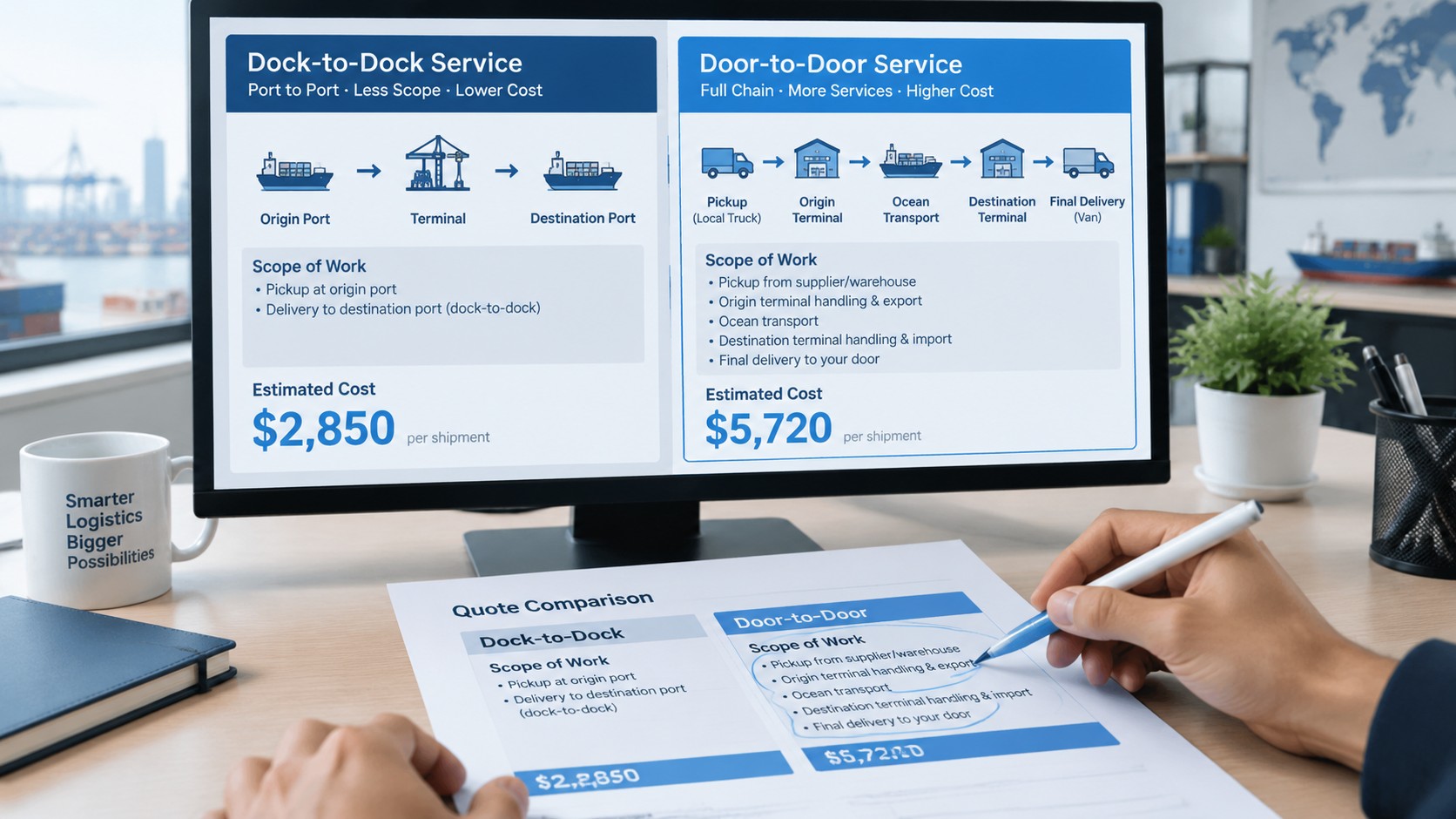
Note: A freight quote is tied to the cargo, handoffs, route, service level, timing, and destination work stated in it. Carrier and handling conditions can change. Align the scope first, then request confirmation for the specific shipment.
Choose the Option That Matches the Shipment
The right comparison depends on what the pallet shipment must accomplish. Each option changes the balance among space use, handoffs, transit control, and delivery coordination.
| Option | Buyer fit | Weak fit | Quote question |
|---|---|---|---|
| Consolidated ocean | Planned cargo with flexible timing | Tight delivery window | Where is the consolidation handoff? |
| Dedicated container | Higher volume or controlled handling | Small shipment with unused capacity | What volume and packing assumption is used? |
| Air freight | Time-sensitive or higher-value cargo | Bulky cargo with low urgency | Which weight basis applies? |
| Express | Small urgent shipment with simple delivery needs | Large or operationally complex pallets | What pallet dimensions can the service accept? |
| Multi-modal | Shipments needing a mixed transport path | Simple moves where extra handoffs add complexity | Who owns each transfer point? |
A multi-stage route can make sense when one mode alone does not match the shipment. Rail freight can also be considered when the lane supports it and the timing or route structure makes rail relevant. The practical comparison should stay tied to the actual origin, destination, pallet profile, and required delivery point rather than to a general assumption about one mode being less expensive.
For a mixed service path, ask whether multi-modal freight changes the number of handoffs, who coordinates each transfer, and where the delivery responsibility changes. The forwarder should then confirm the final quote under the same scope as the alternatives.
Find the Gaps That Can Make the Quote Unusable
Most quote problems begin with a missing operating fact rather than with the headline freight line. The buyer should focus on the inputs that can change the route, charge basis, handoff, or delivery operation.
An incomplete pickup address can hide loading restrictions, distance issues, or a different collection point. A changed cargo-ready date can affect the booking sequence and may require the forwarder to check the service again. A mismatch between the packed weight and the quoted weight basis can change how the shipment is rated. A missing destination-handling line can leave the buyer comparing a partial movement with a broader service.
Delivery access creates another common gap. A receiving facility may require an appointment, restricted delivery hours, liftgate service, or other local arrangements. These details should be provided before approval when they are known. The forwarder should identify which conditions are already included and which still require destination confirmation.
Storage and rebooking become material when the cargo misses a planned movement or the receiving side cannot accept the delivery as scheduled. Document correction can create a similar problem when shipping information changes after instructions have been issued. The commercial checkpoint is to ask what change triggers a revised quote and who must authorize that revision.
For unusual pallet shapes, non-stackable cargo, heavy pieces, or project-oriented movements, the shipping pallet size should be confirmed from the packed cargo. When the shipment is materially oversized or requires specialized handling, project cargo shipping may be relevant to the scope discussion rather than treating the pallet as ordinary consolidated freight.
If the cargo value or transit exposure makes risk transfer part of the buying decision, ask what insurance scope is needed and who arranges it. cargo insurance can be reviewed separately from the freight movement so the buyer can confirm the intended coverage with the relevant party.
Common mistake: Approving a quote because the pallet count and headline freight line match another offer. The safer comparison checks packed dimensions, weight basis, pickup scope, destination handling, final delivery point, and all material exceptions before treating the offers as equivalent.
Risk trigger: A new pickup address, changed cargo-ready date, revised pallet dimensions, different gross weight, failed delivery appointment, or newly disclosed cargo restriction should trigger a scope review before the shipment moves.
Prepare the Quote Request by Owner and Action
The fastest route to a usable quote is to give each party a clear information task. A forwarding desk can then verify the operating path instead of spending the first review round identifying missing facts.
Cargo and packing: The shipper provides pallet count, packed dimensions, gross weight, stackability, commodity description, and packing details. These fields support the charge basis and service-acceptance check. The next checkpoint is confirmation that the quote reflects the packed shipment rather than product specifications alone.
Cargo-ready and pickup: The shipper provides the cargo-ready date, pickup address, loading hours, and site restrictions. The forwarder checks routing and pickup feasibility. The next checkpoint is a confirmed pickup window and origin handoff.
Route and service: The buyer states the required destination and acceptable service level. The forwarding desk compares the applicable transport path and confirms the planned handoffs. The next checkpoint is a quote issued on a clearly stated service scope.
Delivery address and appointment: The consignee provides the final delivery point, receiving hours, appointment requirements, and access limitations. The forwarder checks destination delivery conditions. The next checkpoint is confirmation of the intended delivery boundary.
Commercial scope: The buyer states any required named trade term or delivered-service expectation. The relevant parties confirm which destination work is included. The next checkpoint is written scope alignment before booking.
Special handling or restrictions: The shipper identifies fragile, regulated, oversized, non-stackable, or otherwise unusual cargo conditions. The forwarder verifies service acceptance and any changed operating requirements. The next checkpoint is approval of the service path under the confirmed cargo condition.
When the shipment is headed to a fulfillment network, the final receiving point matters as much as the origin. A pallet intended for an Amazon fulfillment workflow should be checked against the actual receiving requirements and booking process, with Amazon FBA shipping considered only when that destination workflow is genuinely part of the request.

Make the Comparison Conditional, Then Approve the Right Scope
The practical default is to compare two or three service paths only after the cargo and delivery scope are fixed. Start with the option that matches the required delivery window and handling conditions, then compare alternatives under the same pickup, destination, and included-work assumptions. The fact that changes the decision is usually one of the shipment variables: pallet dimensions, weight basis, urgency, destination access, or the number of handoffs the buyer is prepared to manage.
For a straightforward pallet movement with flexible timing, begin by confirming whether consolidated ocean service can satisfy the delivery requirement. For time-sensitive cargo, ask the forwarder to compare air or express treatment using the actual packed dimensions and weight. For a route that naturally uses more than one transport mode, ask for a multi-modal option with each transfer point identified. The buyer should then approve the scope, not just the headline number.
Illustrative example (not a customer case): A buyer has several fully packed pallets that are ready on a specified date and must reach a business receiving site with a booked delivery window. One quote covers the main transport and stops before final delivery; another quote includes pickup, destination handling, and delivery appointment coordination. The buyer should not select between the two until the forwarder confirms the packed dimensions, charge basis, destination handoff, and exact delivery scope under a common comparison.
The next checkpoint is written confirmation of the quote assumptions. Ask the forwarder to restate the cargo basis, pickup scope, main service, destination handoff, delivery point, included work, validity condition, and the event that would require re-quoting. That creates a workable approval record without treating an incomplete quote as a final commitment.
Key Takeaways
Compare scope before price: Two headline figures are not equivalent unless they cover the same cargo journey and delivery point.
Use packed cargo data: Confirm pallet count, dimensions, gross weight, and handling characteristics from the actual shipment information.
Confirm the charge basis: Ask the forwarder which measurement controls the quote and what change would trigger a recheck.
Assign every handoff: Know who manages pickup, main transport, destination handling, customs coordination when relevant, and final delivery.
Flag operational risks early: Delivery access, appointment rules, changed readiness, rebooking, storage, and special cargo conditions can alter the shipment plan.
Approve only after confirmation: Have the forwarding desk verify the current scope, assumptions, and required next action for the specific shipment.
FAQ
What information should I send with a pallet shipping quote request?
Send the packed pallet count, dimensions, gross weight, commodity description, stackability, cargo-ready date, pickup address, destination address, receiving requirements, and requested service level. Also state any special handling or delivery restrictions you already know. These details let the forwarding desk check the intended route and confirm whether the quoted scope matches the shipment you actually need to move.
Does pallet size affect the quoted amount?
It can, because physical dimensions influence space usage and may affect the charge basis for some services. The important point is to use packed dimensions, not product dimensions. Give the forwarder the final pallet measurements and ask which measurement the current quote uses. Also confirm whether stackability or unusual dimensions change the handling path.
Why can two quotes for the same number of pallets differ?
The quotes may describe different shipment scopes. One may include pickup, destination handling, or final delivery while another may stop earlier in the route. The charge basis, service level, transit path, and delivery conditions can also differ. Before comparing the figures, ask both providers to state the same cargo assumptions and the exact start and end points of their service.
Should I compare ocean, air, and express for every pallet?
No. The useful comparison depends on the shipment’s urgency, physical profile, destination requirements, and tolerance for additional handoffs. Start with the service that can realistically meet the required delivery condition. Then compare an alternative only when it changes a meaningful decision, such as transit control or handling path. Every option should be reviewed against the same pickup and delivery scope.
What should I ask about destination charges and delivery?
Ask where the quoted destination scope begins and ends. Confirm whether destination handling, customs coordination when relevant, final delivery, and delivery appointment work are included. The consignee should provide receiving hours and access requirements, while the forwarder should verify how those conditions affect the delivery operation. The goal is to identify every handoff before the shipment is approved.
What happens when the pallet weight or dimensions change after quoting?
The forwarding desk should recheck the quote against the revised shipment data. A changed weight or dimension can alter the applicable charge basis, service acceptance, or handling plan. Do not assume that the original quote remains valid for materially different cargo. Provide the updated packing information and ask what needs to be re-quoted before the shipment moves.
When is door delivery worth comparing with terminal delivery?
Compare the two when the buyer needs the cargo to arrive at a specific receiving location rather than stopping at an intermediate handoff. Door delivery can shift more coordination into the quoted service, including pickup and final delivery planning. The key question is not whether door delivery is universally better; it is whether the added coordination matches the actual receiving requirement.
What is the final approval question for a pallet quote?
Ask whether the quote covers the exact cargo, route, service level, pickup point, destination handoff, delivery location, and included work that the shipment requires. Then ask which known change would cause a revised quote. That final check turns the quote from a headline figure into an operational instruction that the forwarding team can use for the next shipment checkpoint.
Disclaimer: This page is general quote-planning guidance, not a binding quotation or delivery commitment. Actual charges and handoffs depend on the cargo, route, timing, provider confirmation, and destination conditions. Where duties, customs, tax, insurance, or contract questions apply, confirm them with the relevant party before booking.