A 40ft container is a standard ocean-freight equipment size used to move larger cargo volumes in one container. For planning, the useful question is not simply whether cargo fits inside a 40ft box. You also need to check internal dimensions, door opening, cargo weight, loading method, and whether the cargo must move through a specific warehouse, truck, rail, or port handling chain.
The common planning reference is a 40ft dry container, but actual dimensions and payload can vary by container type and equipment specification. A shipper should therefore use the nominal size to choose the equipment category, then confirm the carrier or forwarder’s actual equipment dimensions and weight limits before booking. This matters especially when cargo is long, tall, dense, difficult to palletize, or close to the allowed weight.
40ft Container Dimensions at a Glance
For a typical 40ft dry container, the outside footprint is about 12.19 m long and 2.44 m wide. The interior is smaller because the walls, floor, roof, and doors consume part of the nominal space. The figures below are practical planning references rather than a substitute for the equipment specification of the container assigned to a shipment.
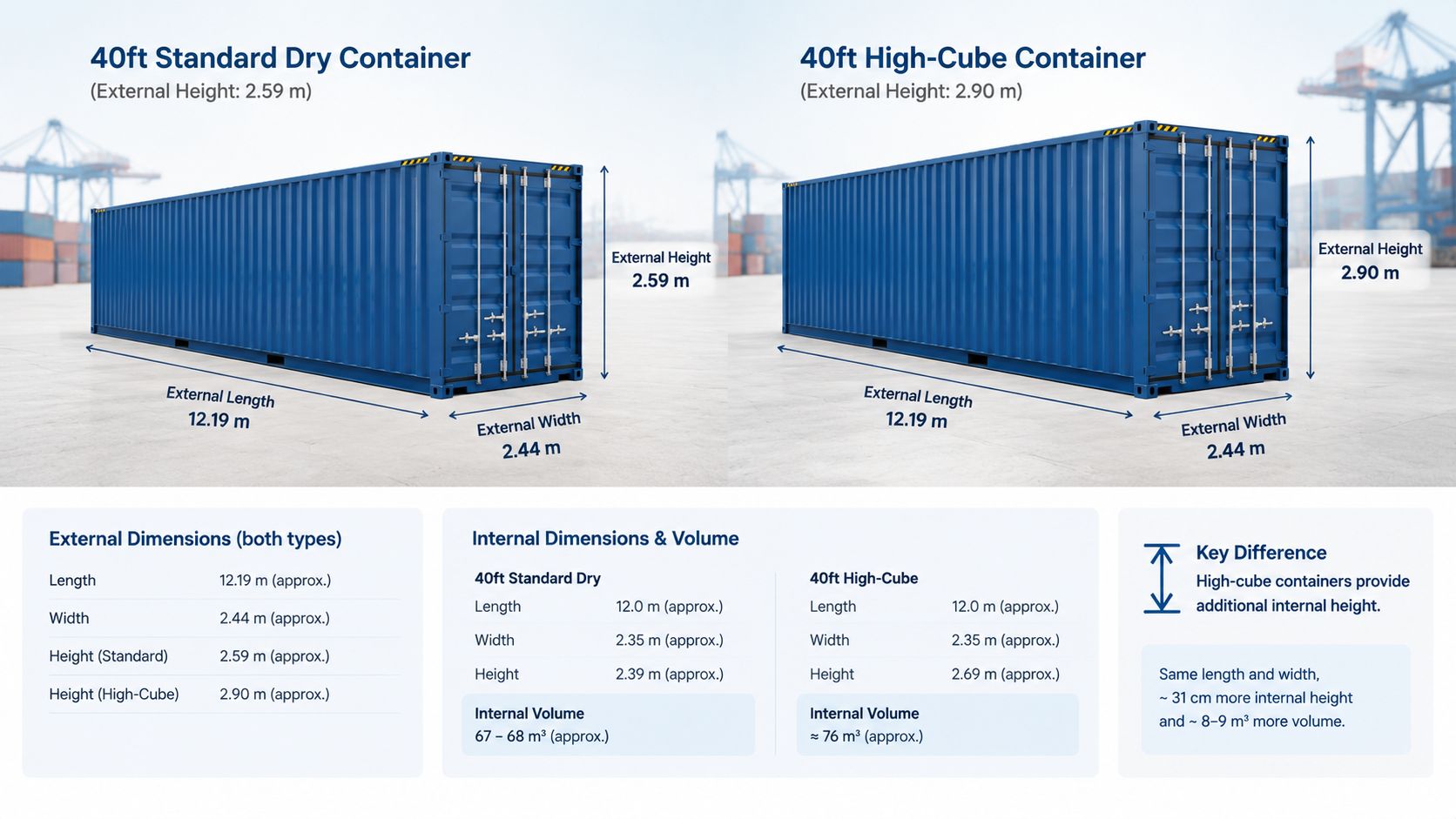
| Measurement | 40ft dry | 40ft high cube | Planning impact |
|---|---|---|---|
| External length | About 12.19 m | About 12.19 m | Sets the basic equipment footprint |
| External width | About 2.44 m | About 2.44 m | Usually unchanged between the two types |
| External height | About 2.59 m | About 2.90 m | Height can change the fit for bulky cargo |
| Internal length | About 12.0 m | About 12.0 m | Use internal length for loading plans |
| Internal width | About 2.35 m | About 2.35 m | Check pallet or crate width and aisle clearance |
| Internal height | About 2.39 m | About 2.69 m | Check stacked cargo and handling equipment needs |
| Volume | Roughly 67-68 m³ | Roughly 76 m³ | Actual usable volume is lower after loading constraints |
These measurements explain why a nominal 40ft container size does not equal a guaranteed usable 67-76 m³ of cargo space. Door geometry, cargo shape, packaging gaps, lashing requirements, and loading sequence can reduce practical utilization. When cargo is near a dimensional limit, obtain the assigned equipment’s internal and door measurements instead of relying only on a generic specification.
What the Measurements Control
The most important measurements serve different planning purposes. External dimensions determine whether the equipment can move through the planned handling network, while internal dimensions determine whether the cargo can physically be loaded. The door opening creates a separate constraint because cargo must pass through the doors even when the interior appears large enough.
Weight creates another independent limit. A container can have unused volume and still be unsuitable because the cargo is too dense. The actual maximum gross weight includes the container’s tare weight and the cargo, so the shipper should check the applicable equipment rating and transport restrictions rather than treating a nominal payload figure as universal.
For international ocean movements, a sea freight service can arrange the main containerized movement, but the equipment decision still depends on cargo details and the route’s handling constraints. The same 40ft equipment may behave differently operationally when inland trucking, rail transfer, port storage, or warehouse loading is involved.
When a 40ft Container Fits the Shipment
A 40ft container usually makes sense when the shipment has enough volume to use a meaningful share of the available space and the cargo dimensions are compatible with standard loading. Shippers should assess the cargo as a complete load rather than selecting equipment from volume alone.
Large standard cargo lots. Palletized, cartonized, or case-packed goods often fit this equipment when the loading pattern can use the interior length and width efficiently.
High-volume but moderate-density cargo. A 40ft unit can provide useful capacity when the shipment needs more space than a smaller container but does not approach its practical weight ceiling.
Mixed cargo with a workable loading plan. Several SKUs can share one container when packaging sizes, stacking limits, and unloading priorities are planned before loading.
The fit becomes weaker when the cargo is exceptionally heavy, unusually tall, wider than the door opening, very long, or difficult to handle safely. In those situations, a high-cube unit, specialized equipment, multiple units, or a different transport solution may need to be evaluated.
40ft Shipping Container Dimensions vs. Practical Capacity
Volume calculations are useful for screening, but they should not be treated as a loading authorization. The theoretical interior volume assumes a rectangular space that can be filled efficiently. Real cargo has cartons, pallets, voids, overhangs, protection material, and handling clearances that change the usable result.
A practical loading review should therefore compare three numbers: total cargo volume, total cargo weight, and the dimensions of the largest individual package. The shipment needs to satisfy all three checks. A cargo planner should also consider forklift access, stackability, center-of-gravity issues, and whether the unloading plan requires certain goods to remain reachable.
When the inland journey includes rail or multiple transport legs, multi-modal freight planning can be relevant because the same container must remain compatible with each handoff. A container that physically fits the cargo may still require a different operational plan if one leg has tighter handling or weight constraints.
Operational Checks Before Booking
The correct equipment choice starts with shipment data. The person preparing the booking should collect the packaged dimensions and weight of each cargo unit, not just a product-level specification. The loading plan should then test the largest pieces against the container door and interior clearances before the booking is finalized.
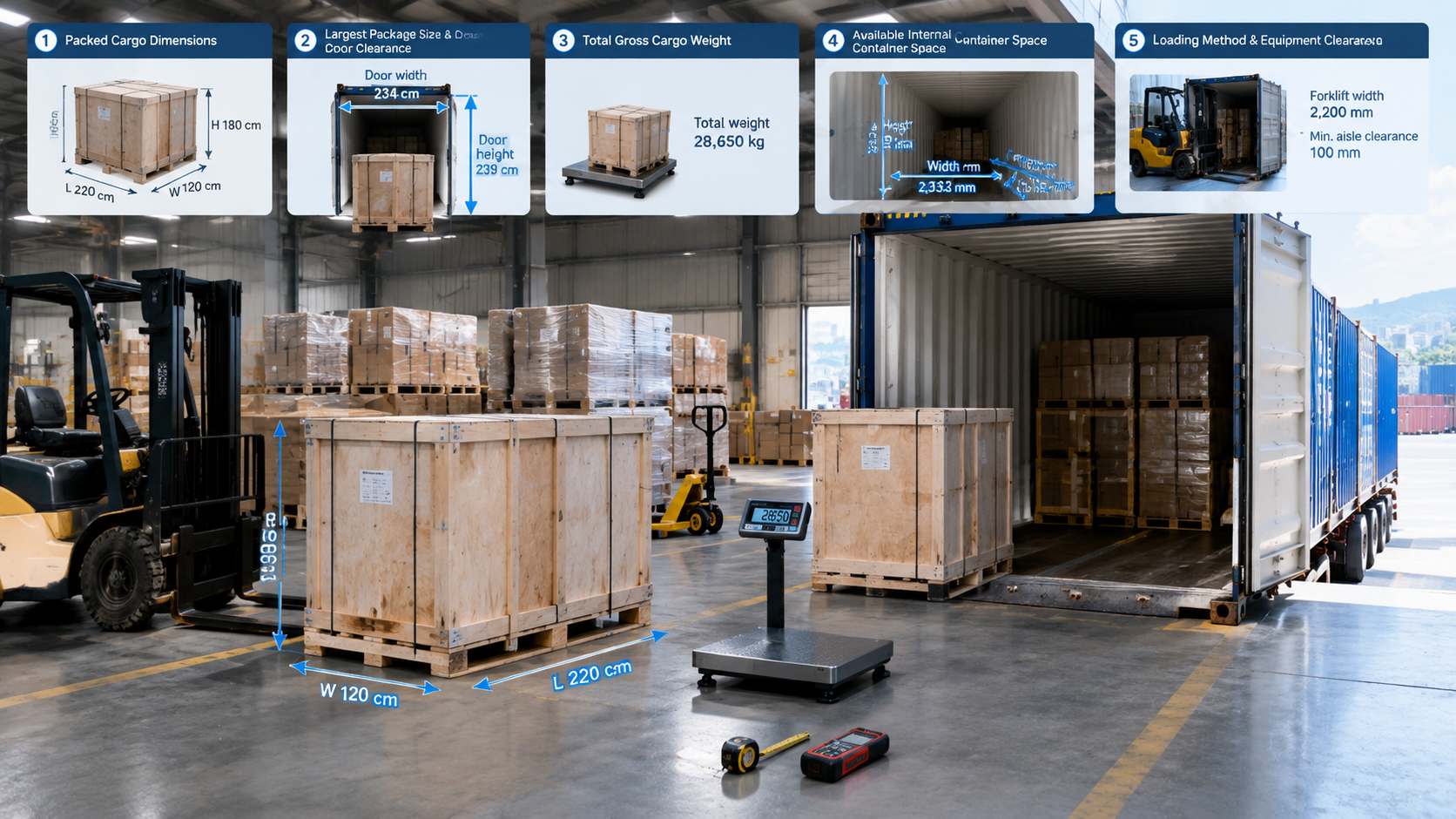
| Input | Who checks it | Why it matters | Verification point |
|---|---|---|---|
| Package dimensions | Shipper | Determines physical fit | Use packed dimensions |
| Gross cargo weight | Shipper | Determines weight feasibility | Include packaging and pallets |
| Largest package | Shipper / planner | Tests door and handling clearance | Check actual package orientation |
| Container specification | Carrier / forwarder | Confirms assigned equipment | Check type, dimensions, and rating |
| Loading method | Shipper / warehouse | Affects usable space and safety | Confirm forklift and loading sequence |
Customs paperwork does not determine the physical dimensions of the container, but the cargo description, package count, and declared shipment data should remain consistent across the commercial and transport records. A customs brokerage service can be relevant when the shipment needs support with the customs handoff, while the shipper remains responsible for supplying accurate cargo information and documents required for the transaction.
Common Sizing Mistakes and Operator Checks
Most avoidable sizing errors come from treating the container label as the full specification. A booking marked “40ft” does not tell the planner whether the selected equipment is standard-height or high-cube, how much cargo weight remains available after tare, or whether the largest package can pass through the door.
Common mistake: The shipper calculates cargo volume from product dimensions before packaging. The finished cartons or pallets then occupy more space than expected. Prevention: calculate from final packed dimensions and include all pallets, skids, protective materials, and planned void space.
Operator check: Ask for the actual container type and equipment specification when cargo is close to a dimensional or weight limit. A generic “40ft” description is not enough for a tight-fit loading plan.
Disclosure: This guide provides general logistics information and may refer to services relevant to the topic. Carrier terms, customs requirements, fees, service coverage, and operating conditions can change. Confirm current requirements and responsibilities before acting.
Key Takeaways
Use the nominal 40ft size to identify the equipment category, not to approve a final loading plan.
Check internal dimensions and door opening separately from external dimensions.
Compare cargo volume, gross weight, and the dimensions of the largest package together.
Distinguish a standard 40ft dry container from a 40ft high-cube unit when vertical clearance matters.
Confirm the assigned equipment specification when cargo is close to any dimensional or weight boundary.
40ft Container FAQ
What are the typical 40ft container dimensions?
A typical 40ft dry container is about 12.19 m long, 2.44 m wide, and 2.59 m high externally. Internal measurements are smaller and vary by equipment, so confirm the actual specification for tight-fit cargo.
What is the internal size of a 40ft container?
A typical internal reference is roughly 12.0 m long, 2.35 m wide, and 2.39 m high for a standard dry unit. These figures are planning references, not guaranteed dimensions for every container.
How much volume does a 40ft container hold?
A standard 40ft dry container has roughly 67-68 m³ of theoretical internal volume, while a 40ft high-cube unit can be around 76 m³. Practical cargo capacity is lower when loading gaps and handling limits are considered.
How is a 40ft container different from a 40ft high cube?
The main difference is height. A high-cube container is taller while keeping a similar length and width, which can provide additional vertical space for suitable cargo. The correct choice depends on cargo height and route handling constraints.
Does a larger container always allow more cargo weight?
No. Container selection involves both volume and weight constraints. A shipment can have unused floor or cubic space while still approaching the permitted gross weight, so the equipment rating and transport restrictions must be checked separately.
Why are door dimensions important when the interior is large enough?
Cargo must physically pass through the container doors during loading. A package can fit within the interior length or height and still fail the loading test because its dimensions or orientation exceed the door opening.
What information should I provide to confirm 40ft equipment?
Provide packed dimensions and gross weight for each package, package count, pallet details, the largest item dimensions, loading method, and delivery requirements. The carrier or forwarder can then verify equipment compatibility against the planned movement.
Can a 40ft container be used across sea and inland transport?
Yes, standard containerized freight can move across connected transport legs, but the route still needs to be checked for handling, road, rail, terminal, and weight restrictions. The container type should be confirmed for the complete transport chain rather than one leg alone.
Disclaimer: This article is general informational guidance, not a binding quotation, legal opinion, customs ruling, carrier commitment, or delivery guarantee. Requirements, charges, service terms, and responsibilities can vary by route, cargo, contract, carrier, and jurisdiction. Confirm current requirements before booking or filing.