

Which Sea Freight Quote Can Actually Move the Cargo?
When you review sea freight from China to the USA, the useful question is not simply which quote shows the lower number. The real question is whether the quoted service can move the cargo from the stated pickup point to the required delivery point with the right handoffs, timing, and included work. A quote becomes difficult to approve when one provider prices port-to-port freight while another prices pickup, destination handling, and final delivery under a different scope.
Before you compare FCL and LCL, first align the cargo-ready date, pickup requirements, main transport service, cargo basis, destination handoff, delivery point, and quote validity. Then ask the forwarder to identify what the line items cover and what still depends on confirmation. That process separates a workable shipping option from a headline freight figure that cannot yet be used for booking.
The operating decision usually comes down to three questions: what service level does the shipment require, which cargo basis applies, and who owns each handoff. Once those points match, you can compare the available sea freight options on an equivalent scope rather than comparing numbers that represent different shipments.
Align the Quote Scope Before Comparing Prices
A forwarding desk normally checks the shipment in operational order. The cargo-ready date controls booking timing and pickup planning. The pickup point and origin handling define what must happen before the container or consolidated cargo reaches the export handoff. The main route and service level determine what transport is actually being quoted. The cargo dimensions, weight, package count, and container requirement determine the applicable charge basis. The destination side then needs a clear handoff, delivery point, and any appointment requirement.
| Checkpoint | What to align | Who confirms it |
|---|---|---|
| Cargo timing | Cargo-ready date and pickup window | Shipper |
| Origin scope | Pickup point and origin handling included | Shipper + forwarder |
| Main service | FCL or LCL and quoted sea service | Forwarder |
| Cargo basis | Container, volume, weight, or shipment basis | Shipper + forwarder |
| Destination scope | Handoff, delivery point, appointment, and included work | Forwarder + consignee |
| Quote condition | Quote date, validity condition, and exclusions | Forwarder |
These fields also prevent a common comparison error: treating the main ocean freight figure as the complete shipment cost. A buyer may receive two apparently similar offers while one includes origin pickup and final delivery and the other stops at a destination terminal. The next checkpoint is therefore not “which number is lower?” but “does each number describe the same operating scope?”
Ask the forwarder to restate the quote in plain operational terms: where the cargo is collected, where the quoted service ends, which handoffs are included, and which line items still require shipment-specific confirmation.
Understand the Charge Basis Before You Judge the Cost
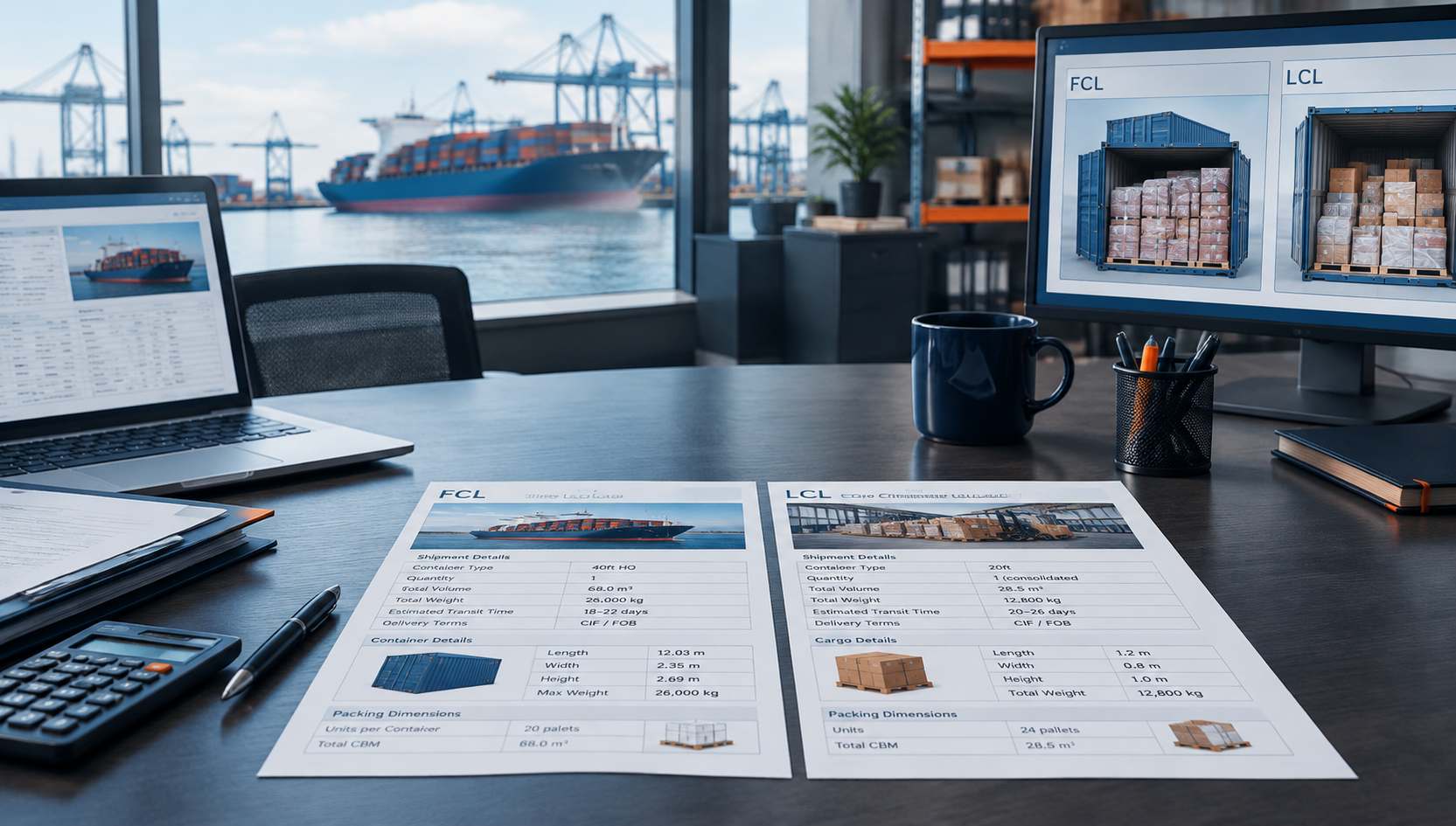
The charge basis matters because the same shipment description can produce different operational requirements depending on whether the cargo moves as a full container or as consolidated freight. For FCL, the quote is generally tied to the container requirement and the stated service scope. The practical question is whether the cargo fits the selected equipment and whether the quote covers the required origin and destination handoffs.
For LCL, the forwarder needs the shipment dimensions, package details, and weight because the applicable cargo basis depends on the shipment data and provider rules. A change in carton count or dimensions can therefore change the quoted basis even when the product itself has not changed. The buyer should provide the actual packing information and ask which basis the quote uses.
Pickup and delivery can also change the commercial picture independently of the main sea movement. A remote pickup point, a difficult delivery location, a required appointment, or another access condition may require additional operational work. The correct question is not whether a charge sounds small or large in isolation. Ask what event triggers it, which handoff it covers, and whether that condition already appears in the quote.
Transit planning should be reviewed in the same way. A sea service has an origin stage, main transport stage, destination handling stage, and potentially a final delivery stage. A quoted transit figure may describe only part of that chain. Ask the forwarder which stage the stated transit refers to and what happens after the main sea movement.
What the Quote Includes and Who Acts
A workable quote should let the buyer see the operating handoffs rather than only the commercial headline. Origin pickup and handling should identify whether the forwarding team is collecting the cargo or whether the shipper is delivering it to a specified handoff point. The main transport line should identify the sea service being quoted. Destination work should make clear whether the scope ends at a terminal or continues into delivery.
When consolidation is involved, confirm who coordinates cargo receipt, consolidation, and the destination handoff. For final delivery, confirm the actual delivery point and whether an appointment or special access condition applies. If a broker or other destination party handles a separate stage, ask who coordinates that handoff and which charges remain outside the quoted scope.
Duties, taxes, customs work, insurance, storage, accessorials, and equipment-return requirements should only be treated as included when the quote or shipment instructions clearly identify them. When a line item is not clear, the fastest way to remove uncertainty is to ask for the owner, the trigger, and the point at which it would be re-quoted.
For buyers comparing sea freight services, the sea freight service should be evaluated against this same handoff logic rather than against the headline ocean line alone.
Note: A freight quote is tied to the cargo, handoffs, route, service level, timing, and destination work stated in it. Carrier and handling conditions can change. Align the scope first, then request confirmation for the specific shipment.
Choose the Sea Freight Option That Fits the Shipment
FCL and LCL should not be treated as interchangeable price labels. They change the cargo handoff, consolidation process, equipment requirement, and the way the shipment is prepared for the main transport.
FCL fit: Use the FCL path when the shipment can support the required container arrangement and the buyer wants a direct container movement rather than shared consolidation.
LCL fit: Use LCL when the cargo does not justify a dedicated container under the shipment’s commercial and operational conditions. Ask how the cargo will be received, consolidated, and handed over at destination.
Door-to-door fit: Use a door-to-door scope when the buyer needs the forwarding team to coordinate the delivery chain beyond the port or terminal handoff. Confirm the exact delivery point and appointment conditions.
Port or terminal handoff: Use a more limited scope when the buyer already has a receiving arrangement for the next stage. Confirm exactly where the forwarder’s work ends.
The right comparison is therefore an equivalent-scope comparison. Ask for the same pickup point, cargo information, main transport scope, destination handoff, and final delivery requirement in each quote. If one option has a different service boundary, the commercial numbers should not be compared as though they represent the same shipment.
A buyer who needs a broader delivery handoff can review the door-to-door service separately, then ask the forwarder to keep the same cargo and timing assumptions when comparing it with a port-based quote.
Where Sea Freight Quotes Commonly Go Wrong
Most quote problems begin with a missing input rather than a mysterious change in the freight market. An incomplete pickup address can leave origin transport outside the intended scope. A changed cargo-ready date can affect booking coordination. Incorrect dimensions can change an LCL charge basis. A delivery location without enough access information can create a handoff problem after the cargo arrives.
Destination work is another frequent gap. A buyer may compare a quote that ends at a destination handoff with one that includes delivery. Storage, rebooking, document correction, or appointment-related work can also become relevant when the shipment does not move according to the original assumptions. These are not reasons to reject a quote automatically. They are reasons to identify the trigger before approval.
Common mistake: Approving an ocean freight number before confirming what happens after arrival. Ask whether the quoted service ends at the destination terminal, includes a destination handoff, or continues to the stated delivery point.
Risk trigger: A quote becomes harder to control when the cargo data, pickup timing, delivery requirements, or service boundary changes after the price was prepared. Ask what must be re-quoted before those changes reach the booking stage.
Prepare the Information the Forwarder Needs

The fastest quote review usually happens when the shipment inputs arrive in a form the forwarding desk can verify without reconstructing the shipment. Each group of information affects a different commercial checkpoint.
Cargo and packing
Provide product description, package count, dimensions, gross weight, and the expected container or consolidation requirement. The forwarding desk uses these details to confirm the applicable cargo basis and handling needs.
Cargo-ready and pickup
Provide the cargo-ready date, pickup address, and pickup window. These details determine whether the quoted origin work matches the actual collection requirement and booking plan.
Route and service
State the required sea service and whether the comparison is FCL or LCL. The desk can then evaluate the main transport scope against the requested timing and cargo profile.
Delivery handoff
Provide the destination delivery point, receiving requirements, and appointment needs. This allows the forwarder to define where the quoted service ends and what must happen next.
Commercial scope
State the intended service boundary and identify any named delivery or duty arrangement that affects who performs the next stage. The desk can then keep the commercial scope consistent across comparison quotes.
Special handling
Flag cargo restrictions, unusual dimensions, delivery access limits, or other handling conditions before approval. The forwarder can confirm whether the quoted plan remains workable or requires a revised scope.
Once these inputs are complete, ask for one final checkpoint: which assumptions are still pending provider confirmation? That question is more useful than simply requesting a “final price,” because it identifies what could still change before booking.
How to Compare the Quote Before Booking
The practical default is to compare FCL and LCL only after the cargo data and delivery scope are fixed. For a shipment with a workable dedicated-container requirement, request an FCL quote with clearly stated pickup, main transport, destination handoff, and delivery assumptions. For cargo better suited to consolidation, request an LCL quote using the actual package dimensions and weight, then confirm the destination handling and delivery scope.
The fact that changes the recommendation is the operating requirement. A shipment may need a broader delivery handoff, tighter scheduling control, different equipment, or a different service boundary. In that situation, keep the cargo information constant and ask the forwarder to re-quote only the changed operational assumption. This makes the difference between options much easier to explain internally.
Illustrative example (not a customer case): A buyer has export-ready cargo in China and needs delivery to a commercial receiving location in the USA. The buyer asks for both FCL and LCL options but gives the same packing data to the forwarder. The forwarder compares the two options using the same cargo-ready timing, pickup scope, destination handoff, and delivery requirement. The buyer then chooses the option that best fits the shipment’s handling and service needs after confirming which destination work is included. No specific rate, location, date, saving, or customer outcome is assumed.
Key Takeaways
Align the shipment first: Match cargo, timing, pickup, route, destination handoff, and delivery scope before comparing quotes.
Review the charge basis: Confirm whether the quote is based on a container, consolidated cargo data, or another stated shipment basis.
Separate included work: Identify what the forwarder handles and where another party or the buyer takes over.
Check delivery conditions: Confirm the destination point, appointment needs, and any access condition that can change the operating scope.
Re-quote changed assumptions: Ask what must be revised when cargo data, timing, or service scope changes after the original quote.
FAQ
What should I compare first in a sea freight quote from China to the USA?
Compare the shipment scope before comparing the headline freight amount. Confirm the cargo-ready date, pickup point, cargo basis, FCL or LCL service, destination handoff, delivery requirement, and included work. Two quotes become commercially comparable only after those operating assumptions are aligned.
How should I compare FCL and LCL for the same shipment?
Use the same cargo information and service boundary for both options. FCL should be evaluated against the required container arrangement, while LCL should be evaluated against the actual packing data and consolidation scope. Then compare the destination handoff and delivery requirements rather than looking only at the main sea transport line.
What cargo information does a forwarder need for an LCL quote?
The forwarding desk normally needs the product description, package count, dimensions, and gross weight, along with the pickup and delivery scope. Those inputs allow the desk to confirm the applicable cargo basis and identify whether the quoted handling scope matches the shipment that will actually move.
Why can two sea freight quotes look different even for the same cargo?
The quotes may use different service boundaries. One may include pickup, destination handling, and final delivery while another stops at a port or terminal handoff. Differences can also come from cargo data, timing, consolidation requirements, or delivery conditions. The first step is to identify the exact scope behind each line item.
What should I confirm about transit time?
Ask which part of the movement the stated transit refers to and whether it covers only the main sea leg or also includes destination handling and delivery. Transit planning should follow the actual handoff structure of the shipment. The forwarding desk should confirm which stages are included in the quoted service.
When should a freight quote be re-quoted?
Request a revised quote when a material shipment assumption changes. Examples include different cargo dimensions, a changed cargo-ready date, a different pickup or delivery point, a new appointment requirement, or a different service boundary. Ask the forwarder which specific change affects the quoted scope before proceeding.
Should final delivery be part of the same quote?
It depends on the shipment requirement. A buyer may need only a port or terminal handoff, while another shipment requires coordinated delivery to a specific receiving location. The important point is to state the required endpoint clearly and ask the forwarder to identify where the quoted service ends.
What is the best next step after receiving a sea freight quote?
Review the assumptions before approving the shipment. Confirm the cargo data, cargo-ready timing, pickup point, FCL or LCL scope, destination handoff, delivery requirement, included work, and any pending provider confirmation. Then ask the forwarding desk whether the quoted plan remains valid for the actual booking details.
Disclaimer: This page is general quote-planning guidance, not a binding quotation or delivery commitment. Actual charges and handoffs depend on the cargo, route, timing, provider confirmation, and destination conditions. Where duties, customs, tax, insurance, or contract questions apply, confirm them with the relevant party before booking.