

Choose a Quote That Can Actually Move the Cargo
A shipping from China to USA price only becomes useful when the quoted service can move the cargo to the required delivery point under the scope the buyer actually needs. Two quotes can show different headline numbers and still be impossible to compare because one covers port-to-port movement while the other includes pickup, destination handling, customs coordination, and final delivery.
Start with the purchase or delivery decision: what cargo will be ready, where must it be picked up, which transport service fits the required timing, and where must responsibility end? The quote should then identify the charge basis, route, handoffs, included work, exclusions, quote date, and the condition that would trigger a revision. That is the practical difference between a price that looks attractive and a quote that is ready for approval.
For routine freight, the quote desk should be able to answer one question without guessing: what exact shipment scope does this price buy? Any missing input should become a confirmation point before booking rather than an assumption carried into the next stage.
Align the Quote Scope Before You Compare Prices
Use the same shipment facts when you compare offers. A quote reviewer should work from cargo readiness to final delivery because an early change can alter several downstream line items. A shipping container transport cost, for example, cannot be assessed properly until the container basis, pickup scope, route, and destination handoff match.
| Quote field | What it controls | Who confirms it | Next quote checkpoint |
|---|---|---|---|
| Cargo-ready date | Booking window and service availability | Shipper | Reconfirm after any schedule change |
| Pickup and origin handling | Origin access, collection, and loading work | Shipper + forwarder | Confirm exact pickup scope |
| Main route and service level | Transport mode and planned handoffs | Forwarder | Confirm routing and service level |
| Cargo or weight basis | How the shipment is measured for transport | Shipper + forwarder | Check packing and measured data |
| Destination handoff | Destination handling and release work | Forwarder + destination party | Confirm included destination services |
| Delivery point or appointment | Final-mile access and delivery requirements | Consignee | Verify address and appointment rules |
| Quote date and included work | Commercial validity and scope boundaries | Forwarder | Request a revised scope when facts change |
Ask the forwarder to state what is included rather than relying on a service label. “Door” can describe a different delivery scope from one provider to another, and “all-in” does not by itself identify every destination or accessorial condition. When the delivery point matters, a defined door-to-door freight scope is easier to review than an undefined final-mile promise.
Understand the Charge Basis Behind the Quote
The next question is not “What is the rate?” but “What measurement and service condition creates this charge?” For containerized ocean freight, the buyer should confirm whether the quote is based on a full container or a shared consolidation and whether pickup, origin handling, destination handling, and delivery are included. For smaller shipments, the quoted basis may depend on cargo volume or another provider-defined measurement. The forwarder should verify the actual packed dimensions and shipment structure before approval.
Air and express quotations require a different check. The relevant amount can depend on the shipment’s chargeable weight rather than only the scale weight, so the shipper should provide the packed weight and dimensions used for rating. For air freight from China to USA, the buyer should also confirm the service level, airport or delivery scope, and any special handling requirement that could change the rated shipment.
Pickup and delivery access create another cost boundary. A commercial warehouse, residential location, liftgate requirement, limited receiving hours, delivery appointment, or other access condition can change the work required even when the main transport leg remains unchanged. The consignee or receiving site should confirm the delivery conditions, while the forwarder confirms whether those conditions are already covered.
A freight rate estimator can help screen transport options, but it should not replace shipment-specific confirmation. An estimator works best when it organizes comparable inputs; the forwarding desk still needs to verify the actual cargo, route, service level, handoffs, and destination work.
Field check: When a quote shows one headline amount without a clear charge basis, ask the forwarder to identify the measured input, the shipment stage it covers, and the exact event that would require re-quoting.
Match Each Quote Line to the Operating Handoff
A workable quote should show where the shipment moves from one owner to another. Review the quote line by line and identify whether the work is included, excluded, or still awaiting confirmation. The forwarding desk should not assume that an origin service automatically includes destination work or that a transport line covers customs coordination and final delivery.
Pickup and origin handling: The shipper confirms the pickup point, cargo-ready condition, loading access, and any origin work that must be included.
Main transport: The forwarder confirms the selected mode, route, service level, and stated shipment basis rather than treating the headline freight as a complete landed scope.
Destination handling: The forwarder or destination provider confirms which arrival, handling, release, and transfer activities are inside the quoted scope.
Customs coordination: The importer and its designated broker or provider confirm who prepares, receives, and checks the required customs information. A defined customs brokerage handoff can make that ownership easier to verify.
Duties or taxes: The commercial scope should state whether these amounts are excluded, separately handled, or covered under a specifically confirmed service arrangement.
Final delivery and accessorials: The consignee and forwarder confirm the delivery point, appointment needs, access conditions, storage exposure, and any equipment or handling work outside the standard scope.
For shipments where the buyer needs the forwarder to coordinate a broader delivery and import scope, a DDP shipping arrangement may be one option to compare. The important quote question is not the label itself; it is which destination work, tax treatment, and delivery activities the provider has actually confirmed.
Insurance should also be separated from freight scope. A buyer that wants shipment protection should ask what coverage is being offered, what value is used for the request, and who confirms the terms before relying on the shipment price. A separate cargo insurance scope keeps that decision visible instead of burying it inside an ambiguous freight total.
Note: A freight quote is tied to the cargo, handoffs, route, service level, timing, and destination work stated in it. Carrier and handling conditions can change. Align the scope first, then request confirmation for the specific shipment.
Compare Options Under Equivalent Scope
Mode selection should follow the shipment requirement, not a headline price viewed in isolation. The strongest comparison keeps the same pickup point, destination point, cargo basis, service level, and included handoffs so that the buyer can see which operating trade-off is being purchased.
Ocean FCL: This is a natural comparison for cargo that can use a full container and does not require air-style speed. The weak fit is a shipment whose volume is too small to justify container space or whose delivery need is driven by a much tighter timeline. Compare the container basis, origin scope, destination handoff, and final delivery separately. A sea freight service scope should make those handoffs clear.
Ocean LCL: Shared consolidation can fit smaller cargo when the buyer accepts additional handling and a more involved transfer chain. The weak fit is cargo that is unusually time-sensitive, highly sensitive to repeated handling, or difficult to consolidate. Ask what volume or measured basis the quote uses and where consolidation and deconsolidation occur.
Air freight: Air is suited to buyers that place a higher value on transit speed and schedule control. The weak fit is a shipment whose cost sensitivity outweighs the need for faster movement. Compare chargeable weight, service level, pickup scope, airport or delivery scope, and special handling. The appropriate air freight service should be evaluated against the same delivery requirement as the ocean option.
Express: Express can fit smaller urgent shipments where a managed parcel-style service is appropriate. It becomes a weaker fit when cargo dimensions, handling needs, or shipment structure make an express product unsuitable. Ask whether the service covers pickup and final delivery as quoted and whether any shipment characteristic requires a different product. Review the defined express shipping scope before comparing totals.
Multi-modal: A combined service can make sense when the buyer needs a balance among transit, routing, and delivery control rather than a single-mode solution. The weak fit is a shipment where every transfer adds unwanted handoffs or creates an approval problem. Confirm exactly where the transport mode changes and which provider owns each transfer. A multi-modal freight arrangement should be compared by its complete handoff chain, not by one leg alone.
Find the Gaps That Can Change the Quote
Most quote problems start with an operating detail that was missing, changed, or interpreted differently. The buyer should identify those triggers before approving a number. A changed pickup location can alter collection work. A later cargo-ready date can affect the planned booking or service level. Revised package dimensions can change the chargeable basis. A delivery site that requires an appointment can add work that was not part of the original scope.

Destination work deserves the same scrutiny. Ask whether the quote includes the destination handling needed to release and transfer the cargo, whether storage conditions have been defined, and who confirms final delivery access. Rebooking, document correction, and special handling can also become quote revision points when the original shipment information no longer matches the cargo that is actually ready.
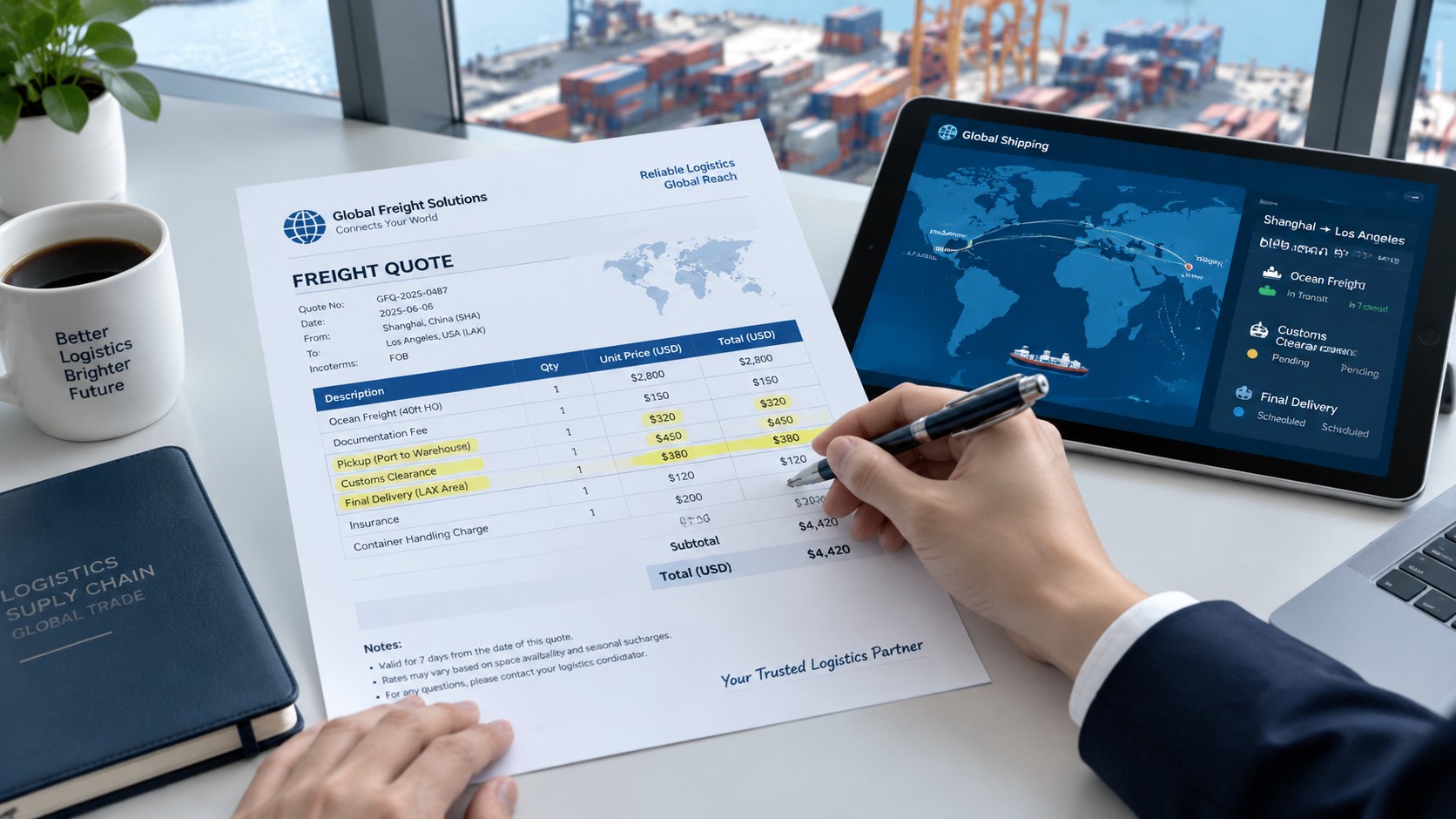
Common mistake: A buyer compares two totals after one provider has included final delivery and the other has quoted only the main transport leg. The fix is to restate the same pickup and delivery scope for both quotes before deciding which option is commercially workable.
Quote risk: A material change in packed dimensions, cargo-ready timing, pickup or delivery access, shipment restrictions, or destination scope should trigger a fresh confirmation instead of being carried forward under the old quote.
Prepare the Quote Request by Owner and Checkpoint
The fastest way to reduce back-and-forth is to collect each input from the party that actually controls it. A forwarding desk can then review the shipment in a consistent order and identify which part of the quote can be confirmed immediately and which part needs another party’s answer.
Cargo and Packing
The shipper provides product description, package count, dimensions, gross weight, packing method, and any handling restriction. The forwarder uses those facts to check the charge basis and service fit.
Cargo-Ready and Pickup
The shipper confirms when the cargo can be collected and where it will be released. The forwarder checks pickup feasibility, origin handling, and whether the requested service level still fits the timing.
Route and Service
The buyer states the required delivery timing and preferred service level. The forwarder compares the workable transport modes and confirms the planned routing and major handoffs.
Delivery Point
The consignee provides the exact delivery address, receiving hours, appointment rules, and site-access constraints. The forwarder checks whether the quoted final-mile scope matches the actual receiving conditions.
Commercial Scope
The buyer identifies the required delivery and import scope, including any specific duty or tax treatment that must be priced or coordinated. The forwarder confirms which services are included and which remain separate.
Special Handling
The shipper discloses restricted, fragile, oversized, temperature-sensitive, or otherwise unusual cargo conditions. The forwarder checks carrier acceptance, handling requirements, and whether the original quote must be revised.
Recommendation: Compare Scope First, Then Price
For a standard China-to-USA shipment, request a comparable ocean, air, or express option only after the cargo, pickup point, delivery point, service level, and charge basis are defined. The practical default is the mode that meets the delivery requirement with the fewest unclear handoffs. The decision changes when cargo timing, size, handling requirements, or destination access makes another service materially better suited.
Ask the forwarding desk to return each option with the same structure: shipment basis, route, included work, excluded work, destination handoff, quote date, and the condition that would force a revision. That format gives procurement and operations one common checkpoint instead of comparing disconnected headline numbers.
Illustrative example (not a customer case): A buyer has a shipment that is fully packed, has a confirmed pickup location, and needs delivery to a receiving site with a stated appointment process. The buyer asks for an ocean option and an air option using the same cargo data and final delivery scope. The quote desk then compares the measured shipment basis, pickup and destination work, service level, and named exclusions. The buyer selects the option only after both providers confirm the same scope and the condition that would require re-quoting.
Key Takeaways
Compare equivalent scope: Match pickup, transport, destination handoff, and final delivery before judging the headline price.
Confirm the charge basis: Make sure the quote uses the actual shipment measurements and service structure.
Name the owner: Assign the shipper, consignee, forwarder, broker, or destination party to each missing confirmation.
Review delivery access: Exact addresses, receiving rules, and appointments can change the work required after arrival.
Re-quote material changes: New dimensions, timing, restrictions, or service scope should not be assumed to fit the original quote.
Approve the complete operating scope: The usable quote is the one whose responsibilities and handoffs are clear enough to act on.
FAQ
Why can two China-to-USA shipping quotes look very different?
They may cover different shipment scopes. One quote can include pickup, destination handling, customs coordination, and final delivery while another covers only the main transport leg. A reliable comparison uses the same cargo basis, route, service level, pickup point, delivery point, and included work before the buyer compares the totals.
What information does a freight forwarder need to quote accurately?
The forwarding desk normally needs the cargo description, package count, packed dimensions, gross weight, cargo-ready timing, pickup location, destination address, required service level, and any special handling condition. The buyer should also identify which destination and import activities need to be included so the provider can return a quote with a clear scope.
Is the main freight amount the same as the total shipment cost?
Not necessarily. The main freight line represents only the scope stated beside it. Pickup, origin handling, destination work, delivery access, customs coordination, taxes, insurance, storage, or other services may be separate. The buyer should ask which items are included, which are excluded, and which still require confirmation before approving the shipment.
How should I compare ocean, air, and express options?
Keep the shipment facts and delivery scope consistent, then compare the service level and handoff chain. Ocean can suit larger routine shipments, while air and express can fit more time-sensitive cargo or smaller shipment structures. The right choice depends on the buyer’s timing, cargo characteristics, delivery control, and tolerance for additional handling.
What can make a confirmed quote need revision?
Material shipment changes can require a new review. Common triggers include different package dimensions or weight, a changed cargo-ready date, a different pickup location, new delivery-access conditions, special cargo restrictions, or a broader destination service request. The buyer should report the change and ask which quote lines need to be reconfirmed.
Who should confirm the final delivery requirements?
The consignee or receiving site should confirm the exact address, receiving hours, appointment process, and physical access conditions. The forwarder then checks whether the requested delivery service covers those requirements. This handoff matters because a transport quote can be operationally incomplete when the final receiving conditions were never supplied.
Should customs and duty treatment be shown in the quote?
They should be addressed whenever they affect the requested commercial scope. The quote should make clear whether customs coordination, duties, and taxes are separate, included under a specified service arrangement, or still awaiting confirmation. The importer, broker, and forwarder should align those responsibilities before booking rather than assuming that a freight total covers them.
What is the best question to ask before approving a freight quote?
Ask: “What exact shipment scope does this price cover, and what change would require a new quote?” That question forces the provider to identify the cargo basis, handoffs, included work, exclusions, timing conditions, and destination scope. It also gives the buyer a clear checkpoint for deciding whether the quote is ready for approval.
Disclaimer: This page is general quote-planning guidance, not a binding quotation or delivery commitment. Actual charges and handoffs depend on the cargo, route, timing, provider confirmation, and destination conditions. Where duties, customs, tax, insurance, or contract questions apply, confirm them with the relevant party before booking.