What Makes a Shipping Quote Usable?
International Shipping Quotes: What to Include for an Accurate All-In Price starts with one practical question: which quote can actually move the cargo to the required delivery point, with the right service scope, and with enough detail for approval? Two freight quotes are not comparable simply because both show a transport price. The cargo-ready date, pickup point, route, shipment basis, destination handoff, final delivery scope, and included work can all change what the buyer is actually purchasing.
A workable comparison aligns those variables before anyone chooses a carrier or service. The forwarding desk should know what is being collected, where the cargo starts, how it will move, where the international transport ends, who handles the destination stage, and what delivery point the quote covers. The buyer should also know which items remain subject to confirmation. That approach makes sea freight service, air service, express service, rail, or a combined route comparable on the same operating scope instead of comparing disconnected headline numbers.
The next checkpoint is simple: send the missing shipment facts to the person preparing the quote and ask which lines will be revised before approval.
How to Align International Shipping Quote Scope
A forwarding desk normally checks the shipment in operating order rather than starting with the displayed freight charge. Each field answers a different quote question, and each unresolved field creates a different comparison problem. Use the baseline below before comparing two or more offers.
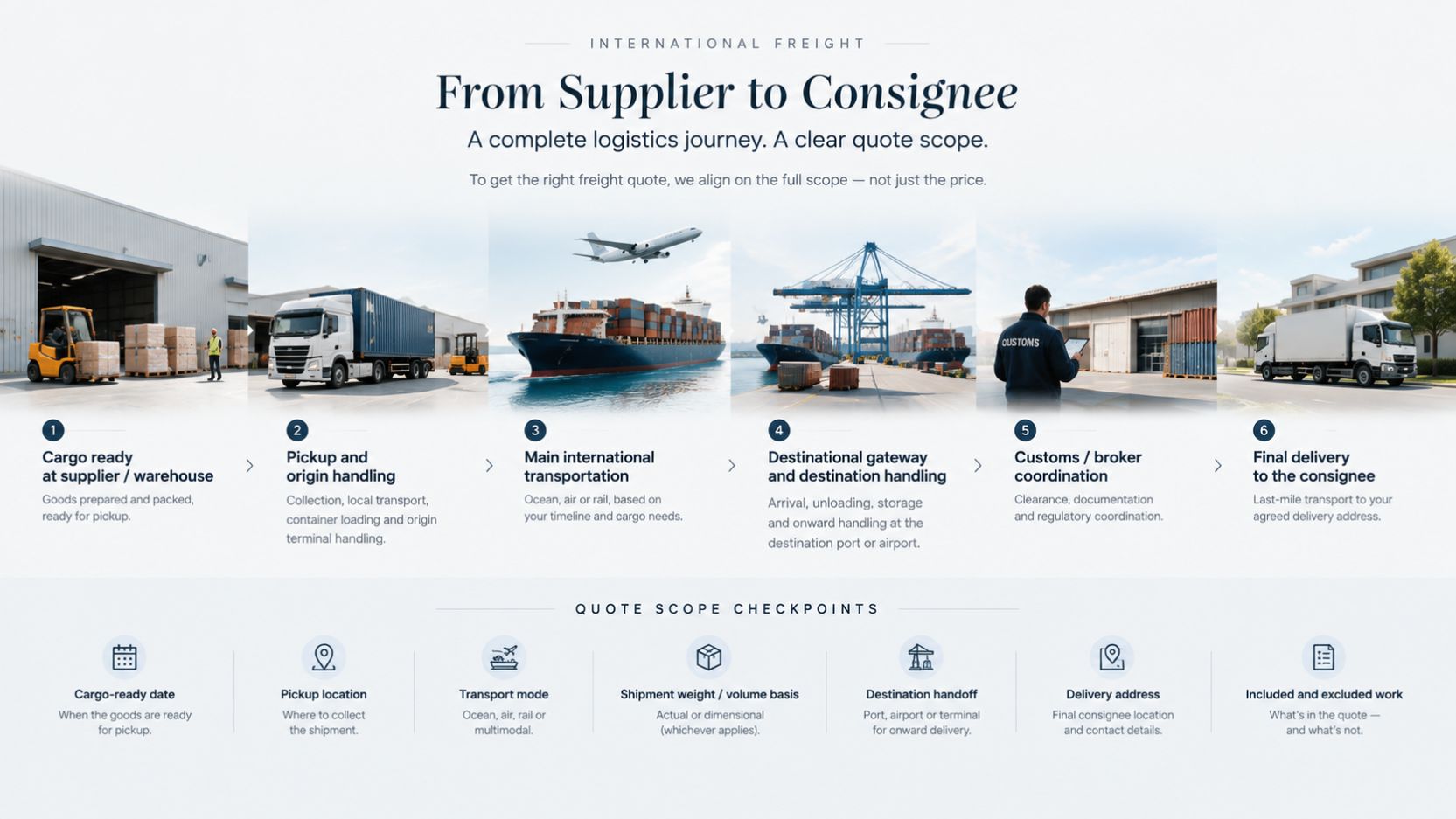
| Checkpoint | What to provide | Why it changes the quote | Who confirms it |
|---|---|---|---|
| Cargo-ready date | Expected ready date | Affects booking and service availability | Shipper and forwarder |
| Pickup and origin | Pickup address and loading conditions | Defines first-mile work and origin handling | Shipper and origin team |
| Main route | Mode and intended gateway | Changes transport path and handoffs | Forwarding desk |
| Cargo basis | Packages, dimensions, weight, CBM | Determines the applicable charging basis | Shipper and forwarder |
| Destination handoff | Port, airport, terminal, broker, or local agent scope | Separates included work from destination work | Forwarder and destination party |
| Delivery point | Address and appointment requirements | Changes final-mile operating conditions | Consignee and forwarder |
| Quote validity and inclusions | Issue date, included work, exclusions | Shows what is actually being approved | Forwarder |
Do not approve a quote while one offer covers door delivery and another stops at a gateway. The same problem appears when one quote includes origin pickup or destination coordination and the other leaves those tasks open. Ask the forwarding desk to restate both offers under the same delivery point and service boundary, then identify the exact line that still needs confirmation.
Charge Basis and the Inputs That Change It
The buyer should separate the charge basis from the charge amount. The basis explains what shipment input the provider uses when building the charge. Once the basis is clear, the forwarding desk can verify whether the cargo data supports the quoted scope and whether a changed shipment detail requires a revised quote.
| Shipment setup | Primary input | Operational effect | Quote question |
|---|---|---|---|
| FCL | Container type and required capacity | Links the quote to container planning | What container scope is included? |
| LCL | Volume, weight, and shipment dimensions | Can change the applicable consolidation basis | Which measurement is being used? |
| Air freight | Actual and chargeable weight inputs | Can change the rated shipment basis | Which weight will be used for rating? |
| Express | Package dimensions, weight, and service level | Can change both rating and handling scope | What service level and rating basis apply? |
| Pickup | Address, access, and loading conditions | Changes the origin collection task | What pickup conditions are assumed? |
| Delivery | Address, access, and appointment needs | Changes the final handoff | What delivery conditions are included? |
Quote review field: Ask for the exact shipment input behind each charge basis. A packing update, revised dimensions, different service level, or new delivery condition can make an earlier comparison invalid even when the main transport route has not changed.
Air and express shipments need particular attention when package dimensions differ materially from actual weight because the provider may use a chargeable-weight basis. The forwarding desk should confirm the current rating input against the final packing information rather than relying on an early estimate.
For multimodal movements, the same principle applies across each handoff. A multimodal freight arrangement can combine different transport stages, so the buyer should ask which party owns each transfer and which stage is still subject to reconfirmation.
What the Quote Includes and Who Acts
An all-in price only has meaning when the buyer can identify the work included behind it. A quote may cover the international movement while leaving pickup, destination coordination, customs brokerage, final delivery, storage, or special handling outside the stated scope. Those gaps matter because the cargo still has to pass through those operating stages even when the displayed freight line does not mention them.
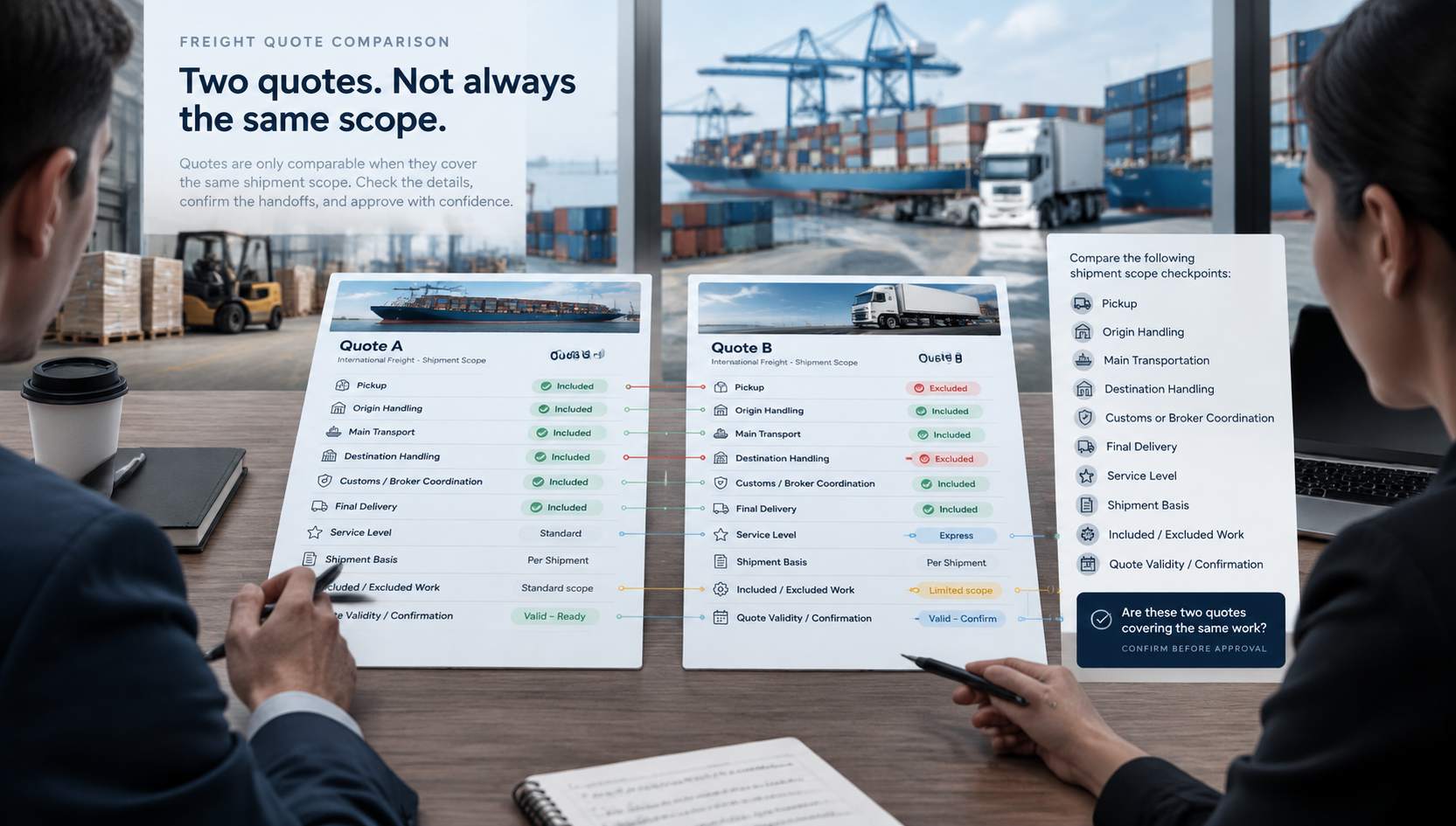
Pickup and origin handling: The shipper should confirm the exact pickup point, loading access, and origin services expected before booking.
Main transport: The forwarding desk should confirm the selected mode, intended route, and service level under the same shipment assumptions.
Destination handoff: The forwarder should state whether terminal handling, local coordination, or customs brokerage coordination is included, excluded, or pending confirmation.
Final delivery: The consignee should confirm the delivery address, access conditions, and any appointment requirements before the quote is treated as a door-delivery comparison.
Special handling: The shipper should identify oversized, fragile, regulated, temperature-sensitive, or otherwise restricted cargo early so the service scope can be checked before booking.
Insurance scope: When the buyer wants cargo cover considered as part of the shipment plan, the relevant cargo insurance option should be discussed separately from the transport charge.
When duties, taxes, or a named delivery structure are material to the buyer’s all-in decision, the forwarding desk should identify exactly what the quote covers and what remains with the importer or other responsible party. A DDP shipping arrangement can therefore be compared only when the parties confirm the commercial and destination scope on the same basis.
Note: A freight quote is tied to the cargo, handoffs, route, service level, timing, and destination work stated in it. Carrier and handling conditions can change. Align the scope first, then request confirmation for the specific shipment.
Which Shipping Options Fit the Shipment?
The useful comparison is the one that changes the operating decision. Buyers should compare options under equivalent scope, then identify where the handoffs, service level, or cargo fit changes. The forwarding desk should not compare a fast service with a slower service as though they were identical products.
FCL versus LCL: FCL can fit cargo that needs dedicated container space or tighter control over handling, while LCL can fit smaller shipments that do not require a full container. The quote question is whether each option uses the correct cargo basis and includes the same destination scope.
Sea versus air: Sea service can suit buyers planning around a longer transport cycle, while air can fit cargo where the delivery target requires a faster service level. Ask the forwarding desk to compare the same pickup and delivery points before discussing the freight lines.
Air versus express: Express may provide a different shipment handling and delivery structure than standard air freight. The buyer should confirm the package profile, destination service, and delivery expectation rather than treating the two as interchangeable.
Port-to-port versus door-to-door: Port delivery leaves more destination work for the buyer or another provider. A door-to-door freight arrangement should be reviewed against the actual delivery address, access conditions, and appointment requirements.
Rail or combined routing: Rail can be considered where the route and inland network support it, while a combined service may use more than one transport stage. Ask which handoff changes and which stage becomes the next quote checkpoint.
The practical default is to request two comparable options when the shipment has a meaningful service trade-off. The forwarding desk can then explain the operating difference without turning an unaligned headline price into a false price comparison.
Where Freight Quotes Go Wrong
Most quote problems begin when an input changes after the original review or when one handoff was never defined. The buyer should focus on the specific trigger, not on a generic warning about extra charges. The correct response is to identify what changed, who owns the confirmation, and whether the quote must be revised.
Common mistake: A shipper gives a warehouse name but not the complete pickup address or loading conditions. The forwarding desk may therefore price the wrong origin task. Confirm the actual collection point before comparing pickup-inclusive offers.
A changed cargo-ready date can affect booking or service selection. Revised dimensions can change the shipment basis. A missing delivery appointment requirement can change the final-mile task. A destination handoff that was assumed but never written into the quote can leave the buyer comparing different scopes. Storage, rebooking, document correction, or equipment-return requirements can also create a new quote checkpoint when the original conditions no longer apply.
Risk trigger: Re-quote the shipment when the cargo, packing, pickup point, delivery conditions, service level, or required destination work differs materially from the assumptions used for the original quote.
Special cargo needs the same discipline. The buyer should disclose the relevant handling restriction before the forwarding desk confirms the service. Oversized or unusual project movements may require a dedicated review through project cargo shipping rather than being forced into a standard shipment assumption.
Build a Quote-Ready Handoff
A complete quote request should move information from the shipper to the forwarding desk in a sequence that reduces rework. The person preparing the quote can then verify the transport basis, route, handoffs, and delivery scope without guessing at missing conditions.
Cargo and Packing
Provide cargo type, package count, dimensions, gross weight, and CBM. The shipper supplies these figures, and the forwarding desk checks whether the selected service can be rated against the stated packing data.
Ready Date and Pickup
Provide the cargo-ready date, pickup address, loading conditions, and warehouse contact when relevant. The origin team can then verify the first-mile scope and identify any access condition that needs clarification.
Route and Service
State the preferred mode, acceptable service level, and any timing requirement. The forwarding desk can compare suitable routing choices, including air freight service or rail freight service where the route supports them.
Delivery Details
Provide the delivery address, postcode, receiving hours, access conditions, and appointment needs. The destination team can confirm whether the requested final-mile scope matches the intended delivery point.
Commercial Scope
State which party should coordinate duties, taxes, customs steps, and other destination work when those items matter to the purchase decision. The forwarding desk should identify what is included and what requires separate confirmation.
Special Restrictions
Disclose fragile, oversized, regulated, temperature-sensitive, or otherwise restricted cargo conditions. The relevant operations team can then verify handling requirements before the quote is treated as ready for approval.
Quote checkpoint: Ask the forwarding desk to return the route, service level, shipment basis, included work, exclusions, quote date, and the specific facts that would trigger a revision.
What to Compare First
Request the quote in two layers: first align the physical shipment and delivery scope, then compare the service options that fit that same scope. That sequence gives the buyer a practical baseline and makes it easier to see whether a difference comes from the transport mode, shipment basis, destination handoff, or delivery requirement.
For a standard commercial shipment, a useful default is to compare the primary mode against one operational alternative under matching pickup and delivery conditions. The fact that should change that default is the shipment’s actual requirement: available cargo space, required delivery timing, package profile, routing constraints, handling restrictions, or the amount of destination work the buyer expects the forwarder to coordinate.
After the comparison, ask one approval question: “Which specific assumption would make you request a revised quote?” That question keeps the next checkpoint tied to an operational change rather than a vague request for a better price.
Illustrative example (not a customer case): Assume a buyer has several packaged cartons that are ready for collection, needs delivery to a commercial address, and is deciding between a slower consolidated service and a faster air option. The buyer asks both providers to use the same pickup point, cargo data, delivery address, and destination scope. The forwarding desk can then explain which operating condition changes between the two services and identify the exact shipment fact that would require a revised quote.
Key Takeaways
Align the shipment first: Cargo, pickup, route, delivery point, and service level must describe the same movement before prices can be compared.
Separate basis from amount: Confirm which shipment input creates the charge before evaluating the displayed freight figure.
Define the handoffs: Ask who owns origin work, destination coordination, customs steps, and final delivery under the quoted scope.
Use equivalent service scope: Compare options only after pickup, destination, and delivery conditions are aligned.
Flag change triggers: Revised packing, timing, access, restrictions, or destination work can require the quote to be reviewed again.
Prepare the next checkpoint: Send complete cargo and delivery data, then ask what the forwarding desk needs to confirm before approval.
FAQ
What should an international shipping quote include?
A usable quote should identify the cargo assumptions, pickup scope, transport mode, destination handoff, delivery point, service level, included work, exclusions, and quote date. The buyer should also know which conditions remain subject to confirmation. That information creates a workable commercial scope instead of leaving the approval decision dependent on a single freight number.
Why can two shipping quotes for the same cargo differ so much?
Two quotes may describe different services even when the cargo is identical. One may include pickup and door delivery while another ends at a terminal. The offers may also use different cargo assumptions, service levels, routing choices, or destination handoffs. Ask both providers to restate the scope against the same shipment facts before comparing the figures.
What cargo information should I send with a quote request?
Send the cargo type, package count, dimensions, gross weight, CBM, cargo-ready date, pickup location, delivery address, and any service or handling requirement that could affect the movement. Accurate packing information is especially important because the applicable shipment basis can depend on the way the cargo is packed and measured.
Should pickup and final delivery appear in the same quote?
They do not have to be included in every shipment, but the buyer should know whether they are included, excluded, or handled by another party. A port-only quote and a door-delivery quote are different scopes. The forwarding desk should identify the exact handoff point so the buyer does not treat separate service boundaries as a single all-in movement.
When should a freight quote be reviewed again?
Request a review when a material shipment assumption changes. Examples include a different cargo-ready date, revised dimensions or weight, a new pickup or delivery location, a changed service level, different access conditions, or newly disclosed handling restrictions. The useful question is which changed fact affects the quoted scope and which line now needs confirmation.
How should I compare FCL and LCL quotes?
Start with the same pickup and delivery scope, then confirm the cargo basis behind each option. FCL planning centers on container requirements, while LCL planning depends on the shipment’s consolidation basis and cargo measurements. The comparison should also account for the different handoffs created by each service so the buyer is comparing the same stage of the journey.
What does “all-in” mean on a freight quote?
“All-in” should be treated as a scope statement, not as a universal label. The buyer should ask which transport stages, handling tasks, destination work, and delivery services the quoted amount covers. The quote should also identify exclusions and conditions that can trigger a revision. That detail defines what the buyer is actually approving.
What should I ask a forwarder before approving shipping quotes?
Ask the forwarder to confirm the pickup point, shipment basis, route, service level, destination handoff, delivery scope, included work, exclusions, and the conditions that would require a revised quote. That conversation gives the buyer a clear checkpoint for approval and makes it easier to identify any unresolved assumption before cargo is booked.
Disclaimer: This page is general quote-planning guidance, not a binding quotation or delivery commitment. Actual charges and handoffs depend on the cargo, route, timing, provider confirmation, and destination conditions. Where duties, customs, tax, insurance, or contract questions apply, confirm them with the relevant party before booking.