

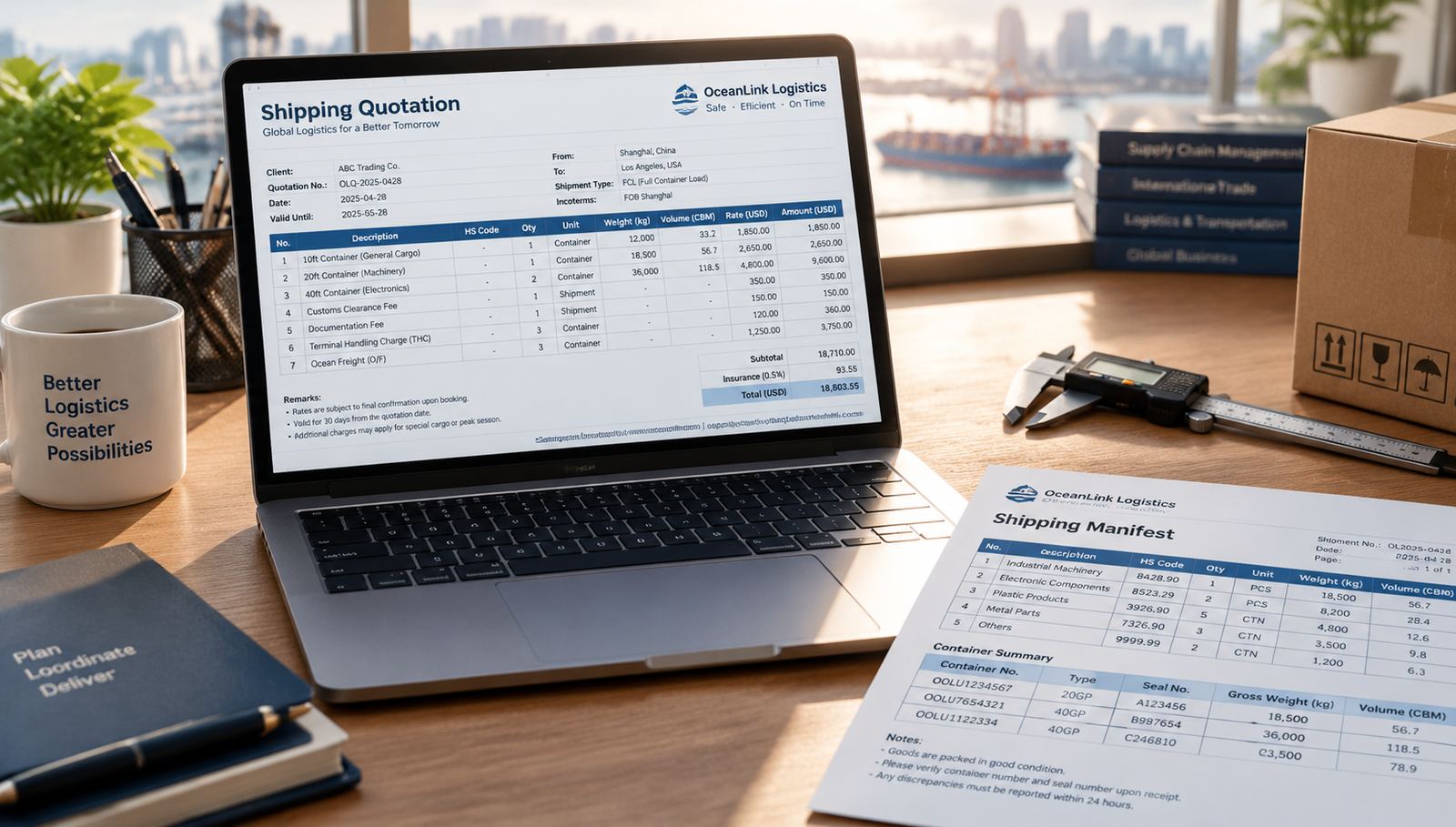
Freight charges are the amounts billed for transporting cargo and providing the services specified in a shipment quotation. To understand freight terms in practice, identify what each line item covers, which party pays it, and whether the amount is included, excluded, estimated, or payable only when a specific condition occurs. These distinctions help importers, exporters, and procurement teams compare offers without overlooking costs that may arise before delivery.
The safest way to review a freight quote is to compare the complete service scope rather than the headline price. Check the origin, destination, transport mode, cargo measurements, handling requirements, and delivery arrangements first. Then review each charge, the basis used to calculate it, and any conditions that could change the final amount. The result is a more consistent budget and a clearer basis for approving bookings, checking invoices, and resolving unexpected charges.
What Freight Charges Include
A freight quotation may combine transportation with handling and administrative services, or it may list those items separately. The names used for individual charges vary by provider, route, and contract, so the description alone does not establish what the fee covers.
| Charge category | Typical purpose | What to verify |
|---|---|---|
| Base freight | Transportation over the quoted route or transport leg. | Origin, destination, service level, and charging basis. |
| Origin and destination handling | Specified cargo or terminal activities at either end. | Which activities are included and where they occur. |
| Documentation and administration | Preparation or processing of specified shipping documents and records. | Which documents or administrative tasks the fee covers. |
| Accessorials | Additional services or handling outside the standard quoted scope. | What triggers the charge and how it is calculated. |
| Third-party and import costs | Separate expenses such as brokerage, duties, taxes, or certain inspection and storage costs. | Who arranges and pays each item, and whether it is excluded. |
A freight fee is a broad commercial label rather than a universally standardized category separate from a freight charge. One provider may use either expression for the same transportation service, while another may use a fee label for administration or handling. Ask for the underlying service and charging method whenever a line item is unclear.
Also distinguish a quoted transportation cost from the total cost of getting goods ready for delivery. Clearance, government charges, special handling, storage, insurance, and final-mile delivery may be priced separately. A quotation is complete for budgeting purposes only when the services required for the shipment have been identified and the costs outside its scope have been addressed.
How to Compare Two Freight Quotes
Two quotations with different headline prices cannot be compared fairly until their service scopes match. The following hypothetical example illustrates why an apparently cheaper offer may require additional cost checks. It uses no market rates or actual customer data.
| Cost component | Quote A | Quote B | Next check |
|---|---|---|---|
| Origin pickup | Priced separately | Included | Confirm pickup address and access requirements. |
| Export handling and documents | Scope unclear | Included | Identify any unpriced origin services. |
| Main freight | Quoted | Quoted | Match the route, cargo data, and rating basis. |
| Destination terminal handling | Not specified | Included | Verify the exact destination activities covered. |
| Customs and final delivery | Quoted separately or excluded | Brokerage separate; delivery included | Price the same delivery and clearance scope. |
| Import duties, taxes, and insurance | Not included or confirmed | Duties and taxes excluded; insurance optional | Confirm separate costs and required protection. |
Quote B covers more identified services in this example, but that does not prove it is less expensive overall. Quote A could become competitive once the missing items are priced, or its final cost could exceed Quote B. Neither conclusion is justified without comparable amounts and equivalent service requirements.
Use a consistent status for each line item: included, excluded, separately quoted, estimated, or billed at actual cost. These labels make uncertainty visible. When a provider uses a term such as “all-in,” ask for the specific inclusions and exclusions rather than assuming that every destination, customs, or delivery expense has been covered.
How Chargeable Weight and Transport Mode Affect Cost
The applicable pricing basis depends on the transport mode, cargo characteristics, route, and quoted service. Accurate weight and dimensions are essential because a difference in the cargo data may change the amount billed under the agreed rating rules.
Chargeable weight in air freight
Air freight commonly compares actual gross weight with dimensional weight and applies the relevant charging rules to determine chargeable weight. Dimensional weight represents the space a shipment occupies relative to a specified conversion factor. The applicable divisor, rounding method, and minimum charge depend on the service and provider terms.
Illustrative calculation: Assume one package measures 100 × 80 × 60 cm, weighs 80 kg, and the quoted service uses a dimensional divisor of 6,000 cm³/kg.
Dimensional weight = (100 × 80 × 60) ÷ 6,000 = 80 kg.
Actual gross weight is also 80 kg, so the calculated chargeable weight is 80 kg before any applicable service-specific rounding or minimum-charge rules. This example explains the mechanism; the divisor is an illustrative assumption, not a universal industry standard. Confirm the actual charging rules with the quoting provider. For shipments requiring this pricing model, review the stated scope of the air freight service alongside the cargo measurements.
Other transport modes
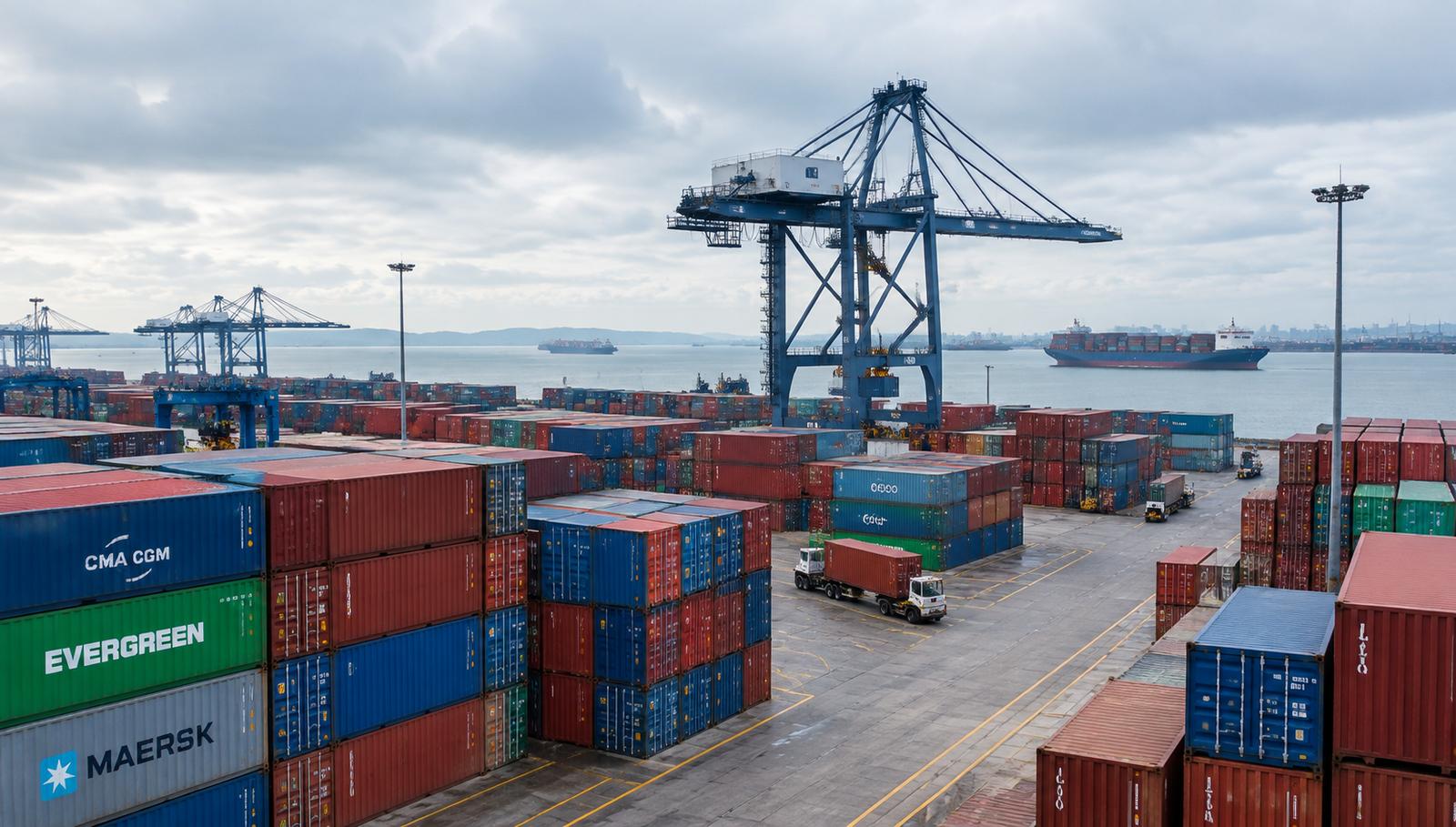
Ocean freight may be priced by container, cargo volume, weight, or another agreed basis. The quotation should distinguish main transportation from origin handling, destination terminal costs, and any separately billed services. Review the relevant sea freight arrangement for the precise port and handling scope.
Rail shipments can involve terminal transfers and inland transportation charges that depend on the route and service configuration. Check which legs and handoffs appear in the rail freight quotation. A shipment using several modes may require separate price components for each leg, so confirm how the provider accounts for transfers under a multimodal freight service.
Service speed is another cost consideration. Express shipping may suit eligible cargo with tight delivery requirements, but the quoted price must still be checked against package limits, delivery scope, and applicable service conditions. A faster service label does not, by itself, confirm the final delivery date or full cost.
Accessorial Charges, Handling Fees, and Potential Extra Costs
Accessorials apply when the service scope or an operating condition requires an additional charge under the applicable terms. Examples may include extra pickup or delivery services, special equipment, additional loading or unloading, storage, redelivery, and cargo handling beyond the standard arrangement. Confirm the charge trigger, applicable unit, and responsible party rather than relying on the line-item name.
Cargo that is oversized, unusually heavy, difficult to handle, or subject to specialized lifting requirements may need equipment or coordination beyond routine transportation. Ask the provider to review these requirements before quoting. For complex or nonstandard cargo, project cargo shipping may be worth evaluating against a standard freight arrangement.
Ocean container shipments may also incur charges associated with using equipment or terminal space beyond the permitted period. In common usage, demurrage generally refers to a charge for a container remaining at the terminal beyond its allotted free time, while detention generally refers to a charge for retaining carrier equipment outside the terminal beyond the permitted period. Definitions, calculation rules, free-time allowances, and charge triggers vary by provider, location, and contract. Confirm the applicable conditions rather than treating these descriptions as universal rules.
Ask for the relevant start and end events, free-time allowance, charging unit, applicable calendar, and rate basis. Also establish who must arrange cargo release, pickup, return, and any required appointments. These checks are particularly useful when clearance delays or receiving restrictions could affect when cargo can be collected or equipment returned.
Shipments destined for a controlled fulfillment facility may require particular labels, packaging, pallet preparation, appointments, or receiving arrangements. For eligible goods moving to Amazon fulfillment, confirm whether these activities sit within the quoted Amazon FBA shipping scope or need a separate arrangement. Transport cost alone does not establish that the cargo meets the destination’s receiving requirements.
Confirm Delivery Scope, Customs, and Payment Responsibilities
A port-to-port quote and a door-to-door quote cover different stages of transportation. Before comparing them, identify the precise pickup and delivery points, access restrictions, included handoffs, and any services that the shipper or consignee must arrange separately. A door-to-door shipping arrangement should specify what happens between collection and final delivery, not merely state that the service covers both ends.
Customs brokerage and government duties or taxes are separate cost categories. Brokerage fees pay for specified clearance services, while duties and taxes are government-imposed amounts determined under the applicable rules. Inspections, storage, or disbursement-related charges may also arise depending on the shipment and local arrangements. Confirm the relevant scope with the party responsible for clearance and review the customs brokerage service when separate clearance support is required.
Where the commercial arrangement uses DDP, verify the named delivery location, the agreed allocation of import clearance and payment responsibilities, and whether the intended seller or importer can meet the destination country’s requirements. The label alone is not a substitute for reviewing the contract and applicable local rules. A DDP shipping arrangement should be checked against the actual transaction rather than assumed to cover every possible expense.
Insurance also deserves separate attention. A freight quotation does not establish that insurance has been arranged or that the cargo’s full value is protected. Confirm the insured value, covered transport stages, relevant risks, exclusions, limits, and claims procedure. When additional coverage is needed, review the proposed cargo insurance service independently of the transportation charge.
Freight Quote Checklist Before Booking
Use the following checks to turn a quotation into a usable shipping budget. Resolve unclear items before accepting the offer, and retain the confirmed scope with the booking record.
Match the shipment details
Confirm pickup and delivery locations, route, mode, package count, cargo description, gross weight, dimensions, and any handling restrictions. Ask the provider to recheck the quote if the shipment data changes.
Reconcile the service scope
Identify which origin activities, main transportation legs, destination services, customs arrangements, and final-delivery tasks are included. Compare offers only after the required scope is consistent.
Classify every material charge
Mark each amount as included, excluded, separately quoted, estimated, or billed at actual cost. Record the unit of charge, the service it covers, and the party responsible for payment.
Check conditional charges
Ask what triggers accessorials, storage, delay-related charges, special equipment, or additional delivery costs. Confirm relevant free-time allowances, approval procedures, and supporting charge records where applicable.
Confirm commercial conditions
Verify quotation validity, exclusions, payment terms, any adjustment conditions, and the process for approving additional expenses. Keep the final written confirmation available for invoice review.
The most common comparison error is choosing a provider based only on the base freight amount. This can hide differences in handling, delivery, and conditional charges. Another recurring risk is quoting with incomplete cargo information, which can lead to revised pricing when actual measurements or service requirements differ. Request written clarification for any material uncertainty before the booking is released.
Invoice review: When the final bill differs from the quotation, compare the disputed line item with the confirmed service scope, actual shipment details, and applicable charging conditions. Ask for the calculation or supporting record, and identify whether the difference results from revised cargo data, an added service, or a condition covered by the original terms.
Disclosure: This guide provides general logistics information and may refer to services relevant to the topic. Carrier terms, customs requirements, fees, service coverage, and operating conditions can change. Confirm current requirements and responsibilities before acting.
Key Takeaways
- Compare freight quotes using the same route, cargo data, transport stages, and delivery requirements.
- Distinguish included charges from exclusions, estimates, and costs triggered by specific conditions.
- Verify the chargeable-weight method and service-specific rating rules before approving a rate.
- Confirm who handles customs, duties, taxes, insurance, and final delivery.
- Retain written confirmation of quotation validity, conditional charges, and the process for approving additional costs.
Frequently Asked Questions About Freight Charges
What does a freight quote include?
A freight quote covers the transportation and other services specified in its written scope. Pickup, terminal handling, documentation, customs brokerage, duties, insurance, and final delivery may be included or charged separately. Check the line items and exclusions before treating the quoted total as the shipment’s complete cost.
What is the difference between a freight fee and a freight charge?
The two expressions often overlap in business usage. A provider may use either term for transportation or use a fee label for a particular service. The quoted description and pricing terms determine what the amount actually covers.
What is chargeable weight in air freight?
Chargeable weight is the weight used to rate a shipment under the applicable air freight rules. It commonly reflects a comparison between actual gross weight and dimensional weight. The conversion factor, rounding method, and minimum charge depend on the quoted service.
What is the difference between demurrage and detention?
In common container-shipping usage, demurrage generally relates to a container remaining at a terminal beyond its allotted free time, while detention generally relates to equipment retained outside the terminal beyond the permitted period. Verify the provider’s definitions, timing rules, and rates for the specific shipment.
Are customs duties and taxes included in freight charges?
Not automatically. Transportation charges, brokerage fees, and government duties or taxes are distinct cost categories, although a broader service arrangement may cover some of them. Confirm the written scope and establish which party is responsible for clearance and payment.
Why is my final freight invoice higher than the quote?
A bill may increase because the actual weight or dimensions differ from the submitted details, an additional service was required, or a condition triggered a charge under the agreed terms. Compare the invoice with the confirmed scope and request an explanation and supporting calculation for each disputed amount.
How can I identify accessorial charges before booking?
Ask the provider to list additional services, the conditions that trigger each charge, the applicable charging units, and whether approval is required. Review cargo handling needs, delivery restrictions, receiving appointments, and potential storage or delay exposure before the shipment moves.
How do I know whether a freight quote is still valid?
Check the quote’s stated validity period and any conditions affecting the rate. Changes to cargo details, routing, service scope, or operating conditions may affect the offer under its terms. Obtain written confirmation of the applicable price and inclusions before booking if the validity or assumptions are unclear.
Disclaimer: This article is general informational guidance, not a binding quotation, legal opinion, customs ruling, carrier commitment, or delivery guarantee. Requirements, charges, service terms, and responsibilities can vary by route, cargo, contract, carrier, and jurisdiction. Confirm current requirements before booking or filing.