

Choosing Between a 20ft and 40ft Shipping Container
Choose a 20-foot container when your cargo fits its usable space and meets its weight limits. Choose a 40-foot container when the shipment needs more internal length or volume and the equipment suits the route and delivery location. For businesses arranging 20 foot container shipping, the key decision is not simply which container is larger. It is which format accommodates the complete shipment safely and produces the most suitable overall shipping arrangement.
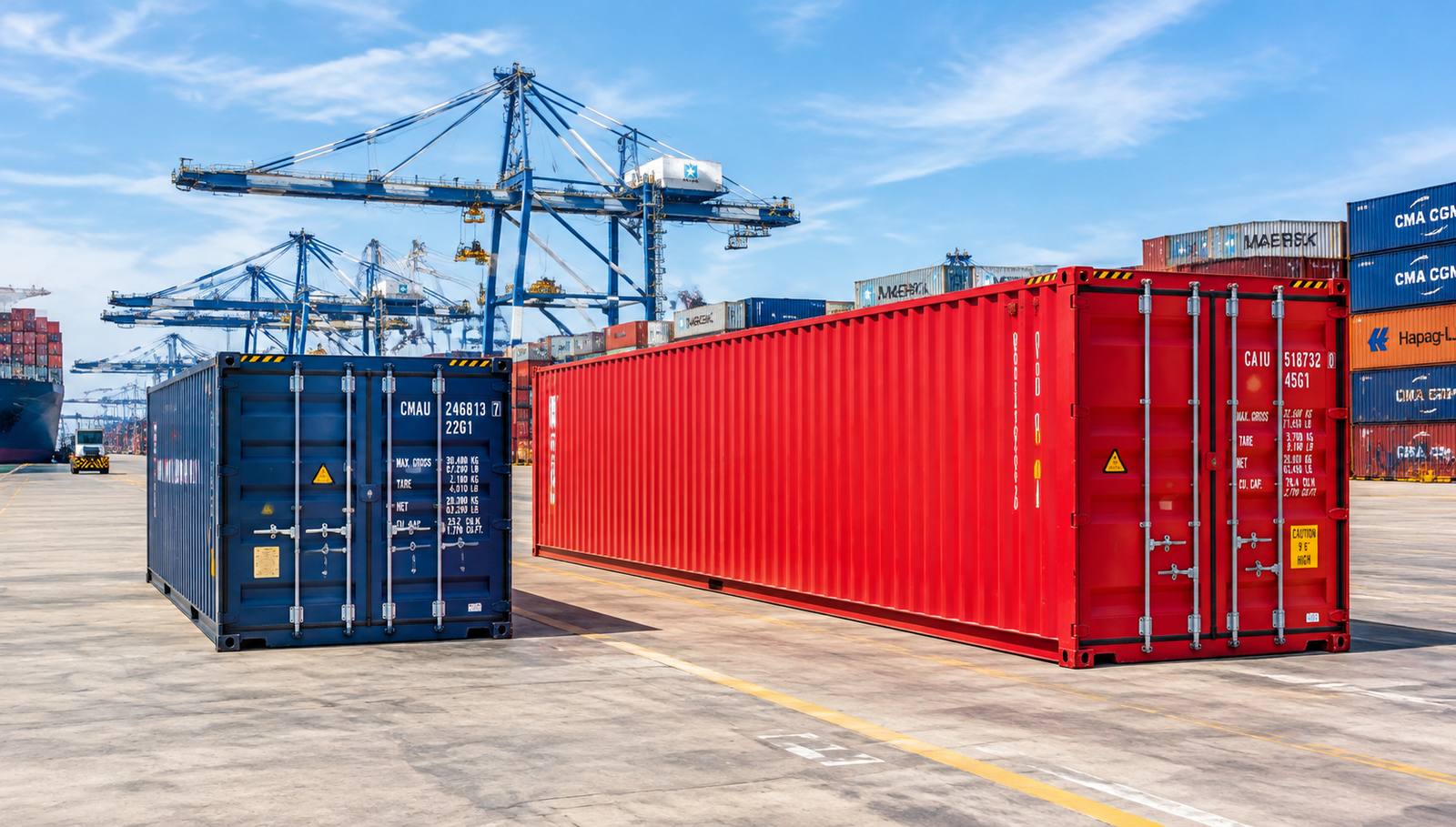
A standard 40-foot container provides approximately twice the internal volume of a standard 20-foot container, but its payload capacity does not double. Dense industrial cargo may suit the smaller unit, while bulky cartons, palletized goods, and longer items may benefit from the larger format. The final choice depends on actual cargo dimensions, gross weight, packaging, loading arrangements, equipment specifications, and comparable freight quotations.
Use the specifications below as an initial screening tool. These are representative values for standard dry containers, not guaranteed dimensions or weight limits for every available unit. Confirm the assigned equipment’s specifications before booking.
| Specification | 20ft standard dry | 40ft standard dry |
|---|---|---|
| Approximate internal length | 5.90 m | 12.03 m |
| Approximate internal width | 2.35 m | 2.35 m |
| Approximate internal height | 2.39 m | 2.39 m |
| Approximate internal capacity | 33.2 m³ | 67.7 m³ |
| Approximate door opening width | 2.34 m | 2.34 m |
| Approximate door opening height | 2.28 m | 2.28 m |
| Representative tare weight | 2,300 kg | 3,750 kg |
| Representative payload capacity | 25,000 kg | 27,600 kg |
| Typical cargo profile | Compact or dense cargo | Bulky, long, or higher-volume cargo |
The dimensions, capacity, tare weight, and payload figures in this table are representative values published by DSV’s dry container specifications. Equipment specifications vary. For comparison, OOCL’s general-purpose container specifications provide equipment-specific weight and capacity information that should be checked separately. Always confirm the actual container’s identification plate, payload, gross-weight limit, and applicable road transport restrictions.
How to Compare Container Sizes for Shipping
The specification table establishes the physical differences, but nominal capacity alone cannot confirm whether a shipment will fit. Compare both options using the same cargo details, route, shipping service, delivery boundary, and timing requirements. This prevents an incomplete quotation or an unsuitable loading plan from influencing the decision.
| Input | What to confirm | Why it matters |
|---|---|---|
| Cargo dimensions | Packed measurements, volume, largest pieces, and pallet arrangement | Establishes physical fit and loading feasibility |
| Weight | Cargo, packaging, pallets, and securing materials | Establishes payload and transport compliance |
| Route | Origin, destination, gateways, and inland connections | Affects equipment availability and delivery feasibility |
| Service scope | Port-to-port or door-to-door, including inclusions and exclusions | Makes the quotations commercially comparable |
| Delivery requirements | Required arrival window, site access, unloading, and container return | Identifies restrictions that can change the preferred option |
Give the forwarder a consistent packing list and cargo specification for both options. Include the dimensions of individual packages rather than providing only the shipment’s total volume. Confirm whether the loading plan allows the cargo to pass through the doors and be positioned and secured safely.
When to Choose a 20ft or 40ft Container
20ft container shipping
Best fit: A 20ft container is worth considering for compact machinery, dense industrial components, and packaged cargo that fits comfortably within the unit’s usable dimensions. It can suit a shipment that reaches its practical weight limit before using the available space.
Operational considerations: The loading team must distribute the cargo safely and keep the total load within the equipment’s permitted payload and gross-weight limits. The shipper should also confirm that the container can be moved to and handled at the destination.
Weak fit: A 20ft container may not accommodate long items, bulky packaging, or pallet arrangements that require additional internal length. Repacking or changing the equipment after booking can disrupt the loading plan.
Selection trigger: Consider the smaller unit when the complete shipment fits safely and the comparable quotation supports the choice.
40ft container shipping
Best fit: A 40ft container can accommodate shipments that require more internal length or volume. It may suit bulky cartons, palletized goods, assembled products, and longer items that cannot be arranged efficiently in a smaller unit.
Operational considerations: The forwarder should confirm the usable dimensions, permitted load, cargo distribution, routing, and destination access. Additional internal space does not remove restrictions imposed by weight limits, handling requirements, or site conditions.
Weak fit: A 40ft container may be unsuitable for dense cargo that reaches its permitted payload before the available space is used. It may also create delivery problems when the destination cannot accommodate the equipment or when the cargo’s shape prevents efficient loading.
Selection trigger: Consider the larger unit when the additional space solves a documented loading requirement and the overall transport arrangement remains practical.
When a 40ft High Cube container may be better
A 40ft High Cube container is another option when cargo requires additional internal height rather than simply more floor length. It can suit light, bulky goods that need greater vertical clearance. The shipper must still verify the actual internal height, door opening, permitted payload, loading method, and route suitability.
Do not assume that every tall item will fit merely because the container has a higher roof. Packaging, loading equipment, door clearance, securing arrangements, and any restrictions at the destination can determine whether the equipment is suitable.
Which Container Size Fits Your Shipment?
Use the following matrix to narrow the options based on the shipment’s actual operating conditions. These recommendations identify which option to evaluate first; they do not replace a loading assessment or equipment confirmation.
| Shipment scenario | Option to consider | What to verify |
|---|---|---|
| Dense industrial components with a compact loading footprint | 20ft | Gross load, payload, load distribution, and securing requirements |
| Bulky cartons or packaged goods requiring more space | 40ft | Packed volume, internal dimensions, and door clearance |
| Palletized cargo with mixed products | Compare both using a loading plan | Pallet dimensions, orientation, stacking, and unused space |
| Cargo requiring additional internal height | Evaluate 40ft High Cube | Actual height, door opening, equipment availability, and route limits |
| Cargo that fits both formats | Compare equivalent quotations | Total shipment cost, delivery scope, and equipment availability |
The primary decision is whether the proposed container can accommodate the cargo safely and whether the complete shipment arrangement makes commercial sense. Additional space is useful when the loading plan needs it. It is not an advantage by itself when the cargo fits the smaller option and the larger format creates no practical benefit.
Field note: Container length, cargo volume, and payload are separate measures. A shipment can fit within the nominal volume but exceed the permitted weight, or meet the weight limit while failing to pass through the doors. Check all relevant constraints before confirming the equipment.
How to Compare 20ft and 40ft Container Shipping Costs
There is no universal rule that a 20ft container or a 40ft container will always be cheaper. The result depends on the route, shipping period, equipment availability, cargo requirements, and services included in the quotation. Compare the complete shipment cost rather than choosing by the headline ocean freight charge.
Request quotations using the same origin, destination, cargo details, shipping service, and delivery boundary. Check whether each quote includes origin handling, export documentation, ocean freight, destination handling, customs support, and final delivery. Record exclusions, conditional charges, and services payable directly to third parties.
Compare total cost and usable capacity
When both container sizes can safely accommodate the cargo, evaluate the complete quoted charge alongside the actual cargo volume and loading requirements. A cost-per-CBM calculation can help explain the commercial difference between suitable options. Divide the comparable total shipment cost by the actual cargo volume to obtain this supporting indicator.
Do not use cost per CBM as the sole selection criterion. It does not establish whether the container can accommodate the cargo, comply with weight restrictions, reach the destination, or meet the required delivery window. A lower unit-volume cost does not compensate for an unsuitable loading plan or missing delivery services.
Before comparing quotations, also check whether the larger container creates unused capacity or whether the smaller unit would require a different loading arrangement. Ask the forwarder to explain the proposed equipment, included services, excluded charges, destination handling, and assumptions behind each option.
For a broader understanding of the proposed sea transport service and its operating scope, review the provider’s sea freight service. Request shipment-specific confirmation rather than assuming that a general service description includes every charge or handling stage.
Note: Freight rates and total shipment charges change with cargo details, route, service scope, carrier conditions, timing, destination handling, and applicable responsibilities. Compare current quotes only after their scope has been aligned.
Transit Time, Handoffs, and Delivery Planning
Container size does not determine the overall delivery date. Timing depends on the route, booking availability, cargo readiness, transport schedules, handling, customs processing, cargo release, and final delivery arrangements. Ask the forwarder to distinguish the estimated main transport time from the complete delivery cycle.
| Stage | What to confirm | Potential effect |
|---|---|---|
| Booking and equipment | Equipment availability, cargo readiness, and booking acceptance | Affects when loading and dispatch can begin |
| Origin operations | Pickup, loading, documentation, and terminal arrangements | Can affect departure readiness |
| Main transport | Route, transport schedule, and planned transfers | Influences estimated arrival |
| Destination release | Import documents, customs processing, and cargo release | Determines when collection can proceed |
| Final delivery | Vehicle access, appointment, unloading, and container return | Affects the final delivery plan |
Request a route-specific estimate and clarify the assumptions behind it. Confirm the expected routing, cargo-ready date, destination handling, delivery appointment, and any dependencies on customs clearance. Treat the estimate as a planning reference, not as a guaranteed delivery commitment.
When the shipment requires coordinated inland transfers or multiple transport modes, consider whether a multimodal freight arrangement suits the route. Confirm where each transfer occurs, which party manages the connection, and whether the handling plan meets the cargo’s protection requirements.
Customs, Service Scope, and Delivery Responsibilities
Container size determines the physical loading format; it does not determine who arranges transport, manages customs documentation, pays destination charges, or delivers the goods. Establish these responsibilities separately so that the chosen container comes with a workable service plan.
Confirm the delivery boundary
A port-to-port arrangement covers the agreed transport between gateways, while a door-to-door arrangement may include origin pickup and delivery to the consignee’s premises. The precise scope depends on the quotation. A door-to-door label does not automatically mean that every customs service, duty, tax, unloading charge, or local handling expense is included.
When the shipment requires collection and delivery at specific addresses, review the proposed door-to-door shipping service. Confirm address access, vehicle restrictions, unloading responsibility, delivery appointments, and the container return plan before booking.
Identify customs and importer responsibilities
Establish which party prepares export documents, provides import documentation, coordinates customs declarations, and communicates with the relevant service providers. Ask the broker or forwarder to identify the documents and shipment information required for the destination. Do not assume that arranging freight automatically includes customs representation or resolves regulatory requirements.

A dedicated customs brokerage service may be appropriate when professional support is needed. Confirm its scope, required documentation, importer responsibilities, and any services that remain outside the agreement.
Keep transport charges, duties and taxes, customs support, insurance, and final delivery distinct. The commercial agreement should identify who is responsible for each item and which conditions apply. Neither container size nor transport method establishes the allocation of every cost or obligation.
Container Selection Rules and Quote Preparation
Prepare the cargo specification
List package dimensions, total volume, gross weight, package types, pallet arrangement, and largest-piece measurements. Include packaging and securing materials in the weight assessment.
Check the physical fit
Compare the complete loading plan with internal dimensions and door openings. Confirm that the cargo can be positioned, loaded, and secured safely.
Verify payload and route limits
Check the specific container’s weight limits along with applicable transport and destination restrictions. Do not infer payload from container length alone.
Request comparable quotations
Use the same route, cargo details, timing assumptions, and service boundary. Compare total shipment costs, equipment assumptions, inclusions, exclusions, and destination handling.
Confirm final delivery feasibility
Check pickup access, unloading arrangements, delivery appointments, special handling, and container return requirements before approving the shipment plan.
Information to include in a freight quote request
Provide the origin and destination, cargo description, packing list, dimensions, gross weight, volume, package count and type, largest-piece measurements, loading requirements, cargo readiness, and required delivery window. Identify unusual dimensions, special handling needs, and restrictions at both loading and unloading locations.
Specify whether you require port-to-port transport or delivery to a final address. Ask the forwarder to propose suitable container options, confirm the equipment specifications, and return a clearly scoped quotation. Where relevant, request the planned routing, estimated main transport time, total delivery cycle, customs arrangements, and destination handling details.
Illustrative example (not a customer case): A shipper has compact industrial components and a separate shipment of bulky, lightweight packaged goods. The components may suit a 20ft container if the loading plan and weight limits permit. The packaged goods may need a 40ft container because of their volume. The shipper obtains comparable quotations, checks the equipment and delivery restrictions, and selects the format that satisfies the physical requirements and complete shipping scope.
Common Container Selection Mistakes and Controls
Choosing by nominal capacity alone: Published cubic capacity does not guarantee that cargo will fit. Package dimensions, pallet orientation, door clearance, stacking limits, and securement requirements all affect usable space.
Ignoring payload limits: A container can have sufficient internal volume while the cargo exceeds its permitted load. Check the actual equipment specification and all applicable transport restrictions before confirming the loading plan.
Comparing unlike quotations: A quote covering ocean transport alone is not equivalent to one that includes pickup, destination handling, customs support, and final delivery. Align the service boundary before assessing the total cost.
Overlooking the delivery location: Restricted access, unloading requirements, delivery appointments, or an unclear container return plan can make an otherwise suitable equipment choice impractical.
Providing incomplete cargo details: Missing dimensions, weight information, or packing data can lead to unsuitable equipment recommendations. Supply the full shipment specification before requesting a final quotation.
Common mistake: Selecting a 40ft container solely because it offers more space. The larger format is appropriate only when the cargo needs the additional capacity and the equipment, route, loading plan, quotation, and delivery arrangements support the choice.
Risk control: If the proposed load approaches an equipment, road transport, or site restriction, obtain confirmation from the responsible provider before booking. Do not approve the load using nominal container dimensions or an unverified cargo estimate.
Disclosure: This page provides general freight comparison guidance and may mention freight services available through this website. Actual cost, timing, service scope, customs requirements, carrier conditions, and destination handling depend on the shipment and can change. Confirm the current shipment plan before booking.
Key Takeaways
Start with the actual dimensions. Use the specification table as a reference and confirm the assigned equipment before booking.
Separate capacity from payload. A larger container provides more volume but does not provide proportionally greater weight capacity.
Use the cargo loading plan to choose. Package dimensions, pallet layouts, access, and securing requirements can change which option fits.
Compare total shipping costs. Align the service scope and use unit-volume cost only as a supporting indicator.
Confirm the complete delivery plan. Check routing, customs responsibilities, destination handling, unloading, and container return.
FAQ
How much cargo can a 20ft or 40ft container hold?
The representative internal capacities are shown in the specification table above. Actual usable loading space depends on the specific container, package dimensions, pallet arrangement, cargo shape, and securing requirements. The total volume alone does not establish whether the cargo will fit.
Does a 40ft container carry twice as much weight as a 20ft container?
No. A 40ft container has approximately twice the nominal internal volume of a standard 20ft container, but its payload capacity is not twice as high. Check the assigned unit’s payload and gross-weight limits and confirm the applicable transport restrictions.
Is a 20ft container always cheaper than a 40ft container?
No. The result depends on the route, equipment availability, cargo requirements, and services included in each quotation. Compare complete shipment costs for the same origin, destination, and delivery scope before choosing.
When should I consider a 40ft High Cube container?
Consider a High Cube when the cargo needs more internal height than a standard container provides. Confirm the actual internal and door dimensions, payload, loading method, equipment availability, and route suitability with the forwarder.
How should I compare container shipping costs per CBM?
Divide each comparable total shipment quotation by the actual cargo volume in cubic meters. Use the result to understand the relative unit-volume cost, but also check cargo fit, payload, unused space, handling, and delivery restrictions before making a decision.
What information is needed for a container shipping quote?
Provide the origin and destination, packing list, cargo dimensions, gross weight, volume, package type, largest-piece measurements, loading requirements, cargo readiness, required delivery window, and any access restrictions. State whether you need port-to-port transport or delivery to a final address.
Does container shipping automatically include customs clearance?
No. Customs support depends on the agreed service scope. Confirm who prepares documents, coordinates customs declarations, communicates with the relevant providers, and handles any applicable duties, taxes, or other obligations.
Disclaimer: Freight comparison information on this page is general planning guidance, not a binding quotation, carrier commitment, customs ruling, legal opinion, or delivery guarantee. Suitability depends on cargo, route, scope, timing, provider terms, and destination conditions. Confirm current shipment requirements before booking.