

Review the Quote Before You Approve the Shipment
Freight forwarder fees only become useful for a shipping decision when the quote covers the same shipment scope you actually need. The practical question is not simply which quote shows the smaller headline amount. The real question is which quote can move the cargo from the stated pickup point to the required delivery point under the service level, timing, and handoffs you expect.
Two offers may look comparable while using different charge bases, different pickup scopes, or different destination work. One may include origin handling while another separates it. One may cover delivery to a warehouse entrance while another requires an appointment or special access arrangement. The cargo-ready date can also change a booking, pickup window, or later revision.
Before approval, align the cargo details, pickup and delivery scope, main transport, service level, included work, quote date, and any accessorial conditions. Then ask the forwarding desk to identify what is included, what is excluded, what depends on a later confirmation, and what should be re-quoted if the shipment facts change.
Align the Quote Scope Before Comparing Freight Forwarder Charges
A forwarding desk should establish the shipment scope before comparing one freight charge with another. The order below follows the information that most directly changes the operational basis of a quote.
| Quote field | What changes | Who confirms | Next checkpoint |
|---|---|---|---|
| Cargo-ready date | Booking and pickup timing | Shipper | Recheck when date moves |
| Pickup and origin handling | Local work and handoff | Shipper / forwarder | Verify scope and address |
| Main route and service level | Transport option and control | Forwarder | Confirm selected service |
| Cargo or weight basis | Charge calculation basis | Shipper / forwarder | Validate shipment data |
| Destination handoff | Local handling scope | Forwarder / destination party | Confirm included work |
| Delivery point or appointment | Final-mile requirements | Consignee | Confirm access conditions |
| Quote date and validity | Need for revision | Forwarder | Reconfirm before booking |
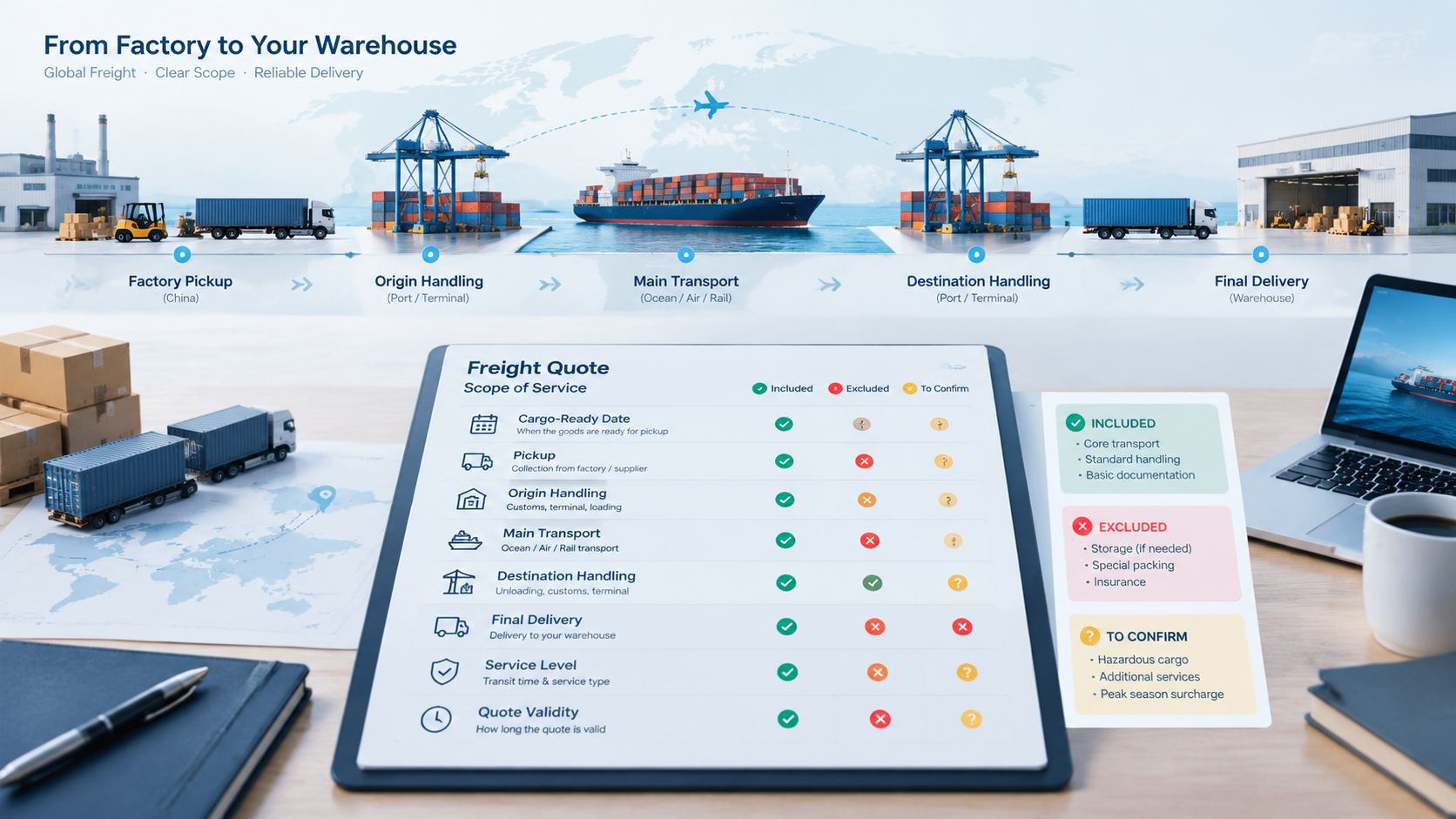
After those fields are aligned, ask what the quoted amount includes. The forwarding desk should be able to distinguish main transport from origin handling, destination work, delivery, and conditional accessorials. This prevents a low headline freight charge from being compared with a broader shipment scope.
Understand the Charge Basis and the Operating Cost Drivers
The charge basis matters because the same cargo can be quoted differently when the shipment moves under a different handling method or service level. Ask what physical input drives each freight fee, then ask which handoff changes when that input changes.
For full-container shipping, the core transport quote usually follows the selected equipment and routing rather than a simple weight-only calculation. The forwarding desk needs the intended equipment type, origin, destination, cargo characteristics, and service scope before it can confirm whether the stated container basis matches the shipment.
For consolidated cargo, volume, weight, packing configuration, and the consolidation arrangement can affect the quoted basis. A small change in dimensions or packing can change the shipment data presented to the forwarding desk. Ask whether the quote was built from measured cargo information or preliminary packing figures, and request a revision when the final packing list changes materially.
Air and express shipments often depend on chargeable weight rather than actual scale weight alone. The correct operational question is which shipment measurements the provider will use, which weight field controls the quote, and whether the forwarding desk has the final dimensions needed for confirmation. Do not insert an assumed divisor or conversion factor unless the current provider quote states it.
Pickup, handling, delivery access, special cargo requirements, and service level can also create separate freight forwarder charges. A shipment that requires a scheduled delivery appointment, unusual pickup access, additional handling, or a different transport service should be quoted against those exact conditions rather than against a generic lane assumption.
Quote check: Ask the forwarder, “What shipment input controls this line, what part of the route does it cover, and what should be re-quoted if the cargo details change?” That question ties the charge to a measurable shipment fact and a defined handoff.
For ocean cargo, review the planned operating scope through the sea freight service scope when the quote depends on container or consolidation handling. For time-sensitive cargo, compare the stated basis with the air freight service or express shipping option before treating the headline freight charge as interchangeable.
Check What the Quote Includes and Who Acts Next
A workable quote should make the handoff sequence understandable. Start with pickup and origin handling, then follow the cargo through main transport, destination handling, final delivery, and any conditional work. A forwarding desk can confirm its own quoted scope, while the shipper, consignee, destination provider, carrier, broker, or facility may need to verify a separate condition.
Pickup and origin handling: Confirm the pickup point, access conditions, pickup window, and whether local origin work is part of the quoted scope.
Main transport: Confirm the selected mode, routing, service level, and whether the stated freight amount covers the intended transport segment.
Destination handoff: Ask what destination handling is included and which party takes control before final delivery.
Delivery: Verify the delivery address, receiving requirements, appointment needs, and any access condition that could require separate handling.
Accessorial charges: Ask which events can create a separate freight charge and what trigger would cause the forwarding desk to revise the quote.
Storage or rebooking: Confirm whether an operational delay changes the scope and who must approve the revised movement.
For shipments that require a specific final-mile scope, compare the quote with the stated door-to-door service scope rather than assuming delivery is included because a destination is shown on the quote. When cargo requires planned consolidation or multiple transport legs, review the multi-modal freight option against the same pickup, destination, and service requirements.
Where rail is part of the comparison, review the rail freight service using the same origin, destination, handoffs, and delivery scope. The purpose is not to treat every mode as interchangeable, but to confirm whether the quote reflects the same commercial journey.
Note: A freight quote is tied to the cargo, handoffs, route, service level, timing, and destination work stated in it. Carrier and handling conditions can change. Align the scope first, then request confirmation for the specific shipment.
Compare Options That Change Cost or Delivery Control
The useful comparison is the one that changes the shipment plan. A forwarding desk should compare options under equivalent scope so that the buyer can see what changes in freight and handling, what handoffs are added, and what operational control is gained or lost.
| Option | Buyer fit | Weak fit | Quote question |
|---|---|---|---|
| FCL | Dedicated container need | Cargo does not justify planned equipment use | What equipment and scope are included? |
| LCL | Smaller consolidated shipment | Highly sensitive cargo or complex handling | What volume and handling basis was used? |
| Sea | Lower urgency and planned replenishment | Tight delivery window | What delivery scope matches the quote? |
| Air or express | Time-sensitive cargo | Cargo is poorly suited to higher-service handling | What weight and service basis controls the quote? |
| Port or terminal delivery | Buyer controls final handoff | Consignee cannot manage local delivery | Who owns the next destination step? |
| Door delivery | Buyer needs one planned final-mile scope | Delivery conditions are unknown | What access and appointment details are included? |
The practical default is to compare the service that matches the cargo and delivery requirement first, then price a second option only when it changes the business decision. A faster service may change both the freight charge and the handoff structure. A consolidated option may reduce the need for dedicated equipment while adding additional handling points. The quote should show those differences rather than presenting one number without context.
For shipments requiring structured delivery to a fulfillment network, use the Amazon FBA shipping scope only when the actual delivery destination and receiving process make that service relevant. For oversized, heavy, or unusual cargo, compare against the project cargo shipping scope when the shipment requires a materially different planning process.
Find the Gaps That Can Create Additional Freight Fees
Unexpected charges often begin with a shipment detail that was incomplete at quote stage. The fastest review is to identify the exact trigger, the owner of the missing information, and the point at which the quote should be revised.
Common mistake: Comparing freight quotes from the same origin and destination while using different pickup addresses, packing data, delivery scope, or service levels. The figures may look like competing prices even though the forwarding desks are pricing different shipments.
An incomplete pickup address can change local handling or access requirements. A moved cargo-ready date can alter pickup planning or the selected transport service. Revised dimensions can affect the charge basis for air, express, or consolidated cargo. A destination that requires an appointment, restricted access, or a different receiving procedure can also change the final-mile scope.
Rebooking, storage, document correction, and other operational events should be treated as specific triggers rather than vague warnings. Ask the forwarding desk what event would create a revised freight charge, whether the event is already contemplated in the quote, and who must authorize the next movement.
A quote needs an immediate scope check when the cargo address, dimensions, weight, cargo-ready date, delivery requirements, or service level changes after pricing. Request a revision before relying on the earlier figure.
Special handling requires the same discipline. Describe the cargo condition that matters to the shipment, ask whether the selected service accepts it, and confirm whether additional handling or documentation changes the quoted scope. For insured shipments, review the cargo insurance service scope separately so insurance arrangements are not confused with the underlying freight and handling scope.
Prepare a Quote Request That the Forwarding Desk Can Use
A complete handoff reduces the number of times the quote desk has to rebuild the shipment basis. Organize the request around the party that can provide or confirm each input.
Cargo and packing
The shipper provides cargo type, package count, dimensions, CBM where relevant, gross weight, and packing details. The forwarding desk checks whether the information supports the proposed charge basis.
Cargo-ready and pickup
The shipper provides the cargo-ready date, pickup address, warehouse conditions, and pickup window. The forwarder confirms whether the local collection scope matches the proposed service.
Route and service
The buyer states the preferred transport mode, service level, origin gateway when relevant, destination gateway or delivery point, and required timing. The forwarding desk confirms the workable routing basis.
Delivery handoff
The consignee provides the delivery address, postcode, receiving hours, appointment needs, and access restrictions. The forwarder confirms which destination work is inside the quoted scope.
Commercial scope
The buyer identifies the required commercial handoff and any specific scope that must be included. The forwarding desk confirms which party performs each step and what remains outside the quote.
Special handling and restrictions
The shipper identifies cargo restrictions, unusual dimensions, special equipment, documentation needs, or site conditions. The forwarding desk checks whether the proposed service remains suitable and what requires separate confirmation.
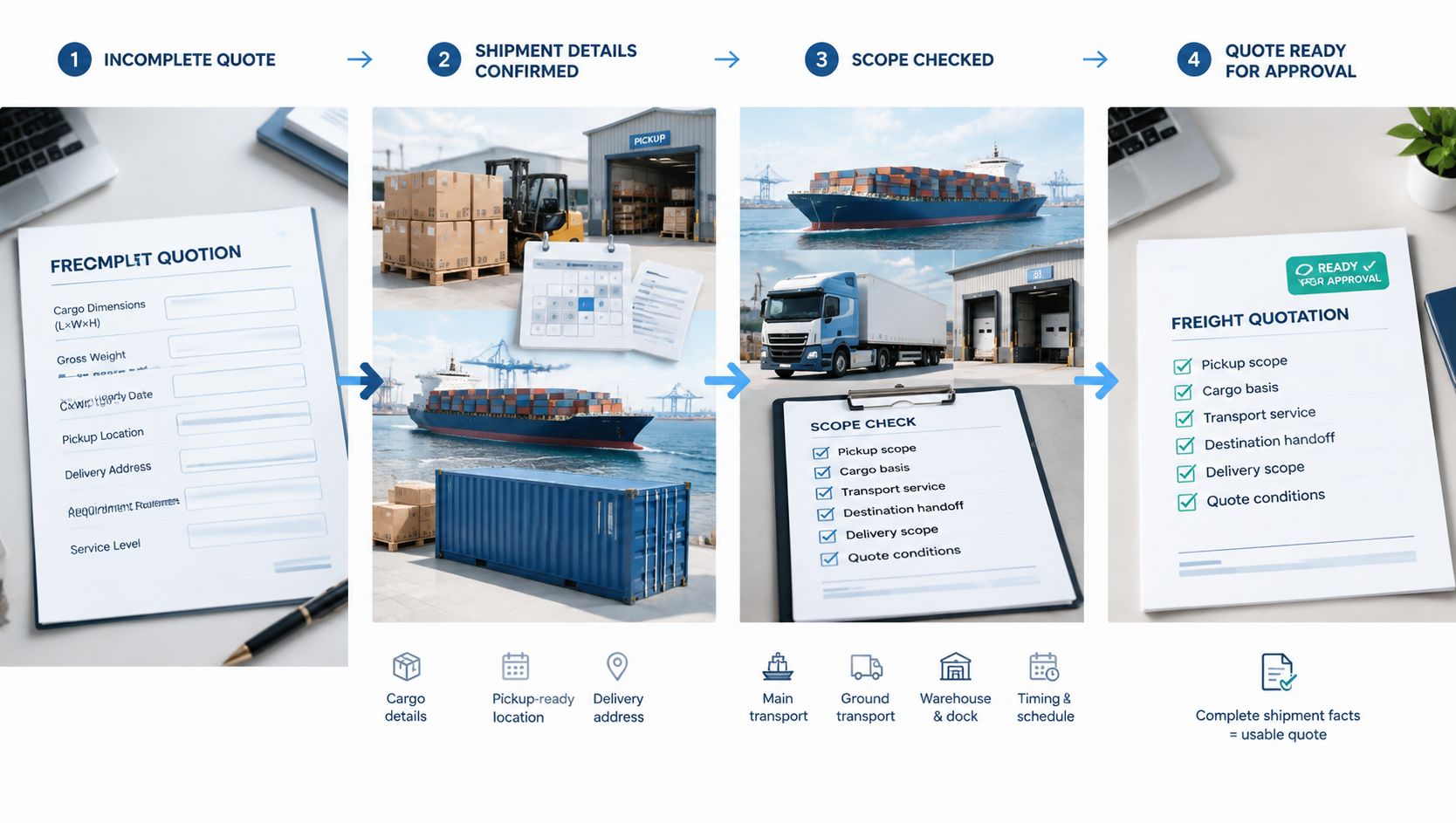
When the shipment needs a defined customs coordination handoff, review the customs brokerage service scope separately from the main transport quote. The quote request should identify the required party and scope without assuming that an unstated destination task is automatically included.
Use a Conditional Recommendation, Then Recheck the Scope
Start by requesting one quote built around the actual delivery requirement, then request a second option only when it answers a real trade-off such as service level, equipment use, consolidation, or final-mile control. The practical default is to approve only after the charge basis and all major handoffs are aligned. The fact most likely to change that comparison is usually a material change in cargo data, timing, pickup conditions, or delivery requirements.
Ask the forwarding desk to identify the line items that are firm within the stated scope, the items that remain conditional, and the shipment change that would trigger a fresh quote. That creates a clearer checkpoint than comparing headline freight forwarder fees alone.
Illustrative example: A buyer has packaged commercial cargo ready on a stated date and needs delivery to a receiving location with a scheduled appointment. One quote combines main transport and final delivery, while another separates origin handling, destination work, and delivery. The buyer should not select between the two figures until both desks confirm the same pickup scope, cargo basis, destination handoff, appointment requirement, and included work.
Key Takeaways
Compare freight forwarder fees only after the pickup, transport, destination, delivery, and service scope match.
Separate the charge basis from the charge amount and validate the shipment inputs that control each line.
Ask who owns each handoff and what work the quoted freight and handling actually covers.
Recheck the quote when dimensions, weight, cargo-ready timing, pickup conditions, or delivery requirements change.
Use accessorial charges as specific operational triggers to confirm, not as unexplained catch-all additions.
Request a final scope confirmation before booking so the forwarding desk and shipper are working from the same shipment facts.
FAQ
What do freight forwarder fees usually cover?
They can cover different parts of the shipping operation depending on the quote scope. A quote may include main transport, origin handling, destination work, delivery coordination, or selected service functions, while other items remain separate. The forwarding desk should identify each included handoff and state which shipment conditions would require a revision.
Why can freight forwarder charges differ for the same shipment?
Quotes can differ because the providers may be pricing different service scopes, transport options, charge bases, pickup conditions, or destination handoffs. The quoted shipment facts may also differ. Compare the underlying scope first, then compare the figures. A numerical difference is not meaningful until both quotes describe the same operating journey.
What information should I give a forwarder before asking for a quote?
Provide the cargo type, package count, dimensions, weight, cargo-ready date, pickup address, delivery address, postcode, preferred service, and any known access or special-handling conditions. More complete data gives the forwarding desk a clearer basis for reviewing the route, charge basis, handoffs, and items that still require confirmation.
What is a freight charge compared with a freight fee?
In ordinary logistics use, both terms can refer to a quoted shipping cost, but the wording alone does not establish the scope. The useful distinction is the underlying charge basis and the service included. Ask what the line covers, which shipment input controls it, and whether the amount applies to transport only or to a broader handling scope.
How should I review accessorial charges?
Review them as event-based conditions tied to the shipment operation. Ask what event creates the charge, which party controls the missing or changed information, whether the condition is already included, and when the quote should be revised. This makes the charge review operational rather than treating every possible event as a generic warning.
Should I compare two quotes by the headline freight amount?
No single figure is enough. Check the pickup scope, cargo basis, main transport, destination handoff, delivery requirement, service level, included work, and quote date before comparing the headline amount. A broader quote may contain work that another quote lists separately, so the correct comparison starts with equivalent shipment scope.
When should a freight quote be rechecked?
Recheck the quote whenever a material shipment fact changes. Common triggers include a different cargo-ready date, revised package dimensions, changed weight, a new pickup address, a different delivery point, added appointment requirements, or a change in service level. The forwarding desk can then confirm whether the original charge basis and handoff plan still apply.
What should I ask before approving freight and handling?
Ask three practical questions: What does each line include, who performs the next handoff, and what shipment change would require a re-quote? Then confirm the cargo data, pickup conditions, delivery requirements, and service level used to build the quote. Those checks give the buyer a clearer approval point than price alone.
Disclaimer: This page is general quote-planning guidance, not a binding quotation or delivery commitment. Actual charges and handoffs depend on the cargo, route, timing, provider confirmation, and destination conditions. Where duties, customs, tax, insurance, or contract questions apply, confirm them with the relevant party before booking.