Choose the Quote That Can Actually Move the Shipment
The useful quote is the one that matches the cargo, pickup point, main transport, customs handoff, delivery scope, and service level you actually need. A customs broker and freight forwarder may both appear on a shipment plan, but the quoted work can differ substantially. One quote may cover transport coordination and origin handling, while another may include customs entry work or destination delivery under a different handoff.
Before approval, ask which party controls each stage and what the quoted amount actually covers. Cargo dimensions, weight, packing, cargo-ready date, pickup conditions, destination address, delivery appointment, and required customs work can all change the commercial scope. A buyer should compare like with like rather than choosing the lower headline number before these details are aligned.
The next checkpoint is simple: have the forwarding desk restate the route, service level, included work, exclusions, quote date, and destination handoff in writing. Then ask what needs to be re-quoted if the cargo, timing, or delivery conditions change.
Align Quote Scope Before Comparing Providers
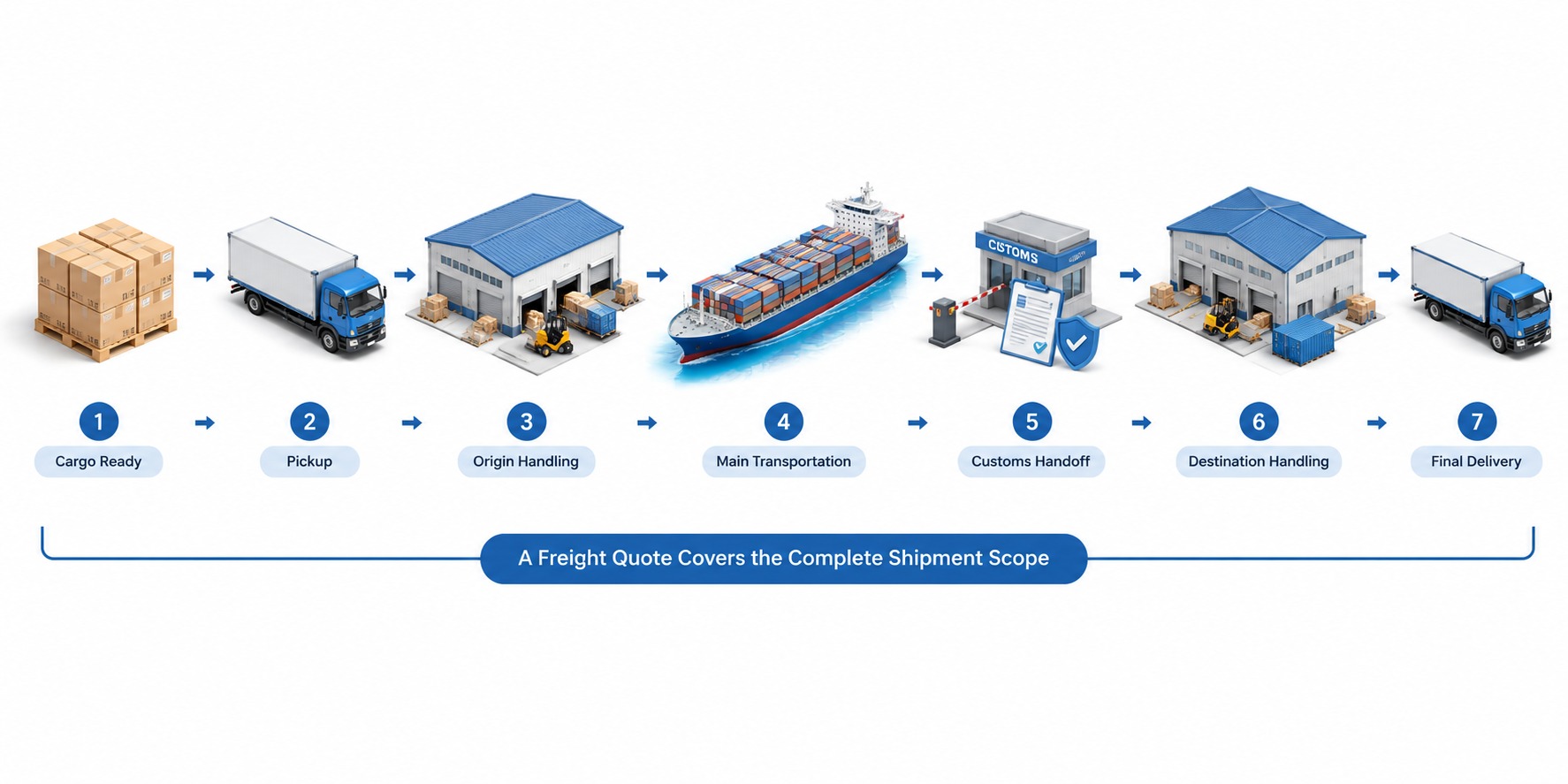
A forwarding desk normally starts with shipment facts rather than price. The sequence below gives both sides a common baseline and makes missing information visible before a comparison is approved.
| Quote field | Buyer supplies | Forwarder confirms | Approval checkpoint |
|---|---|---|---|
| Cargo-ready date | Ready date and pickup window | Feasible booking and handoff timing | Re-quote if timing changes |
| Pickup and origin | Address, access, packing status | Origin handling scope | Confirm pickup conditions |
| Main route | Required service level | Mode and carrier/service fit | Approve the transport scope |
| Cargo basis | Pieces, dimensions, weight | Applicable charging basis | Confirm measurement source |
| Destination and delivery | Address and appointment needs | Destination handoff and delivery scope | Confirm who performs each step |
| Quote date and work | Requested service scope | Validity conditions and inclusions | Approve or request revision |
Customs work belongs in this comparison when the shipment requires a broker or entry coordination. Ask who prepares the required information, who submits the customs work, and where the cargo changes from transport coordination to customs handling. A customs brokerage service can be evaluated as part of that handoff, but the quote should still state which tasks are included.
Check the Charge Basis and Operational Cost Drivers
The amount on a quote only becomes useful after the charging basis is clear. A forwarding desk should identify which shipment input controls each major cost and which handoff is affected. The buyer then knows what information must stay stable and what should trigger a quote revision.
For containerized cargo, the quoted transport may depend on the equipment and shipment scope. Ask whether the proposal covers an FCL move, an LCL consolidation, or another arrangement, and confirm the equipment or consolidation basis. The cargo-ready date can also affect the practical service choice because a different booking or consolidation window may be required.
For air or express service, the quote may depend on the chargeable weight rather than gross weight alone. The forwarding desk should identify the weight and dimensional information used for the quote and confirm which measurement source will be accepted. The buyer should ask, “Which cargo measurement is this quote based on, and what would cause that basis to change?”
Pickup and delivery can create another scope difference. A quote that assumes standard loading access may not match a location that requires special equipment, restricted access, a scheduled appointment, or extra handling. Ask the provider to confirm the pickup conditions and delivery method before approval.
Quote field to confirm: Ask the forwarder to show the charge basis beside each material line item, identify the shipment input that controls it, and state what change would trigger a revised quotation. This separates the basis of a charge from the amount quoted for the current shipment scope.
For ocean planning, the buyer can compare the operating assumptions under sea freight. For faster time-sensitive cargo, the comparable service scope may be air freight or express shipping. The useful question is not which mode has a lower headline figure in the abstract, but which quoted service matches the cargo and required delivery control.
Map the Quote to Each Operating Handoff
A buyer should be able to trace the quote from pickup through final delivery and identify who confirms each stage. The following structure keeps transport work, customs coordination, destination handling, and customer-controlled steps separate.
| Stage | Typical scope question | Who confirms | Next checkpoint |
|---|---|---|---|
| Pickup | Is collection included for the stated address? | Forwarder and shipper | Confirm pickup window |
| Origin | What handling or consolidation work is included? | Origin forwarder | Confirm cargo handoff |
| Main transport | Which service and route are quoted? | Forwarder or carrier | Confirm booking scope |
| Customs | Who coordinates entry work and what is excluded? | Broker and importer | Confirm document readiness |
| Destination delivery | Does the quote include delivery to the stated point? | Destination provider and buyer | Confirm appointment and access |
| Exceptions | What happens if storage, rebooking, or extra handling is required? | Party controlling the affected handoff | Confirm trigger and revision process |
When a quote names a customs clearance broker facility, ask what work takes place there, who owns the cargo handoff at that point, and whether destination transport continues under the same provider. Do not assume that a customs line automatically includes final delivery or every destination service.
When the shipment requires delivery beyond the transport terminal or port, compare the exact door-to-door scope rather than adding a generic delivery assumption. A door-to-door service can be useful when one provider needs to coordinate the full physical movement, but the delivery address, access, and appointment conditions still need confirmation.
Where duties or taxes are part of the requested commercial scope, ask which party is expected to coordinate those items and what documentation the buyer must provide. A DDP shipping option can be considered when the buyer needs a different responsibility structure, but the specific quote must define the included work and any exclusions rather than relying on the service label alone.
Note: A freight quote is tied to the cargo, handoffs, route, service level, timing, and destination work stated in it. Carrier and handling conditions can change. Align the scope first, then request confirmation for the specific shipment.
Compare Options Under Equivalent Scope
Different transport choices become commercially meaningful when they change the handoffs, control points, or service level. The buyer should compare the options against the same pickup and delivery assumptions so that the comparison measures a real operating difference.
| Option | Buyer fit | Weak fit | Operational trade-off | Quote question |
|---|---|---|---|---|
| FCL | Dedicated container movement | Small, irregular cargo | Equipment and container handling | What equipment and handoffs are included? |
| LCL | Smaller shipments using consolidation | Urgent or highly sensitive cargo | More consolidation handoffs | What consolidation scope is quoted? |
| Air | Shorter planned transit | Bulky, non-urgent cargo | Higher service intensity and weight sensitivity | Which chargeable-weight basis applies? |
| Door-to-door | One coordinated delivery scope | Buyer controls local transport | More destination handoff coordination | Who controls final delivery? |
| Multimodal | Mixed transport needs | Simple direct routing | Additional transfer points | Where are the transfer handoffs? |
A shipment that needs multiple transport legs may justify multi-modal freight when the quote clearly identifies the transfer points and responsible parties. Rail can also be part of the comparison when the route and service plan support it; review the specific rail freight scope rather than assuming it matches an ocean or air quotation.
The practical comparison rule is to hold the cargo information, pickup assumptions, delivery point, and required service level constant. Then review what changes in transit planning, handling, customs coordination, and destination control. That produces a usable operating comparison without assuming that one mode or structure is universally cheaper.
Find Quote Gaps Before They Become Shipment Problems
Most quote disputes begin with a scope change rather than a mysterious charge. A pickup address can become harder to service, the cargo-ready date can move, the measured weight can differ from the initial submission, or the destination can require a delivery appointment that was not included in the original plan.
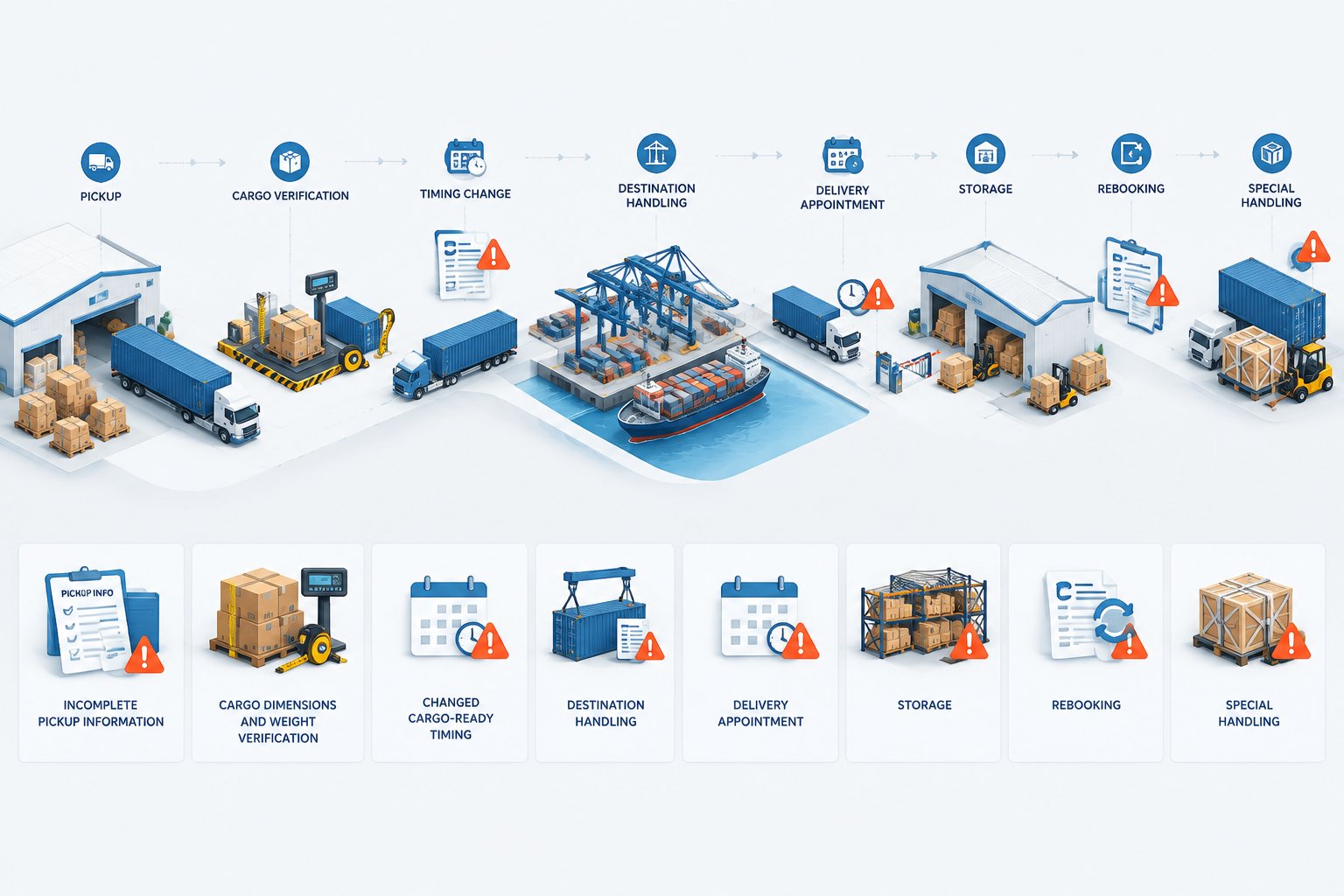
The forwarding desk should specifically recheck the pickup address, access conditions, cargo dimensions and weight, booking timing, destination handling, delivery appointment requirements, and any restrictions that were not known when the quotation was prepared. When a shipment changes after booking, ask which line item or handoff needs a new confirmation instead of assuming the original scope still applies.
Common mistake: A buyer compares the headline freight figure while one quote includes destination handling and the other stops at a transport handoff. The correct response is to normalize the scope and ask each provider to identify the next cost-bearing handoff.
Storage, rebooking, document correction, special handling, and delivery access should be treated as trigger-based questions. They are not automatic additions to every shipment, so the quote should state whether the current scope assumes none of these conditions and what information would require a revision.
When customs is involved, the buyer should also confirm who supplies the commercial and shipment information needed for entry work and who communicates with the broker. The broker scope should be clear enough that the importer knows which steps remain with the customer and which steps the forwarding or broker team coordinates.
Risk trigger: If the cargo dimensions, pickup conditions, delivery address, or service timing changes after the quote is issued, ask for a scope review before booking or dispatch. Those changes can alter the applicable charge basis or the number of required handoffs.
Build a Quote Request the Forwarding Desk Can Verify
A strong request gives the provider enough information to validate the physical move and the customs handoff without forcing assumptions. The sequence below works as a practical collection process because each input supports the next quote checkpoint.
Cargo and packing
Provide commodity description, pieces, dimensions, gross weight, and packing status. The forwarding desk can check the applicable transport basis and identify whether the packing information is sufficient for the quote.
Cargo-ready and pickup
Provide the cargo-ready date, pickup address, loading conditions, and preferred window. The desk can then review booking timing, pickup scope, and origin handling requirements.
Route and service
State the preferred mode or the service level you need. The provider can compare feasible routing and identify whether another transport structure should be quoted under the same shipment scope.
Delivery address and appointment
Give the final delivery point, receiving hours, access restrictions, and appointment needs. The desk can determine whether final delivery requires additional coordination or a different handoff.
Commercial and customs scope
State which party is expected to coordinate customs work, duties or taxes when relevant, and destination delivery. The provider can identify what belongs in the quote and what the customer must confirm.
Special handling and restrictions
Declare oversized dimensions, unusual handling needs, restricted cargo, or other operating constraints. The forwarding desk can check whether the proposed service remains suitable before the quote is approved.
For higher-value cargo, insurance scope should be considered separately from transport scope. Ask what protection is being requested, who arranges it, and what documentation is required before relying on any cargo insurance service as part of the shipment plan.
Once the request is complete, ask the forwarding desk to return one consolidated scope: cargo basis, pickup, origin work, main transport, customs handoff, destination work, final delivery, exclusions, validity condition, and the event that would require re-quotation.
Use a Conditional Forwarding Recommendation
The practical default is to request one fully scoped quotation first, then compare a second service structure only when it changes a real shipment decision. For a buyer evaluating a customs broker and freight forwarder together, the first comparison should clarify who controls transport, who coordinates customs work, and who owns the final destination handoff.
A second quote becomes useful when the cargo, timing, delivery point, or service level creates a meaningful trade-off. The fact that changes the recommendation is the shipment requirement itself: urgency, cargo size, pickup conditions, destination access, or the amount of coordination the buyer wants one provider to manage.
Illustrative example (not a customer case): A buyer has standard commercial cargo that is ready for collection, needs transport to a defined receiving point, and also needs customs entry coordination. The first quote should state pickup, origin handling, main transport, broker coordination, destination handoff, and final delivery separately. The buyer can then compare a second routing or service level without changing the underlying cargo and delivery assumptions.
The approval question should remain concrete: “Does this quote cover the entire handoff I need, and who confirms the next step if one shipment input changes?” That question keeps the discussion on workable shipment control rather than a headline price alone.
Key Takeaways
Align the shipment first. Compare quotes only after cargo, pickup, route, delivery point, and service level are stated consistently.
Separate charge basis from amount. Ask what cargo input controls each material line and what change would trigger re-quotation.
Assign each handoff. Identify who handles pickup, origin work, transport, customs coordination, destination handling, and final delivery.
Expose exclusions early. Delivery access, appointments, storage, rebooking, and special handling should be treated as explicit quote questions.
Re-check changed inputs. A new cargo-ready date, measurement, pickup condition, or destination requirement can make the original scope unsuitable.
Approve a defined scope. Keep the next checkpoint tied to written confirmation of inclusions, exclusions, and the responsible party.
FAQ
How does a customs broker differ from a freight forwarder?
A customs broker focuses on customs entry and related coordination, while a freight forwarder organizes the physical movement and supporting logistics services. The same shipment can involve both roles. The important quote question is which party performs each task, which documents each party needs, and where the handoff occurs.
What information should I give a forwarder before requesting a quote?
Provide the cargo description, pieces, dimensions, weight, packing status, cargo-ready timing, pickup address, delivery address, preferred service level, and known handling or customs requirements. Complete shipment information helps the forwarding desk build a scope that can be checked against the actual pickup and delivery plan.
Can one provider coordinate both freight and customs work?
A shipment can be coordinated through a provider that manages multiple stages, but the quote should still identify the actual work at each handoff. Ask who performs customs coordination, who controls the transport booking, and who manages destination delivery. The service label alone does not establish what the quotation includes.
Why can two quotes for the same shipment look different?
Two quotes can use different charging bases, transport services, pickup assumptions, destination handoffs, or included work. One may also stop at a different delivery point. Before comparing amounts, ask both providers to restate the cargo basis, route, service level, included handling, customs scope, delivery point, and exclusions under the same assumptions.
When should I ask for a quote revision?
Request a revision when a material shipment input changes. Common triggers include a different cargo-ready date, changed dimensions or weight, a new pickup condition, a different delivery address, a new appointment requirement, or a different service level. The provider should confirm which part of the original scope no longer applies.
What should I check in the destination portion of a quote?
Check where the main transport ends, who receives the cargo, whether destination handling is included, and who controls final delivery. Also confirm the delivery address, access conditions, and appointment needs. These details determine whether the quoted service matches the physical handoff required at destination.
How should I compare freight options without relying only on price?
Hold the cargo information and delivery requirement constant, then compare the operating differences. Review service level, number of handoffs, delivery control, customs coordination, cargo measurement basis, and any special handling requirements. A useful comparison shows what changes operationally and what information the provider needs before the quote can be approved.
Disclaimer: This page is general quote-planning guidance, not a binding quotation or delivery commitment. Actual charges and handoffs depend on the cargo, route, timing, provider confirmation, and destination conditions. Where duties, customs, tax, insurance, or contract questions apply, confirm them with the relevant party before booking.