A Standard Carrier Alpha Code (SCAC) is a two-to-four-letter identifier used to identify transportation companies in freight records, logistics systems, and certain regulatory filings. The National Motor Freight Traffic Association (NMFTA) administers the SCAC program. If you already have a carrier name or code, start with NMFTA’s official SCAC lookup and verification resources to check available carrier information and status. Carriers that need a new code or a renewal must use the separate application process.
A SCAC identifies a transportation company, not an individual shipment, booking reference, container, or shipper. Whether a document requires one depends on the applicable transport arrangement, filing, business partner, and receiving system. The most important operational check is to confirm that the code belongs to the intended carrier and matches the party identified by the relevant document field. A valid-looking code alone does not establish that the carrier has operating authority or that the shipment meets every applicable requirement.
What Is a SCAC Code? Meaning and Format
SCAC stands for Standard Carrier Alpha Code. NMFTA developed the system to help transportation companies identify themselves consistently across freight operations and electronic records. Shippers, importers, exporters, freight forwarders, brokers, and transportation systems may use the identifier when exchanging carrier information.
A SCAC generally contains two to four letters. Trucking companies, freight forwarders, and other companies assigned a code typically receive four-letter codes. Railroads and bus companies may use two-, three-, or four-letter codes. Do not use the length or appearance of a code as the sole test of validity. Confirm the exact identifier and its status through an appropriate official source.
The code identifies a carrier or transportation service provider within the relevant record. It does not identify every company involved in a shipment. For example, a seller may hire a freight forwarder that arranges transportation with an ocean carrier and a separate trucking company. Each organization has a different role, and the SCAC field should identify the party specified by the document or filing instructions.
A SCAC status or identity-verification indicator also has limits. Identity verification is not the same as confirming operating authority, insurance coverage, safety performance, available capacity, or a carrier’s ability to complete a particular movement. Businesses should evaluate those matters separately when their onboarding or transportation procedures require them.
Key distinction: A SCAC is a carrier identifier. A booking number, bill of lading number, container number, and shipper reference serve different functions and belong in their designated fields.
When Is a SCAC Used in Shipping?
A SCAC matters when a transportation document, electronic record, business partner, or filing system uses it to identify the relevant carrier. The requirement can vary by transaction. A carrier may need a code for a specific program, while a shipper may only need to provide that carrier’s information when completing a document or coordinating a shipment.
For ocean freight, the relevant documents may identify the carrier responsible for the movement or the party submitting a particular manifest. When arranging sea freight, distinguish the carrier’s SCAC from the booking reference, bill of lading number, vessel details, and container number. Those values may appear together, but they do not replace one another.
Air freight, rail freight, and multimodal movements can involve different documents, data fields, and transportation providers. An identifier requested in one system should not automatically be transferred to another. Before submitting information for air freight, confirm the identifier specified by the actual document or filing instructions.
Rail and truck movements require similar attention when a shipment changes carriers. For rail freight or a multimodal freight arrangement, establish which provider the field represents at each relevant stage. The organization arranging the movement may differ from the company physically performing a transport leg.
A SCAC is not universally required on every international shipment or every shipping document. Requirements may arise from a specific regulatory filing, transportation program, customer instruction, carrier procedure, or data-exchange system. The document owner or responsible filing provider should confirm the requirement for the actual transaction.
Where Does a SCAC Appear in Shipping Documents?
The document’s purpose determines whether a SCAC belongs in a particular field. Some records identify the carrier that accepted the booking, while others identify a carrier associated with an electronic manifest or a defined transportation role. Always follow the field definition rather than assuming that every carrier-related document needs the same identifier.
| Record or system | When a SCAC is relevant | What to verify |
|---|---|---|
| Bill of lading | When a field or associated record identifies a carrier by SCAC | Match the carrier specified by the document instructions |
| Booking confirmation | When carrier details are included or requested | Separate the carrier identifier from the booking number |
| Shipper Letter of Instruction (SLI) | When the form or forwarder’s workflow requests carrier details | Confirm which transportation provider the field identifies |
| U.S. ACE ocean import manifest | The applicable M01 Carrier Code field requires a SCAC | Identify the correct carrier for that filing record |
| TMS or EDI record | When the transaction definition requires a carrier identifier | Follow the field specification and the intended carrier role |
The Shipper Letter of Instruction is particularly relevant when an exporter gives shipping instructions to a freight forwarder. An SLI may request carrier information for coordination or document preparation, but the form does not independently validate the code. The shipper should provide confirmed details and ask the forwarder to identify any missing information needed to complete the relevant process.
Example: SCAC in a U.S. Ocean Import Manifest
U.S. Customs and Border Protection (CBP) provides a specific example in its ACE Ocean Import automated manifest specification. The M01 manifest record identifies Carrier Code as a mandatory field and defines it as a SCAC representing the automated importing carrier, master vessel-operating common carrier (MVOCC), or non-vessel-operating common carrier (NVOCC), as applicable.
This example demonstrates why the field’s intended role matters. The carrier associated with a filing is not necessarily the same as the organization that arranged the shipment. The M01 instruction applies to that specific manifest record; it does not establish a universal requirement for every bill of lading or international shipment. Before filing, confirm which party the record identifies and use the technical specification applicable to the transaction.
How to Look Up and Verify a SCAC Code
If you know the carrier’s company name or already have a SCAC, verify the information before using it in a shipping document or electronic filing. NMFTA’s SCAC Verified service provides access to official SCAC information, including active or inactive status and identity-verification indicators where applicable. Check the service’s current access and pricing terms before relying on it for recurring or high-volume lookup work.
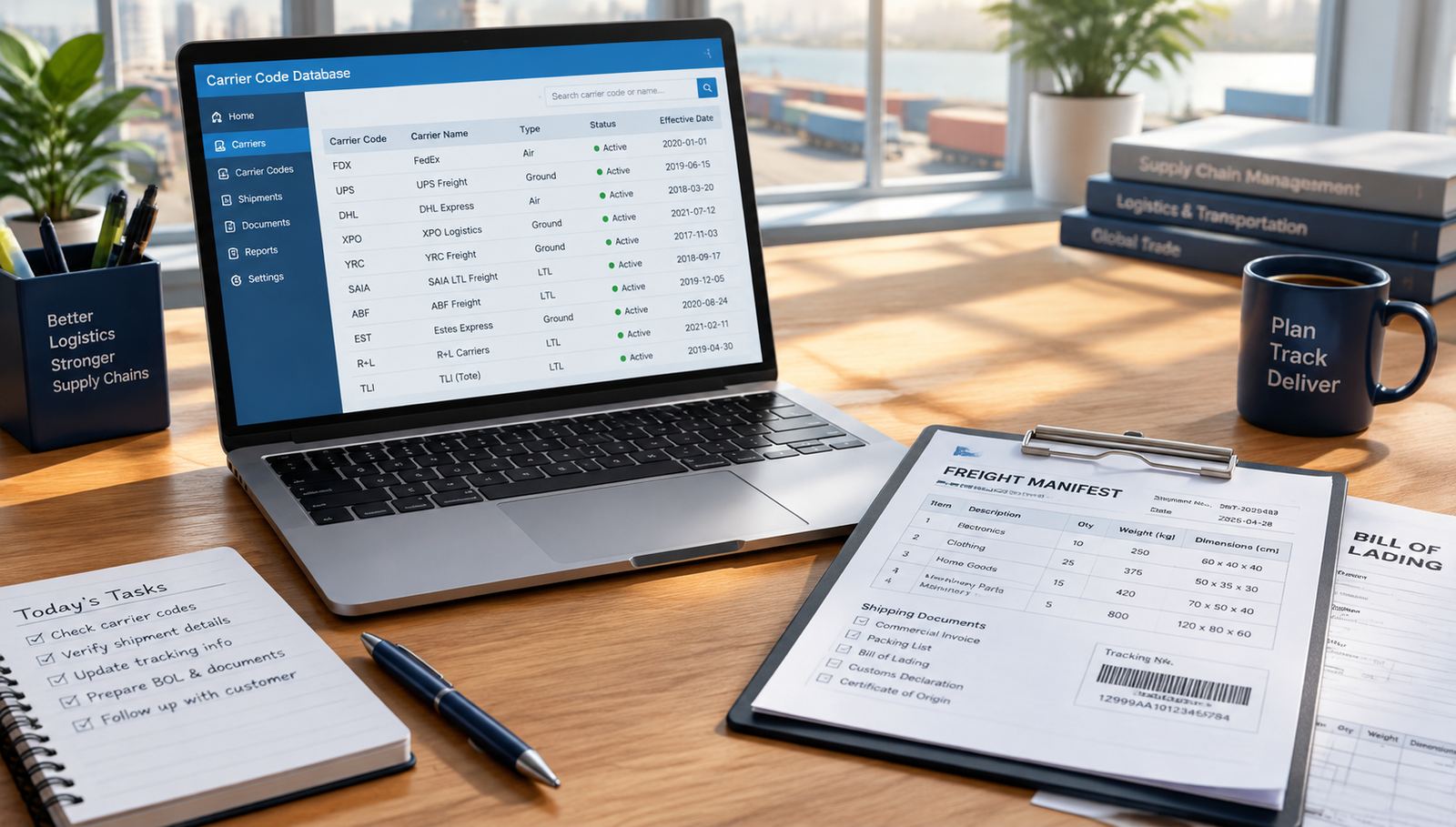
Search by carrier name or existing code
Start with the confirmed company name or SCAC supplied by the carrier, broker, or freight forwarder. Use NMFTA’s official lookup resources rather than relying solely on an old spreadsheet, an unverified directory, or a code copied from a previous shipment.
Match the result to the correct company
Compare the displayed company information with the carrier’s documentation. Where relevant, check the legal name or doing-business-as (DBA) name. A familiar-looking code does not establish that it belongs to the intended company.
Check current status and verification information
Review the available active or inactive status and any applicable identity-verification indicator. An expired code requires attention before it is relied on for a transaction. An identity-verification signal does not, by itself, establish operating authority, safety, insurance coverage, or performance.
Match the SCAC to the document field
Determine whether the field identifies the booked carrier, operating carrier, importing carrier, or another specifically defined party. Compare the result with the booking confirmation, transport documents, manifest instructions, and receiving system’s requirements.
Resolve discrepancies before submission
If the company name does not match, the code is inactive, or the carrier role is unclear, contact the carrier and the responsible document owner or filing provider. Correct the source record and review dependent documents before submitting the data.
Applying for a code is a separate task from looking one up. A carrier that needs a new SCAC or renewal should use NMFTA’s official SCAC application and renewal portal. A lookup result does not constitute a new application or renewal, and a code should not be assumed active simply because it appeared in an older record.
Who Provides the SCAC Code?
The carrier is the primary source for confirming its SCAC. A shipper usually needs the identifier for the transportation provider named in a document, rather than a new code for the shipper’s own business. A freight forwarder or broker may supply the code or enter it in a record, but the parties should establish whose identifier the field requires.

The responsibility for entering a code may differ from the responsibility for supplying or validating it. For example, an exporter may complete the SLI, the forwarder may prepare transport documents, and a designated filing party may submit the electronic manifest. Each party should understand which information it must provide and which party confirms the final record.
When a customs-related filing requires a carrier identifier, the responsible broker, carrier, or filing provider should confirm the exact data requirement. Businesses using customs brokerage services should resolve the carrier identity and document-field requirements before submission. The broker’s participation does not make an unverified code correct.
Common SCAC Errors and Operator Checks
Common errors involve selecting the wrong carrier, reusing an outdated code, or entering a shipment reference into a carrier-identity field. Depending on the affected document and system, these errors may cause rejected data, corrections, or additional coordination before the shipment can proceed through the relevant workflow.
Wrong carrier identified: The booking agent appears in one record, while the receiving system requests the operating carrier. Confirm the field definition before copying either company’s information.
Expired code reused: An operator copies a code from an earlier shipment without checking its current status. Validate the code before using it in a new filing or carrier onboarding record.
Different identifiers confused: A booking number or bill of lading number is entered into a SCAC field. Check the field label and correct the value at its source instead of changing unrelated references.
Responsibility remains unclear: The shipper, forwarder, and broker assume someone else will provide the carrier details. Assign responsibility for supplying, validating, and entering the code before the document handoff.
Common mistake: Treating a valid SCAC as proof that a carrier is authorized or suitable for a particular shipment. Verify the identifier for the intended company, then complete any separate authority, insurance, safety, or contractual checks required by your business process.
Final check: Confirm that the carrier name, SCAC, transport leg, and document field agree. Resolve discrepancies with the responsible carrier or filing provider before the affected data is submitted.
Key Takeaways
- A SCAC is a two-to-four-letter transportation company identifier, not a shipment reference.
- Use NMFTA’s official lookup resources to check available carrier information and status; use the separate application portal for applications and renewals.
- Match the code to the carrier specified by the document or filing field, especially when multiple transportation providers are involved.
- Confirm the actual document and transaction requirements instead of assuming every shipment needs a SCAC.
Frequently Asked Questions About SCAC Codes
What does SCAC stand for?
SCAC stands for Standard Carrier Alpha Code. It is a standardized identifier used to identify transportation companies in relevant freight records and systems.
How many letters are in a SCAC code?
A SCAC generally contains two to four letters. Trucking companies and freight forwarders typically use four-letter codes, while railroads and bus companies may use two-, three-, or four-letter codes.
Where can I look up a SCAC code?
Start with NMFTA’s official SCAC Verified resources. Search using the available carrier information, compare the result with the company’s confirmed identity, and review the available status information. Check current access and pricing terms before using the service.
Is a SCAC code required by law?
Not universally for every shipment or document. A particular regulatory filing or transportation program may require a SCAC, while a carrier, customer, broker, or platform may request it for its own process. Confirm the rules for the specific transaction.
Does a SCAC prove that a carrier has operating authority?
No. A SCAC identifies a carrier, and an identity-verification indicator addresses identity within the applicable verification process. Neither alone establishes operating authority, insurance coverage, safety performance, or suitability for a specific load.
Does a Shipper Letter of Instruction always require a SCAC?
No. An SLI may request carrier details as part of a forwarder’s workflow, but the required information depends on the document and transaction. Ask the forwarder which party’s identifier is needed and who should provide it.
Is a SCAC the same as a bill of lading number?
No. A SCAC identifies a transportation company, while a bill of lading number identifies a transport document or shipment record. Enter each value in the field intended for that identifier.
What should I do if a SCAC is inactive or does not match the carrier?
Do not rely on the disputed value without resolving the discrepancy. Contact the carrier and the responsible document owner or filing provider, confirm the correct company and status, and update the affected records before submission.
Disclaimer: This article provides general informational guidance, not a binding quotation, legal opinion, customs ruling, carrier commitment, or delivery guarantee. Requirements, charges, service terms, and responsibilities can vary by route, cargo, contract, carrier, and jurisdiction. Confirm current requirements and responsibilities before booking or filing.